
Movements & Components · Clock
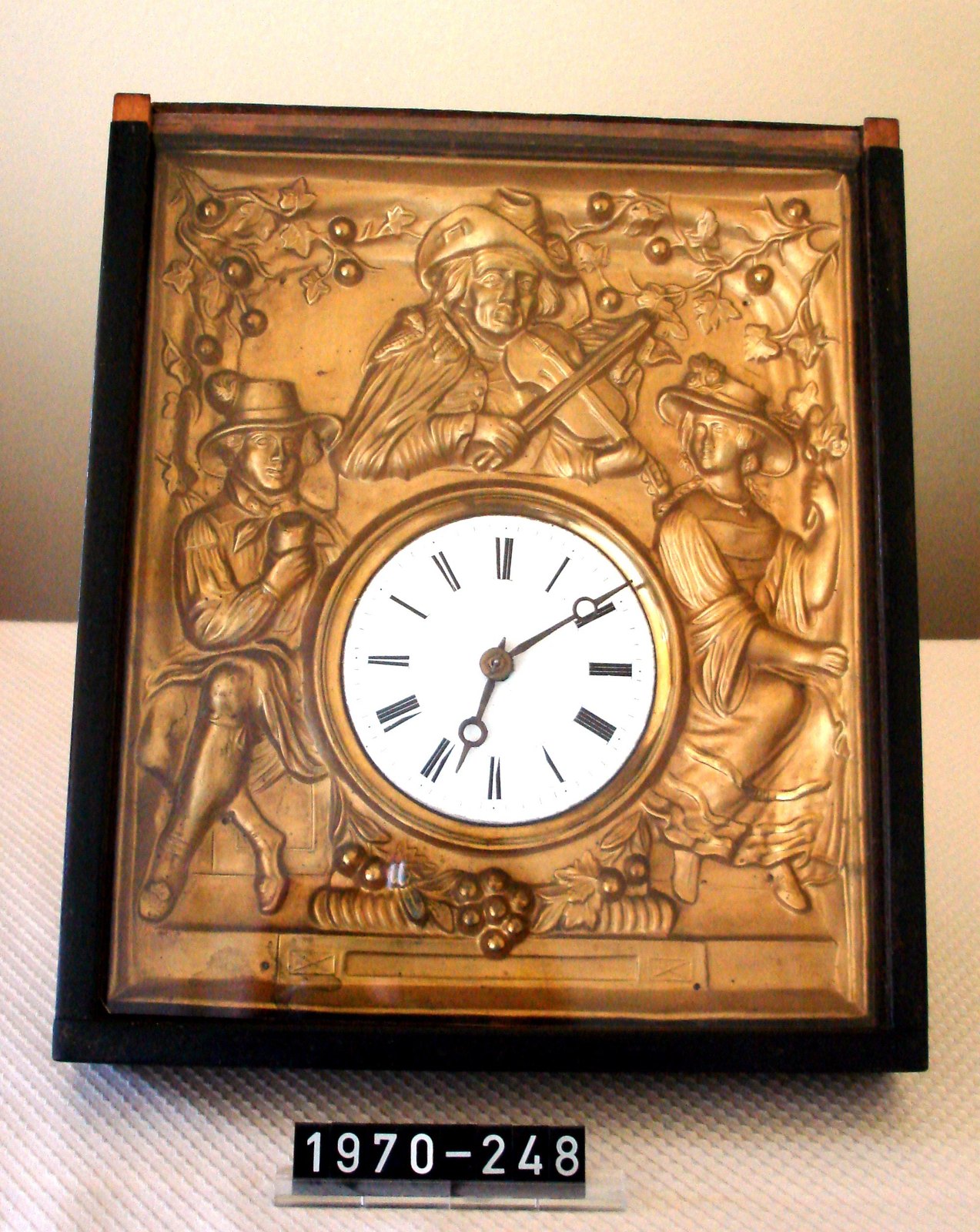
Clock, c. 1850
- Maker / attribution
- Unrecorded in source
- Date
- c. 1850
- Historical period
- Industrial Revolution (1850 – 1900)
- Country of origin
- Unrecorded in source
- Object type
- Clock
- Materials / technique
- Holz; Messing; Emaille, bronzefarben; schwarz; weiß; braun * bearbeitet; geprägt; lackiert; emailliert
- Dimensions
- Breite/Länge: 25 cm; Höhe: 28,5 cm; Tiefe: 13,6 cm; Weitere Maße: Kasten für Uhrwerk: 20,3 cm x 15 cm x 9,3 cm
- Holding institution
- Stadtmuseum Bad Dürkheim im Kulturzentrum Haus Catoir
- Accession / object no.
- 1970/0248
- Credit line
- Stadtmuseum Bad Dürkheim im Kulturzentrum Haus Catoir
- Catalogue title (original)
- Uhr; Rahmenuhr; Kastenuhr mit Zeiger; Biedermeier, um 1850 (German)
View the source record ↗ (opens another website in a new tab)Suggest a correction
Record summary
Held and catalogued by Stadtmuseum Bad Dürkheim im Kulturzentrum Haus Catoir (object number 1970/0248), this is a clock, dated c. 1850. The Atlas places it in the Industrial Revolution period (1850 – 1900) of its Movements & Components collection. Materials and techniques recorded by the source: Holz; Messing; Emaille, bronzefarben; schwarz; weiß; braun * bearbeitet; geprägt; lackiert; emailliert. Recorded dimensions: Breite/Länge: 25 cm; Höhe: 28,5 cm; Tiefe: 13,6 cm; Weitere Maße: Kasten für Uhrwerk: 20,3 cm x 15 cm x 9,3 cm. The record is illustrated with 1 photograph.
Assembled from the source record's structured fields. Dates and attributions are given as the source states them; where a field is missing the Atlas leaves it blank rather than estimating.
Catalogue description
Catalogue description from Stadtmuseum Bad Dürkheim im Kulturzentrum Haus Catoir (German)
Uhr; Rahmenuhr; Kastenuhr; aus Holz: schwarzer Rahmen und brauner Aufnahmekasten für Uhrwerk; Vorderfront aus geprägtem Messing mit Motiv: Liebespaar (Mann und Frau) sitzend, darüber ein Violinenspieler; weißes Ziffernblatt, emailliert mit schwarzen, römischen Ziffern; mit Glasscheibe; Öse zum Aufhängen; Kasten mit Uhrwerk; Biedermeier, um 1850 beiliegender Zettel: "Rahmen- und Bilderuhren sind typisch für die Zeit des Biedermeier. Viele wurden in Süddeutschland und Wien hergestellt. Oft handelt es sich im vergoldete Holzrahmen aus Fichtenholz, die statt eines Bildes eine geprägte Messingfront oder bemalte Ornamente aus Gips umgeben. In diese sind Ziffernblätter eingelassen. Unser Museum besitzt 6 solcher Uhren aus der Zeit 1840 - 1875. Sie haben alle ein Schlossscheibenschlagwerk mit einer Tonfeder aus Draht. Die Holzgehäuse sind schwarz lackiert und enthalten geprägte Blechornamente, z.B. mit einem Adler und Siegeskranz. Die Ziffernblätter sind emailliert mit römischen Ziffern. Die Werke sind sehr einfach etwa nach Art vieler Schwarzwalduhren. Wir finden Messingzahnräder auf Stahlachsen, deren Zapfen in Messingbuchsen laufen. Die Buchsen sind in Holzbrettchen eingesetzt.. Wenn diese rissen, kam das Werk zum Stehen. Wahrscheinlich aus diesem Grund finden wir auf einem Uhrgehäuse 5 Reparaturangaben aus der Zeit von !859 - 1902. Bei den Uhren handelt es sich um einen Altbestand unbekannter Herkunft, der 1970 inventarisiert wurde. (Inv.-Nr.n 1970/248 - 253). Anhaltspunkt der Datierung: Vermutung Festgestellt am: 16.11.2009
Shown in the original language of the source catalogue. An editor-reviewed English translation has not yet been published; we do not publish machine translations as authoritative text.
Historical context
Industrial Revolution (1850 – 1900)
American interchangeable-parts manufacture; railroad time standards; Swiss and German factory systems.
Standardised calibres, interchangeable parts and machine tools allowed movements to be mass-produced in American and Swiss factories.
Read the period in the timelineMore movements & components from this periodEarlier: Precision & Scientific Horology
Atlas type guide
Dials and hands
Dials record both fashion and technology. Early watches had engraved metal dials; champlevé dials with raised numerals dominated around 1680–1730, followed by white vitreous enamel, guilloché gold and silver dials, and printed metal dials in the twentieth century. Luminous paints — radium from c. 1910, tritium from c. 1960 and non-radioactive pigments from the late 1990s — answered the need for legibility in the dark.
Because dials are visible and easily damaged, they were often restored or replaced. Distinguishing original dials from 'redials', and original hands from later replacements, is one of the main tasks of identification and authentication.
What to look for
- Enamel hairlines, chips and the quality of painted numerals.
- Signatures and Swiss-made markings ('Swiss', 'Swiss Made', 'T Swiss T') at the bottom edge.
- Lume colour and condition, which should match between hands and dial.
- Dial feet and their positions on the reverse, which must match the movement.
Dating clues
- Champlevé metal dials: c. 1680–1730.
- 'Swiss Made' dial markings became usual after the 1950s; 'T Swiss T' indicates tritium (c. 1960–1998).
General guidance written by the Atlas editors about this kind of object. It is not a statement about this particular piece; for that, rely on the source record above and on physical examination.
Related records
Movements & Components · 1840–1900
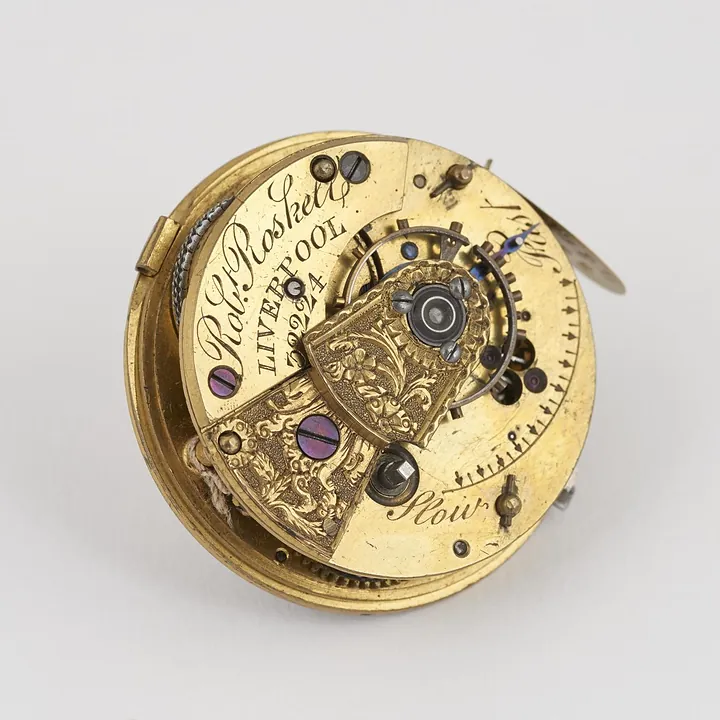
English lever, by Roskell, "banking" on escape wheel arbor, no.32224, 1840–1900
Science Museum Group, London
Movements & Components · 1841–1870
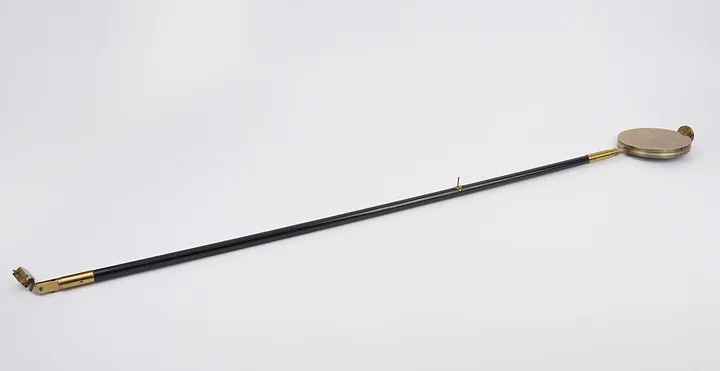
Pendulum from electric clock, unsigned, London, England, 1841–1870
Science Museum Group, London
Movements & Components · 1843–1884
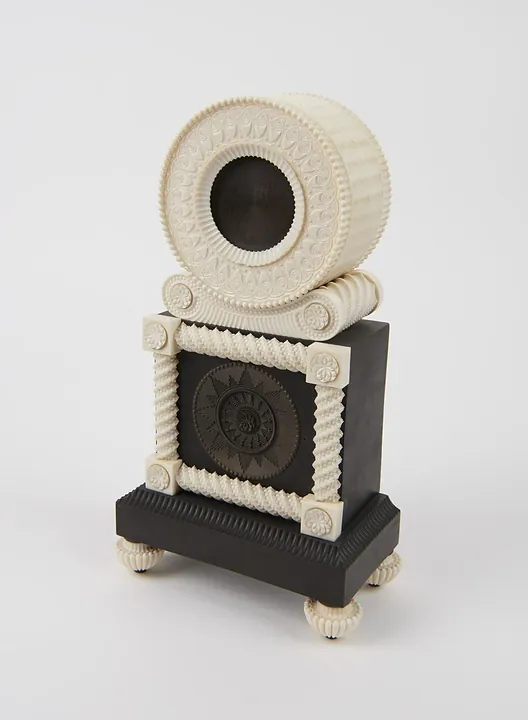
Ivory and blackwood clock case, by Holtzapffel and Company, London, England, 1843–1884
Science Museum Group, London
Movements & Components · c. 1850
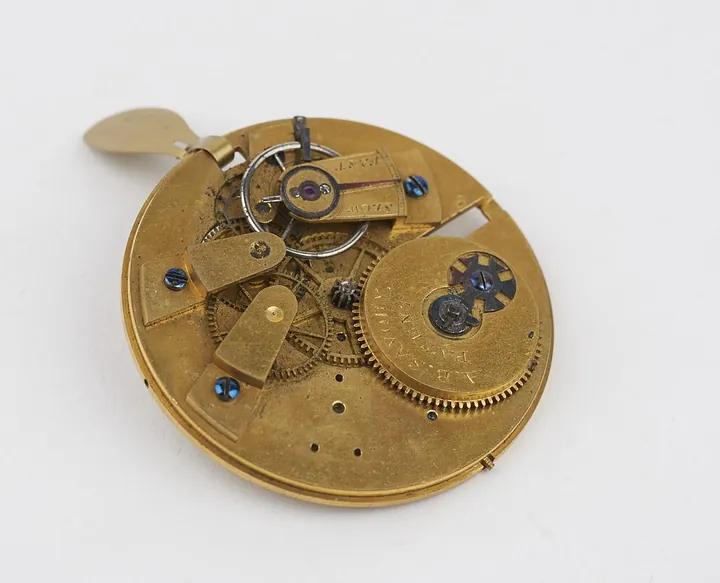
Self-winding pumping keyless cylinder watch mechanism, by Savory, about 1850
Science Museum Group, London
Movements & Components · 1848–1903
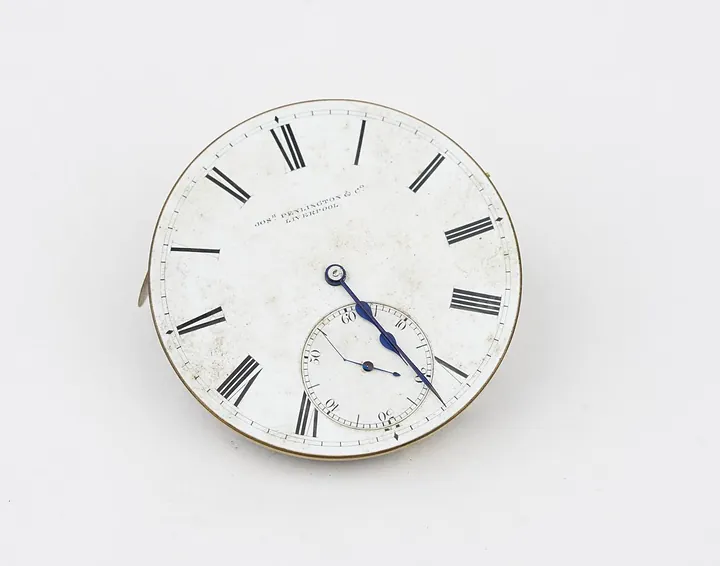
Watch movement by Josh Penlington, Liverpool, No.15231, with bi-metallic compensation balance and overcoil hairspring
Science Museum Group, London
Movements & Components · 1850–1909
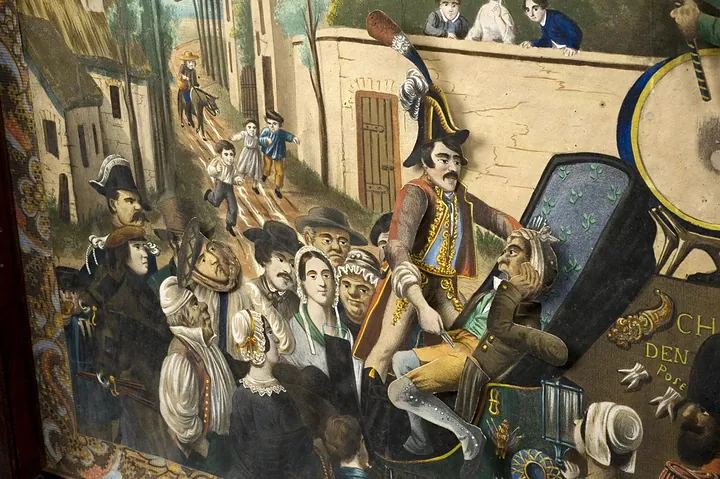
Clockwork picture showing a tooth extraction, France, 1850–1909
Science Museum Group, London
Movements & Components · 1850–1900
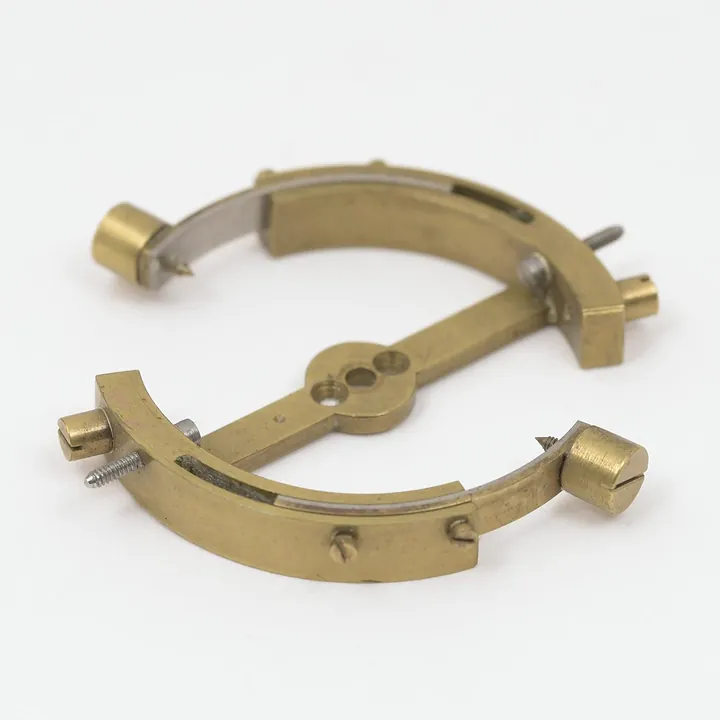
Compensation balance with sliding bi-metallic affixes
Science Museum Group, London
Movements & Components · 1850–1880
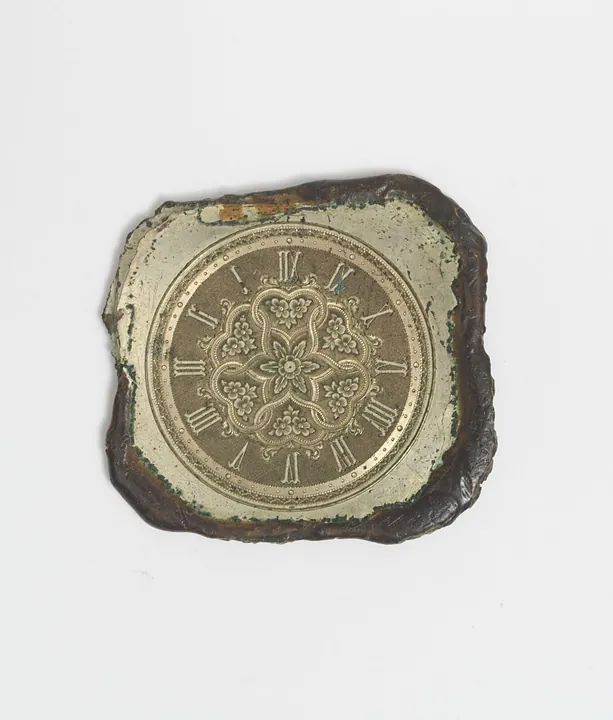
Gilt copper, electrotype, from original engraving by Jean Julien Faucherre, London, 1850–1880
Victoria and Albert Museum, London