Movements & Components · Clockwork picture
Clock movement by Gachet, Paul Ferdinand, France, 1850-1909
- Maker / attribution
- Gachet, Paul Ferdinand (maker); Paul Ferdinand Gachet (maker)
- Date
- 1850-1909
- Historical period
- Industrial Revolution (1850 – 1900)
- Country of origin
- France
- Place
- France, France
- Object type
- Clockwork picture
- Dimensions
- overall: 467 mm x 552 mm x 143 mm,
- Holding institution
- Science Museum Group, London
- Accession / object no.
- A86213
- Credit line
- Gachet, Dr.
- Catalogue title (original)
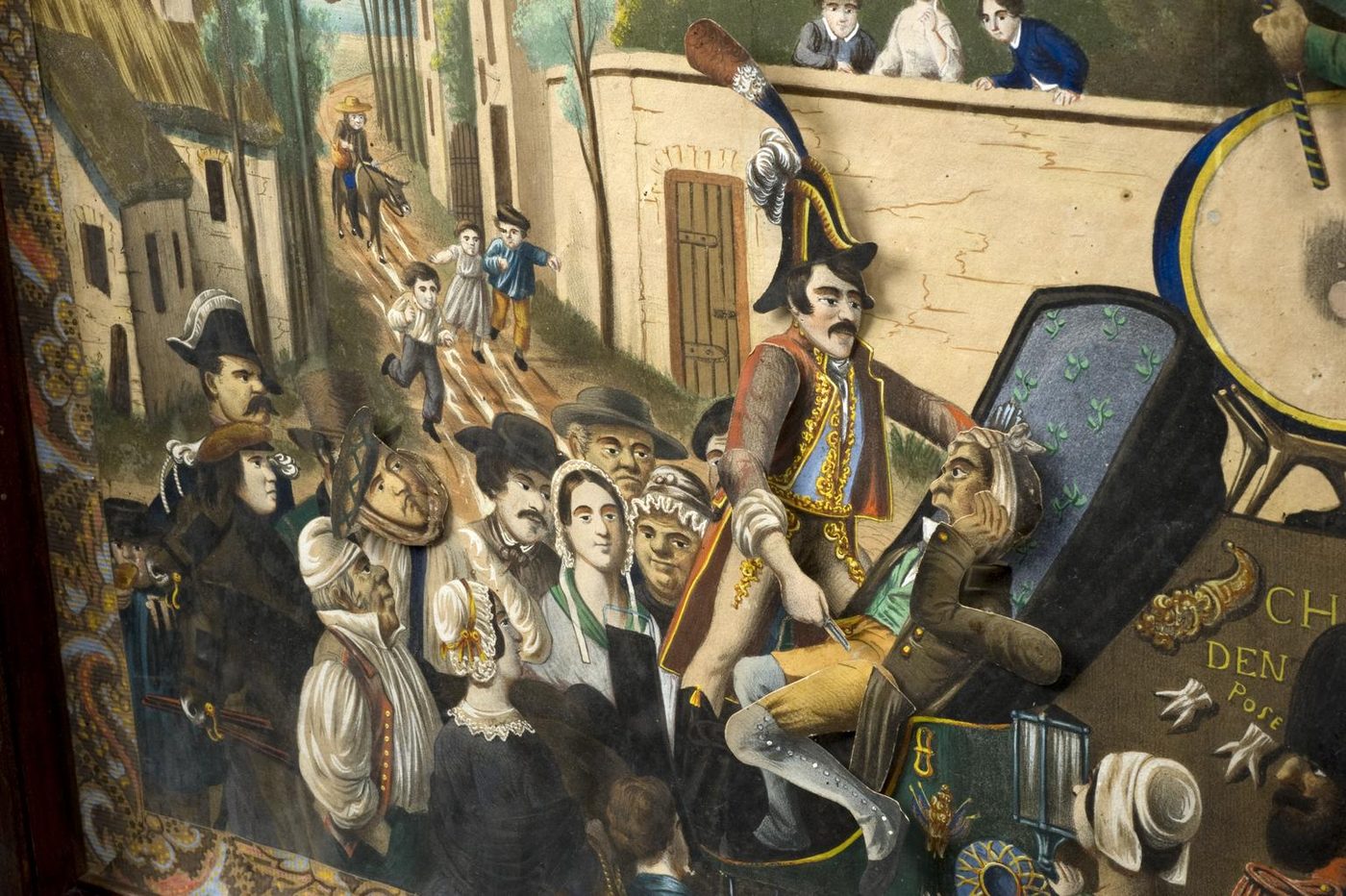
- Clockwork picture showing a tooth extraction, France, 1850-1909
Record summary
Held and catalogued by Science Museum Group, London (object number A86213), this is a clockwork picture by Gachet, Paul Ferdinand, made in France, France, dated 1850-1909. The Atlas places it in the Industrial Revolution period (1850 – 1900) of its Movements & Components collection. Recorded dimensions: overall: 467 mm x 552 mm x 143 mm. The record is illustrated with 2 photographs.
Assembled from the source record's structured fields. Dates and attributions are given as the source states them; where a field is missing the Atlas leaves it blank rather than estimating.
Catalogue description
Science Museum Group description
Set in the French countryside, the illustration shows a travelling tooth puller practising his trade. A drummer beats a drum to drown out the screams of the patient whose only available pain relief was probably alcohol or herbal medicines. The tooth puller and the drummer can be moved by a clockwork mechanism. Removing the tooth was one of the few treatments for toothache and tooth decay available at this time and was carried out by barber-surgeons and travelling practitioners – who often had little, if any medical knowledge. The operation was clearly something of a spectacle as a crowd has gathered around to watch. Dr Paul Ferdinand Gachet (1828-1909), a doctor specialising in mental illnesses who has been immortalised in a famous painting by Vincent van Gogh, once owned this illustration. The original documentation on this object also suggests that it sustained minor damage during the bombing blitz on London in the Second World War.
Historical context
Industrial Revolution (1850 – 1900)
American interchangeable-parts manufacture; railroad time standards; Swiss and German factory systems.
Standardised calibres, interchangeable parts and machine tools allowed movements to be mass-produced in American and Swiss factories.
Read the period in the timelineMore movements & components from this periodEarlier: Precision & Scientific Horology
Atlas type guide
Clock and watch movements
The movement is the mechanism of a clock or watch, without its case and dial. It consists of the power source (weight or mainspring in its barrel, sometimes with a fusee), the going train of wheels and pinions, the escapement and oscillator, the motion work that drives the hands, and in many cases additional trains for striking or complications.
From the eighteenth century watch movements were increasingly produced in stages: Swiss and French ébauche makers supplied rough movements that finishers, repasseurs and retailers completed and signed. Calibre numbers — first used systematically by American and Swiss factories in the nineteenth century — make it possible to identify movements, find spare parts and date watches.
What to look for
- Plate and bridge layout: full plate, three-quarter plate, Lépine bar calibre, bridges and cocks.
- Jewel count and whether jewels are set in chatons or rubbed in.
- Signatures, calibre and serial numbers on the plate or under the dial.
- Finishing: Geneva stripes (Côtes de Genève), perlage, bevelled edges, blued screws.
- Fusee and chain, going barrel, or electrical components.
Dating clues
- Full-plate English movements dominate before c. 1850; three-quarter plate and Lépine calibres after.
- Jewelled movements spread after Facio and Debaufre's patent of 1704, mainly in English work until c. 1800.
- Calibre numbers and factory serials allow close dating for industrial production after c. 1850.
General guidance written by the Atlas editors about this kind of object. It is not a statement about this particular piece; for that, rely on the source record above and on physical examination.
Related records
Movements & Components · 1801-1900
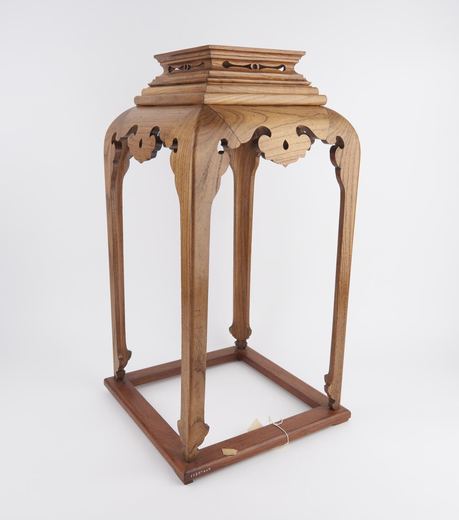
Stand for Japanese clock with two-balance foliot escapement and double strike arrangement
Science Museum Group, London
Movements & Components · 1840-1900
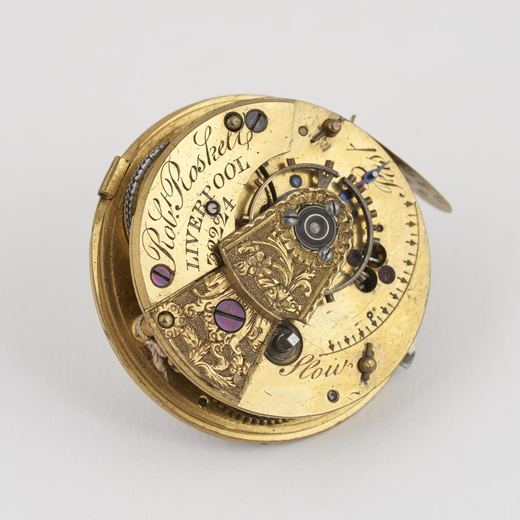
English lever, by Roskell, "banking" on escape wheel arbor, no.32224, 1840-1900
Science Museum Group, London
Movements & Components · 1841-1870
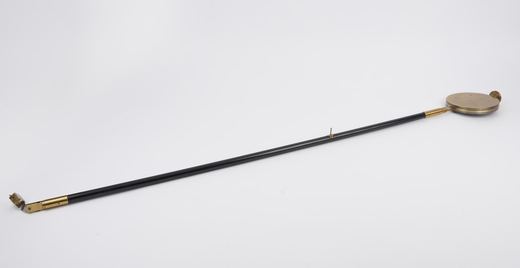
Pendulum from electric clock, unsigned, London, United Kingdom, 1841-1870
Science Museum Group, London
Movements & Components · 1843-1884
Ivory and blackwood clock case, by Holtzapffel and Company, London, England, 1843-1884
Science Museum Group, London
Movements & Components · 1844-1929
Pendulum from the electric master clock (no.663, seconds pendulum model), by Robert Mann Lowne, England, 1844-1929
Science Museum Group, London
Movements & Components · circa 1850
Self-winding pumping keyless cylinder watch mechanism, by Savory, about 1850
Science Museum Group, London
Movements & Components · 1848-1903
Watch movement by Josh Penlington, Liverpool, No.15231, with bi-metallic compensation balance and overcoil hairspring
Science Museum Group, London
Movements & Components · 1850-1900
Compensation balance with sliding bi-metallic affixes
Science Museum Group, London