
Wristwatches · Wristwatch
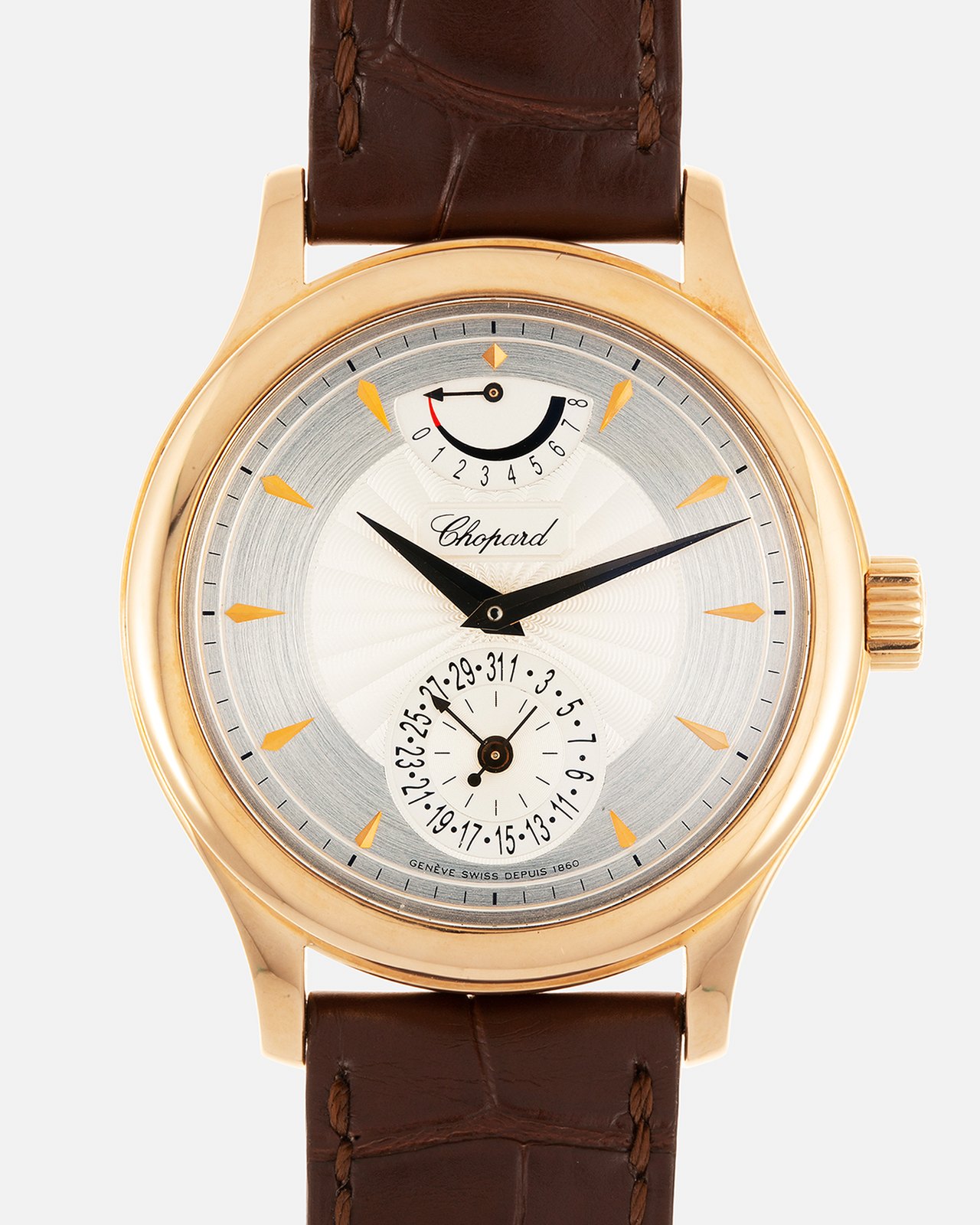
Chopard L.U.C Ref. 16/1863 Quattro, 1990s
- Maker / attribution
- Chopard (maker)
- Date
- 1990s
- Historical period
- Mechanical Renaissance (1990 – 2010)
- Country of origin
- Switzerland
- Object type
- Wristwatch
- Dimensions
- Case 38 mm
- Stock no.
- Product 6991195897943
- Credit line
- Dealer listing, S.Song Watches (product 6991195897943)
- Catalogue title (original)
- Chopard L.U.C Ref. 16/1863 Quattro (English)
View the source record (dealer listing) ↗ (opens another website in a new tab)Suggest a correction
Record summary
Catalogued by S.Song Watches (dealer), Seattle (stock number Product 6991195897943), this is a wristwatch by Chopard, made in Switzerland, dated 1990s. The Atlas places it in the Mechanical Renaissance period (1990 – 2010) of its Wristwatches collection. Recorded dimensions: Case 38 mm. The record is illustrated with 6 photographs.
Assembled from the source record's structured fields. Dates and attributions are given as the source states them; where a field is missing the Atlas leaves it blank rather than estimating.
Catalogue description
Dealer description — S.Song Watches
For a long time, Chopard was predominantly seen as a jewelry house and not thought of as a serious horological manufacture. This perception has solid reasons, including some questionable watch designs in the past which certainly have presented some challenges for the brand. However, after you've finished reading this, you'll come to understand why the Chopard L.U.C. 16/1860 defies these preconceptions and holds a highly esteemed position among enthusiasts and connoisseurs alike. To begin, the example you see here today is a slightly later variant derived from the L.U.C. 1860 – this is the 16/1863 ‘Quattro’. However, before we get into it, I believe it is important for us to grasp some historical context about the L.U.C. 16/1860. The 1990s marked a period of recovery, as companies remained cautious following the devastating impact of the quartz crisis in the 1980s. Consequently, most watch brands adopted a conservative approach during this era. They relied on movements that had been in use for decades, often sourced from suppliers like Valjoux, Lemania, and ETA. With only a few exceptions, this was simply not a time for bold experimentation. Relative to this, Chopard was striving to establish itself as a reputable watchmaking brand, embarking on this journey in 1993 with the collaboration of renowned independent watchmaker Michel Parmigiani. This partnership demonstrated their commitment to this endeavour. Notably, it wasn't until 1996 that they deemed themselves ready to introduce their prestigious watchmaking line, known as the manufacture L.U.C. Coming back to the L.U.C 16/1863 ‘Quattro’ offered here today, this reference marks the next chapter in Chopard’s pursuit of haute horlogerie. Building on the legacy of its predecessor, the inaugural 16/1860, the 16/1863 introduces a host of technical enhancements and aesthetic refinements. This example here boasts a marginally larger 38mm case crafted from exquisite 18-carat yellow gold, which showcases a distinguished stepped bezel design and ergonomically shaped lugs, delicately sloping down to meet the strap. The tri-tone dial is a symphony of details, featuring a power reserve indicator at 12 o'clock, a date indicator cum small seconds at 6 o'clock, applied hour markers, and a set of exquisite faceted dauphine-style hands – all in resplendent yellow gold. The dial's pièce de résistance is the beautiful rose lathe guilloché emanating from the center. For those who are familiar, the dial on this 16/1863 also bears a visual resemblance to a certain world-renowned Philippe Dufour Simplicity. This is because the dial was produced by Metalem, the same Swiss dial manufacturer Dufour used. Turn the 16/1863 over on its back and you will be greeted with Chopard’s manual-winding Cal. 1.98, also known as the ‘Quattro’, which refers to its distinctive twin-stacked barrels. This remarkable movement bestows the watch with an impressive 8-day power reserve—some sources even hinted that its actual power reserve extends closer to 9 days. A departure from the Cal. 1.96 found inside the 16/1860, the Cal. 1.98 upholds an equal standard of craftsmanship and finishing which becomes evident when the movement is observed from specific angles through its glorious exhibition caseback, revealing deep Côtes de Genève engraving, elegantly black-polished screw heads with chamfering, a meticulously polished and bevelled swan neck regulator, mirror-like anglage along the edges of the oversized bridges, and subtle glimpses of engine-turned perlage beneath the baseplate. As a bonus, this 16/1863 is not only Contrôle Officiel Suisse des Chronomètres (COSC) certified but also bears the prestigious Poinçon de Genève (Geneva Seal). The 16/1863 was initially said to be produced in a limited run of 1860 pieces across various variants in gold, mirroring the quantity of the original 16/1860. However, scholarly sources seem to suggest that Chopard likely manufactured fewer than half of that intended number. Nevertheless, as an overall package, the subtle yet striking allure of the 16/1863 is seriously unparalleled; it is THAT good. In a saturated industry where excellence is paramount, I’d go as far as to say that the over-engineered 16/1863 makes a compelling case for itself and stands shoulder-to-shoulder with some of the most esteemed watch manufactures. Considering the brand's rapid ascent from obscurity to excellence in the haute horlogerie space during the '90s, I tip my hat off to Chopard for making arguably one of the most underrated dress watches of all time.
Historical context
Mechanical Renaissance (1990 – 2010)
Mechanical watches return as cultural objects; independent watchmaking flourishes.
Mechanical watches returned as cultural and luxury objects. Complications, tourbillons and new materials proliferated; independent watchmakers such as George Daniels, F.P. Journe and Philippe Dufour revived artisanal watchmaking; collecting vintage watches became a major field.
Read the period in the timelineMore wristwatches from this periodEarlier: Quartz Revolution
Atlas type guide
Wristwatches
Bracelet watches were worn by women from the early nineteenth century — Breguet made one for Caroline Murat, Queen of Naples, in 1810–12 — but the wristwatch only became a man's instrument with military use and aviation in the early twentieth century. Between the World Wars it overtook the pocket watch; the 1920s and 1930s brought rectangular Art Deco cases, water-resistant cases and the first automatic winding systems.
After 1945 the wristwatch became a carrier of identity — dress watches, sports and dive watches, chronographs, calendars — produced by Swiss, American, Japanese, German, Soviet and Chinese industries. The quartz revolution after 1969 and the mechanical renaissance since the 1990s, including the rise of independent watchmakers, complete the story.
What to look for
- The reference number (between the lugs or inside the case back) and serial number, the starting point for dating.
- The calibre: its maker and number are often stamped under the dial or on the bridge.
- Originality of dial, hands and crown — refinished ('redial') dials are common.
- Case material marks: 18K/750, 14K/585, stainless steel, gold-filled, plated.
Dating clues
- Wire-lug cases: before c. 1925.
- Water-resistant screw-down cases: from 1926.
- Quartz movements: from 1969; sapphire crystals widespread after c. 1980.
General guidance written by the Atlas editors about this kind of object. It is not a statement about this particular piece; for that, rely on the source record above and on physical examination.
Related records
Wristwatches · Sold on 23 Jun 1998
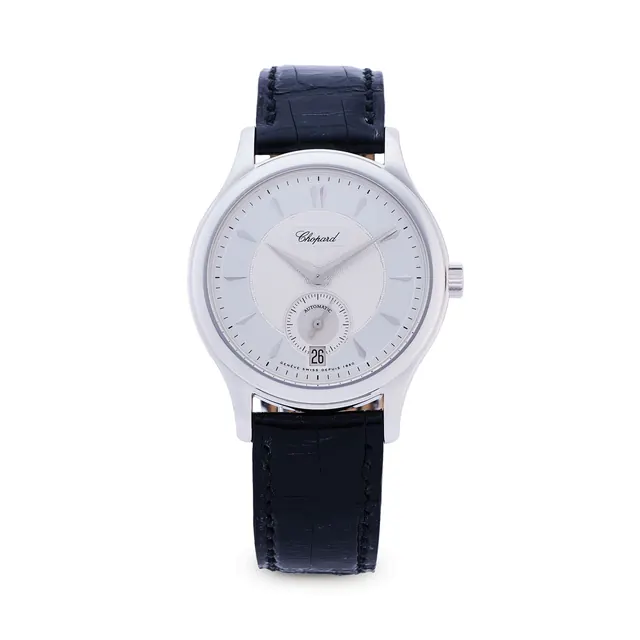
Chopard wristwatch, ref. 16/91860/2, L.U.c. 1860 Guilloche Dial, Sold on 23 Jun 1998
Antiquorum auction archive, Geneva
Wristwatches · c. 2000s
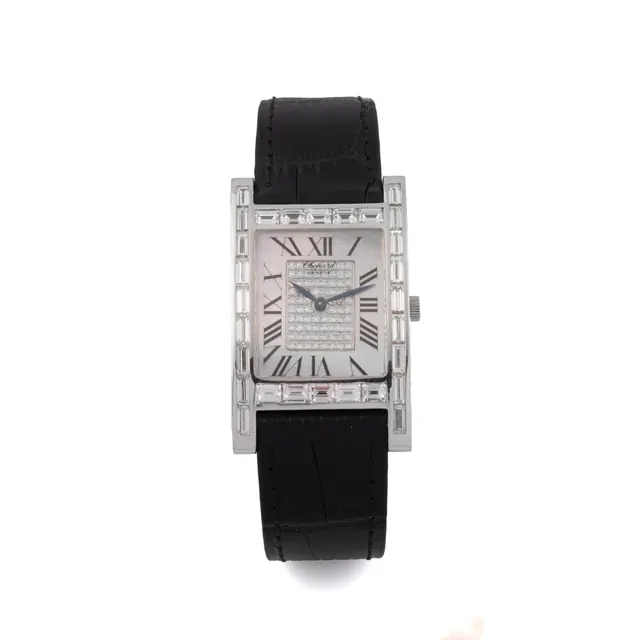
Chopard wristwatch, ref. 471, Your Hour Mop Dial, circa 2000's
Antiquorum auction archive, Geneva
Wristwatches · 2017
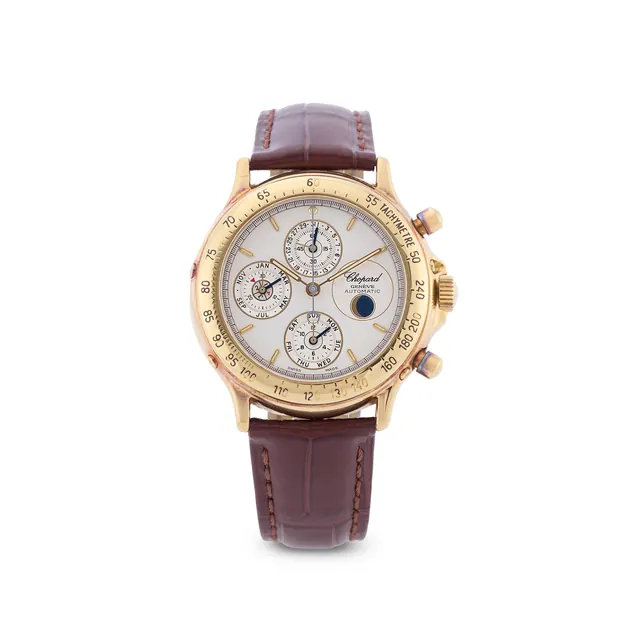
Chopard wristwatch, ref. 36/1208, Classic Perpetual Calendar Limited 12/50, Sold in June, 2017
Antiquorum auction archive, Geneva
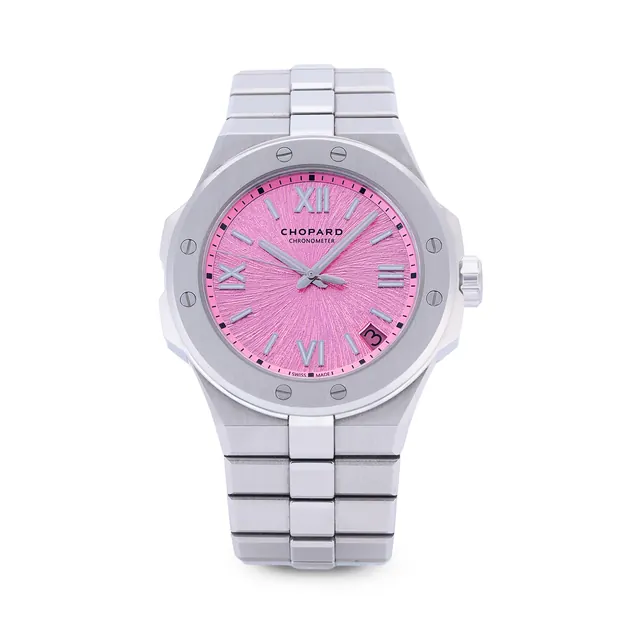
Wristwatches · c. 2024
Chopard wristwatch, ref. 298600-3022, Alpine Eagle, circa 2024
Antiquorum auction archive, Geneva

Wristwatches · 2008
Wristwatch by Breitling?, 2008
Museum Rotterdam

Wristwatches · c. 1990s
Audemars Piguet Bamboo, c. 1990s
Antiquorum auction archive, Geneva

Wristwatches · c. 1990
Audemars Piguet Huitieme Perpetual Calendar, ref. 25696PT, c. 1990
Antiquorum auction archive, Geneva

Wristwatches · c. 1990
Breitling Chronomat, ref. b13050.1, c. 1990
Antiquorum auction archive, Geneva