
Wristwatches · Quartz wristwatch
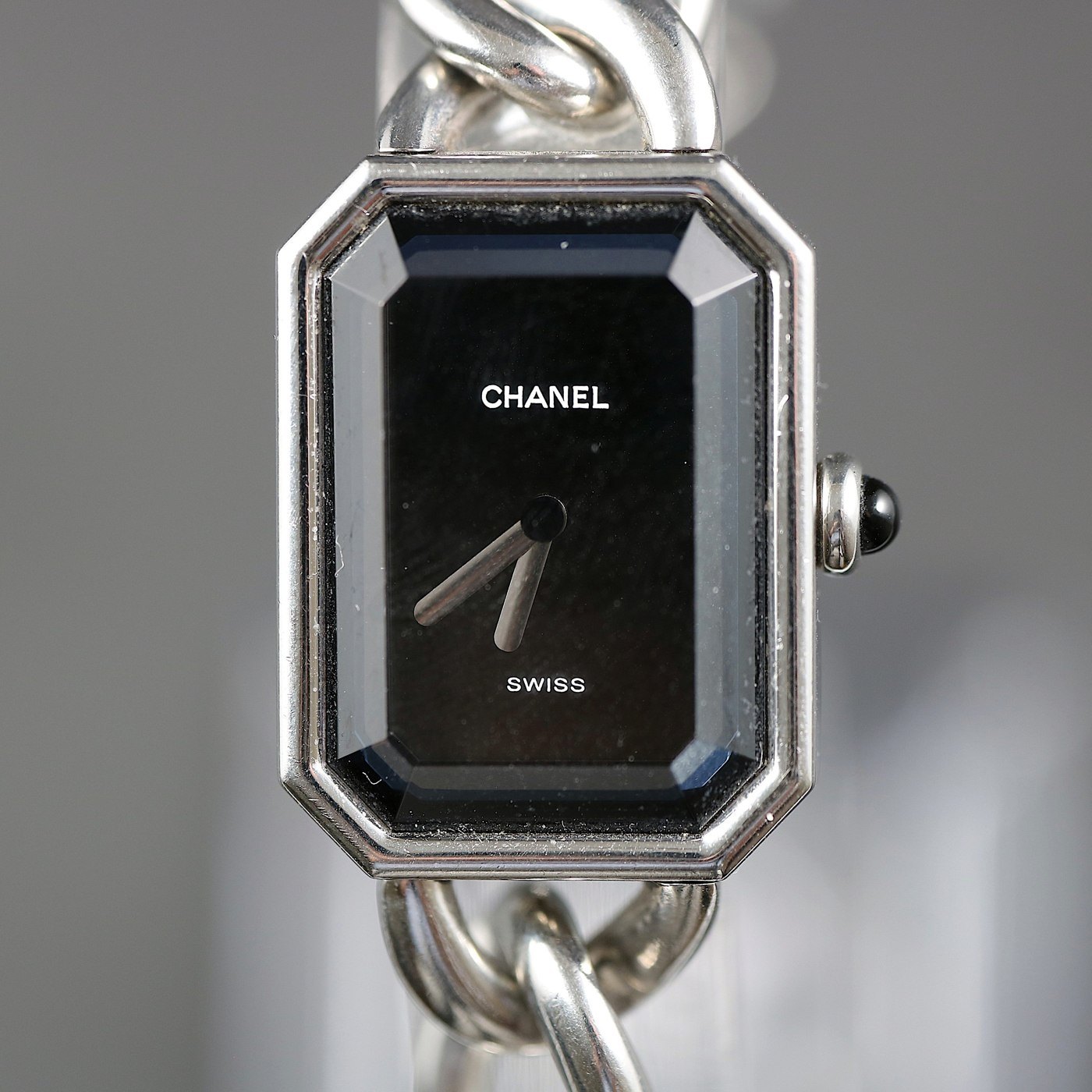
Chanel Premiere Gourmette
- Maker / attribution
- Chanel (source attribution)
- Date
- 1987
- Historical period
- Quartz Revolution (1969 – 1990)
- Country of origin
- Switzerland
- Object type
- Quartz wristwatch
- Materials / technique
- Stainless steel
- Holding institution
- Laurent Fine Watches
- Accession / object no.
- chanel-premiere-gourmette-f736ab40a6
- Credit line
- Laurent Fine Watches
- Catalogue title (original)
- ساعت مچی Chanel Premiere Gourmette رفرنس Q.K.48566 (English)
View the source record ↗ (opens another website in a new tab)Suggest a correction
Record summary
Held and catalogued by Laurent Fine Watches (object number chanel-premiere-gourmette-f736ab40a6), this is a quartz wristwatch attributed to Chanel, made in Switzerland, dated 1987. The Atlas places it in the Quartz Revolution period (1969 – 1990) of its Wristwatches collection. Materials and techniques recorded by the source: Stainless steel. The record is illustrated with 1 photograph.
Assembled from the source record's structured fields. Dates and attributions are given as the source states them; where a field is missing the Atlas leaves it blank rather than estimating.
Catalogue description
Original object description
Launched in 1987, the Chanel Premiere Gourmette is a quartz watch crafted in stainless steel, measuring 20 mm in diameter (excluding the winding crown) and 26 mm from lug to lug. Its clean rectangular black dial abandons all numerals and indices, showing the time solely through two central steel baton hands. The octagonal case silhouette reflects both the Paris Place Vendôme and the stopper of the Chanel No. 5 perfume bottle. An interlocking stainless steel curb-chain 'Gourmette' bracelet fastens the timepiece via a signature Chanel double clasp. Secured by screws, the caseback displays manufacturer engravings noting references, origin, and water resistance. A Chanel velvet presentation case accompanies the watch.
Case and Dial Design
The eight-sided stainless steel case mirrors the architectural contours of the Place Vendôme. Secured by screws, the rear cover is engraved with brand markings, reference data, and a water-resistance specification of 30 meters. The black rectangular face entirely lacks hour markers, reading time strictly via a pair of steel baton hands mounted at the center.
Bracelet and Construction
Assembled from stainless steel links in the Gourmette pattern, the curb-style bracelet is fitted with a dual-clasp mechanism bearing the Chanel mark. This all-steel execution adheres to the launch standards introduced with the Première collection in 1987.
Provenance and Documentation
Described in auction records as a pre-owned Swiss-made timepiece, this watch includes a velvet-lined Chanel box but lacks original production paperwork or warranty certificates. Although noted by the auctioneers as being in good condition, it has no recorded mechanical inspections or service history for its quartz movement.
Historical context
Quartz Revolution (1969 – 1990)
Seiko's Astron begins mass quartz timekeeping; traditional industries contract sharply.
Quartz and digital watches transformed the market after 1969. Swiss employment collapsed, Japanese and Hong Kong production soared, and the Swatch (1983) helped the Swiss industry recover; mechanical watches survived as luxury goods.
Read the period in the timelineMore wristwatches from this periodEarlier: Modern Mechanical Horology
Atlas type guide
Quartz, digital and electronic watches
Electronic watches arrived in three steps. The Hamilton Electric 500 (1957) was the first battery-powered wristwatch, still with a balance; Bulova's Accutron (1960) used a tuning fork. On 25 December 1969 Seiko released the Astron 35SQ, the first quartz wristwatch, closely followed by the Swiss Beta 21 group. In 1972 Hamilton's Pulsar introduced the LED digital watch, and LCD displays soon made digital watches cheap.
The 'Quartz Crisis' that followed devastated the Swiss mechanical industry, which lost two-thirds of its workforce between 1970 and 1984 before recovering with the Swatch (1983) and the luxury mechanical revival. Solar, radio-controlled, kinetic and connected smartwatches continue the electronic line.
What to look for
- Battery hatch in the case back and calibre markings with 'Quartz' or a crystal frequency.
- Display technology: LED (red, push-button) versus LCD (always-on).
- Tuning-fork hum and a smoothly sweeping seconds hand on Accutrons.
- Model and reference numbers, often printed on the back.
Dating clues
- Electric balance watches: from 1957.
- Tuning-fork watches: 1960–c. 1977.
- Quartz analogue: from December 1969; LED digital: 1972–c. 1978; LCD from 1973.
General guidance written by the Atlas editors about this kind of object. It is not a statement about this particular piece; for that, rely on the source record above and on physical examination.
Read next:Seiko calibre 35A (Astron)
Related records

Wristwatches · 1970
Wristwatch by Heno, Switzerland, 1970
Museum Rotterdam
Wristwatches · 1973
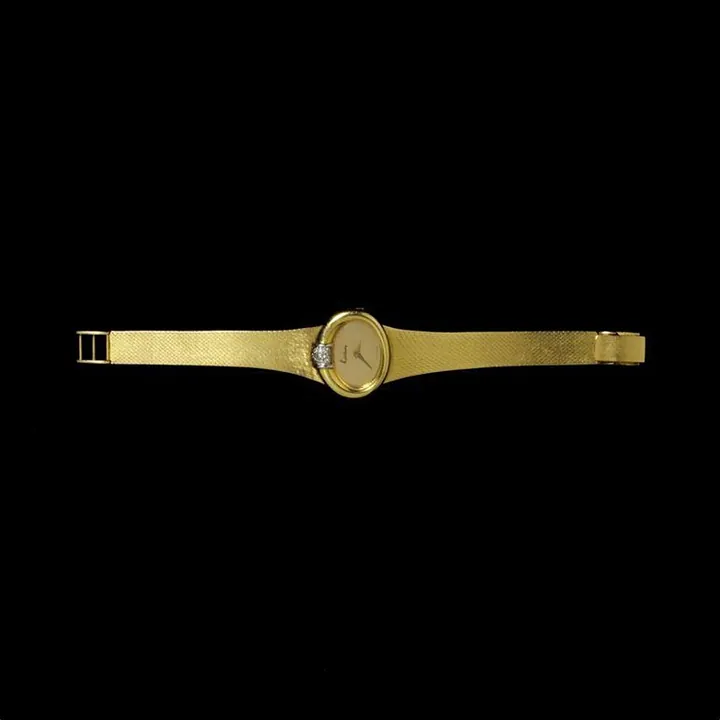
Woman's watch, gold with diamonds set in platinum. Made for Kutchinsky, London by Chopard et Cie. Switzerland, 1973
Victoria and Albert Museum, London
Wristwatches · 1985–1991
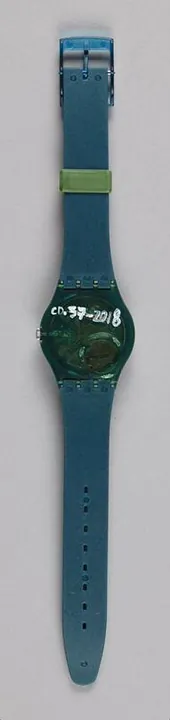
Swatch dummy watch: Blue Leaves GN104 design
Victoria and Albert Museum, London
Wristwatches · 1985–1991
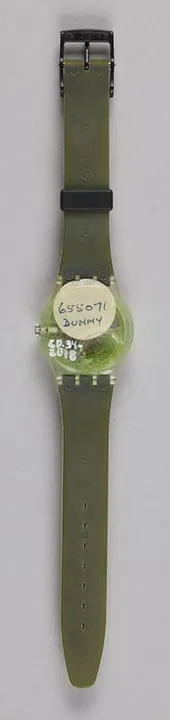
Swatch dummy watch: Technosphere GK101 design
Victoria and Albert Museum, London

Wristwatches · 1960–1986
'Tri-Compax' calendar chronograph wristwatch in gold case, by Universal, Geneva, Switzerland, 1960–1986.
Science Museum Group, London

Wristwatches · 1969–1970
Beta 21 Quartz wristwatch movement, made in Switzerland, 1970.
Science Museum Group, London

Wristwatches · c. 1969
Omega Speedmaster Moonwatch, ref. 145022-69st, c. 1969
Antiquorum auction archive, Geneva
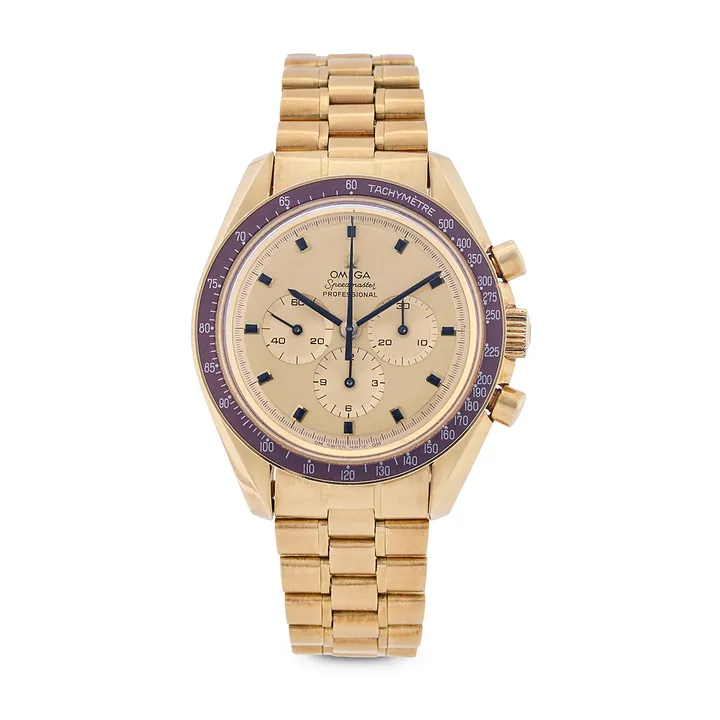
Wristwatches · c. 1969
Omega Speedmaster Professional Apollo XI, ref. 145.022-69, c. 1969
Antiquorum auction archive, Geneva