
Wristwatches · Wristwatch
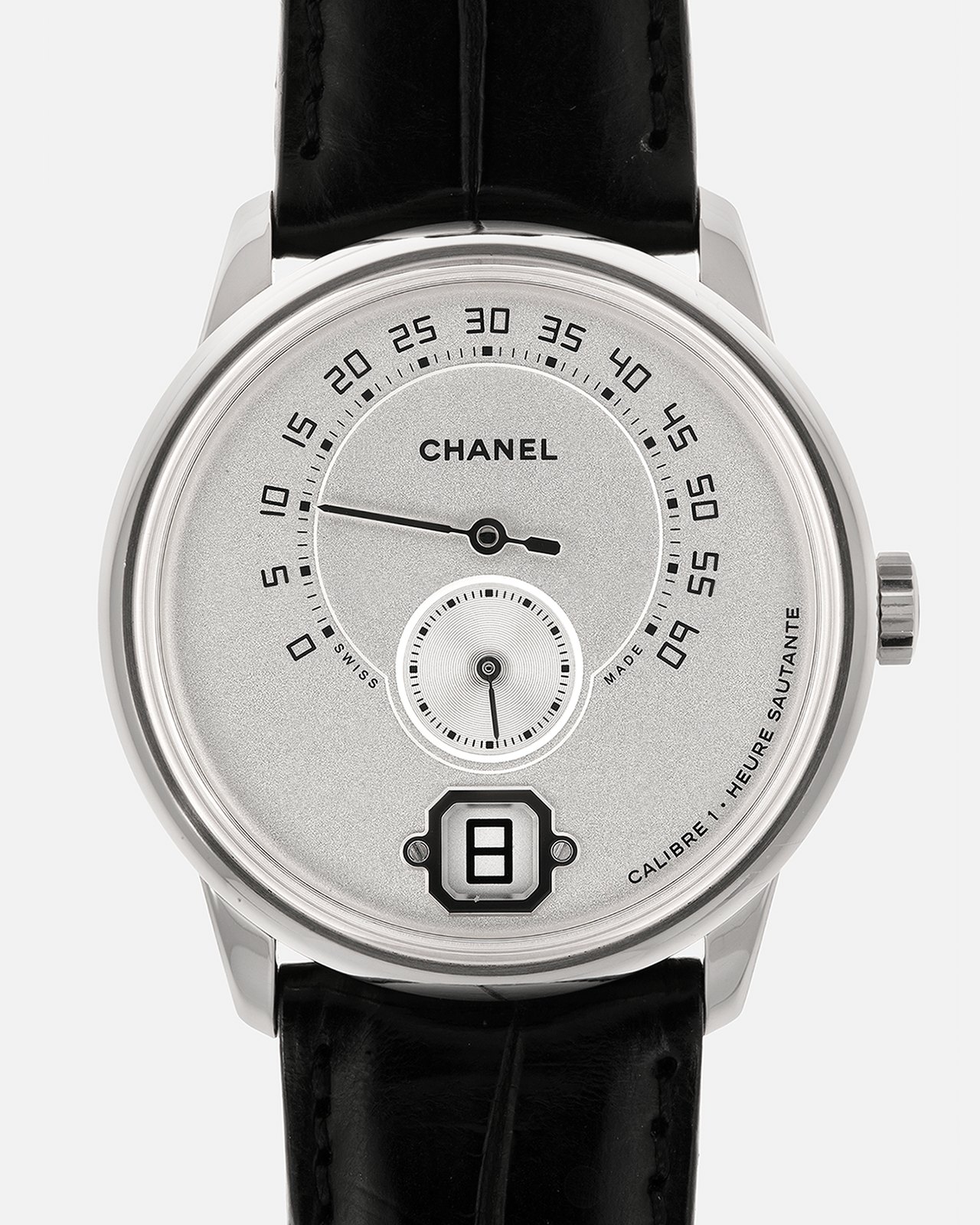
Chanel Monsieur Jump Hour H4799 White Gold, 2017
- Maker / attribution
- CHANEL (maker)
- Date
- 2017
- Historical period
- Contemporary Horology (2010 – Present)
- Country of origin
- Unrecorded in source
- Object type
- Wristwatch
- Materials / technique
- white gold
- Dimensions
- Case 40 mm
- Stock no.
- Product 7450302611543
- Credit line
- Dealer listing, S.Song Watches (product 7450302611543)
- Catalogue title (original)
- Chanel Monsieur Jump Hour H4799 White Gold (English)
View the source record (dealer listing) ↗ (opens another website in a new tab)Suggest a correction
Record summary
Catalogued by S.Song Watches (dealer), Seattle (stock number Product 7450302611543), this is a wristwatch by CHANEL, dated 2017. The Atlas places it in the Contemporary Horology period (2010 – Present) of its Wristwatches collection. Materials and techniques recorded by the source: white gold. Recorded dimensions: Case 40 mm. The record is illustrated with 6 photographs.
Assembled from the source record's structured fields. Dates and attributions are given as the source states them; where a field is missing the Atlas leaves it blank rather than estimating.
Catalogue description
Dealer description — S.Song Watches
As one of the world’s most iconic fashion houses, Chanel has created some truly remarkable timepieces over the years. Historically, however, Chanel has not been a primary brand destination for watch collectors and enthusiasts seeking horological innovation. While the J12 collection, launched in the early 2000s, offered some intriguing designs, it quickly became predominantly favoured by female wearers. That narrative shifted in 2016 when Chanel made a concerted effort to refocus on watchmaking for men with the introduction of the Monsieur de Chanel collection at Baselworld. This launch marked an ambitious attempt to blend the brand’s signature Parisian style with genuine technical expertise in watchmaking. Introducing the Monsieur de Chanel Jump Hour H4799 in 18-carat white gold. What makes this reference especially significant to collectors and enthusiasts is that the watch was entirely designed and manufactured in-house by Chanel—a testament to the brand’s growing technical prowess and commitment to haute horlogerie. Looking at the design as a whole, the H4799 feels both refreshingly original and confidently masculine, yet pure in its expression. Its 18-carat white gold case measures a contemporary 40mm x 10.4mm—an ideal size for modern wrists. Notably, the time display mechanism is fully integrated into the baseplate rather than built as separate modules, which contributes significantly to the H4799’s overall thinness and structural coherence. Speaking of the dial, the H4799 features a jumping hour display prominently placed at the 6:00 position, distinguished by sleek contemporary typography and a tastefully framed octagonal window inspired by the Place Vendôme in Paris as well as the Chanel No. 5 perfume bottle. Just above it sits a beautifully executed small seconds subdial, while a retrograde minute display arcs gracefully across the upper half of the dial. What makes this retrograde mechanism particularly compelling is its 240-degree arc, which is significantly more than the typical 180 degrees, and the fact that it can even be set in reverse, thanks to a clever blocking mechanism at zero. While subtle in function, these elements underscore the thoughtful and technically refined approach Chanel took in developing this watch. Flip the watch over, and you’re greeted by Chanel’s first in-house, manually wound movement: the Calibre 1 which showcases a distinctly modern aesthetic, with most components finished in a combination of matte and glossy black ADLC (Amorphous Diamond-Like Carbon) coating. This contemporary treatment not only enhances visual cohesion but also reflects Chanel’s horological philosophy: respecting traditional watchmaking while boldly embracing the modern and avant-garde. It’s also worth highlighting that the development of Calibre 1 began in 2011, with Chanel enlisting the expertise of acclaimed independent watchmaker and micro-engineer Romain Gauthier. His involvement in crafting several of the movement’s key components explains the visual parallels to his own horological creations. Despite its stealthy, blacked-out aesthetic, the movement offers a captivating visual experience. Displayed through a sapphire exhibition caseback, the Calibre 1 is composed of 170 components and features a free-sprung balance along with a twin-barrel architecture, allowing it to hold a robust 72-hour power reserve on a full wind. Now, if you’re wondering why there’s a small lion motif subtly engraved on one of the bridges and on the crown, it’s because Chanel uses this symbol to signify its in-house movements. Why a lion? Beyond representing strength and power, it also serves as a quiet tribute to Gabrielle “Coco” Chanel, who was born under the Leo zodiac sign. Released in 2016 alongside its beige gold counterpart (the H6596), the H4799 was limited to just 300 pieces total, 150 in each metal, making both variants exceptionally rare. I genuinely believe the Monsieur de Chanel line succeeds in bridging the often elusive gap between haute fashion and haute horlogerie. This is by no means a fashion watch. For those in search of a high-end timepiece that embodies true watchmaking pedigree, distinctive design, and undeniable presence, the Monsieur de Chanel stands as a compelling statement piece, worthy of a place in any discerning collection.
Historical context
Contemporary Horology (2010 – Present)
Silicon components, connected watches, optical-lattice research clocks and a thriving independent scene.
Smartwatches became the world's best-selling watches, while mechanical watchmaking focuses on craft, innovation (silicon components, new escapements) and independent makers.
Read the period in the timelineMore wristwatches from this periodEarlier: Mechanical Renaissance
Atlas type guide
Wristwatches
Bracelet watches were worn by women from the early nineteenth century — Breguet made one for Caroline Murat, Queen of Naples, in 1810–12 — but the wristwatch only became a man's instrument with military use and aviation in the early twentieth century. Between the World Wars it overtook the pocket watch; the 1920s and 1930s brought rectangular Art Deco cases, water-resistant cases and the first automatic winding systems.
After 1945 the wristwatch became a carrier of identity — dress watches, sports and dive watches, chronographs, calendars — produced by Swiss, American, Japanese, German, Soviet and Chinese industries. The quartz revolution after 1969 and the mechanical renaissance since the 1990s, including the rise of independent watchmakers, complete the story.
What to look for
- The reference number (between the lugs or inside the case back) and serial number, the starting point for dating.
- The calibre: its maker and number are often stamped under the dial or on the bridge.
- Originality of dial, hands and crown — refinished ('redial') dials are common.
- Case material marks: 18K/750, 14K/585, stainless steel, gold-filled, plated.
Dating clues
- Wire-lug cases: before c. 1925.
- Water-resistant screw-down cases: from 1926.
- Quartz movements: from 1969; sapphire crystals widespread after c. 1980.
General guidance written by the Atlas editors about this kind of object. It is not a statement about this particular piece; for that, rely on the source record above and on physical examination.
Related records
Wristwatches · c. 1993
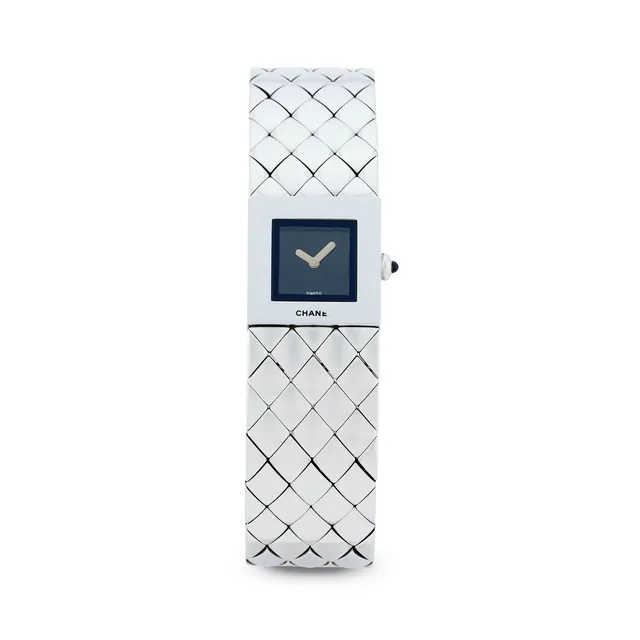
Chanel wristwatch, ref. C.K.30464, Matelassé, circa 1993
Antiquorum auction archive, Geneva
Wristwatches · c. 2000s
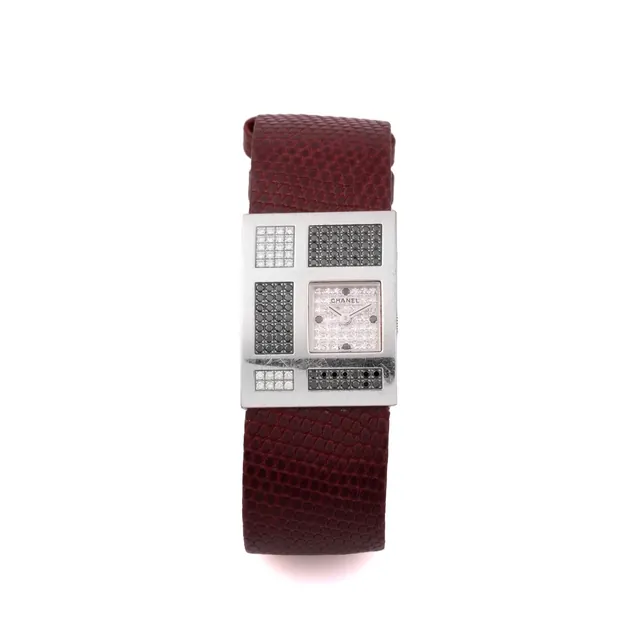
Chanel wristwatch, White and Black Diamonds, circa 2000's
Antiquorum auction archive, Geneva
Wristwatches · sold in Sept 3rd, 2004
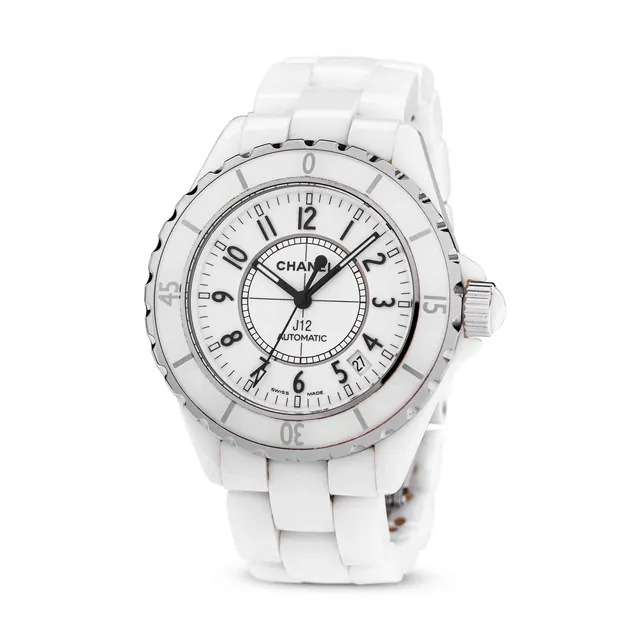
Chanel wristwatch, ref. H0970, J12, sold in Sept 3rd, 2004
Antiquorum auction archive, Geneva
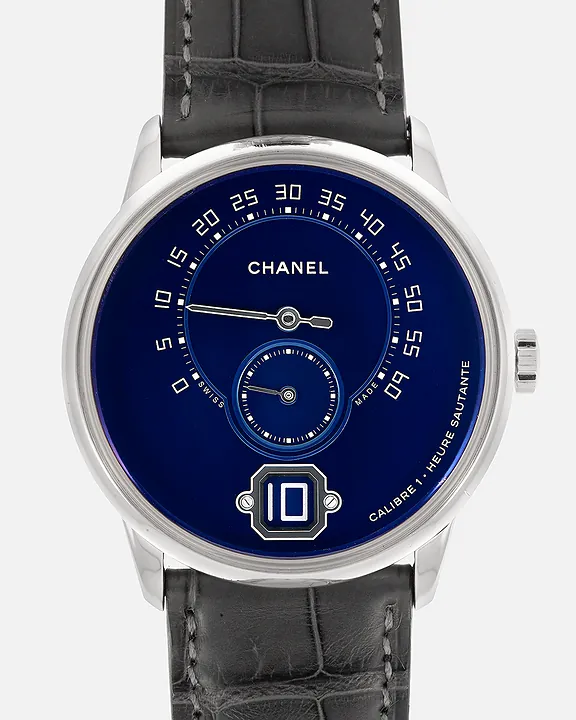
Wristwatches · 2018
Chanel Monsieur Jump Hour H5467 Blue Enamel Dial Platinum Limited, 2018
S.Song Watches (dealer), Seattle
Wristwatches · 2010
Wristwatch, 2010
Modemuseum Hasselt
Wristwatches · 2018 (Series 4 released in September 2018; '1977' in the source is the model number A1977)
Apple Watch Series 4 (GPS, 40 mm, model A1977), 2018
Vienna Museum of Science and Technology
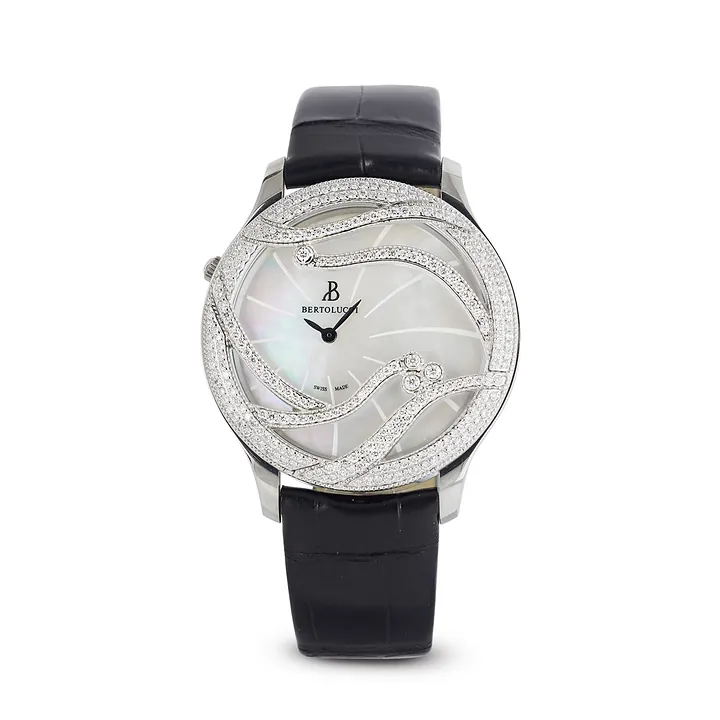
Wristwatches · c. 2010s
Bertolucci Stria III, ref. 11513.50.45.B88.6C1.501, c. 2010s
Antiquorum auction archive, Geneva
Wristwatches · c. 2010s
Bertolucci Uoma, ref. 824.51.41.10B, c. 2010s
Antiquorum auction archive, Geneva