
Wristwatches · Wristwatch
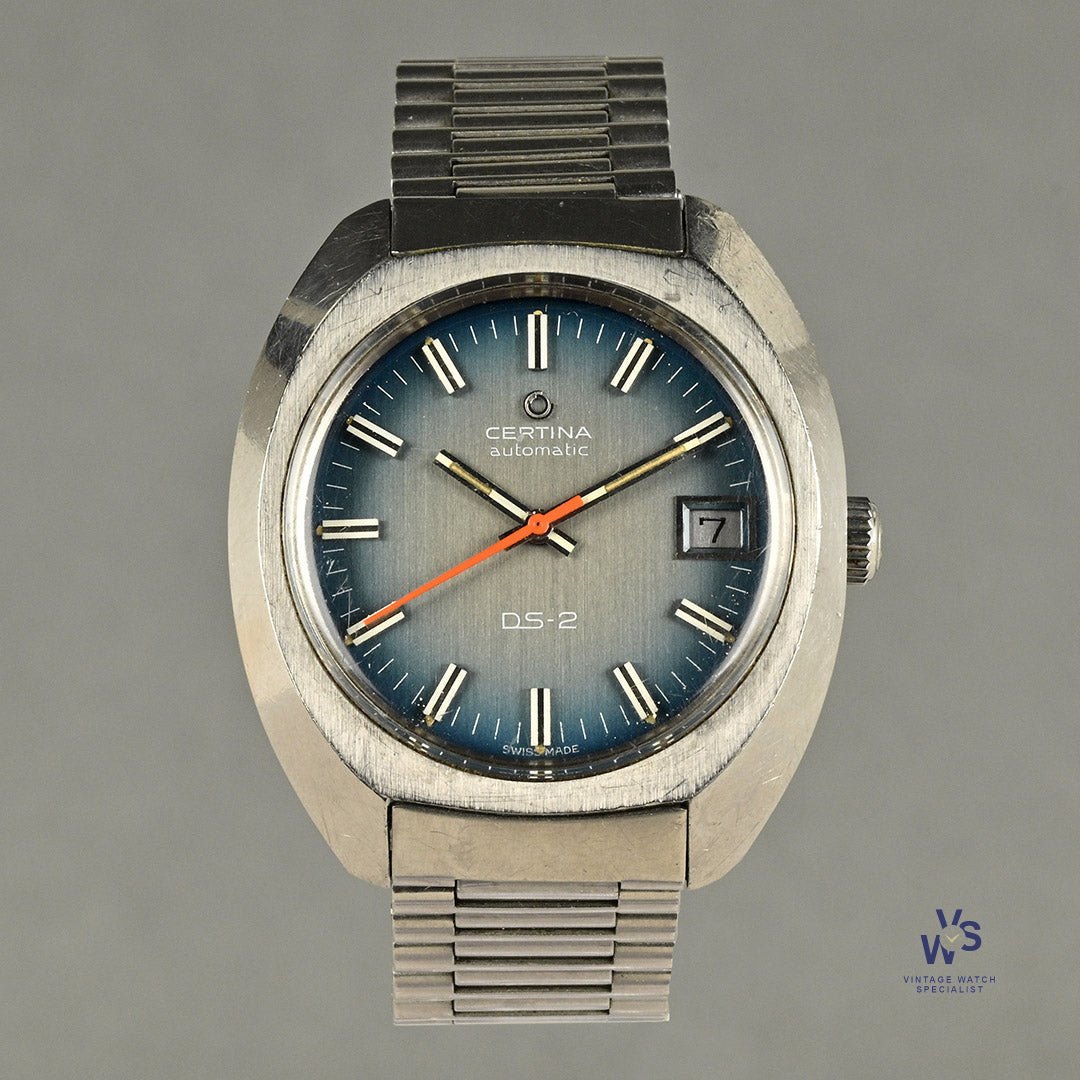
Certina DS2 Automatic, circa 1968
- Maker / attribution
- Certina (maker)
- Date
- c. 1968
- Historical period
- Modern Mechanical Horology (1945 – 1969)
- Country of origin
- Switzerland
- Object type
- Wristwatch
- Dimensions
- Case 38 mm
- Stock no.
- vws4413cs
- Credit line
- Dealer listing, Vintage Watch Specialist (vws4413cs)
- Catalogue title (original)
- Certina DS2 Automatic - c.1968 (English)
View the source record (dealer listing) ↗ (opens another website in a new tab)Suggest a correction
Record summary
Catalogued by Vintage Watch Specialist (dealer), United Kingdom (stock number vws4413cs), this is a wristwatch by Certina, made in Switzerland, dated c. 1968. The Atlas places it in the Modern Mechanical Horology period (1945 – 1969) of its Wristwatches collection. Recorded dimensions: Case 38 mm. The record is illustrated with 6 photographs.
Assembled from the source record's structured fields. Dates and attributions are given as the source states them; where a field is missing the Atlas leaves it blank rather than estimating.
Catalogue description
Dealer description — Vintage Watch Specialist
Certina DS2 Automatic, Reference 5801.300-M, Calibre 25-651, On Dual Marked, Certina/NSA Bracelet In 1959, Certina launched the Double Security, or DS. The movement floated inside a sealed case, cushioned by a ring of shock-absorbing material, so that a knock or a splash had a harder time reaching it. The DS-2 followed in 1968. It wrapped the same thinking in a chunkier case that guarded the crown, and it stands as one of the sturdiest watches of its era, with a look to match. What's On Offer We are delighted to offer this Certina DS-2 Automatic, dating from circa 1968. At 38mm across and 42mm lug-to-lug, with 18mm lugs, it is a chunky, confident watch, and the thick, rounded case has the protective feel the DS name promises. The stainless-steel case shows brushing and surface marks consistent with age, and it sits on its original, dual-marked NSA bracelet. Charmingly, the caseback is engraved with a turtle, accompanied by the Certina DS signature. The gradient blue dial fades from deep blue at the edges to a pale steel-grey at the centre, almost resembling faded denim texture. Slim baton indices with white metal inserts mark the hours, and a framed date window sits at three o'clock. Tiny luminous pips sit snugly above each index. The Certina signature and "Automatic" sit under twelve, with "DS-2" above six. A vivid orange seconds hand adds a single flash of colour. The crystal is acrylic. Inside is the Certina Calibre 25-651, a 27-jewel automatic movement with quickset date and approximately 44 hours of power reserve. The watch is in working order and runs relatively well. The reference “5801.300-M” is engraved inside the case back. Rated 8.8/10, this is a characterful, robust and strikingly dialled early-seventies-feeling sports watch. It is offered without box or papers.
Historical context
Modern Mechanical Horology (1945 – 1969)
Tool watches for divers, pilots and astronauts; electric watches anticipate the electronic age.
The classic era of the mechanical wristwatch: dive watches, chronographs for motor racing and space flight, GMT watches for jet travel, slim dress watches, automatic calendars, and the rise of Japanese manufacturers alongside Swiss, American, German and Soviet industries.
Read the period in the timelineMore wristwatches from this periodEarlier: Golden Age of Mechanical Watchmaking
Atlas type guide
Automatic (self-winding) watches
Self-winding watches use the wearer's motion to wind the mainspring. Abraham-Louis Perrelet and Breguet made 'perpétuelle' pocket watches with oscillating weights in the late eighteenth century, but the principle only became practical in the wristwatch. John Harwood patented a bumper automatic in 1923; Rolex's Perpetual rotor (1931) winding in one direction, and later bidirectional rotors (Eterna, Felsa Bidynator), established the modern form. Micro-rotors (Universal Genève, Buren) and peripheral rotors made automatic watches thinner.
What to look for
- A semicircular rotor turning 360° over the movement, or a 'bumper' weight that rebounds between springs.
- 'Automatic', 'Perpetual' or 'Self-winding' on the dial.
- A sealed screw-back case, since automatic watches are wound less often by the crown.
Dating clues
- Bumper automatics: 1923–c. 1955.
- Full rotors: from 1931 (Rolex); widespread after c. 1950.
- Micro-rotors: from 1954–1958.
General guidance written by the Atlas editors about this kind of object. It is not a statement about this particular piece; for that, rely on the source record above and on physical examination.
Related records

Wristwatches · 1900–1999
Wristwatch by Certina, Switzerland, 1900–1999
Nordic Museum Foundation
Wristwatches · originally sold in December 2025 (per the lot record)
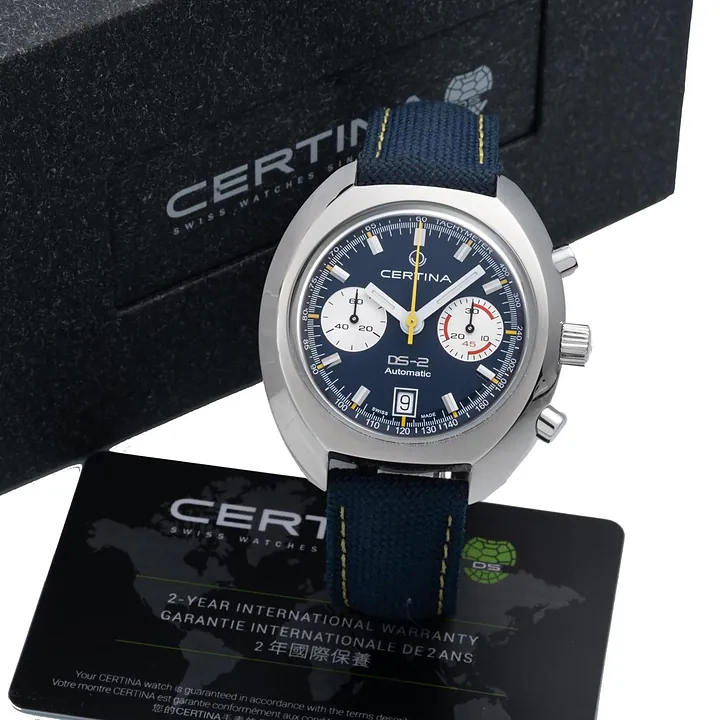
Certina DS-2 Chronograph Automatic, ref. C024.462.18.041.00, originally sold in December 2025
Antiquorum auction archive, Geneva
Wristwatches · originally sold in January 2026 (per the lot record)
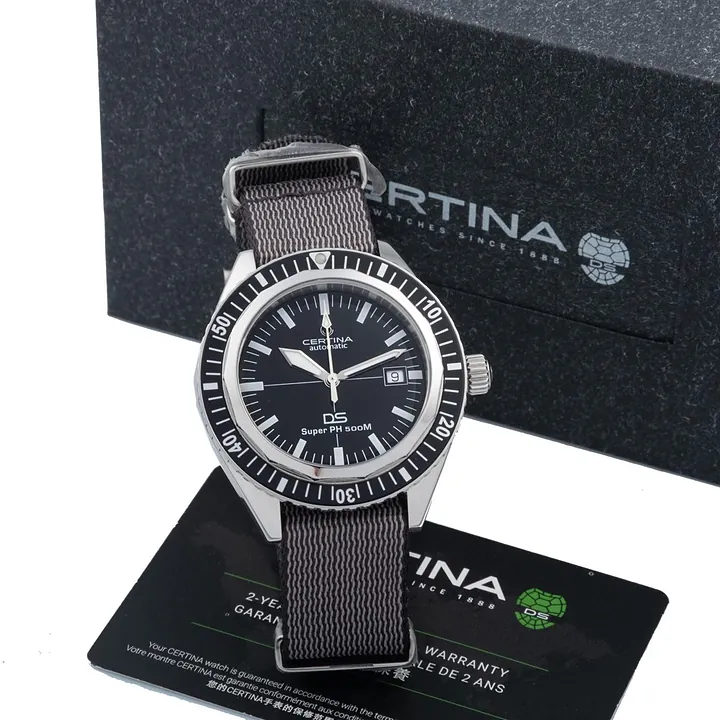
Certina DS Super PH 500m, ref. C037.407.18.050.00, originally sold in January 2026
Antiquorum auction archive, Geneva
Wristwatches · c. 1965-1970
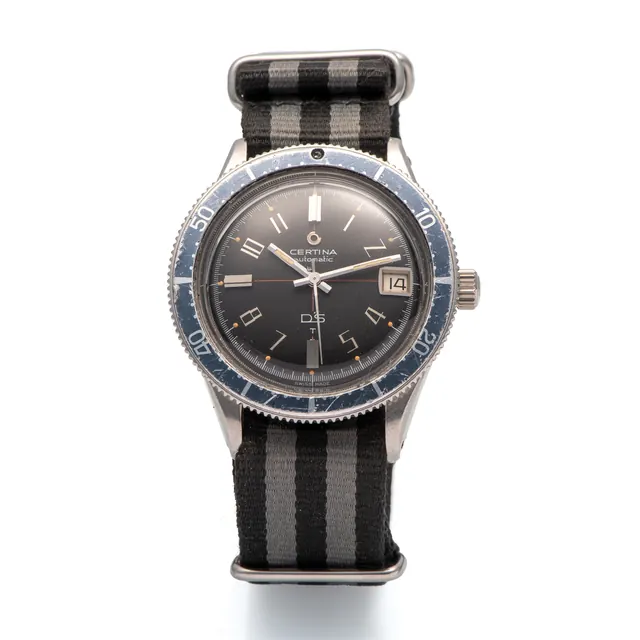
Certina wristwatch, ref. 5801, Ds, circa 1965-1970
Antiquorum auction archive, Geneva

Wristwatches · 1945
Wristwatch by Eterna, 1945
Museum Rotterdam

Wristwatches · c. 1945
Breitling Premier, ref. 790, c. 1945
Antiquorum auction archive, Geneva

Wristwatches · c. 1945
Universal Genève Uni-Compax, ref. 22492, c. 1945
Antiquorum auction archive, Geneva

Wristwatches · c. 1950s
Baume & Mercier wristwatch, c. 1950s
Antiquorum auction archive, Geneva