
Clocks · Prismatic desk clock
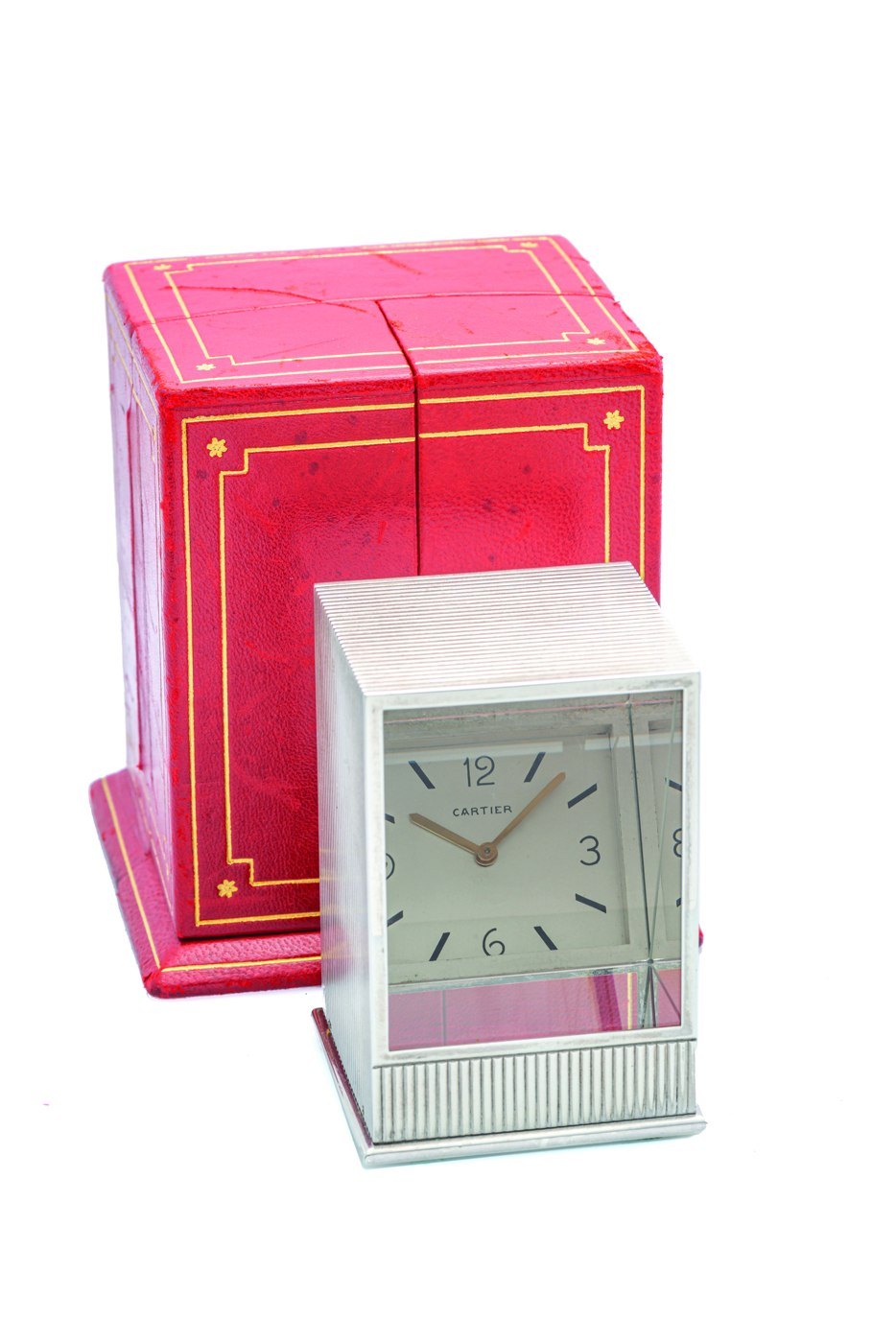
Cartier Pendule Mystérieuse à Prisme Desk Clock
- Maker / attribution
- Cartier (source attribution)
- Date
- c. 1950
- Historical period
- Modern Mechanical Horology (1945 – 1969)
- Country of origin
- France
- Object type
- Prismatic desk clock
- Dimensions
- 83.3 x 59.8 x 58.7 mm
- Holding institution
- Antiquorum
- Accession / object no.
- 239
- Credit line
- Antiquorum
- Catalogue title (original)
- CARTIER Eight-day going mystery prismatic desk-clock; “Pendule Mystérieuse à Prisme”; silver (English)
View the source record ↗ (opens another website in a new tab)Suggest a correction
Record summary
Held and catalogued by Antiquorum (object number 239), this is a prismatic desk clock attributed to Cartier, made in France, dated c. 1950. The Atlas places it in the Modern Mechanical Horology period (1945 – 1969) of its Clocks collection. Recorded dimensions: 83.3 x 59.8 x 58.7 mm. The record is illustrated with 1 photograph.
Assembled from the source record's structured fields. Dates and attributions are given as the source states them; where a field is missing the Atlas leaves it blank rather than estimating.
Catalogue description
Original object description
Dating to roughly 1950, this Cartier desk timepiece bears the designation 'Pendule Mystérieuse à Prisme'. Its vertical rectangular housing is fabricated from silver with polished fluted (godronné) detailing, anchored at its base by four screws inserted into the sides. Time setting and manual winding are handled through an inset side crown. Two opposed rock crystal prisms positioned in the upper tier manipulate incoming light, creating an optical effect where the time display appears visible only from chosen angles. Gilded metal baton hands traverse a matte silver dial marked with radiating indexes alongside painted floating-style Arabic numbers. Supplying an eight-day reserve, the 19''' rhodium-finished 15-jewel mechanism is constructed on the LeCoultre caliber 205 (19 LECBC) architecture and incorporates a straight-line lever escapement, a poising-screw bimetallic cut balance, a flat balance spring of blued steel, and a polished index-regulator. Cartier signatures appear on the dial, the movement (numbered 104 922 M), and the case (stamped 02 164). An indistinct maker's stamp present on the housing is tentatively connected by auction records to Edmond Jaeger's Paris workshop. The timepiece retains its custom red fitted box, known as 'La petite boîte rouge'.
Inscriptions & marks
Case No. 02 164; Movement No. 104 922 M
Historical context
Modern Mechanical Horology (1945 – 1969)
Tool watches for divers, pilots and astronauts; electric watches anticipate the electronic age.
Post-war clocks combined new materials and industrial design: plastic and metal cases, battery-powered transistor movements from the late 1950s, and design classics by George Nelson, Max Bill and others. The first caesium atomic clock (1955) moved the definition of time from astronomy to physics.
Read the period in the timelineMore clocks from this periodEarlier: Golden Age of Mechanical Watchmaking
Atlas type guide
Mantel and French pendule clocks
The mantel clock — the French pendule de cheminée — is as much decorative art as timekeeper. From the late seventeenth century Parisian clockmakers worked with cabinet-makers, bronze founders and gilders (ciseleurs-doreurs) to create cases in Boulle marquetry, gilt bronze and marble, while the movements were often supplied by specialist makers. Clocks of the Louis XIV, Louis XV and Louis XVI periods, and Empire clocks with allegorical figures, set fashions copied across Europe.
The nineteenth century industrialised the type. The 'Paris movement', a standardised round movement with silk-thread or Brocot suspension and count-wheel striking, was made in huge numbers by firms such as Japy and Vincenti, and fitted into cases of every style and material.
What to look for
- Round 'Paris' movements with makers' stamps (e.g. Japy Frères, Vincenti, S. Marti) and medal marks from exhibitions.
- Suspension type: silk thread (earlier) or Brocot adjustable suspension (after c. 1840).
- Visible Brocot escapement on the dial in later clocks.
- Fire-gilt (mercury) gilding on bronzes versus later electro-gilding.
- Signed dials naming a retailer rather than the movement maker.
Dating clues
- Silk-suspension Paris movements: c. 1800–1850.
- Brocot suspension and visible escapements: after c. 1840.
- Exhibition medal stamps on movements give dates after the medal year.
General guidance written by the Atlas editors about this kind of object. It is not a statement about this particular piece; for that, rely on the source record above and on physical examination.
Read next:Anchor (recoil) escapement
Related records

Clocks · 1863
Clock by Albert-Ernest Carrier-Belleuse, France, 1863
The Metropolitan Museum of Art, New York

Clocks · c. 1980s
Cartier "art Deco", c. 1980s
Antiquorum auction archive, Geneva

Clocks · c. 2000s
Cartier Desk Clock with Alarm, c. 2000s
Antiquorum auction archive, Geneva

Clocks · c. 2000s
Cartier Lacquer Arched Desk Clock with Alarm, ref. W0100037, c. 2000s
Antiquorum auction archive, Geneva
Clocks · 1950s (estimated)
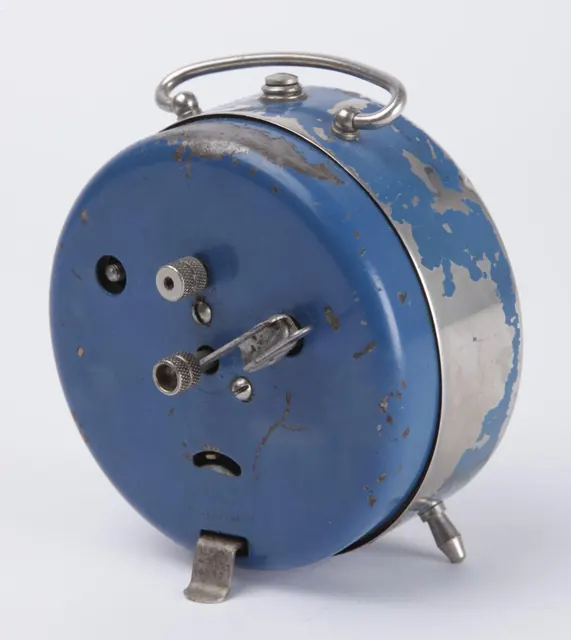
Alarm clock by Compagnie Industrielle de Mécanique Horlogère, France, 1950stimated
Lusto – Suomen Metsämuseo
Clocks · c. 1947
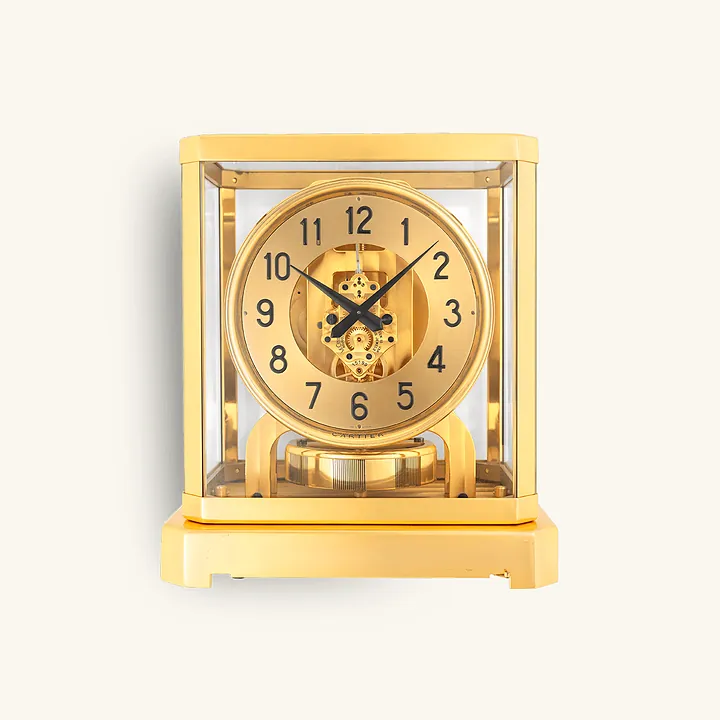
Cartier Atmos Clock, circa 1947
Watches of Knightsbridge (dealer), London
Clocks · c. 1960
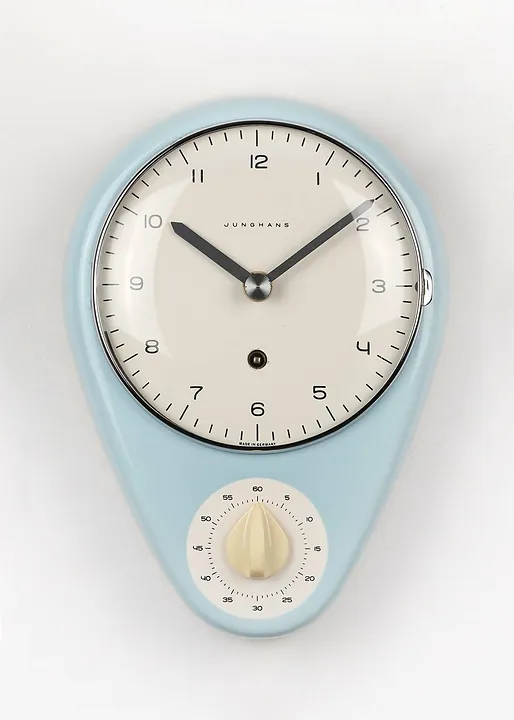
Clock, Germany, c. 1960 (no. 58196)
German Clock Museum
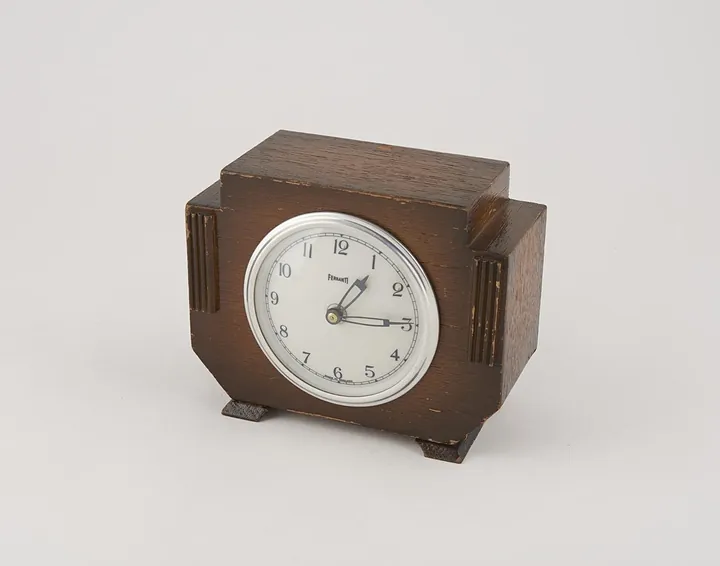
Clocks · 1930–1960
Ferranti electric mantel clock. (no. Y1996.10.820)
Science Museum Group, London