
Wristwatches · Self-winding wristwatch
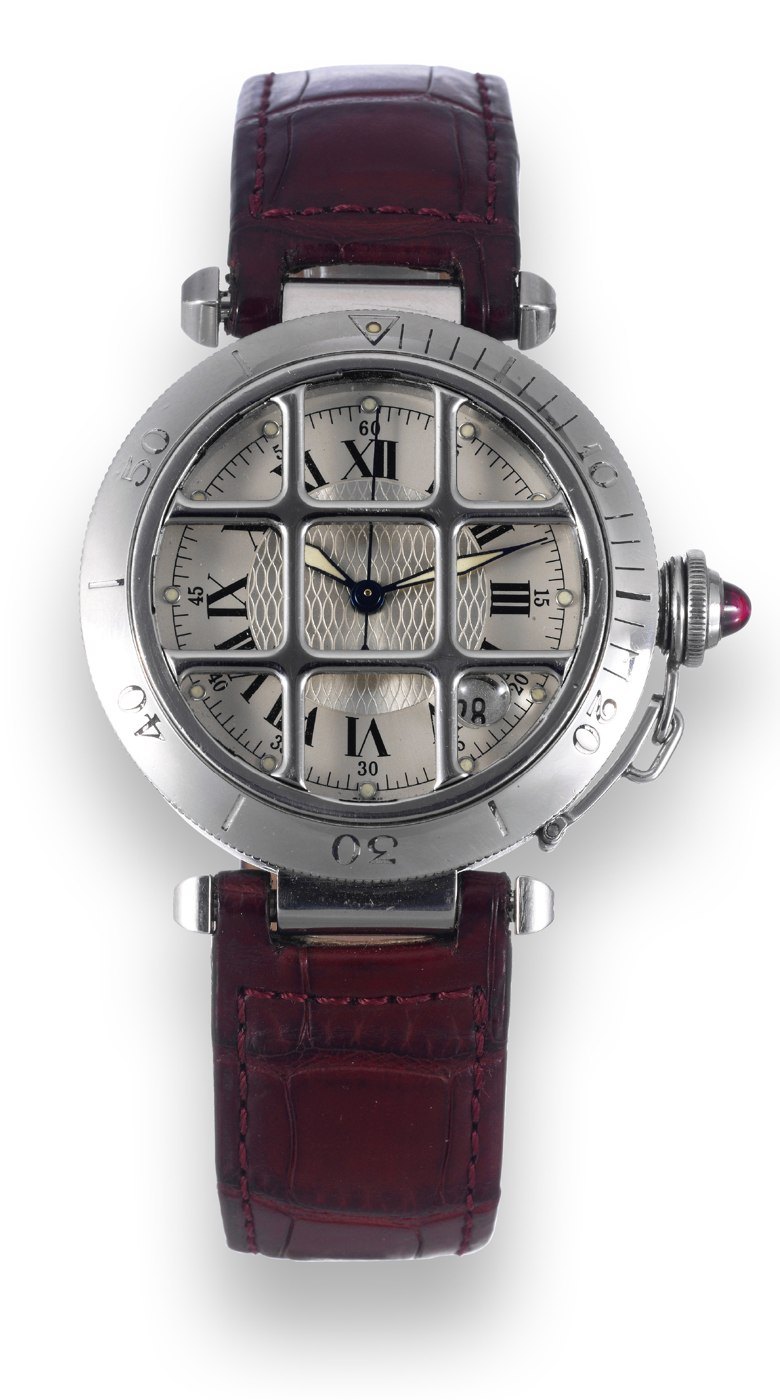
Cartier Pasha Grille, Ref. 1847
- Maker / attribution
- Cartier (source attribution)
- Date
- 1997
- Historical period
- Mechanical Renaissance (1990 – 2010)
- Country of origin
- France
- Object type
- Self-winding wristwatch
- Dimensions
- 38 mm
- Holding institution
- Antiquorum
- Accession / object no.
- 166
- Credit line
- Antiquorum
- Catalogue title (original)
- Pasha Grille\nCartier, \"Pasha Grille\", No. 0408/1847. Made in a limited edition of 1847 pieces to celebrate the 150th\nAnniversary of Cartier in 1997.\nVery fine and rare, center seconds, self-windi (English)
View the source record ↗ (opens another website in a new tab)Suggest a correction
Record summary
Held and catalogued by Antiquorum (object number 166), this is a self-winding wristwatch attributed to Cartier, made in France, dated 1997. The Atlas places it in the Mechanical Renaissance period (1990 – 2010) of its Wristwatches collection. Recorded dimensions: 38 mm. The record is illustrated with 1 photograph.
Assembled from the source record's structured fields. Dates and attributions are given as the source states them; where a field is missing the Atlas leaves it blank rather than estimating.
Catalogue description
Original object description
Created in 1997 as piece number 0408 of an edition limited to 1,847 units in commemoration of Cartier's 150th anniversary, this 'Pasha Grille' reference 1847 has a tripartite stainless steel case with mirror-polished and brushed surfaces measuring 38 mm in diameter and 11 mm thick. It incorporates Vendome-style lugs, a unidirectional rotating bezel with calibration, an exhibition back secured by eight screws, and a detachable protective grille placed over the sapphire crystal. A tethered, screw-down cap set with a cabochon ruby secures the winding crown. The self-winding, rhodium-finished Caliber 049 is embellished with circular graining (oeil-de-perdrix) and integrates 21 jewels, a straight-line lever escapement, monometallic balance, shock-absorbing system, micrometer regulator, and a flat self-compensating hairspring. A silver guilloche dial features blued steel lozenge hands filled with luminous paint, a date aperture nestled between 4 and 5 o'clock, radiant painted Roman numerals with a miniature signature integrated into the VII numeral, and an unpatterned track hosting luminescent dots. Graded in overall 'AA Very good' condition with light scratching noted on its casing, the watch is signed across the case, dial, and movement, and is offered with a stainless steel folding clasp and a dedicated presentation box.
Inscriptions & marks
0408/1847
Historical context
Mechanical Renaissance (1990 – 2010)
Mechanical watches return as cultural objects; independent watchmaking flourishes.
Mechanical watches returned as cultural and luxury objects. Complications, tourbillons and new materials proliferated; independent watchmakers such as George Daniels, F.P. Journe and Philippe Dufour revived artisanal watchmaking; collecting vintage watches became a major field.
Read the period in the timelineMore wristwatches from this periodEarlier: Quartz Revolution
Atlas type guide
Automatic (self-winding) watches
Self-winding watches use the wearer's motion to wind the mainspring. Abraham-Louis Perrelet and Breguet made 'perpétuelle' pocket watches with oscillating weights in the late eighteenth century, but the principle only became practical in the wristwatch. John Harwood patented a bumper automatic in 1923; Rolex's Perpetual rotor (1931) winding in one direction, and later bidirectional rotors (Eterna, Felsa Bidynator), established the modern form. Micro-rotors (Universal Genève, Buren) and peripheral rotors made automatic watches thinner.
What to look for
- A semicircular rotor turning 360° over the movement, or a 'bumper' weight that rebounds between springs.
- 'Automatic', 'Perpetual' or 'Self-winding' on the dial.
- A sealed screw-back case, since automatic watches are wound less often by the crown.
Dating clues
- Bumper automatics: 1923–c. 1955.
- Full rotors: from 1931 (Rolex); widespread after c. 1950.
- Micro-rotors: from 1954–1958.
General guidance written by the Atlas editors about this kind of object. It is not a statement about this particular piece; for that, rely on the source record above and on physical examination.
Related records

Clocks · 1863
Clock by Albert-Ernest Carrier-Belleuse, France, 1863
The Metropolitan Museum of Art, New York

Clocks · c. 1980s
Cartier "art Deco", c. 1980s
Antiquorum auction archive, Geneva

Clocks · c. 2000s
Cartier Desk Clock with Alarm, c. 2000s
Antiquorum auction archive, Geneva

Clocks · c. 2000s
Cartier Lacquer Arched Desk Clock with Alarm, ref. W0100037, c. 2000s
Antiquorum auction archive, Geneva
Wristwatches · 1999
Watch made by Akteo/ Canal Productions, to promote David Bowie's show in Paris on the Hours Tour , 1999
Victoria and Albert Museum, London
Wristwatches · c. 1990
Cartier Pasha, ref. 2412, c. 1990
Antiquorum auction archive, Geneva
Wristwatches · c. 1990
Cartier Santos Ronde Vendome, c. 1990
Antiquorum auction archive, Geneva
Wristwatches · c. 1990s
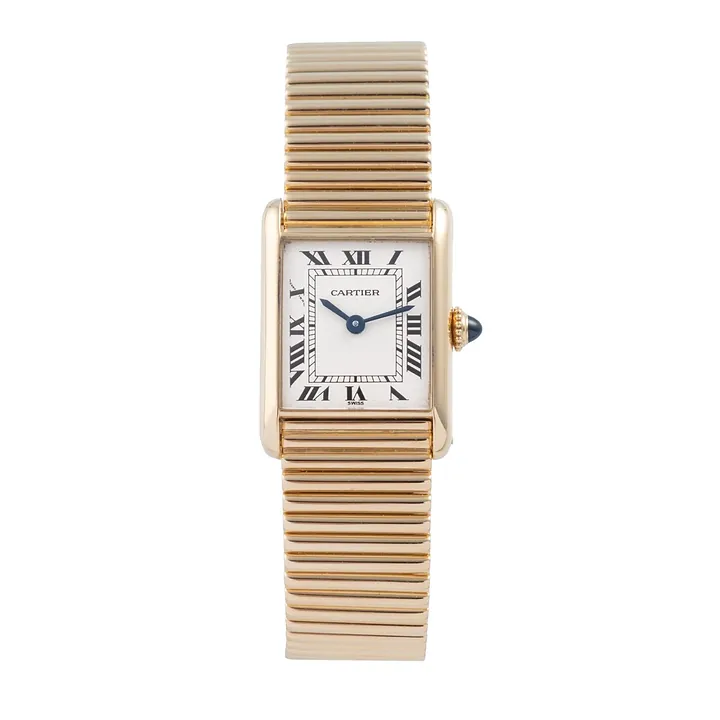
Cartier Tank Louis Cartier, ref. 6711, c. 1990s
Antiquorum auction archive, Geneva