
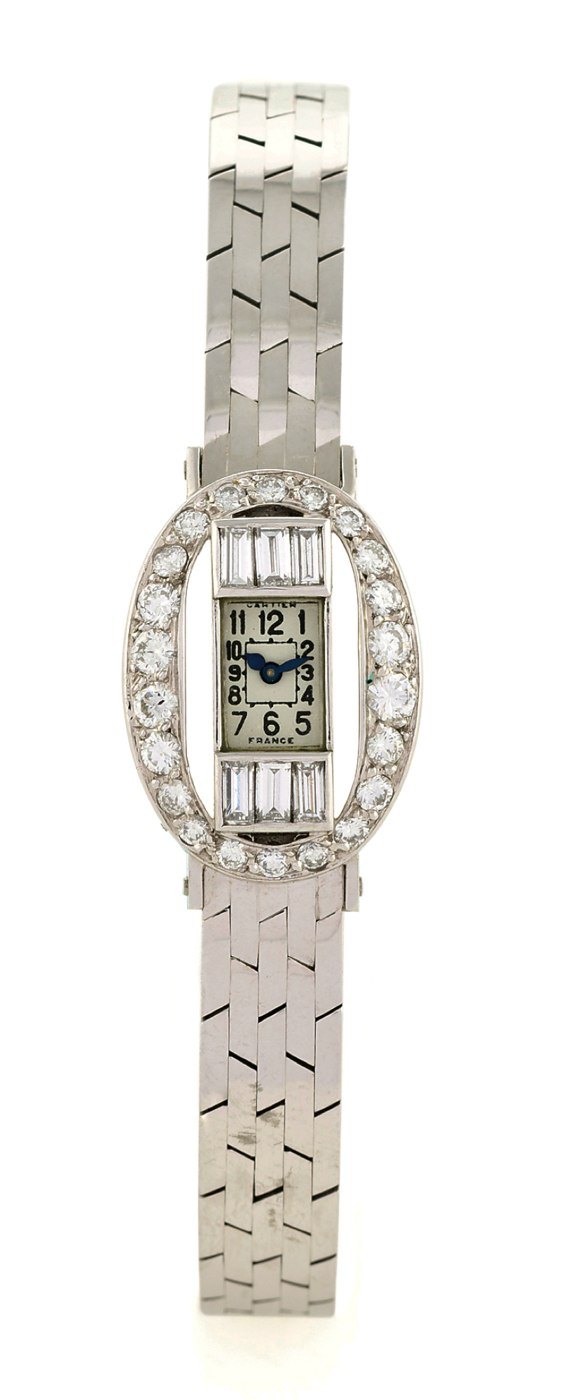
Wristwatches · Baguette wristwatch
Cartier Baguette à mouvement Duoplan Bracelet Watch
- Maker / attribution
- Cartier (source attribution)
- Date
- c. 1940
- Historical period
- Golden Age of Mechanical Watchmaking (1900 – 1945)
- Country of origin
- France
- Object type
- Baguette wristwatch
- Holding institution
- Antiquorum
- Accession / object no.
- 67
- Credit line
- Antiquorum
- Catalogue title (original)
- CARTIER PLATINUM, WHITE GOLD &\nDIAMOND \nBRACELET WATCH - CALIBER 101\nCartier, \"Baguette à mouvement Duoplan\", No. 920287/49104. \nMade circa 1940. \nVery fine and rare, very small and elegant, ov (English)
View the source record ↗ (opens another website in a new tab)Suggest a correction
Record summary
Held and catalogued by Antiquorum (object number 67), this is a baguette wristwatch attributed to Cartier, made in France, dated c. 1940. The Atlas places it in the Golden Age of Mechanical Watchmaking period (1900 – 1945) of its Wristwatches collection. The record is illustrated with 1 photograph.
Assembled from the source record's structured fields. Dates and attributions are given as the source states them; where a field is missing the Atlas leaves it blank rather than estimating.
Catalogue description
Original object description
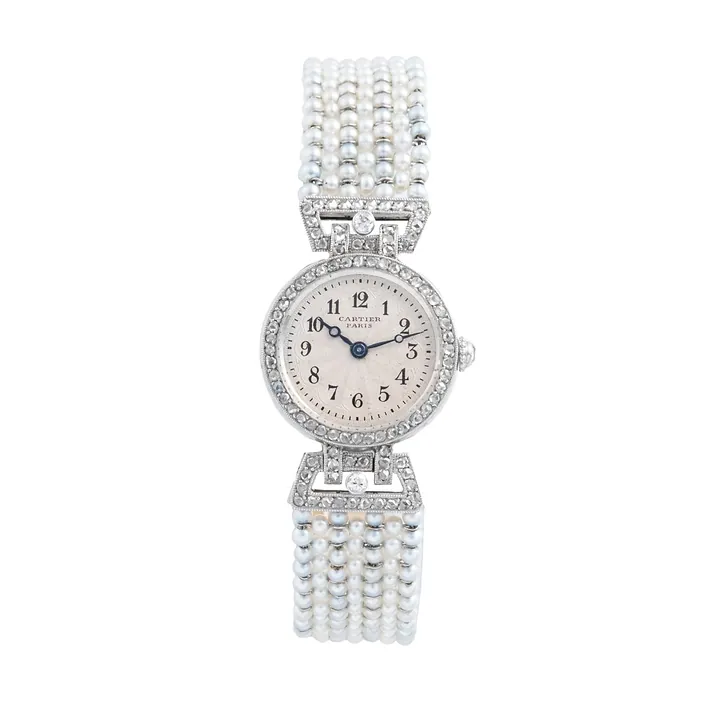
Dating to approximately 1940, this ladies' Cartier Baguette à mouvement Duoplan wristwatch is centered on a two-body, oval platinum case measuring 19.5 by 14 mm with a thickness of 5 mm. Its bezel is bordered by twenty-two graduated circular diamonds, complemented at the upper and lower edges by six baguette-cut diamonds. Two screws retain the case back, which houses a winding crown underneath to preserve a slender silhouette. Attached directly to the case is an 18K white gold tile-link bracelet fitted with a hidden deployant clasp numbered 3789, bringing the overall length to around 150 mm. The white dial displays painted black Arabic numerals tracked by blued steel lozenge hands. Ticking inside is the Calibre 101 baguette movement—designed by Henri Rodanet to compress the gear train into minimal space—featuring rhodium plating and fausses-côtes finishing. This 15-jewel mechanism includes a lateral lever escapement, an index regulator, a blued steel Breguet balance spring, and a cut bimetallic balance adjusted to two positions. Cartier signatures and serial numbers are present on the movement, dial, and case. In addition, the case and clasp are stamped with the "EJ" mark of Edmond Jaeger, highlighting the historic partnership between Cartier and Jaeger-LeCoultre.
Inscriptions & marks
920287/49104
Historical context
Golden Age of Mechanical Watchmaking (1900 – 1945)
The wristwatch displaces the pocket watch; waterproof cases, self-winding and grand complications.
The wristwatch overtook the pocket watch. Military use in the First World War, aviation, water-resistant cases (1926), automatic winding (1923–31), rectangular Art Deco designs and early chronographs and calendars defined the period.
Read the period in the timelineMore wristwatches from this periodEarlier: Industrial Revolution
Atlas type guide
Wristwatches
Bracelet watches were worn by women from the early nineteenth century — Breguet made one for Caroline Murat, Queen of Naples, in 1810–12 — but the wristwatch only became a man's instrument with military use and aviation in the early twentieth century. Between the World Wars it overtook the pocket watch; the 1920s and 1930s brought rectangular Art Deco cases, water-resistant cases and the first automatic winding systems.
After 1945 the wristwatch became a carrier of identity — dress watches, sports and dive watches, chronographs, calendars — produced by Swiss, American, Japanese, German, Soviet and Chinese industries. The quartz revolution after 1969 and the mechanical renaissance since the 1990s, including the rise of independent watchmakers, complete the story.
What to look for
- The reference number (between the lugs or inside the case back) and serial number, the starting point for dating.
- The calibre: its maker and number are often stamped under the dial or on the bridge.
- Originality of dial, hands and crown — refinished ('redial') dials are common.
- Case material marks: 18K/750, 14K/585, stainless steel, gold-filled, plated.
Dating clues
- Wire-lug cases: before c. 1925.
- Water-resistant screw-down cases: from 1926.
- Quartz movements: from 1969; sapphire crystals widespread after c. 1980.
General guidance written by the Atlas editors about this kind of object. It is not a statement about this particular piece; for that, rely on the source record above and on physical examination.
Read next:Identification Centre
Related records
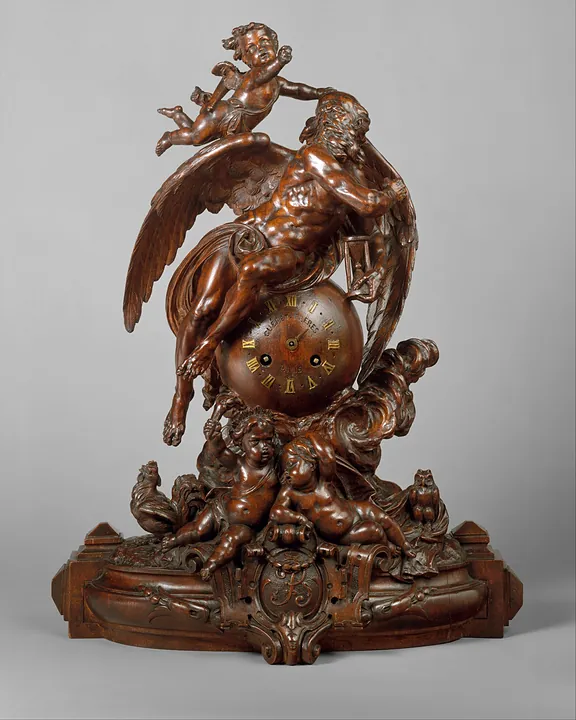
Clocks · 1863
Clock by Albert-Ernest Carrier-Belleuse, France, 1863
The Metropolitan Museum of Art, New York
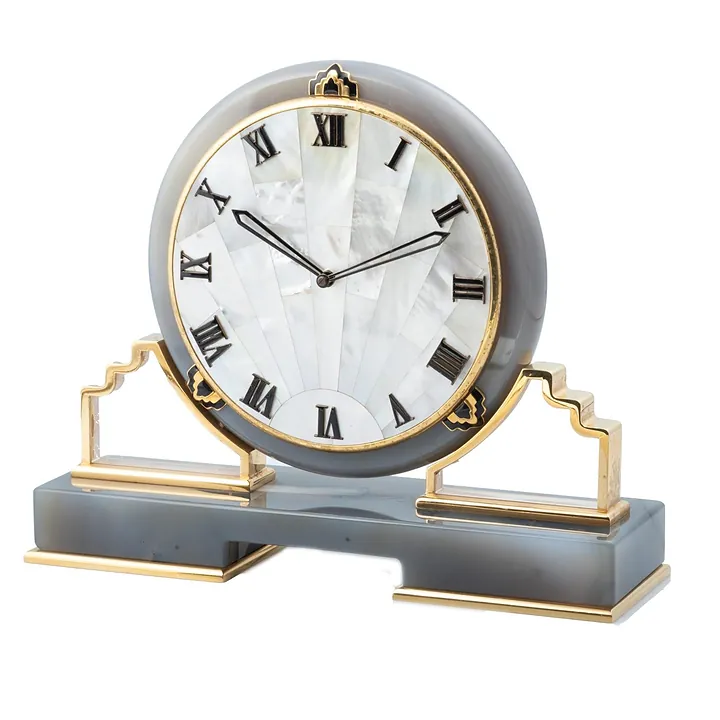
Clocks · c. 1980s
Cartier "art Deco", c. 1980s
Antiquorum auction archive, Geneva
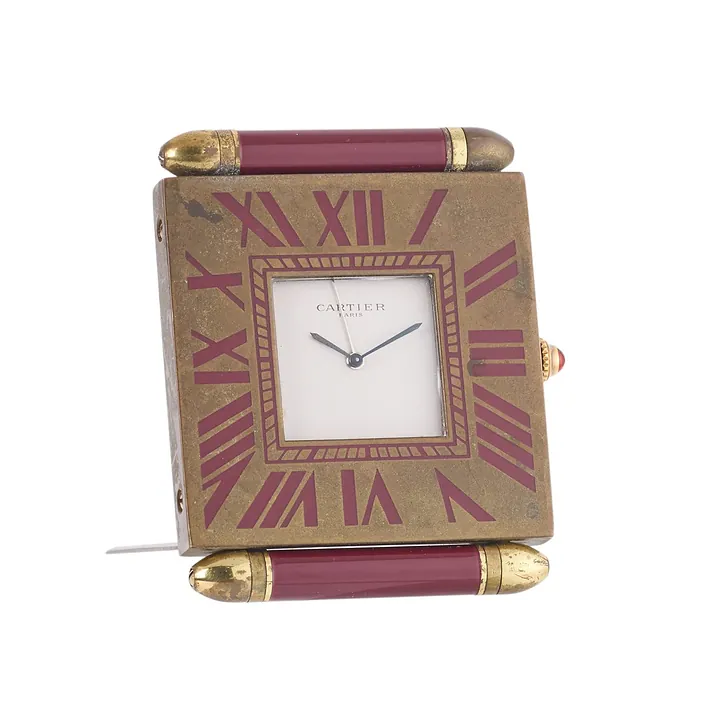
Clocks · c. 2000s
Cartier Desk Clock with Alarm, c. 2000s
Antiquorum auction archive, Geneva
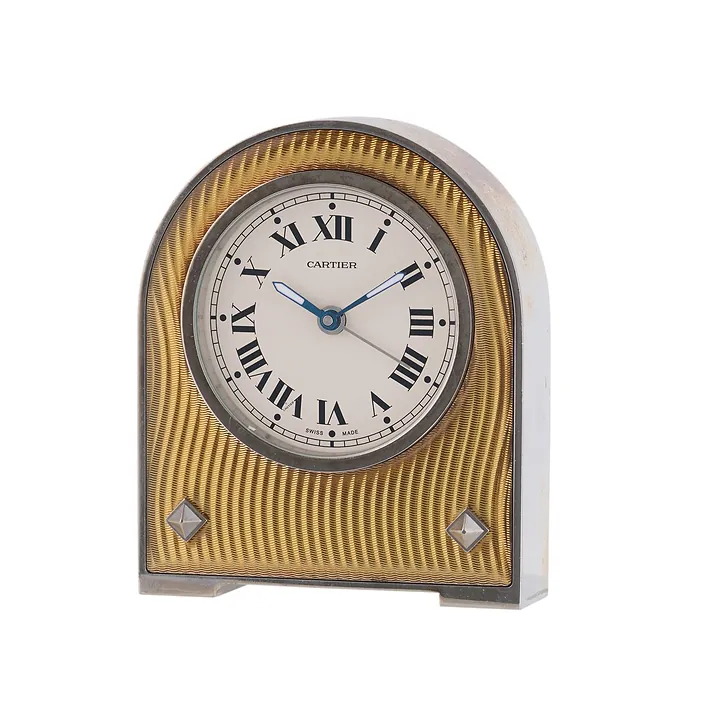
Clocks · c. 2000s
Cartier Lacquer Arched Desk Clock with Alarm, ref. W0100037, c. 2000s
Antiquorum auction archive, Geneva
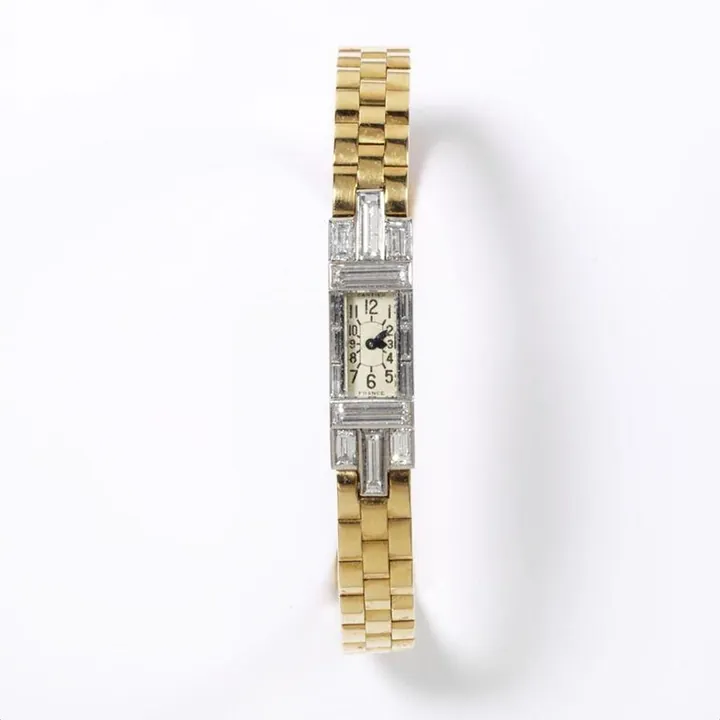
Wristwatches · c. 1936
Watch with diamond-set platinum case and gold link bracelet, Cartier, Paris, c. 1936.
Victoria and Albert Museum, London
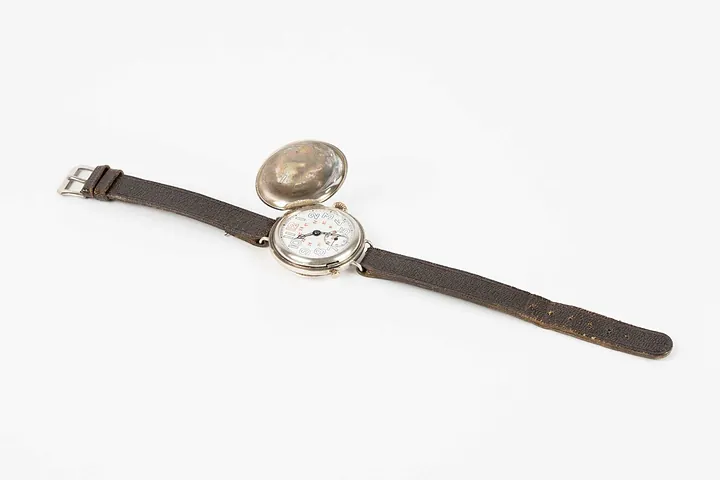
Wristwatches · c. 1920
Wristwatch by dazwischen Schwert J S, France, c. 1920
German Clock Museum
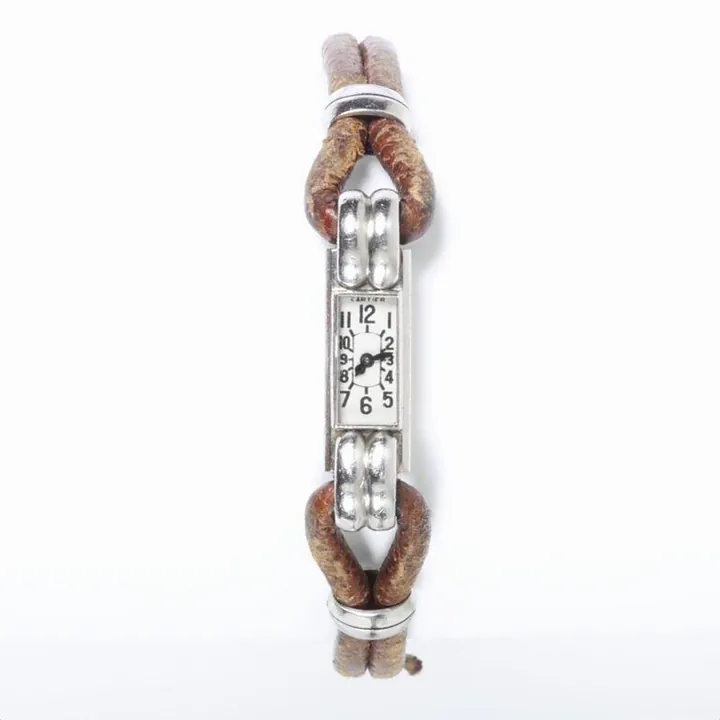
Wristwatches · 1928
Platinum watch with leather strap with gold deployant buckle, Cartier, Paris, mark of Edmond Jaeger, 1928
Victoria and Albert Museum, London
Wristwatches · c. 1930s
Cartier wristwatch, c. 1930s
Antiquorum auction archive, Geneva