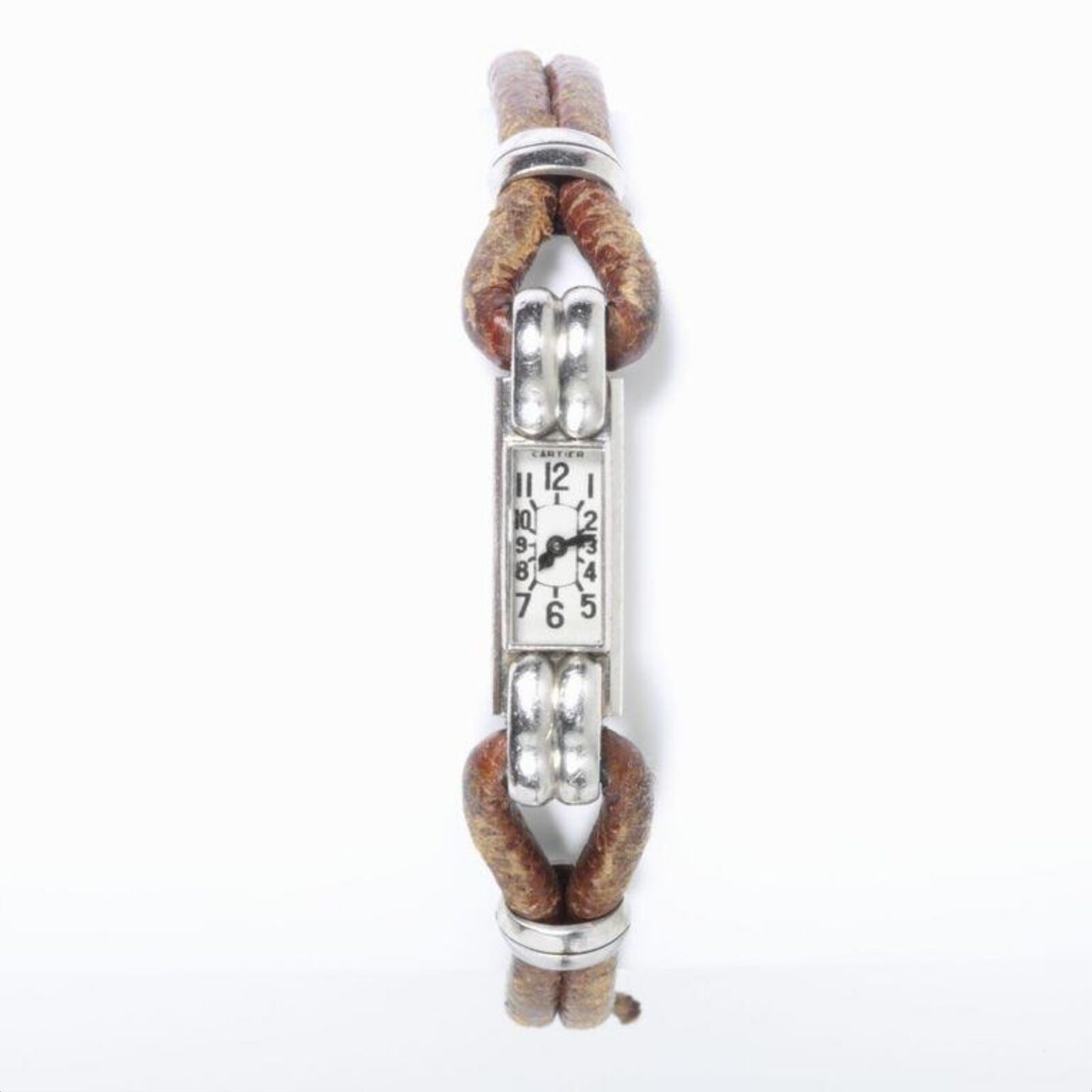
Wristwatches · Wristwatch
Platinum watch with leather strap with gold deployant buckle, Cartier, Paris, mark of Edmond Jaeger, 1928
- Maker / attribution
- Edmond Jaeger (maker); Cartier (retailer)
- Date
- 1928
- Historical period
- Golden Age of Mechanical Watchmaking (1900 – 1945)
- Country of origin
- France
- Place
- Paris
- Object type
- Wristwatch
- Materials / technique
- Platinum; leather with gold
- Dimensions
- Height: 6.7 cm; Width: 1.0 cm; Depth: 4.5 cm
- Holding institution
- Victoria and Albert Museum, London
- Accession / object no.
- M.136-1987
- Credit line
- The Bettine, Lady Abingdon Collection, bequeathed by Mrs T.R.P. Hole
Record summary
Held and catalogued by Victoria and Albert Museum, London (object number M.136-1987), this is a wristwatch by Edmond Jaeger, made in Paris, France, dated 1928. The Atlas places it in the Golden Age of Mechanical Watchmaking period (1900 – 1945) of its Wristwatches collection. Materials and techniques recorded by the source: Platinum; leather with gold. Recorded dimensions: Height: 6.7 cm; Width: 1.0 cm; Depth: 4.5 cm. The record is illustrated with 2 photographs.
Assembled from the source record's structured fields. Dates and attributions are given as the source states them; where a field is missing the Atlas leaves it blank rather than estimating.
Catalogue description
V&A — Summary
This wristwatch was bought by 5th Duke of Sutherland at Cartier, Paris, in 1928, possibly as a wedding present for Bettine Stuart Wortley who married the 8th Earl of Abingdon, 21 August 1928. The wristwatch proved an enduring object of fashion for both sexes. It became a pre-eminent item of male jewellery.
V&A — Physical description
Case: platinum Strap: leather with gold deployant buckle, mark of Edmond Jaeger
V&A — Object history
Bought by 5th Duke of Sutherland at Cartier, Paris, possibly as a wedding present for Bettine Stuart Wortley who married the 8th Earl of Abingdon, 21 August 1928.
Inscriptions & marks
mark of Edmond Jaeger; 'CARTIER'; Paris mark registered in 1908; French gold mark for 1919 ( third standard) and mark for Jaeger
Historical context
Golden Age of Mechanical Watchmaking (1900 – 1945)
The wristwatch displaces the pocket watch; waterproof cases, self-winding and grand complications.
The wristwatch overtook the pocket watch. Military use in the First World War, aviation, water-resistant cases (1926), automatic winding (1923–31), rectangular Art Deco designs and early chronographs and calendars defined the period.
Read the period in the timelineMore wristwatches from this periodEarlier: Industrial Revolution
Atlas type guide
Wristwatches
Bracelet watches were worn by women from the early nineteenth century — Breguet made one for Caroline Murat, Queen of Naples, in 1810–12 — but the wristwatch only became a man's instrument with military use and aviation in the early twentieth century. Between the World Wars it overtook the pocket watch; the 1920s and 1930s brought rectangular Art Deco cases, water-resistant cases and the first automatic winding systems.
After 1945 the wristwatch became a carrier of identity — dress watches, sports and dive watches, chronographs, calendars — produced by Swiss, American, Japanese, German, Soviet and Chinese industries. The quartz revolution after 1969 and the mechanical renaissance since the 1990s, including the rise of independent watchmakers, complete the story.
What to look for
- The reference number (between the lugs or inside the case back) and serial number, the starting point for dating.
- The calibre: its maker and number are often stamped under the dial or on the bridge.
- Originality of dial, hands and crown — refinished ('redial') dials are common.
- Case material marks: 18K/750, 14K/585, stainless steel, gold-filled, plated.
Dating clues
- Wire-lug cases: before c. 1925.
- Water-resistant screw-down cases: from 1926.
- Quartz movements: from 1969; sapphire crystals widespread after c. 1980.
General guidance written by the Atlas editors about this kind of object. It is not a statement about this particular piece; for that, rely on the source record above and on physical examination.
Related records
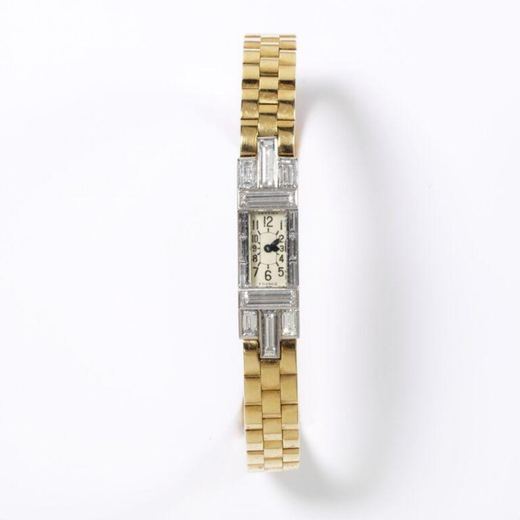
Pocket Watches · ca. 1936
Watch with diamond-set platinum case and gold link bracelet, Cartier, Paris, ca. 1936.
Victoria and Albert Museum, London
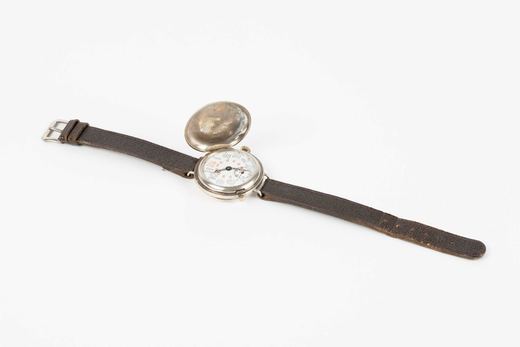
Wristwatches · 1920
Wristwatch by dazwischen Schwert J S, France, 1920
German Clock Museum
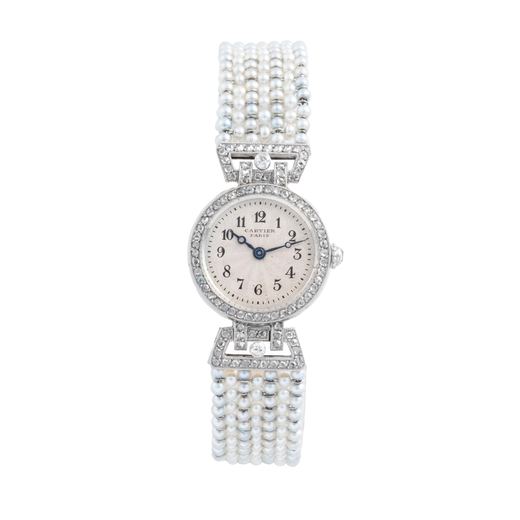
Wristwatches · circa 1930's
Cartier wristwatch, circa 1930's
Antiquorum auction archive, Geneva
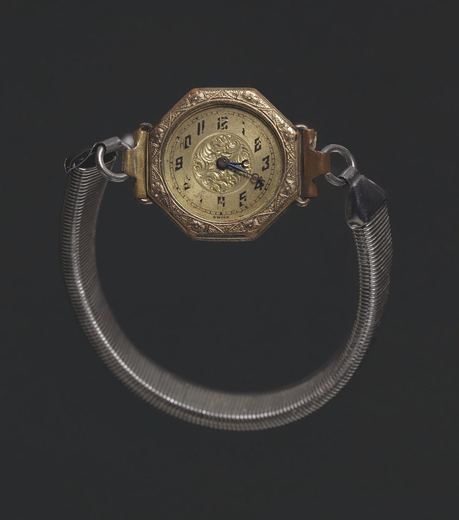
Wristwatches · early to mid 20th century
Wrist watches by Unidentified, United States, early to mid 20th century
National Museum of African American History and Culture, Smithsonian Institution, Washington DC
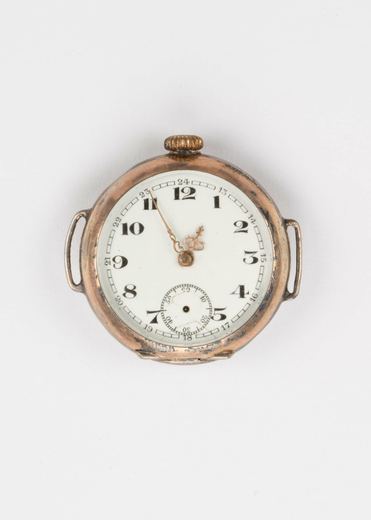
Wristwatches · 1900
Wristwatch, Switzerland, 1900 (German Clock Museum Museu_ProvidedCHO_museum_digital_57124__technical_number_)
German Clock Museum
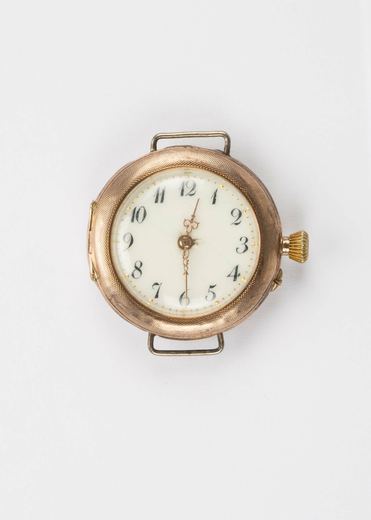
Wristwatches · 1900
Wristwatch, Switzerland, 1900 (German Clock Museum Museu_ProvidedCHO_museum_digital_57216__technical_number_)
German Clock Museum
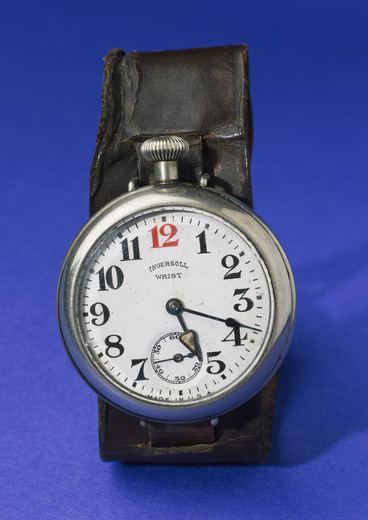
Wristwatches · 1915
"Ingersoll" wrist watch with leather strap, pin pallet escapement and luminous hour hand, 1915
Science Museum Group, London
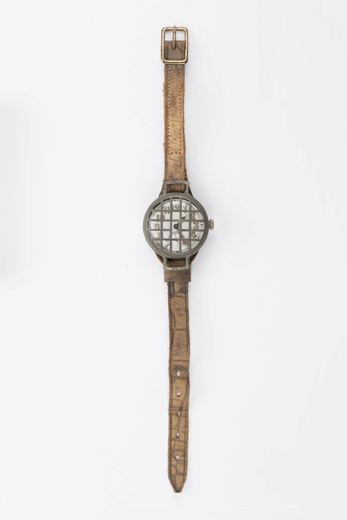
Wristwatches · 1915
Wristwatch by S.S.und Co., Stauffer, Son und Co., Switzerland, 1915
German Clock Museum