
Wristwatches · Wristwatch
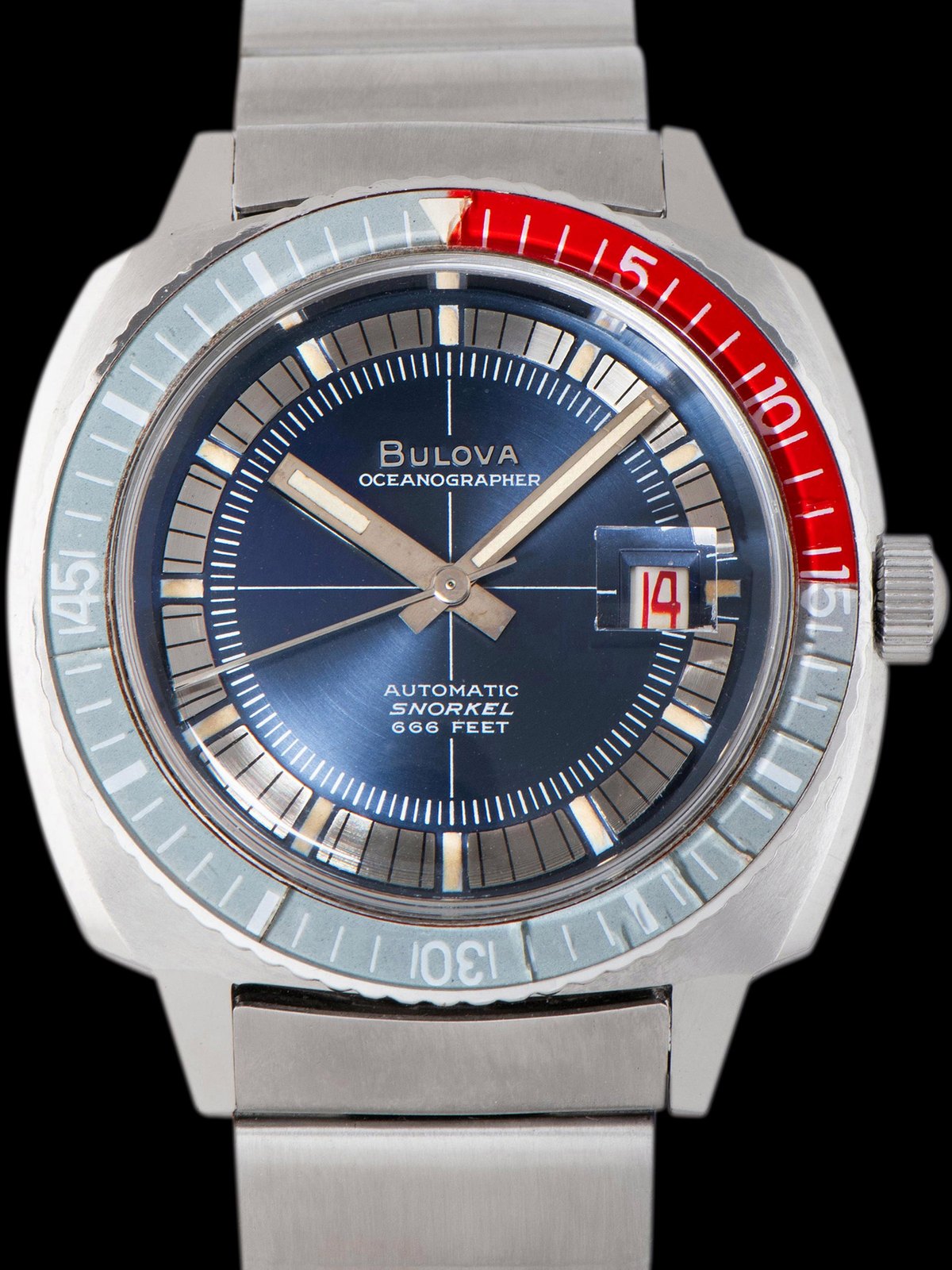
Bulova Oceanographer Snorkel "M" (Ref. 2969), 1969
- Maker / attribution
- Bulova (maker)
- Date
- 1969
- Historical period
- Quartz Revolution (1969 – 1990)
- Country of origin
- United States
- Object type
- Wristwatch
- Stock no.
- BLVOS-3
- Credit line
- Dealer listing, Craft & Tailored (BLVOS-3)
- Catalogue title (original)
- 1969 Bulova Oceanographer Snorkel "M" (Ref. 2969) (English)
View the source record (dealer listing) ↗ (opens another website in a new tab)Suggest a correction
Record summary
Catalogued by Craft & Tailored (dealer), Los Angeles (stock number BLVOS-3), this is a wristwatch by Bulova, made in United States, dated 1969. The Atlas places it in the Quartz Revolution period (1969 – 1990) of its Wristwatches collection. The record is illustrated with 6 photographs.
Assembled from the source record's structured fields. Dates and attributions are given as the source states them; where a field is missing the Atlas leaves it blank rather than estimating.
Catalogue description
Dealer description — Craft & Tailored
The vintage Bulova resurgence is well deserved. Throughout the 1960s and ’70s, Bulova produced some of the most distinctive and unconventional tool watches of the era, ranging from vibrant dive chronographs to forward-thinking designs like the Bulova Accutron, all of which continue to captivate collectors today. Diving watches were no exception. Bulova’s Oceanographer line earned a loyal following, with many models carrying the now-iconic “Devil Diver” nickname, a nod to their 666ft depth rating. Beyond the spec sheet, these watches stood out for their bold color palettes, playful design language, and unmistakable presence on the wrist. The 1969 Bulova Oceanographer Snorkel “M” ref. 2969 is a perfect representation of that ethos; robust, highly legible, and full of character. Marketed as a capable companion for underwater exploration yet versatile enough for everyday wear, it strikes a balance between function and personality that defines vintage Bulova at its best. SPECS Stock # BLVOS-3 Brand Bulova Style Oceanographer Snorkel "M" Model 2969 Serial K2XXXX Size Men's Material Stainless Steel Dial Matte Black Millimeters 39 Bracelet Bulova "Kriesler" Bracelet CASE & BRACELET The excellent cushion-style case retains strong angles and dimensions throughout, featuring minimal wear with no notable evidence or prior polishing present. The bakelite blue and red "Pepsi" bezel is in wonderful condition, though the blue color has faded to a lighter, more gray color, and there is some cracking present, which is expected for the material and the age of the watch. The Bulova signed crown is original. The case back displays all of its original factory engravings. The watch comes supplied on its original Bulova bracelet made by Kreisler. The bracelet retains 15 links that show no notable stretch and will fit up to a 7.75-inch wrist. DIAL & HANDS The metallic blue and silver two-tone "crosshair" dial is a complex combination to execute, and the result is a beautiful design, especially when preserved as impeccably as the example presented here. The dial is in virtually perfect vintage condition, exhibiting no damage or notable elements of age. The tritium lume plots and original tritium hands feature a matching creamy patina and neither exhibits degradation when inspected under UV light. ACCESSORIES None. The watch is keeping time, but the service history is unknown. A movement service can be purchased upon request.
Historical context
Quartz Revolution (1969 – 1990)
Seiko's Astron begins mass quartz timekeeping; traditional industries contract sharply.
Quartz and digital watches transformed the market after 1969. Swiss employment collapsed, Japanese and Hong Kong production soared, and the Swatch (1983) helped the Swiss industry recover; mechanical watches survived as luxury goods.
Read the period in the timelineMore wristwatches from this periodEarlier: Modern Mechanical Horology
Atlas type guide
Wristwatches
Bracelet watches were worn by women from the early nineteenth century — Breguet made one for Caroline Murat, Queen of Naples, in 1810–12 — but the wristwatch only became a man's instrument with military use and aviation in the early twentieth century. Between the World Wars it overtook the pocket watch; the 1920s and 1930s brought rectangular Art Deco cases, water-resistant cases and the first automatic winding systems.
After 1945 the wristwatch became a carrier of identity — dress watches, sports and dive watches, chronographs, calendars — produced by Swiss, American, Japanese, German, Soviet and Chinese industries. The quartz revolution after 1969 and the mechanical renaissance since the 1990s, including the rise of independent watchmakers, complete the story.
What to look for
- The reference number (between the lugs or inside the case back) and serial number, the starting point for dating.
- The calibre: its maker and number are often stamped under the dial or on the bridge.
- Originality of dial, hands and crown — refinished ('redial') dials are common.
- Case material marks: 18K/750, 14K/585, stainless steel, gold-filled, plated.
Dating clues
- Wire-lug cases: before c. 1925.
- Water-resistant screw-down cases: from 1926.
- Quartz movements: from 1969; sapphire crystals widespread after c. 1980.
General guidance written by the Atlas editors about this kind of object. It is not a statement about this particular piece; for that, rely on the source record above and on physical examination.
Related records
Wristwatches · c. 1969
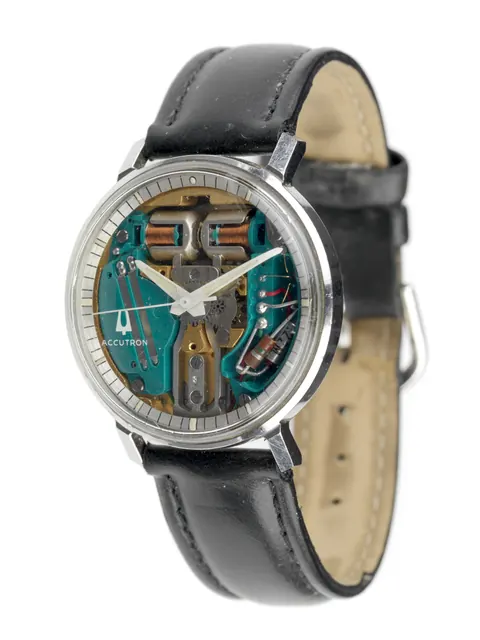
Bulova 'Accutron' tuning-fork wristwatch by Bulova
Royal Museums Greenwich
Wristwatches · c. 1965
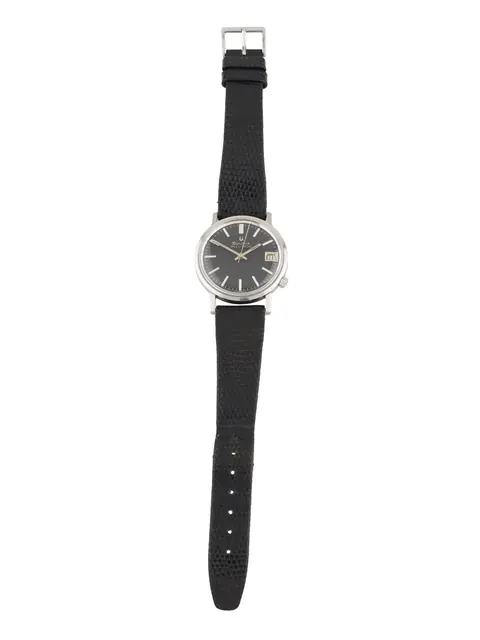
Wristwatch Accutron by Knud Geelmuyden Bull
Royal Museums Greenwich
Clocks · c. 1960s
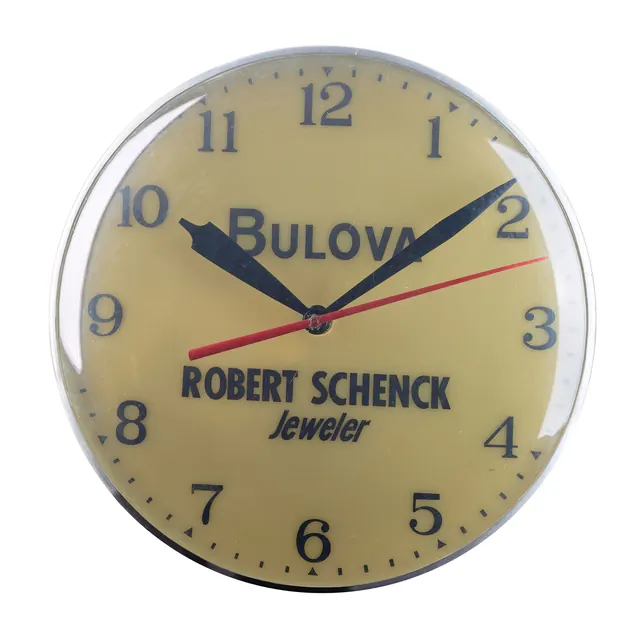
Bulova wall clock, Lighted Advertising Wall Clock for Robert Schenck Jeweler, circa 1960s
Antiquorum auction archive, Geneva
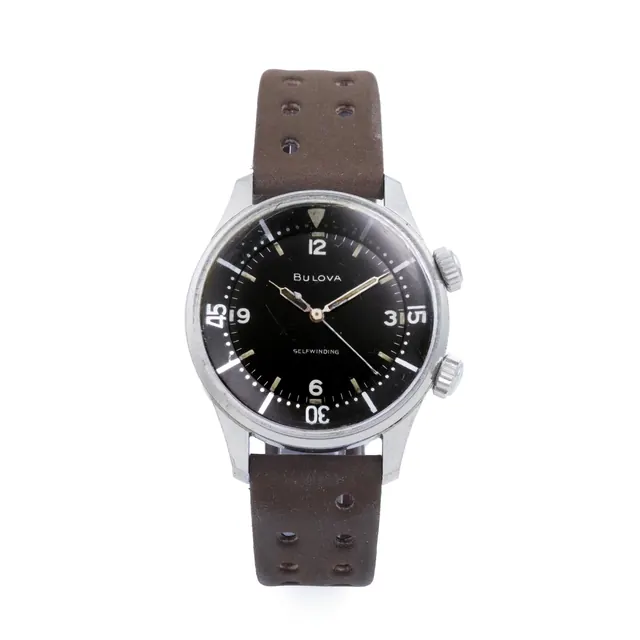
Wristwatches · 1963
Bulova wristwatch, ref. 314, Diver Super Compressor, 1963
Antiquorum auction archive, Geneva
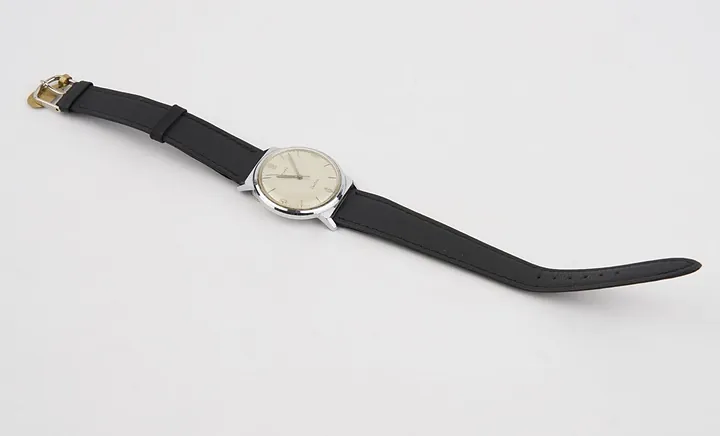
Wristwatches · 1949–1992
Timex `Electric' wristwatch, with electrically operated balance wheel mechanism, United States, 1949–1992
Science Museum Group, London
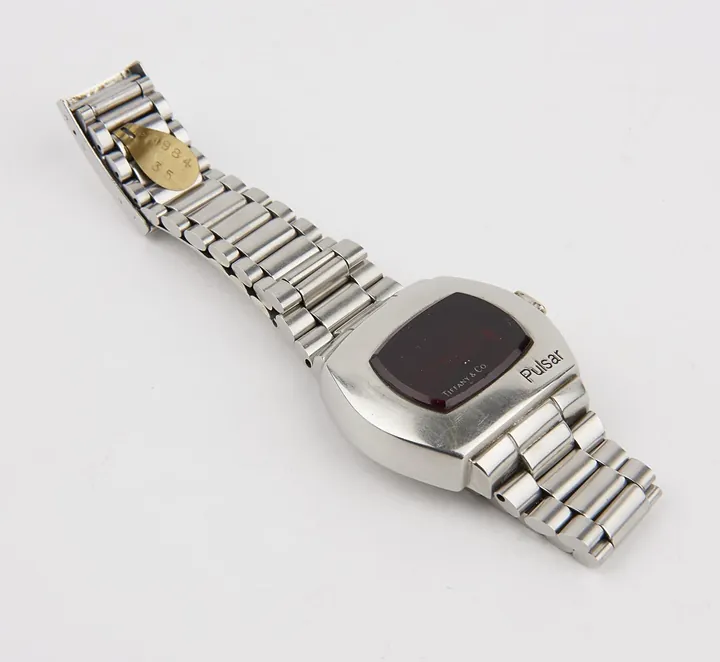
Wristwatches · 1972
Wristwatch by Hamilton Watch Company and Electro-Data Inc, United States, 1972
Science Museum Group, London
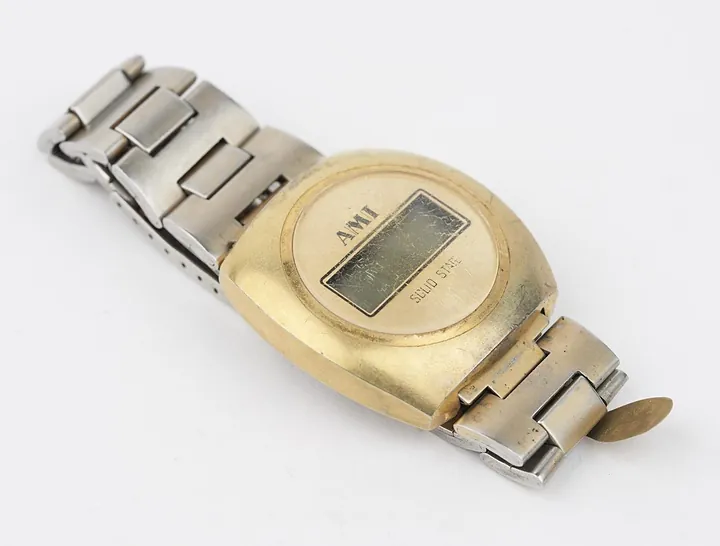
Wristwatches · 1973–1974
Quartz watch with liquid crystal digital display, made by American Microsystems Inc. (AMI) . 1973/74
Science Museum Group, London
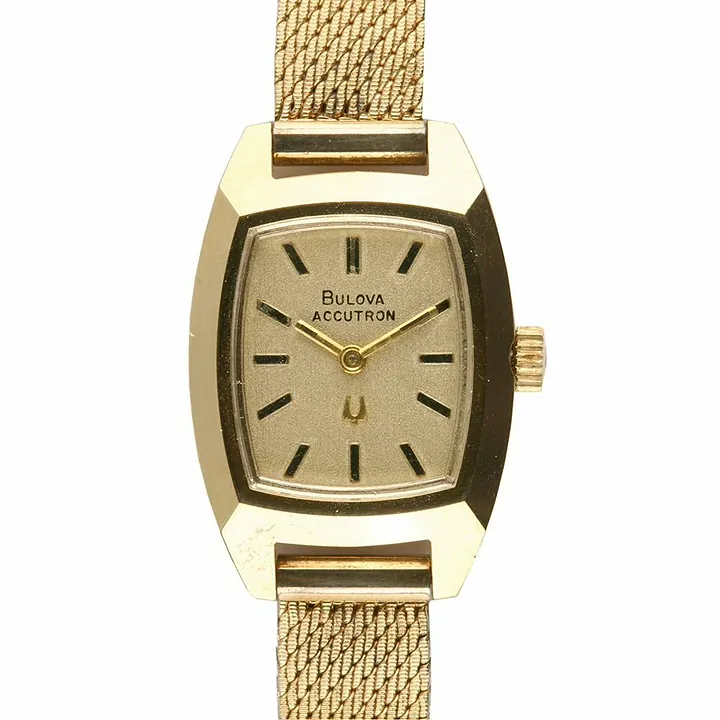
Wristwatches · c. 1973
Wristwatch by Josef Bulova, United States, c. 1973
German Clock Museum