
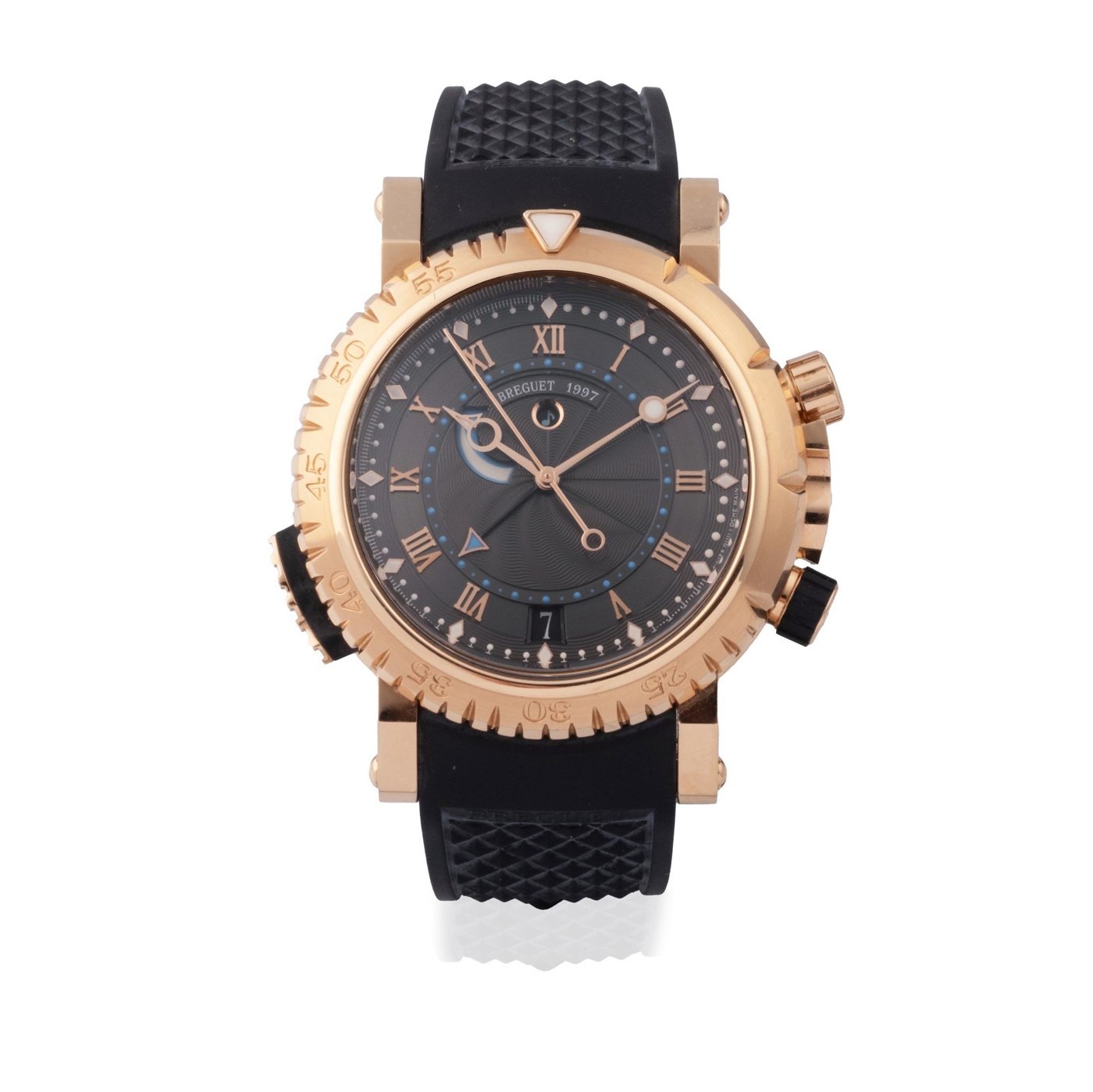
Wristwatches · Alarm wristwatch
Breguet Marine Royale Alarme Reference 5847 BR
- Maker / attribution
- Breguet (source attribution)
- Date
- c. 2021
- Historical period
- Contemporary Horology (2010 – Present)
- Country of origin
- Switzerland
- Object type
- Alarm wristwatch
- Materials / technique
- 18k pink gold
- Dimensions
- 45 mm
- Holding institution
- Antiquorum
- Accession / object no.
- 205
- Credit line
- Antiquorum
- Catalogue title (original)
- BREGUET, SWITZERLAND, REF. 5847 BR S2 5ZV, MARINE ROYALE ALARME, ORIGINAL BOX AND WARRANTY, 18K PINK GOLD (English)
View the source record ↗ (opens another website in a new tab)Suggest a correction
Record summary
Held and catalogued by Antiquorum (object number 205), this is an alarm wristwatch attributed to Breguet, made in Switzerland, dated c. 2021. The Atlas places it in the Contemporary Horology period (2010 – Present) of its Wristwatches collection. Materials and techniques recorded by the source: 18k pink gold. Recorded dimensions: 45 mm. The record is illustrated with 1 photograph.
Assembled from the source record's structured fields. Dates and attributions are given as the source states them; where a field is missing the Atlas leaves it blank rather than estimating.
Catalogue description
Original object description
Manufactured in Switzerland around 2021 and sourced from a Swiss private collection, this Breguet Marine Royale Alarme (reference 5847 BR S2 5ZV) features a 45 mm case constructed from 18k pink gold. The case is detailed with external alarm pushers, crown guards, and a unidirectional 60-minute dive bezel bearing a luminescent pip at the zero position. Its dark guilloché dial presents applied Roman numerals, a date aperture at 6 o'clock, and a power reserve sector for the alarm mechanism between 9 and 12 o'clock. Driven by the 36-jewel automatic caliber 519R, the watch incorporates signatures on the movement, dial, and case. It is paired with a black rubber strap secured by an 18k pink gold folding clasp, and includes its factory box, instruction booklet, and certificate of origin. Condition reports cite slight superficial marks on the case and suggest a mechanical overhaul.
Inscriptions & marks
1997 AS
Historical context
Contemporary Horology (2010 – Present)
Silicon components, connected watches, optical-lattice research clocks and a thriving independent scene.
Smartwatches became the world's best-selling watches, while mechanical watchmaking focuses on craft, innovation (silicon components, new escapements) and independent makers.
Read the period in the timelineMore wristwatches from this periodEarlier: Mechanical Renaissance
Atlas type guide
Dive and water-resistant watches
Keeping water and dust out of a wristwatch was a long-standing challenge. Rolex's screw-down Oyster case (1926) and Omega's Marine (1932) were landmarks; in the early 1950s Blancpain's Fifty Fathoms and Rolex's Submariner defined the professional dive watch with rotating bezels for timing dives, luminous dials and high water resistance. The ISO 6425 standard (1982) later codified what a 'diver's watch' must do.
Dive watches became icons of post-war design and exploration, and their evolution — helium escape valves, ceramic bezels, saturation-diving depth ratings — records the history of underwater work.
What to look for
- Unidirectional or bidirectional rotating bezel with minute markings.
- Screw-down crown and case back; depth rating printed on the dial.
- Luminous hands and markers (radium before c. 1960, tritium c. 1960–1998, then Super-LumiNova).
- Reference numbers on the case between the lugs or inside the back.
Dating clues
- Screw-down Oyster cases: from 1926.
- Professional dive watches: from 1953.
- Tritium 'T' marks on dials: c. 1960–1998.
General guidance written by the Atlas editors about this kind of object. It is not a statement about this particular piece; for that, rely on the source record above and on physical examination.
Related records
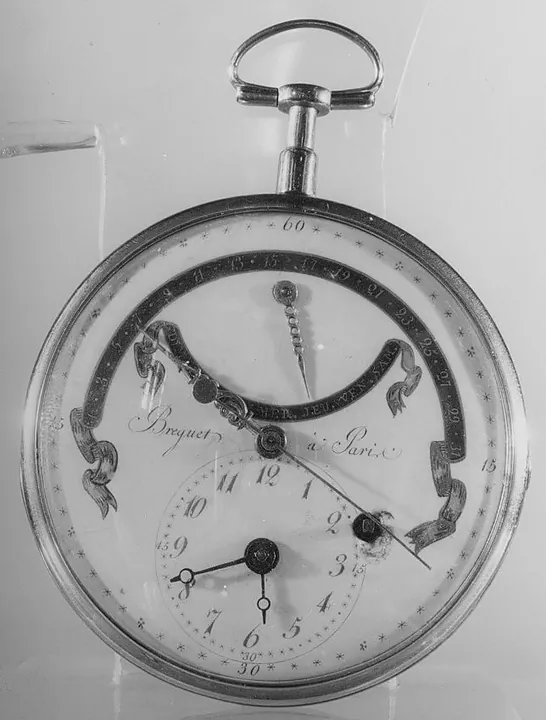
Pocket Watches · 1700–1799
Pocket watch by Breguet, Belgium, 1700–1799
Royal Institute for Cultural Heritage
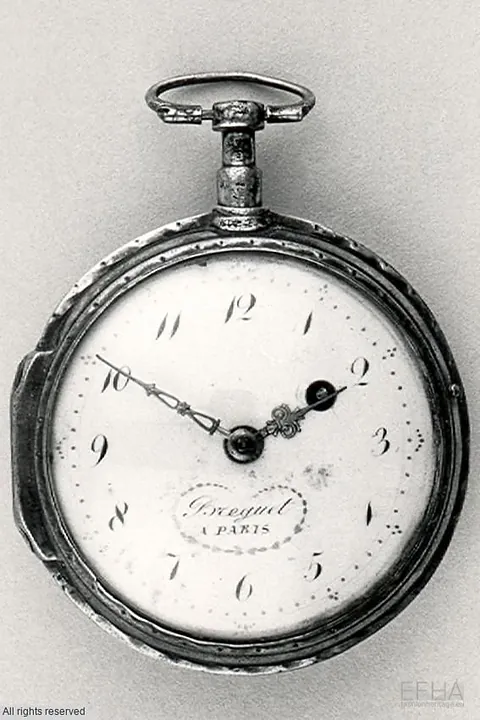
Pocket Watches · 1700–1799
Pocket watch by Breguet, France, 1700–1799
Fashion Museum of Antwerp
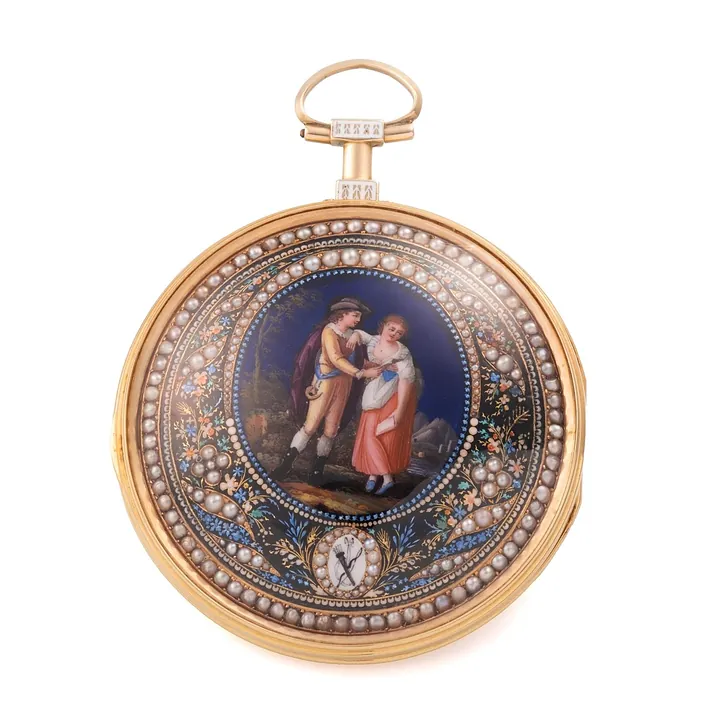
Pocket Watches · c. 1790
Breguet Love Letter, c. 1790
Antiquorum auction archive, Geneva
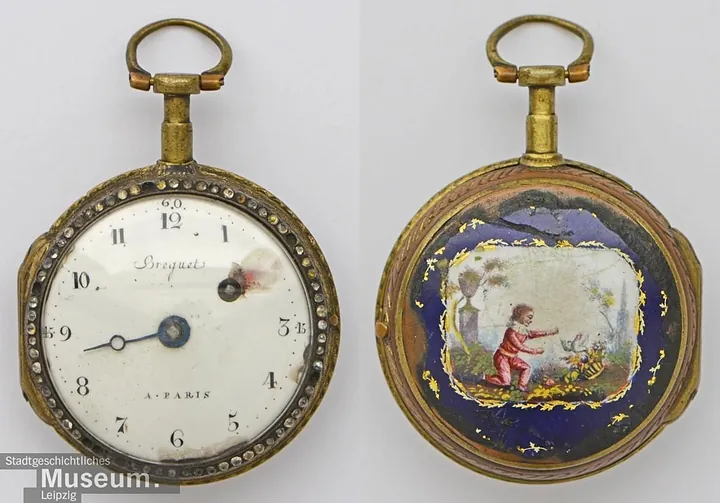
Pocket Watches · 1790
Pocket watch possibly by Breguet, France, 1790
Museum of City History Leipzig

Wristwatches · c. 2010s
Breguet Type XXI, ref. 3810, c. 2010s (Antiquorum Lot 381-24)
Antiquorum auction archive, Geneva

Wristwatches · c. 2010s
Breguet Type XXI, ref. 3810, c. 2010s (Antiquorum Lot 386-229)
Antiquorum auction archive, Geneva

Wristwatches · Sold in September 2010
Breitling Cosmonaute, ref. A 22322, Sold in September 2010
Antiquorum auction archive, Geneva

Wristwatches · c. 2010
Corum Bubble Chrono, ref. 396.150.20, c. 2010
Antiquorum auction archive, Geneva