
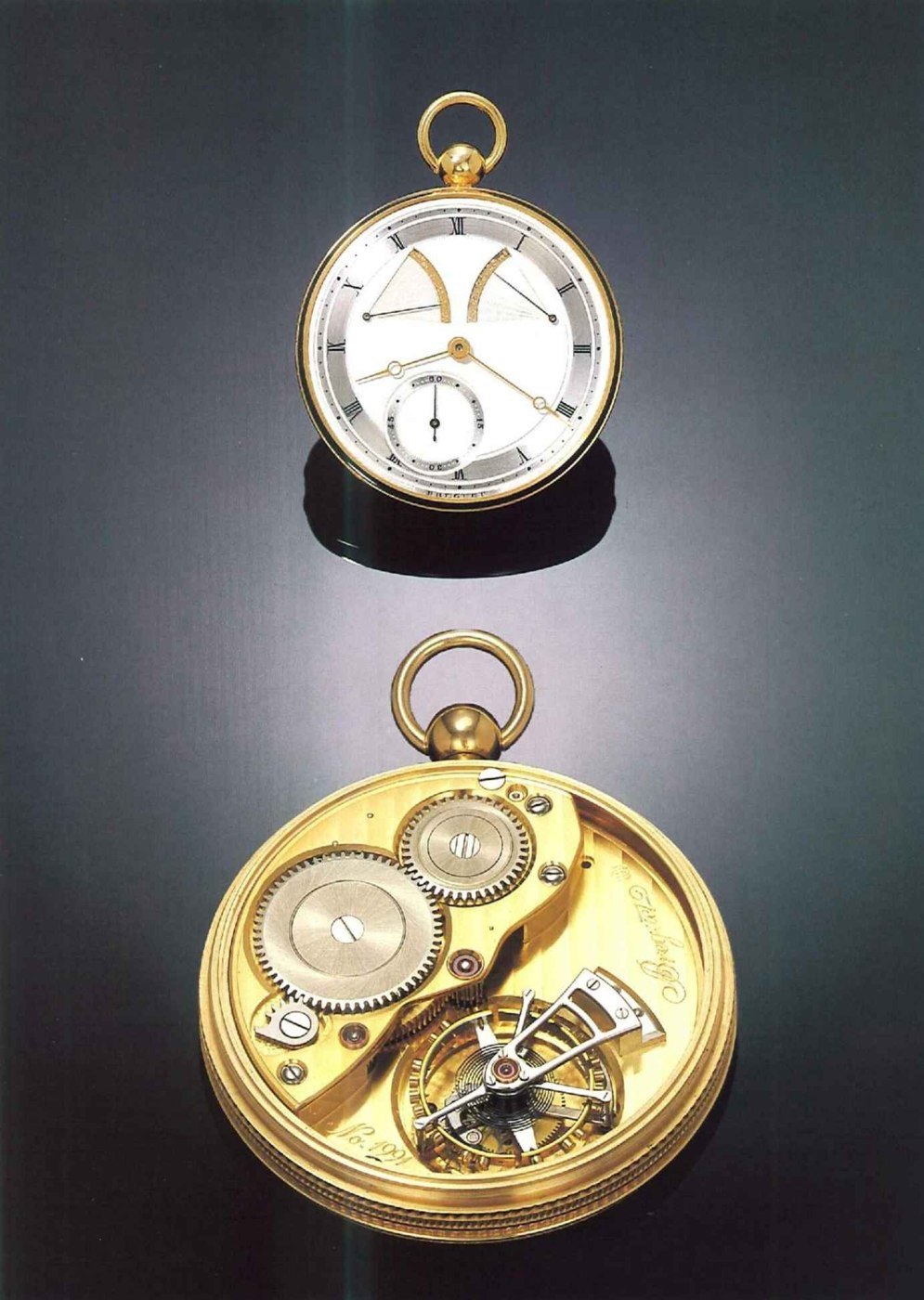
Pocket Watches · Tourbillon pocket chronometer
Breguet Exhibition Tourbillon Watch No. 1991
- Maker / attribution
- Breguet (source attribution)
- Date
- 1986
- Historical period
- Quartz Revolution (1969 – 1990)
- Country of origin
- Switzerland
- Place
- Geneva
- Object type
- Tourbillon pocket chronometer
- Materials / technique
- 18ct gold
- Holding institution
- Antiquorum
- Accession / object no.
- 183
- Credit line
- Antiquorum
- Catalogue title (original)
- An Exhibition Tourbillon\nWatch No. 1991, specially made for the Breguet\nexhibitions in London, Geneva, Paris, New York,\nBrussels and Zurich in 1986.\nGold keyless pocket chronometer with one\nminut (English)
View the source record ↗ (opens another website in a new tab)Suggest a correction
Record summary
Held and catalogued by Antiquorum (object number 183), this is a tourbillon pocket chronometer attributed to Breguet, made in Geneva, Switzerland, dated 1986. The Atlas places it in the Quartz Revolution period (1969 – 1990) of its Pocket Watches collection. Materials and techniques recorded by the source: 18ct gold. The record is illustrated with 1 photograph.
Assembled from the source record's structured fields. Dates and attributions are given as the source states them; where a field is missing the Atlas leaves it blank rather than estimating.
Catalogue description
Original object description
Retaining its pristine exhibition condition, this 56 mm keyless pocket chronometer housing caliber number 1991 was fabricated for Breguet's 1986 traveling showcase presented in London, Geneva, Paris, New York, Brussels, and Zurich. It is encased in an 18-karat gold, three-piece "bassine et filets" frame highlighted by a glazed back, a pendant winding crown, a reeded case band, and fine "vannerie" basket-weave guilloché. The engine-turned silver dial features blued Roman numerals upon a polished chapter ring, gold Breguet hands, a lower running seconds track, and applied gold sectors indicating a centigrade thermometer alongside a 48-hour power reserve. Driven directly by the minute wheel, the polished three-arm steel tourbillon carriage revolves once per minute within a 22-ligne, 19-jewel gilt-brass half-plate caliber finished with fausses côtes. Inscribed by Breguet and bearing the stamp of T. Engel, the mechanism employs a side lever escapement, a bimetallic split balance, and a free-sprung blued-steel overcoil balance spring with terminal curves.
Inscriptions & marks
1991
Historical context
Quartz Revolution (1969 – 1990)
Seiko's Astron begins mass quartz timekeeping; traditional industries contract sharply.
Quartz pocket watches and inexpensive novelty watches appeared, while traditional mechanical pocket watches survived mainly as collectibles and gifts.
Read the period in the timelineMore pocket watches from this periodEarlier: Modern Mechanical Horology
Atlas type guide
Pocket chronometers and precision watches
A pocket chronometer is a watch built to observatory standards, traditionally with a detent escapement like a marine chronometer. English makers such as John Arnold and Thomas Earnshaw made the first pocket chronometers in the 1780s. In the nineteenth century the term increasingly referred to any watch that had passed official rating trials at observatories in Kew, Neuchâtel, Geneva or Besançon, and the Swiss lever chronometer became dominant.
Tourbillon and karrusel watches belong to the same world of precision. Breguet patented the tourbillon in 1801 to average out positional errors; Bahne Bonniksen's karrusel (1892) was a cheaper English alternative. Rating certificates (bulletins de marche) that accompany such watches are historical documents in their own right.
What to look for
- Detent escapement (no pallets; a fine spring detent locks the escape wheel).
- Observatory certificates, competition results or 'Chronometer' marking on the dial.
- Tourbillon carriage visible through an aperture or on the movement.
- Fine finishing: jewelled holes in gold chatons, diamond endstones.
Dating clues
- English pocket chronometers: c. 1780–1900.
- Observatory trials at Neuchâtel from 1866, Geneva from 1873, Kew from 1884.
- Karrusels: 1892–c. 1915.
General guidance written by the Atlas editors about this kind of object. It is not a statement about this particular piece; for that, rely on the source record above and on physical examination.
Read next:Spring detent (chronometer) escapement
Related records
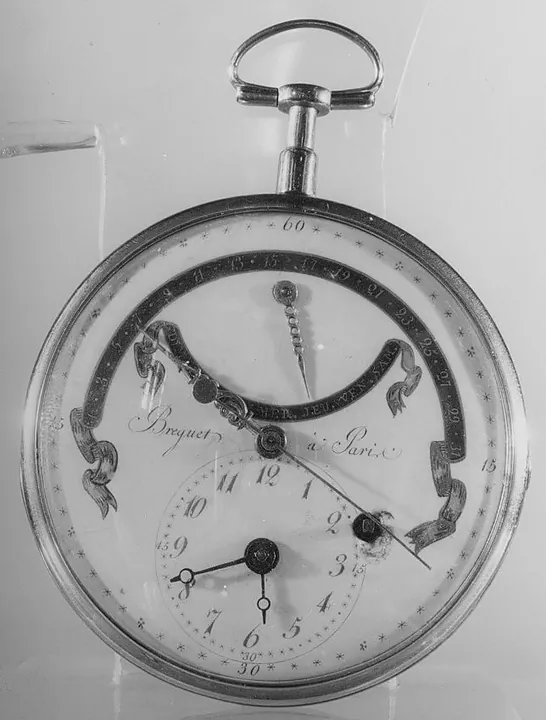
Pocket Watches · 1700–1799
Pocket watch by Breguet, Belgium, 1700–1799
Royal Institute for Cultural Heritage
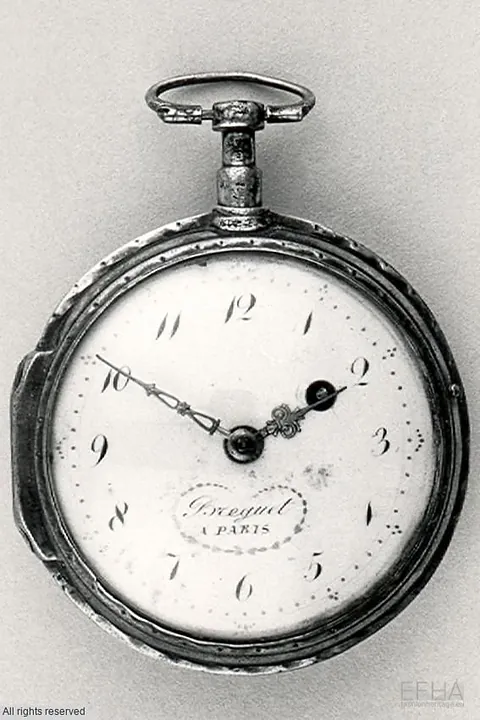
Pocket Watches · 1700–1799
Pocket watch by Breguet, France, 1700–1799
Fashion Museum of Antwerp
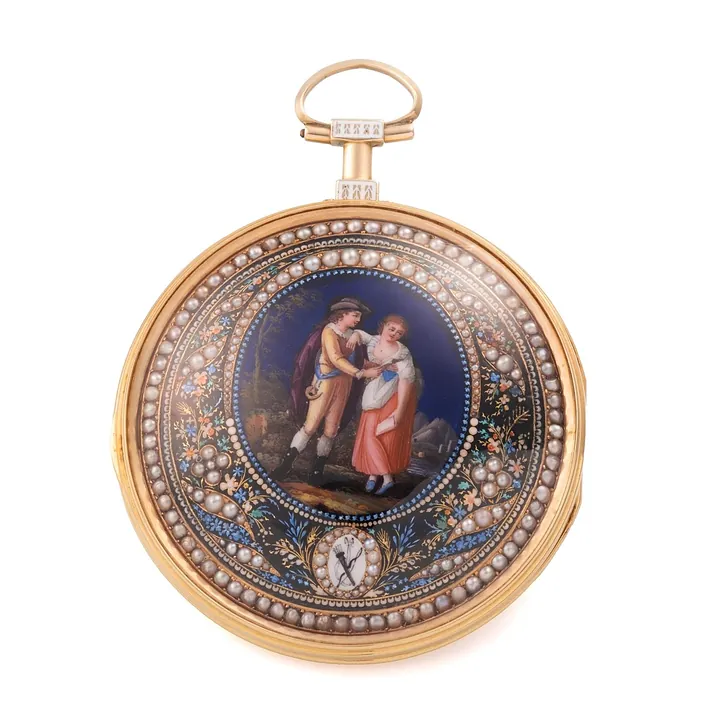
Pocket Watches · c. 1790
Breguet Love Letter, c. 1790
Antiquorum auction archive, Geneva
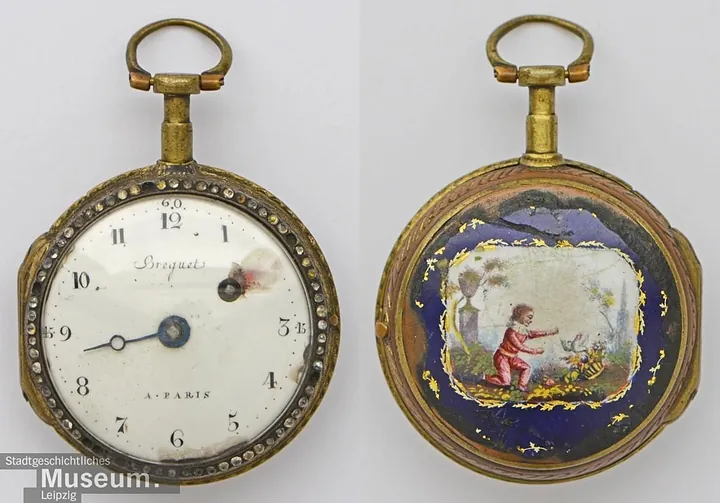
Pocket Watches · 1790
Pocket watch possibly by Breguet, France, 1790
Museum of City History Leipzig
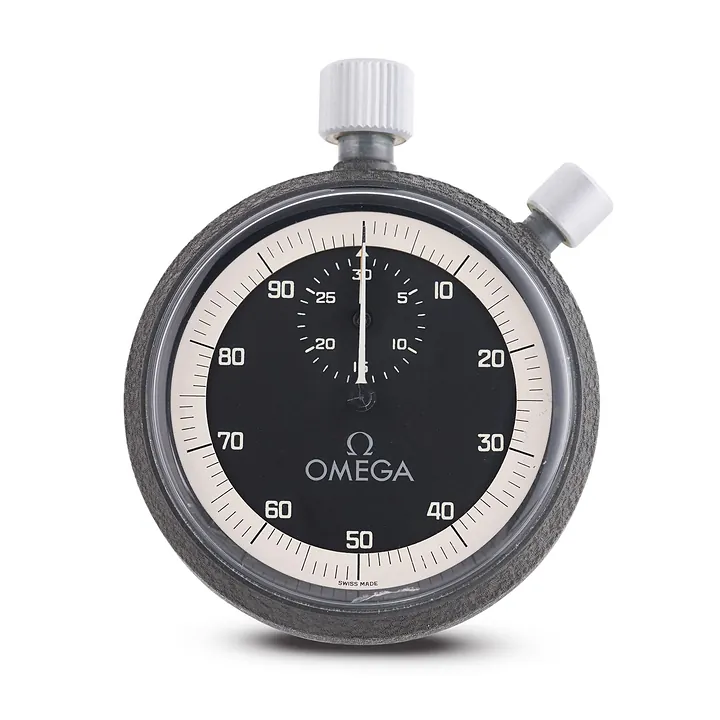
Pocket Watches · c. 1970s
Omega Stop Watch, c. 1970s
Antiquorum auction archive, Geneva
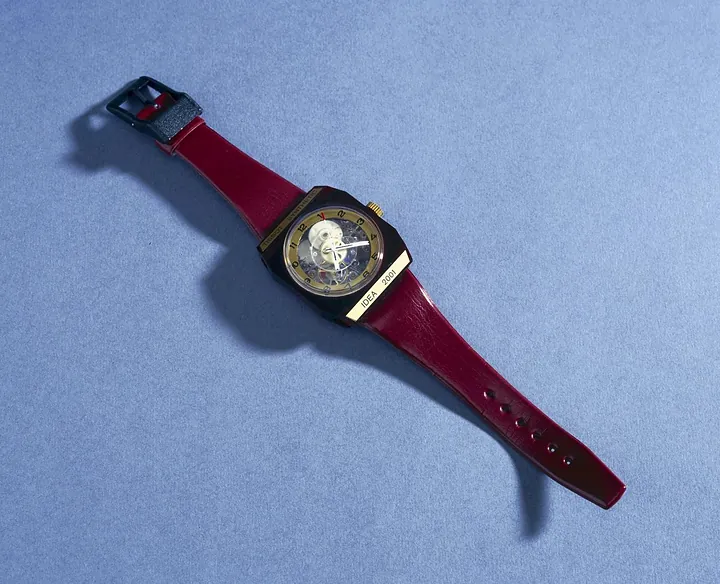
Pocket Watches · 1971–2001
"Tissot synthetic idea 2001" the first plastic watch, introduced in 1971
Science Museum Group, London
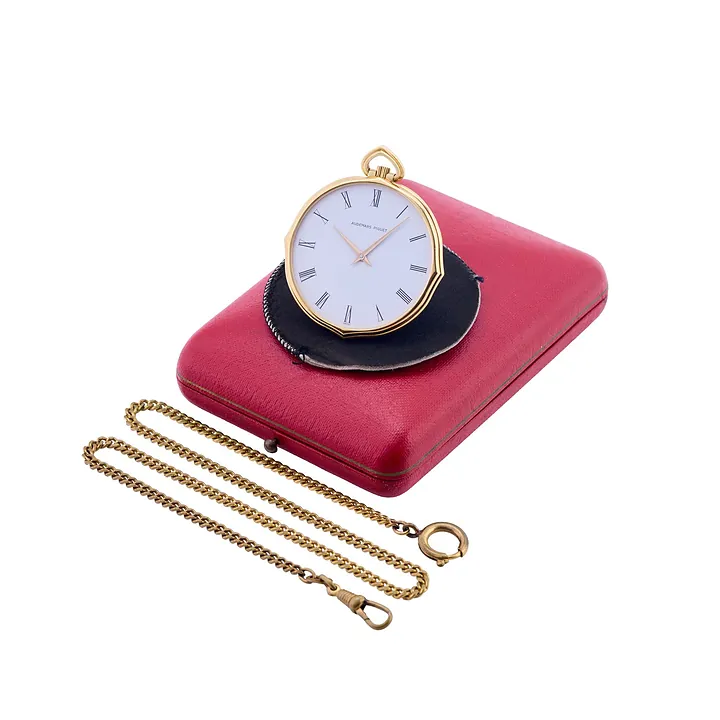
Pocket Watches · c. 1980
Audemars Piguet pocket watch, c. 1980
Antiquorum auction archive, Geneva
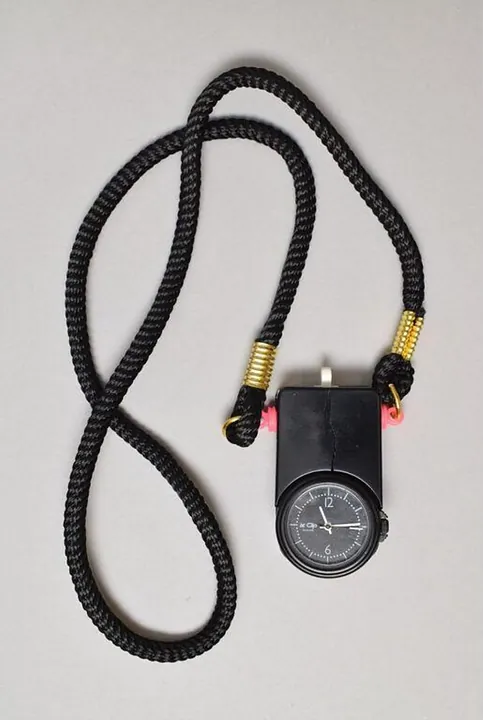
Pocket Watches · 1980s
Clip-on plastic watch with cord, made in Switzerland, 1980s
Victoria and Albert Museum, London