
Wristwatches · Wristwatch
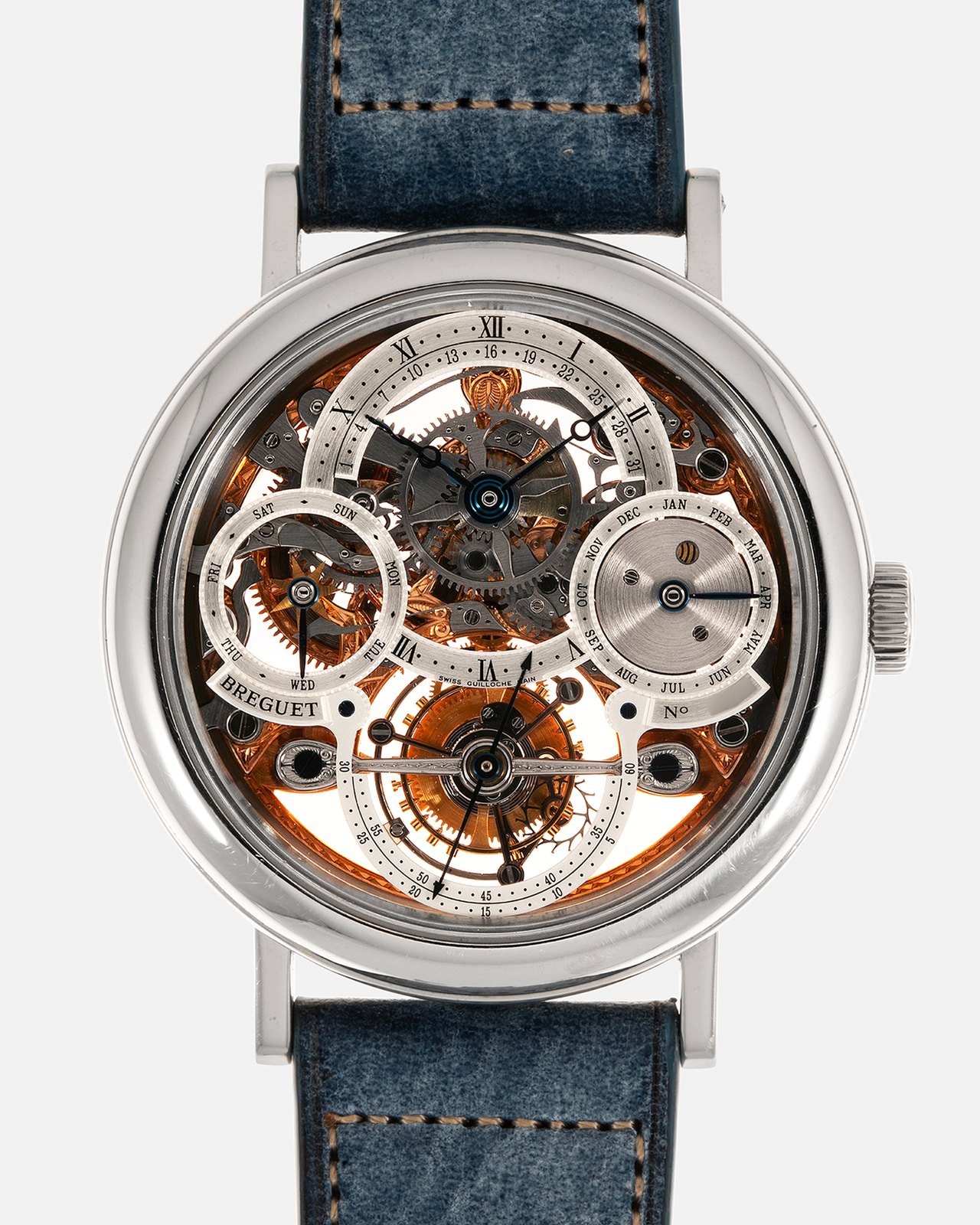
Breguet Classique Perpetual Calendar Tourbillon Skeleton Ref. 3755, 2000s
- Maker / attribution
- Breguet (maker)
- Date
- 2000s
- Historical period
- Mechanical Renaissance (1990 – 2010)
- Country of origin
- Switzerland
- Object type
- Wristwatch
- Dimensions
- Case 40 mm
- Stock no.
- Product 7148570542167
- Credit line
- Dealer listing, S.Song Watches (product 7148570542167)
- Catalogue title (original)
- Breguet Classique Perpetual Calendar Tourbillon Skeleton Ref. 3755 (English)
View the source record (dealer listing) ↗ (opens another website in a new tab)Suggest a correction
Record summary
Catalogued by S.Song Watches (dealer), Seattle (stock number Product 7148570542167), this is a wristwatch by Breguet, made in Switzerland, dated 2000s. The Atlas places it in the Mechanical Renaissance period (1990 – 2010) of its Wristwatches collection. Recorded dimensions: Case 40 mm. The record is illustrated with 6 photographs.
Assembled from the source record's structured fields. Dates and attributions are given as the source states them; where a field is missing the Atlas leaves it blank rather than estimating.
Catalogue description
Dealer description — S.Song Watches
Perhaps one of watchmaking's most overlooked industry titans, few brands can claim as many mechanical innovations and iconic pieces of design as Breguet can. Be it their Breguet hands, Breguet numerals, the tourbillon, the Breguet overcoil, or others; the industry has benefited tremendously from Breguet's continuous technical evolution throughout the decades. Among its standout creations, the Classique Perpetual Calendar Tourbillon Ref. 3755, which is also the watch offered here today, epitomizes Breguet's pinnacle in contemporary watchmaking excellence and features a very special complication—the Tourbillon. While we’re on the topic, I have to say that the tourbillon stands out as one of my all-time favorite horological complications. They are true mechanical marvels of horology and are incredibly dynamic, animated, and a sheer delight to both wear and behold. On that note, I think it goes without saying that Breguet tourbillons deserve extra special attention, especially considering the remarkable legacy of the brand's founder, Abraham-Louis Breguet, who invented the tourbillon in 1795. For context, the tourbillon is a complex horological mechanism enclosed within a rotating carriage, designed to counteract fluctuations and errors in timekeeping caused by gravitational forces acting on the moving components within a watch movement. Essentially, a watch's balance tends to oscillate at varying speeds depending on its position and orientation. By integrating a tourbillon into the mechanism, the balance and escapement are continuously rotated, effectively averaging out positional errors and thereby enhancing the overall accuracy of timekeeping. The Breguet Classique Perpetual Calendar Tourbillon Ref. 3755 we have before us represents a later evolution within Breguet's lineup. Despite its slightly larger case size of 40mm, which aligns with modern preferences, the Ref. 3755 Tourbillon maintains a classic aesthetic true to its heritage. Crafted entirely from platinum 950, its design features beautiful mirror-polished bezels, an elegantly fluted case band, and fine scalloped lugs with a gentle downward curve. Even at a glance, its unmistakable Breguet identity shines through. The dial on this Ref. 3375 is nothing short of a visual marvel, as it has been purposefully openworked to reveal the beauty and technical mastery of the exquisite hand-engraved 18-carat gold movement underneath — a labyrinthine network of gears, bridges, springs, and plates, all of which have been hand-finished spectacularly. Positioned at 12:00 is an off-centered, silvered chapter ring embellished with Roman numerals and hand-turned guilloché decoration, as denoted by the inscription "Swiss Guilloché Main" at its centre. This serves as an open-worked sub-dial, displaying both the time and the retrograde date function, which allows the hand to swiftly return to the ‘1’ position once it reaches the end (either the 28th, 29th,30th or 31st day) of the month. Additionally, two sub-dials at 3:00 and 9:00 indicate the month (including an aperture for its leap year indication) and the day, respectively. But the true highlight here is at 6:00: the magnificent one-minute tourbillon cage, which also serves as a running small-seconds indicator. While the dial alone on this Ref. 3375 is enough to win hearts over, the true enchantment of the Ref. 3375 unfolds when the watch is turned over to reveal the Breguet Cal. 558QPSQ movement. This manual-winding movement showcases some of the most magnificent and breathtaking engraving work I've ever seen executed on a movement. Honestly, words fail to fully convey its beauty; it is one of those watches that must be seen in person to be fully appreciated. As far as power reserve is concerned, the Cal. 558QPSQ can hold a charge of up to 50 hours on a full wind. Without a shadow of a doubt, the Breguet Classique Perpetual Calendar Tourbillon Ref. 3755 stands as a grand complication that is simply a feast for the eyes. You can't imagine how much time I've spent getting lost by staring endlessly into its mechanical abyss. It is truly exceptional, visually captivating, and mechanically intriguing in every way. Personally, I tend to gravitate towards watches with case sizes around 36/37mm, but this Ref. 3755 is a compelling exception that I’d gladly make, for obvious reasons. I'm certain that fellow collectors who share my preferences would also agree after seeing this masterpiece in person. This, without a doubt is Breguet giving it the beans, combining a tourbillon, perpetual calendar and open working in one watch. It is high horoglogy at its finest.
Historical context
Mechanical Renaissance (1990 – 2010)
Mechanical watches return as cultural objects; independent watchmaking flourishes.
Mechanical watches returned as cultural and luxury objects. Complications, tourbillons and new materials proliferated; independent watchmakers such as George Daniels, F.P. Journe and Philippe Dufour revived artisanal watchmaking; collecting vintage watches became a major field.
Read the period in the timelineMore wristwatches from this periodEarlier: Quartz Revolution
Atlas type guide
Calendar, moon-phase and perpetual calendar watches
Calendar complications range from a simple date to the perpetual calendar, which automatically allows for months of different lengths and leap years until 2100. Pocket watches with perpetual calendars were made in the eighteenth and nineteenth centuries; Patek Philippe made the first perpetual calendar wristwatch in 1925, and series production followed in 1941. The annual calendar (Patek Philippe, 1996) needs correction only once a year.
Moon-phase displays use a disc with two moons and 59 teeth advanced daily, approximating the 29.5-day lunation; more precise trains reduce the error to one day in over a century.
What to look for
- Apertures or subsidiary dials for day, date, month and leap year.
- Moon disc under a 'bosom' shaped aperture.
- Recessed correctors on the case band for setting the calendar.
Dating clues
- Triple-date wristwatches: popular c. 1940–1955.
- Perpetual calendar wristwatches: from 1925 (unique) and 1941 (series).
General guidance written by the Atlas editors about this kind of object. It is not a statement about this particular piece; for that, rely on the source record above and on physical examination.
Related records
Pocket Watches · 1700–1799
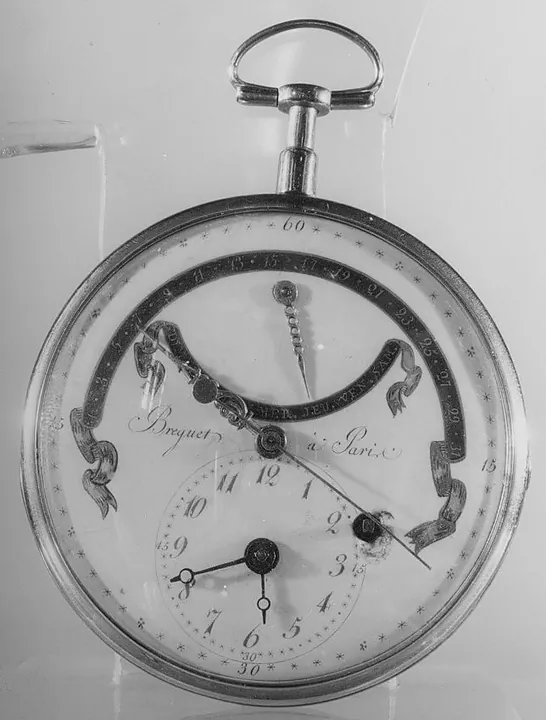
Pocket watch by Breguet, Belgium, 1700–1799
Royal Institute for Cultural Heritage
Pocket Watches · 1700–1799
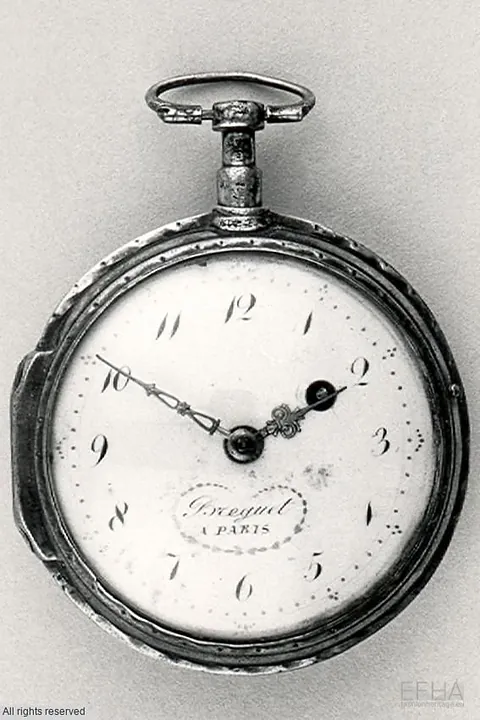
Pocket watch by Breguet, France, 1700–1799
Fashion Museum of Antwerp
Pocket Watches · c. 1790
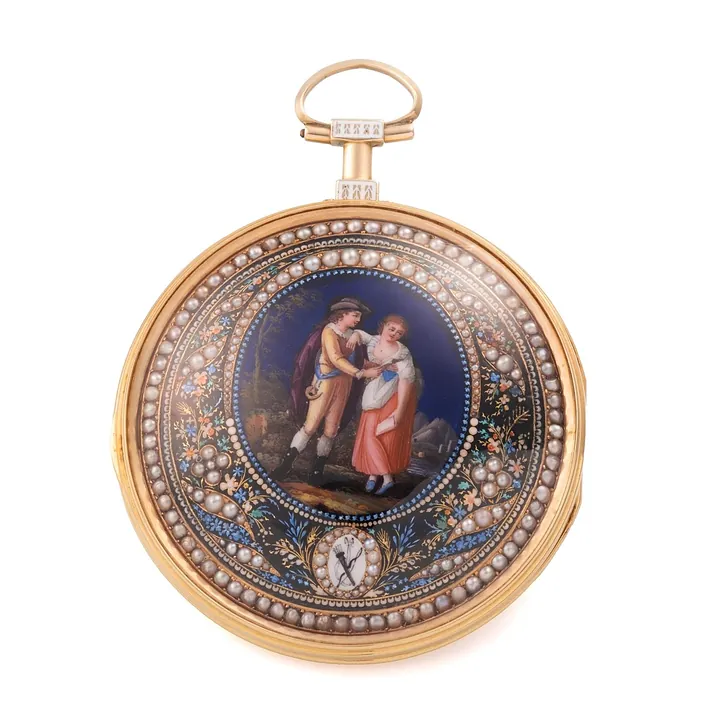
Breguet Love Letter, c. 1790
Antiquorum auction archive, Geneva
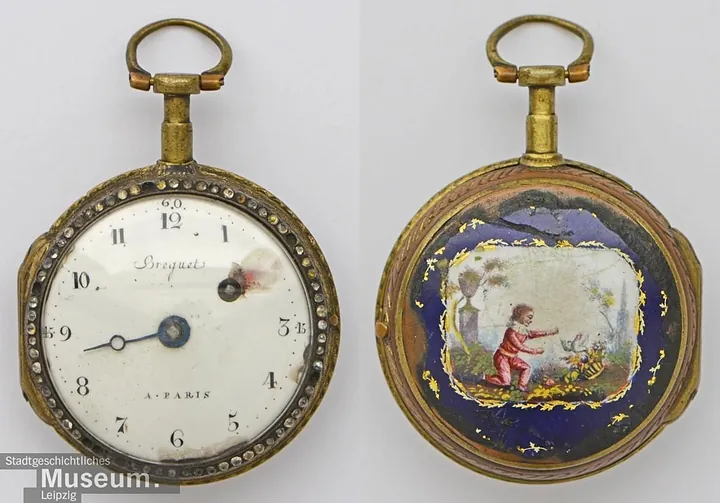
Pocket Watches · 1790
Pocket watch possibly by Breguet, France, 1790
Museum of City History Leipzig

Wristwatches · 2008
Wristwatch by Breitling?, 2008
Museum Rotterdam

Wristwatches · c. 1990s
Audemars Piguet Bamboo, c. 1990s
Antiquorum auction archive, Geneva

Wristwatches · c. 1990
Audemars Piguet Huitieme Perpetual Calendar, ref. 25696PT, c. 1990
Antiquorum auction archive, Geneva

Wristwatches · c. 1990
Breitling Chronomat, ref. b13050.1, c. 1990
Antiquorum auction archive, Geneva