
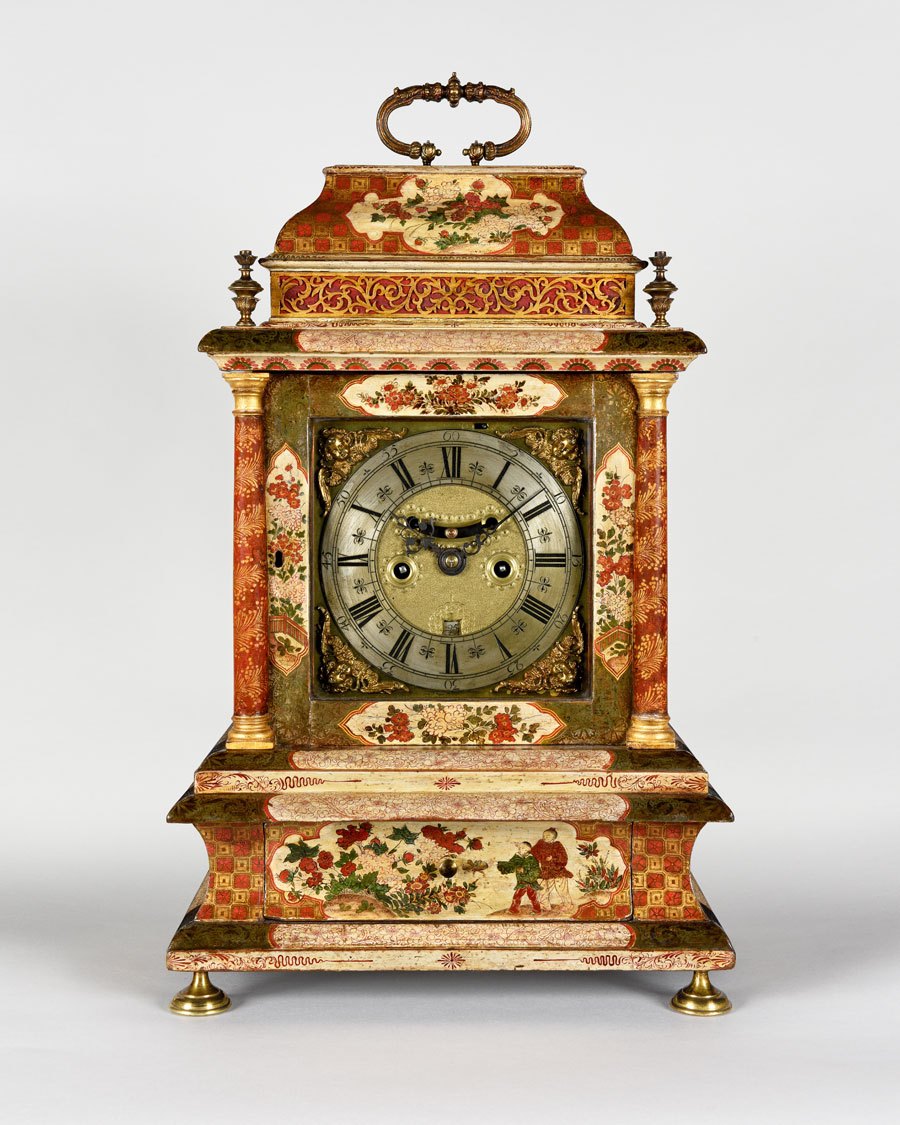
Clocks · Bracket clock
Bracket clock by Peter Walker, London, c. 1705–1710
- Maker / attribution
- Peter Walker (maker)
- Date
- c. 1705–1710
- Historical period
- Early Modern Horology (1600 – 1750)
- Country of origin
- England
- Place
- London
- Object type
- Bracket clock
- Materials / technique
- lacquer
- Dimensions
- Height 59 cm
- Stock no.
- SKU 523
- Credit line
- Dealer listing, Howard Walwyn (SKU 523)
- Catalogue title (original)
- PETER WALKER. A beautiful and rare Queen Anne period cream and polychrome lacquer table clock. (English)
View the source record (dealer listing) ↗ (opens another website in a new tab)Suggest a correction
Record summary
Catalogued by Howard Walwyn Fine Antique Clocks (dealer), London (stock number SKU 523), this is a bracket clock by Peter Walker, made in London, England, dated c. 1705–1710. The Atlas places it in the Early Modern Horology period (1600 – 1750) of its Clocks collection. Materials and techniques recorded by the source: lacquer. Recorded dimensions: Height 59 cm. The record is illustrated with 6 photographs.
Assembled from the source record's structured fields. Dates and attributions are given as the source states them; where a field is missing the Atlas leaves it blank rather than estimating.
Catalogue description
Dealer description — Howard Walwyn
A beautiful and rare Queen Anne period cream and polychrome lacquer table clock of 8-day duration with hour strike and pull quarter-repeat work. The remarkable ‘japanned’ case is adorned on all four sides with polychrome flower and foliate spray decoration set against a cream ground colour and with elements in red and green. Within the japanning on the key drawer there are oriental figures in a garden observing the flowers and an insect. The unusual design of the case is also of note as it is a hybrid of the best French and English cabinetmakers’ work. The gilt wooden sound fret above the dial to the front and sides beneath the inverted bell top is characteristic of Huguenot workmanship as is the concave key drawer which can be found on musical table clocks by Claudius Du Chesne . It also retains its original gilt metal foliate carrying handle, two brass finials and four turned brass bun feet. The 7-inch square brass dial with raised silvered chapter ring has a dummy pendulum aperture and inset datework above VI. The corner spandrels are of the wing and cherub’s heads variety typical of the period and there is a strike/silent lever above XII on the dial plate. The 8-day knife edge verge movement has five ring turned pillars, hour strike and pull quarter repeatwork on four bells via four hammers. The exquisite backplate is engraved with flowers and foliage and signed by the maker Peter Walker London within an elaborate foliate cartouche . Height: 23 ¼ in (59 cm) Width: 13 ½ in (34.25 cm) Depth: 8 in (20 cm) * Peter Walker was apprenticed to Andrew Savory in 1681 but he seems to have been affiliated to the Ironmongers’ Company. It was there that he signed the ‘Oath of the Allegiance’ to the King in 1697. His working address was Wild Street End and it is believed that he died in Amsterdam in 1730. This wonderfully well preserved clock is discussed and illustrated in fig.12 on page 214 of Antiquarian Horology, Vol.32, No. 2, June 2010. Provenance : An American Private Collection References: Robert Donaldson, Early Japanned Table Clocks, Antiquarian Horology, Number 2 Vol. 32, June 2010, pp. 201-219 Cescinsky & Webster., English Domestic Clocks , Chancery House Publishing, 1976, pp. 279- 282
Historical context
Early Modern Horology (1600 – 1750)
Huygens' pendulum and balance spring transform accuracy; English makers develop the anchor and deadbeat escapements.
Huygens's pendulum (1656–57) improved clock accuracy from about a quarter of an hour to under a minute a day. The anchor escapement (c. 1670) and the long seconds pendulum created the longcase clock; London makers such as Fromanteel, Knibb, Tompion and Quare led European clockmaking, and French makers created the Boulle pendule.
Read the period in the timelineMore clocks from this periodEarlier: Renaissance Horology
Atlas type guide
Bracket, table and spring-driven clocks
Spring-driven clocks freed timekeeping from the hanging weight. The coiled mainspring, documented from the fifteenth century, made portable table clocks possible; to even out its declining force, makers used the fusee, a conical pulley connected to the barrel by a gut line or chain. Renaissance table clocks from Augsburg and Nuremberg — drum-shaped, square or tower-shaped in gilt brass — were luxury scientific objects, often with astronomical dials and alarms.
After the pendulum, English makers developed the bracket clock: a wooden case with a carrying handle, a short pendulum with a verge escapement, and often repeating work to sound the hours on demand at night. Later examples use the anchor escapement. In the nineteenth century, 'table clock' became a broad term for spring clocks of every nationality.
What to look for
- A fusee in the movement (cone-shaped pulley) and the type of line — gut or chain.
- Verge escapement with a short bob pendulum, often with a decoratively engraved backplate.
- Repeat cords or buttons that make the clock strike again on demand.
- Gilt-brass engraved cases and horizontal dials on Renaissance pieces.
- Case shapes: inverted bell, bell top, break-arch, lancet or balloon.
Dating clues
- Drum and tower table clocks: c. 1520–1650.
- Ebony veneered English bracket clocks with verge escapements: c. 1670–1800.
- Engraved backplates were usual on English clocks until c. 1800, then generally plain.
General guidance written by the Atlas editors about this kind of object. It is not a statement about this particular piece; for that, rely on the source record above and on physical examination.
Read next:FuseeAnchor (recoil) escapement
Related records
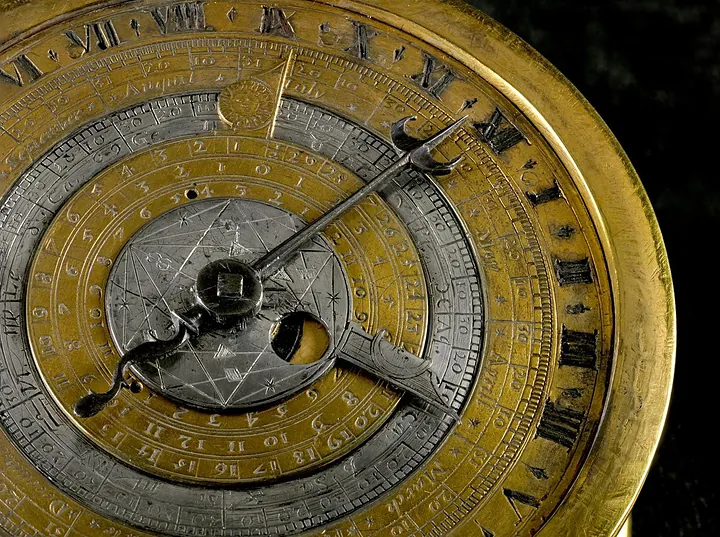
Clocks · 1598–1603
Circular table-clock with calendrical and lunar indications made by Nicholas Vallin in London between 1598 and 1603.
Science Museum Group, London
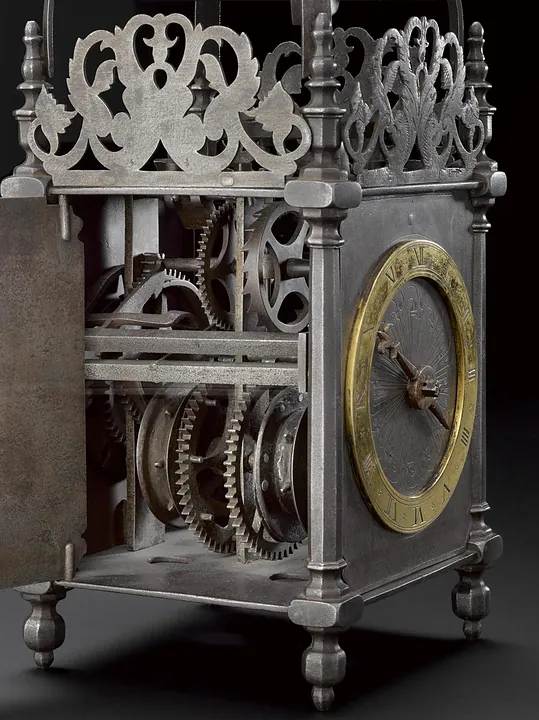
Clocks · 1611
English iron lantern clock, with wheel balance, by John Holloway, Market Lavington, Wiltshire, England, 1611.
Science Museum Group, London
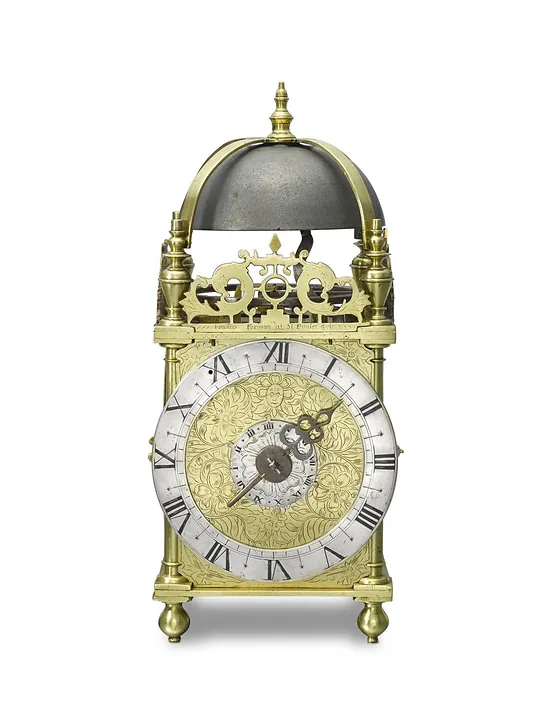
Clocks · 1630
Lantern clock by Francis Forman, England, 1630
Science Museum Group, London
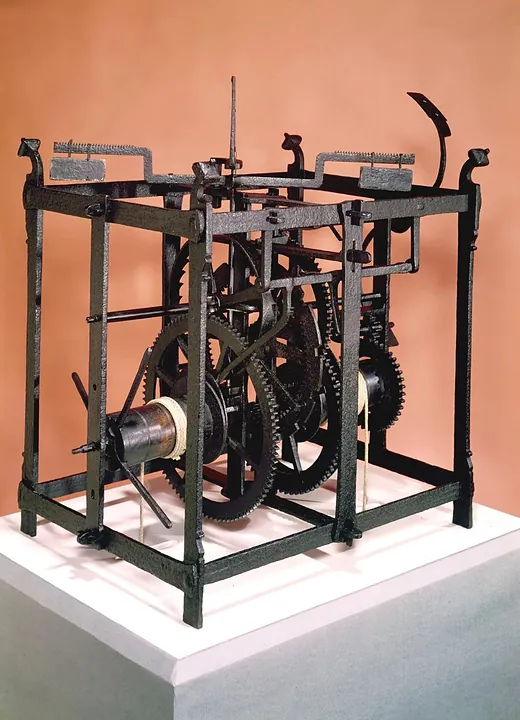
Clocks · 1632–1640
Turret clock, England, 1632–1640
Science Museum Group, London
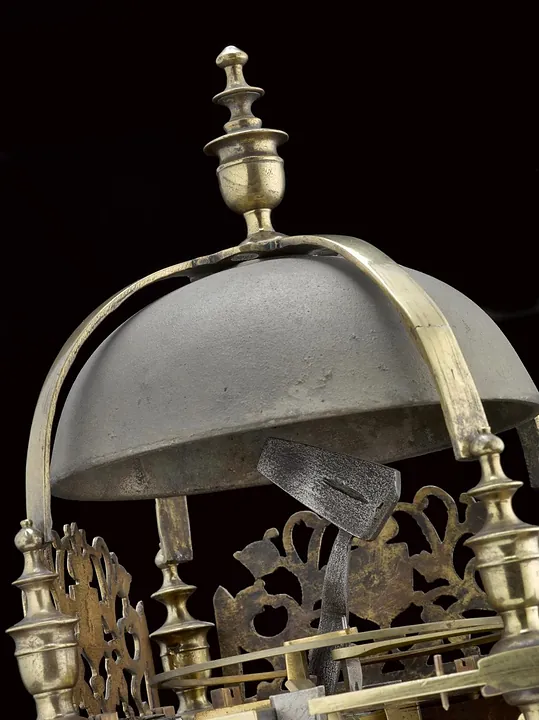
Clocks · 1645–1655
Balance-wheel brass lantern clock, with two driving weights and one counterweight, by Thomas Knifton, Cross Keys, Lothbury, London, England, 1645–1655.
Science Museum Group, London
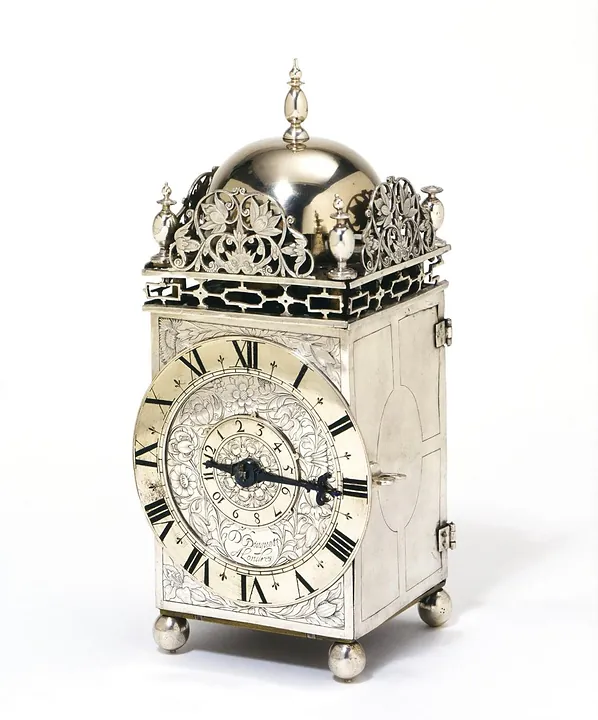
Clocks · c. 1650
Lantern alarm clock, silver, by David Bouquet, circa 1650
Victoria and Albert Museum, London
Clocks · 1650–1660
Lantern clock by Peter Closon, England, 1650–1660
Science Museum Group, London
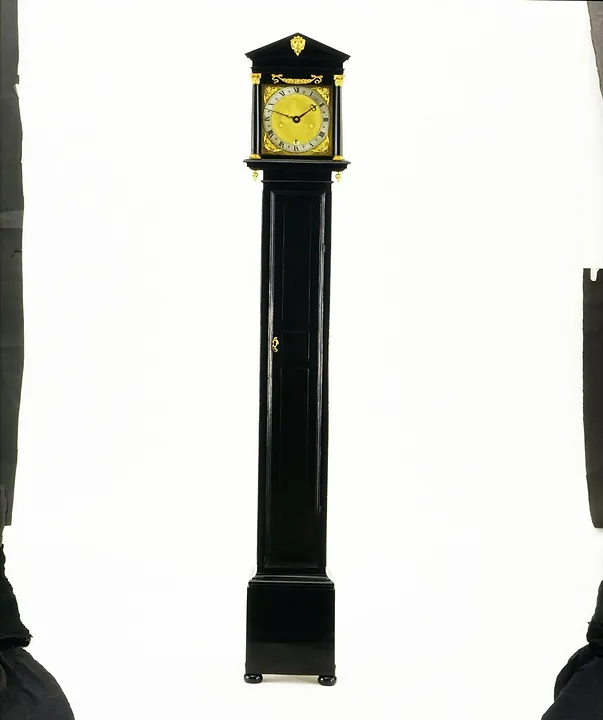
Clocks · c. 1660
Longcase clock, c. 1660, English, made by Ahasuerus Fromanteel
Victoria and Albert Museum, London