
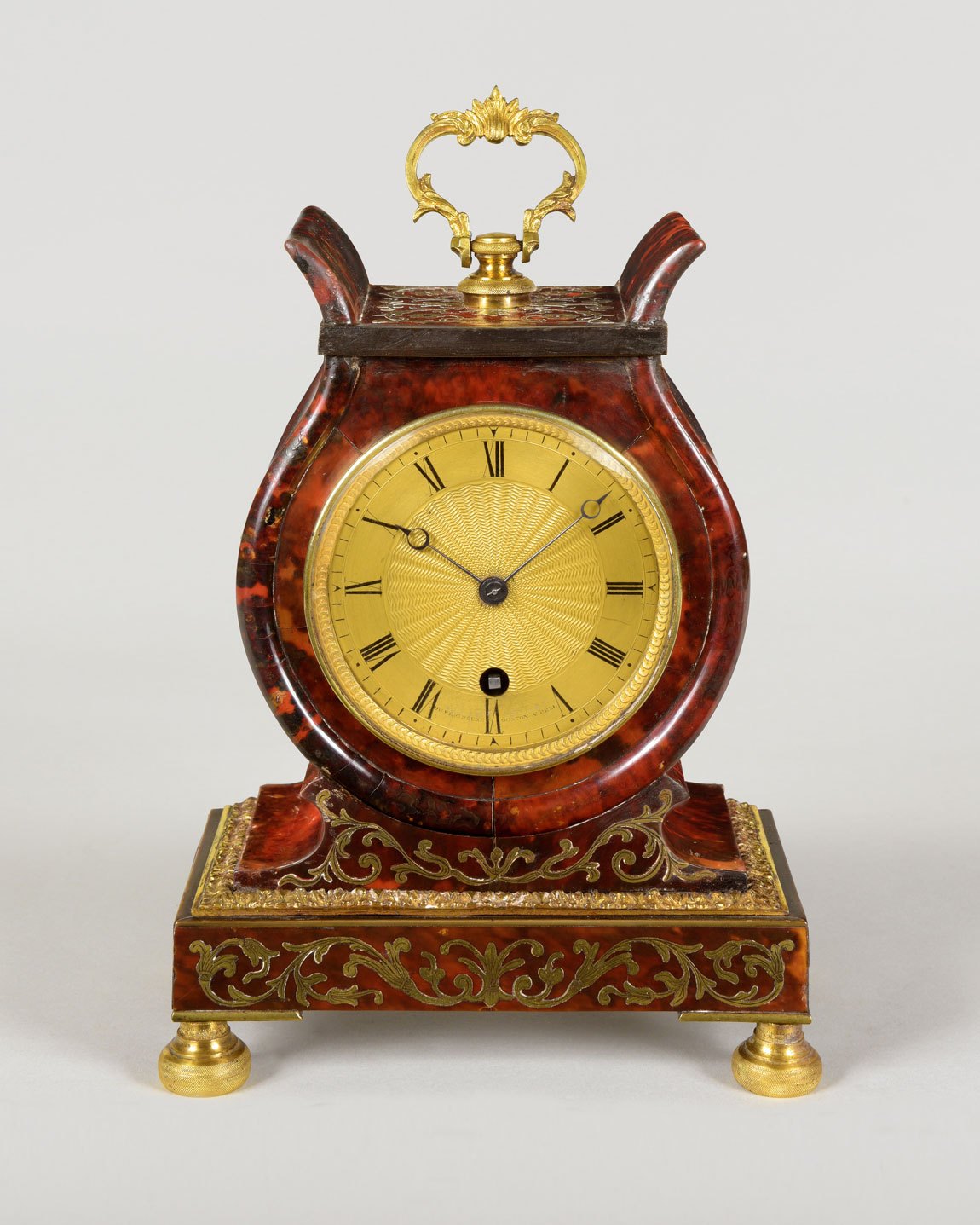
Clocks · Bracket clock
Bracket clock by Dwerrihouse, London, c. 1832–1835
- Maker / attribution
- Dwerrihouse (maker)
- Date
- c. 1832–1835
- Historical period
- Precision & Scientific Horology (1750 – 1850)
- Country of origin
- England
- Place
- London
- Object type
- Bracket clock
- Materials / technique
- tortoiseshell
- Dimensions
- Height 22 cm
- Stock no.
- SKU 518
- Credit line
- Dealer listing, Howard Walwyn (SKU 518)
- Catalogue title (original)
- DWERRIHOUSE, OGSTON & BELL. William IV period Boulle lyre-shaped 8-day faux tortoiseshell mantel timepiece. (English)
View the source record (dealer listing) ↗ (opens another website in a new tab)Suggest a correction
Record summary
Catalogued by Howard Walwyn Fine Antique Clocks (dealer), London (stock number SKU 518), this is a bracket clock by Dwerrihouse, made in London, England, dated c. 1832–1835. The Atlas places it in the Precision & Scientific Horology period (1750 – 1850) of its Clocks collection. Materials and techniques recorded by the source: tortoiseshell. Recorded dimensions: Height 22 cm. The record is illustrated with 3 photographs.
Assembled from the source record's structured fields. Dates and attributions are given as the source states them; where a field is missing the Atlas leaves it blank rather than estimating.
Catalogue description
Dealer description — Howard Walwyn
A William IV period Boulle lyre-shaped 8-day faux tortoiseshell mantel timepiece. Height : 8 ½ in (22 cm) Width : 6 ½ in (16.5 cm) Depth : 4 in (10 cm) * Dwerrihouse, Ogston & Bell are listed on page 235 in Brian Loomes’ Watchmakers and Clockmakers of the World: Complete 21st Century Edition as working from Davies Street, Berkeley Square from1832 until 1835 when the partnership was dissolved.. HW6360 For more information on this clock, please email us at info@howardwalwyn.com
Historical context
Precision & Scientific Horology (1750 – 1850)
Harrison solves longitude; Mudge invents the lever; Breguet's Paris workshop defines the modern watch.
The age of the deadbeat escapement, compensated pendulums and observatory regulators. Domestic clocks spread through the middle classes: English longcase and bracket clocks, French gilt-bronze mantel clocks, Viennese Biedermeier wall clocks, Black Forest painted-shield clocks, and the first American shelf clocks.
Read the period in the timelineMore clocks from this periodEarlier: Early Modern Horology
Atlas type guide
Bracket, table and spring-driven clocks
Spring-driven clocks freed timekeeping from the hanging weight. The coiled mainspring, documented from the fifteenth century, made portable table clocks possible; to even out its declining force, makers used the fusee, a conical pulley connected to the barrel by a gut line or chain. Renaissance table clocks from Augsburg and Nuremberg — drum-shaped, square or tower-shaped in gilt brass — were luxury scientific objects, often with astronomical dials and alarms.
After the pendulum, English makers developed the bracket clock: a wooden case with a carrying handle, a short pendulum with a verge escapement, and often repeating work to sound the hours on demand at night. Later examples use the anchor escapement. In the nineteenth century, 'table clock' became a broad term for spring clocks of every nationality.
What to look for
- A fusee in the movement (cone-shaped pulley) and the type of line — gut or chain.
- Verge escapement with a short bob pendulum, often with a decoratively engraved backplate.
- Repeat cords or buttons that make the clock strike again on demand.
- Gilt-brass engraved cases and horizontal dials on Renaissance pieces.
- Case shapes: inverted bell, bell top, break-arch, lancet or balloon.
Dating clues
- Drum and tower table clocks: c. 1520–1650.
- Ebony veneered English bracket clocks with verge escapements: c. 1670–1800.
- Engraved backplates were usual on English clocks until c. 1800, then generally plain.
General guidance written by the Atlas editors about this kind of object. It is not a statement about this particular piece; for that, rely on the source record above and on physical examination.
Related records
Clocks · c. 1810
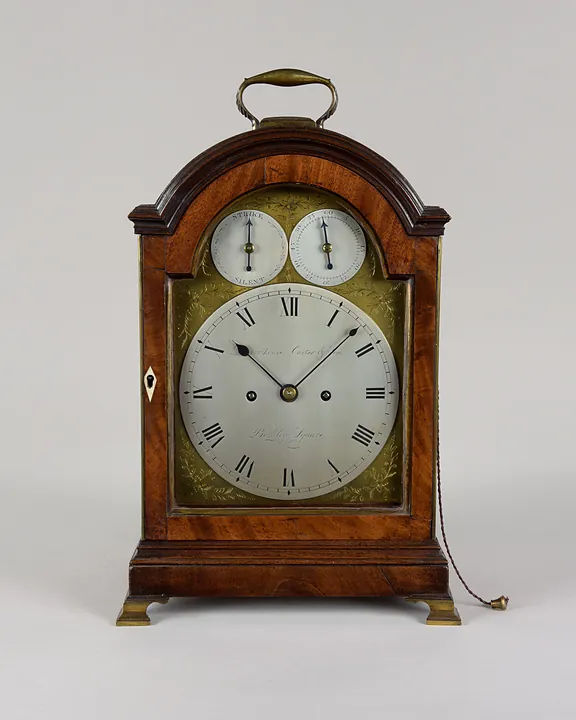
Bracket clock by Dwerrihouse, Berkeley Square, London, c. 1810
Howard Walwyn Fine Antique Clocks (dealer), London
Clocks · c. 1800
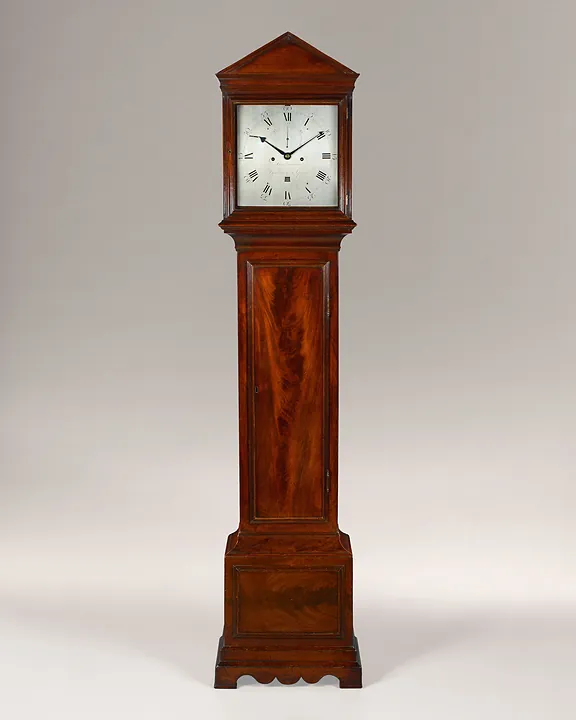
Longcase clock by Dwerrihouse, London, c. 1800
Howard Walwyn Fine Antique Clocks (dealer), London
Clocks · c. 1832–1835
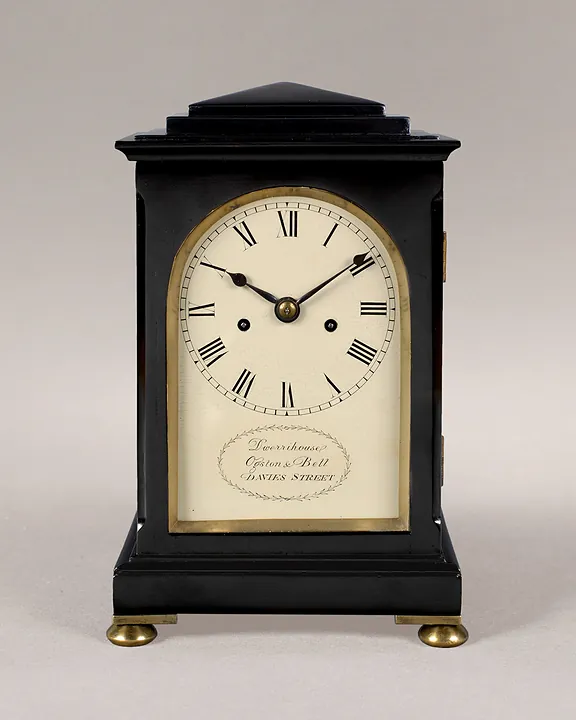
Bracket clock by Dwerrihouse, Davies Street, London, c. 1832–1835
Howard Walwyn Fine Antique Clocks (dealer), London
Clocks · 1740–1760
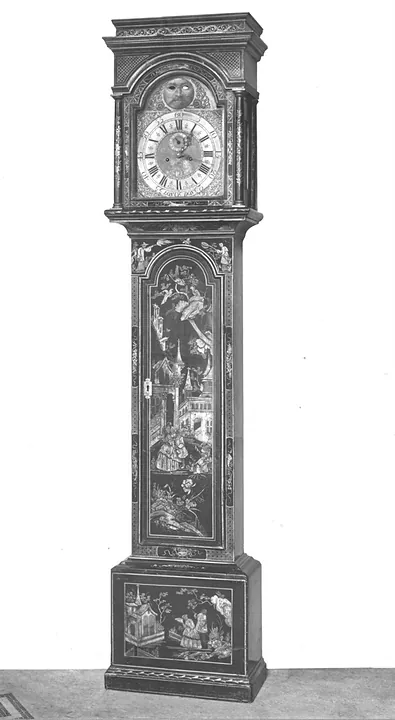
Longcase clock, English, 1740–1760, japanned wood, John Ellicott
Victoria and Albert Museum, London
Clocks · c.1750
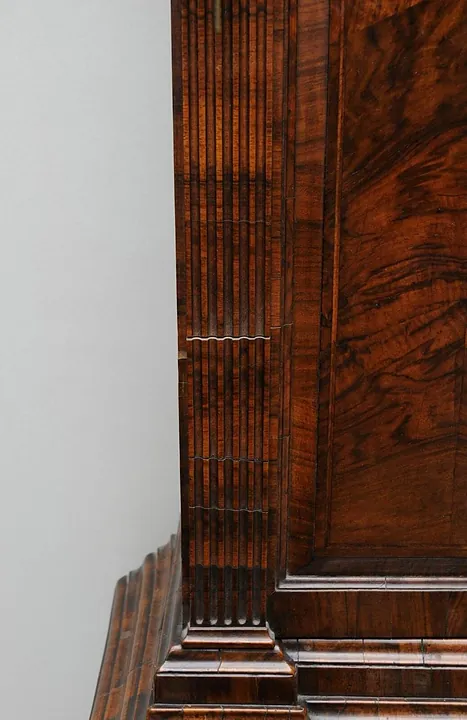
Long-case clock, English, ca. 1750, by Richard Peyton of Gloucester
Victoria and Albert Museum, London
Clocks · 1751
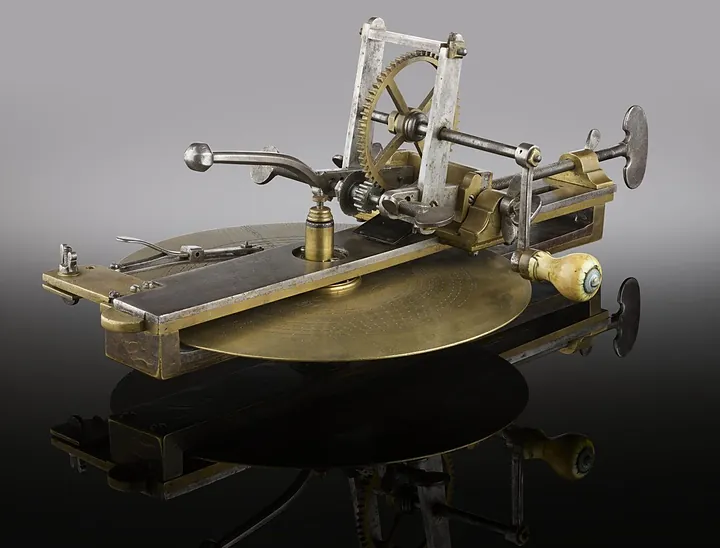
Large wheel engine, signed and dated "John Tipping, Whildon Green, 1751".
Science Museum Group, London
Clocks · 1755
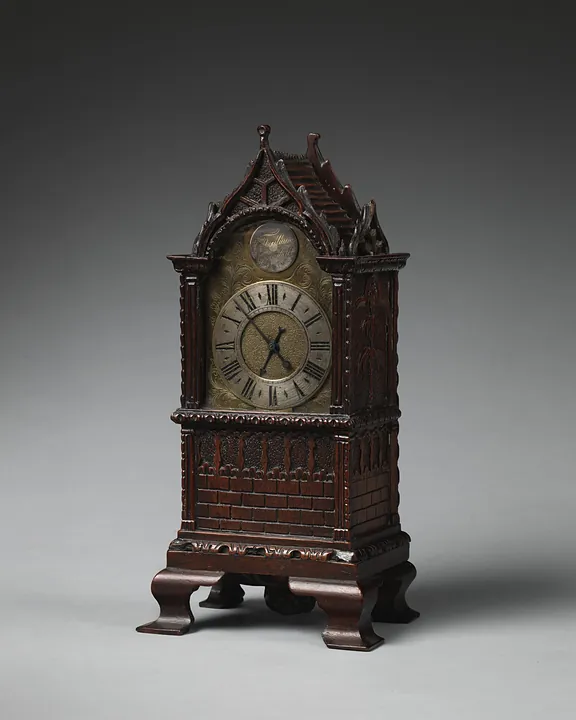
Bracket clock by John Fordham, England, 1755
The Metropolitan Museum of Art, New York
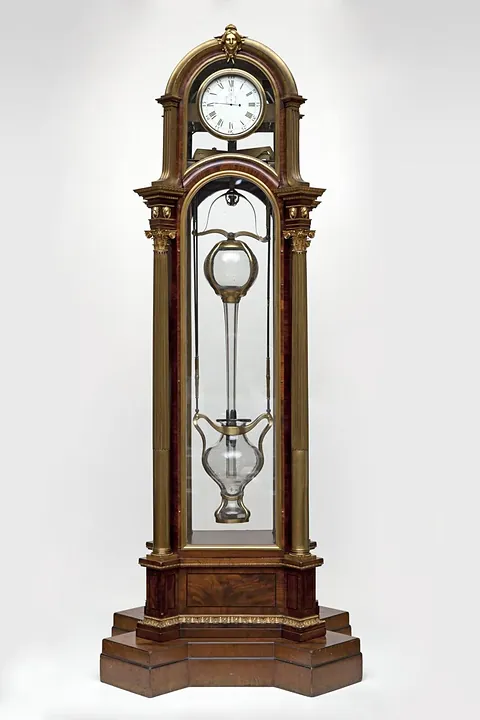
Clocks · c. 1760
Longcase clock by James Cox, England, c. 1760
Victoria and Albert Museum, London