
Pocket Watches · Jump hour calendar pocket watch
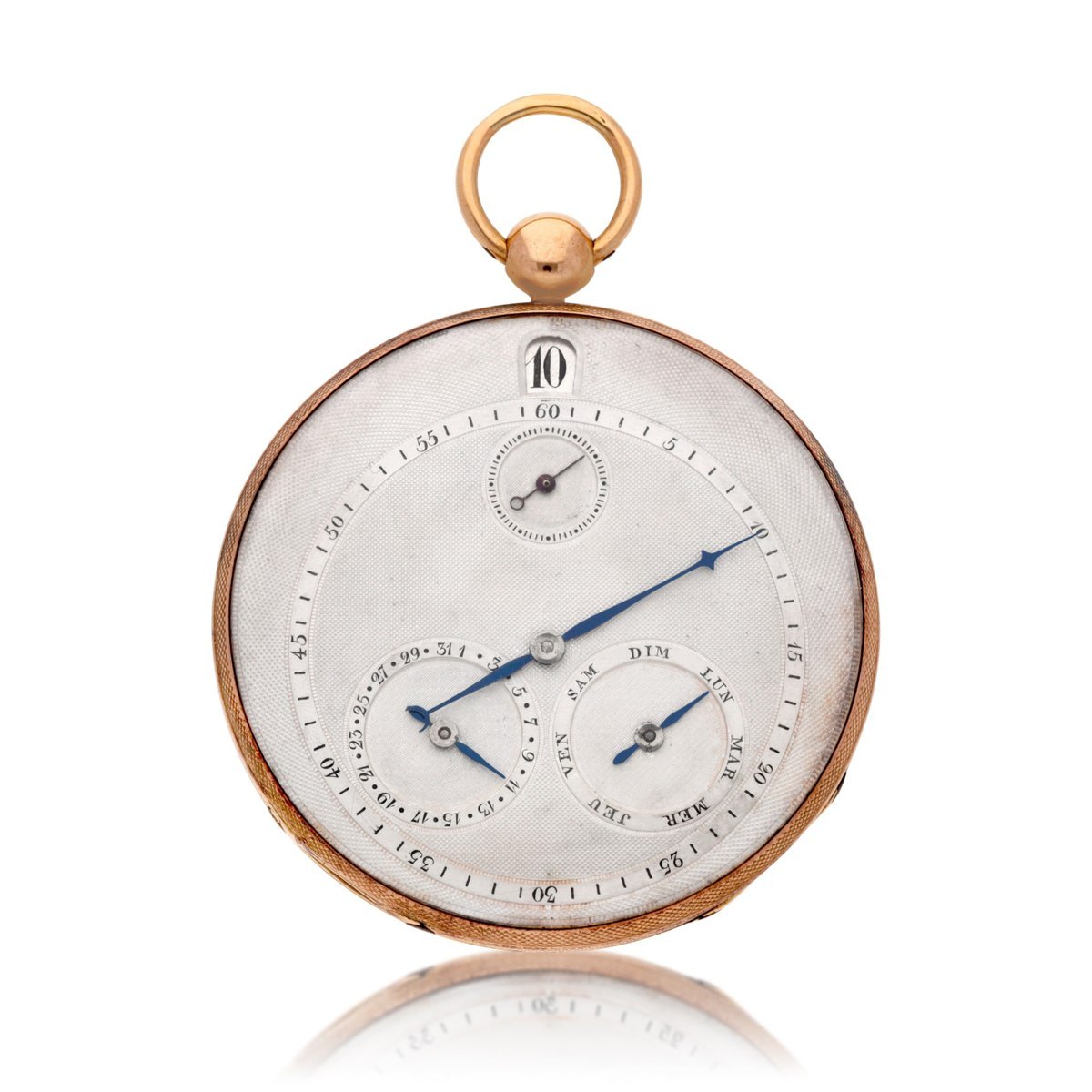
Blondeau à Paris Gold Jump Hour Calendar Watch, No. 1098
- Maker / attribution
- Blondeau à Paris (source attribution)
- Date
- c. 1820
- Historical period
- Precision & Scientific Horology (1750 – 1850)
- Country of origin
- France
- Object type
- Jump hour calendar pocket watch
- Dimensions
- 52 mm
- Auction house
- Sotheby's
- Lot
- 165
- Credit line
- Sotheby's
- Catalogue title (original)
- Blondeau à Paris | A Gold Jump Hour Calendar Watch Circa 1820, No. (English)
View the source record (auction lot) ↗ (opens another website in a new tab)Suggest a correction
Record summary
Catalogued by Sotheby's (lot 165), this is a jump hour calendar pocket watch attributed to Blondeau à Paris, made in France, dated c. 1820. The Atlas places it in the Precision & Scientific Horology period (1750 – 1850) of its Pocket Watches collection. Recorded dimensions: 52 mm. The record is illustrated with 1 photograph.
Assembled from the source record's structured fields. Dates and attributions are given as the source states them; where a field is missing the Atlas leaves it blank rather than estimating.
Catalogue description
Original object description
Dating to circa 1820 and originating from France, this jump hour calendar pocket watch from the Masterworks of Time Collection measures 52 mm in diameter. Crafted in an open-face gold case by Blondeau à Paris, the watch features an engine-turned band and case back, a reeded bezel, a circular pendant, and an oval bow. The silver guilloché dial exhibits multiple decorative patterns and displays an aperture at the 12 o'clock position for the jumping hour. Minutes are tracked along an eccentric ring of Arabic numerals using a blued steel hand, while three subsidiary registers indicate the running seconds, the day of the week in French, and the calendar date. Inside, a polished cuvette bears an engraving identifying Blondeau as royal clockmaker on the Rue de la Paix no. 19 in Paris, bearing watch number 1098. The serial number 16346 is marked on both the cuvette and the interior of the case back, where an indistinct maker's punch also appears. According to auction documentation, the hidden gilt movement operates with a cylinder escapement, an unadorned three-arm gold balance, and a standing barrel.
Inscriptions & marks
1098
Historical context
Precision & Scientific Horology (1750 – 1850)
Harrison solves longitude; Mudge invents the lever; Breguet's Paris workshop defines the modern watch.
From 1750 to 1850 the watch became a precision instrument. Mudge's lever escapement, the cylinder escapement, Lépine's thin bar calibre, Breguet's innovations (overcoil, tourbillon, perpétuelle) and the pocket chronometer of Arnold and Earnshaw all date from this period, while verge watches remained common in cheaper production.
Read the period in the timelineMore pocket watches from this periodEarlier: Early Modern Horology
Atlas type guide
Calendar, moon-phase and perpetual calendar watches
Calendar complications range from a simple date to the perpetual calendar, which automatically allows for months of different lengths and leap years until 2100. Pocket watches with perpetual calendars were made in the eighteenth and nineteenth centuries; Patek Philippe made the first perpetual calendar wristwatch in 1925, and series production followed in 1941. The annual calendar (Patek Philippe, 1996) needs correction only once a year.
Moon-phase displays use a disc with two moons and 59 teeth advanced daily, approximating the 29.5-day lunation; more precise trains reduce the error to one day in over a century.
What to look for
- Apertures or subsidiary dials for day, date, month and leap year.
- Moon disc under a 'bosom' shaped aperture.
- Recessed correctors on the case band for setting the calendar.
Dating clues
- Triple-date wristwatches: popular c. 1940–1955.
- Perpetual calendar wristwatches: from 1925 (unique) and 1941 (series).
General guidance written by the Atlas editors about this kind of object. It is not a statement about this particular piece; for that, rely on the source record above and on physical examination.
Related records
Pocket Watches · 1745–1755
Pocket watch by Jean Baptiste Baillon, France, 1745–1755
Museum of City History Leipzig
Pocket Watches · c. 1750
Baillon À Paris pocket watch, c. 1750
Antiquorum auction archive, Geneva
Pocket Watches · 1750–1780
Pocket watch by BONBIERE, France, 1750–1780
Bohuslän Museum
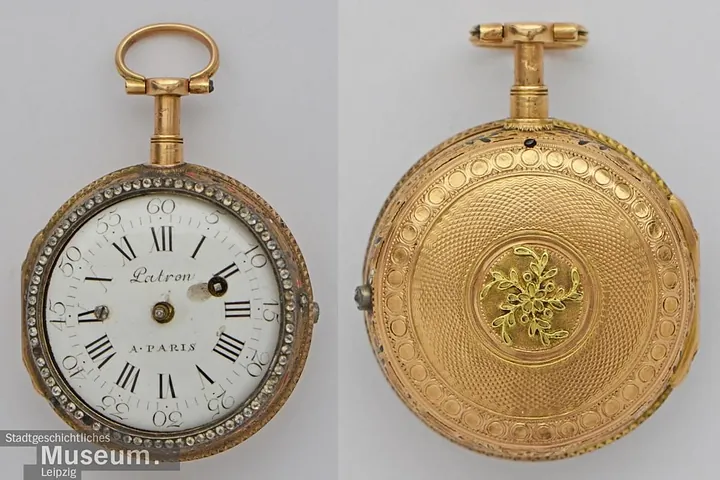
Pocket Watches · 1750
Pocket watch by Patron, France, 1750
Museum of City History Leipzig
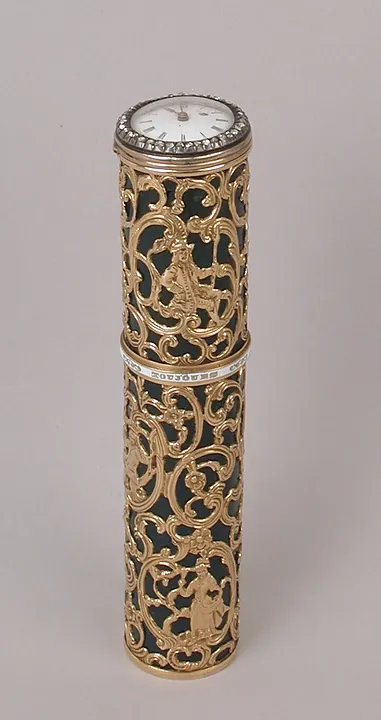
Pocket Watches · second half 18th century
Watch probably by by an imitator of Abraham-Louis Bréguet, France, second half 18th century
The Metropolitan Museum of Art, New York
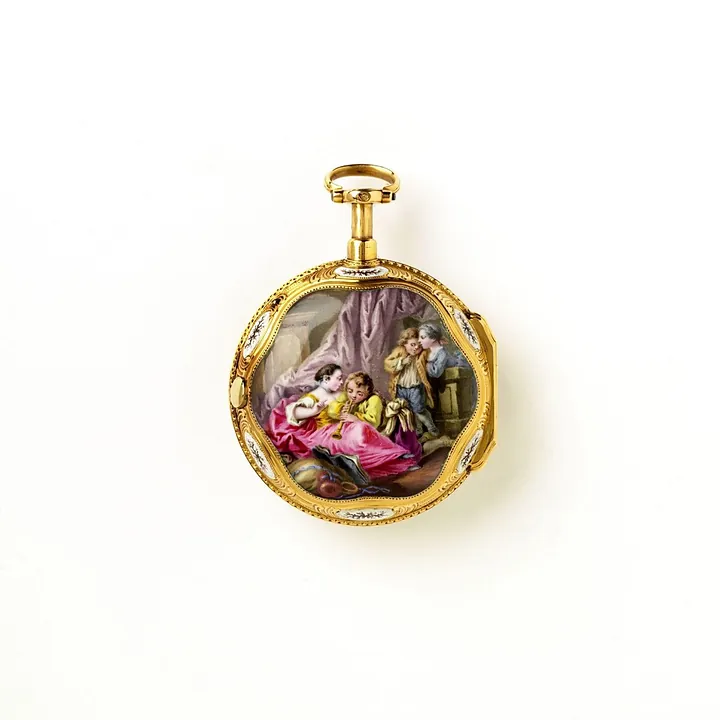
Pocket Watches · 1760–1761
Enamelled gold, quarter repeating watch, Paris, 1760-62, Romilly
Victoria and Albert Museum, London
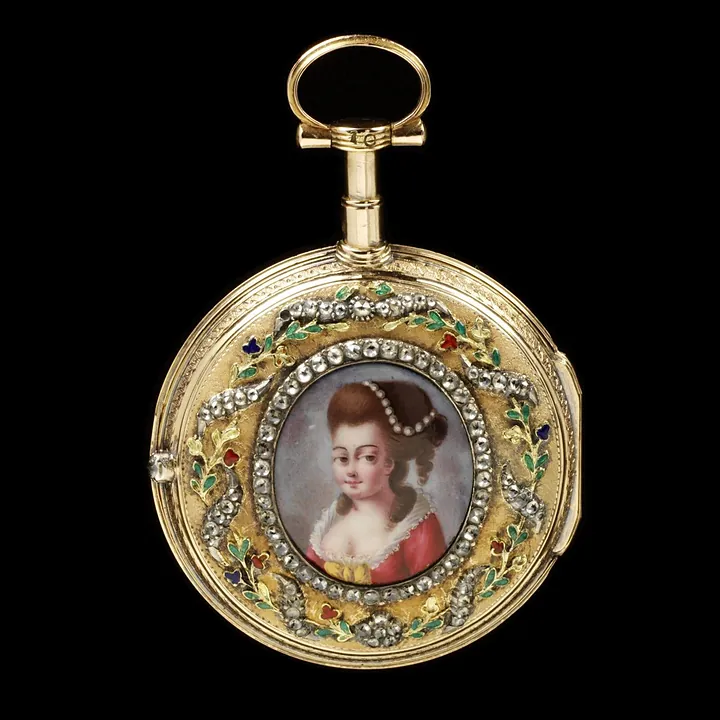
Pocket Watches · 1770-5
Enamelled copper gilt watch set with pastes, signed 'Vauchez A Paris'; made in France or Switzerland, 1770-5
Victoria and Albert Museum, London
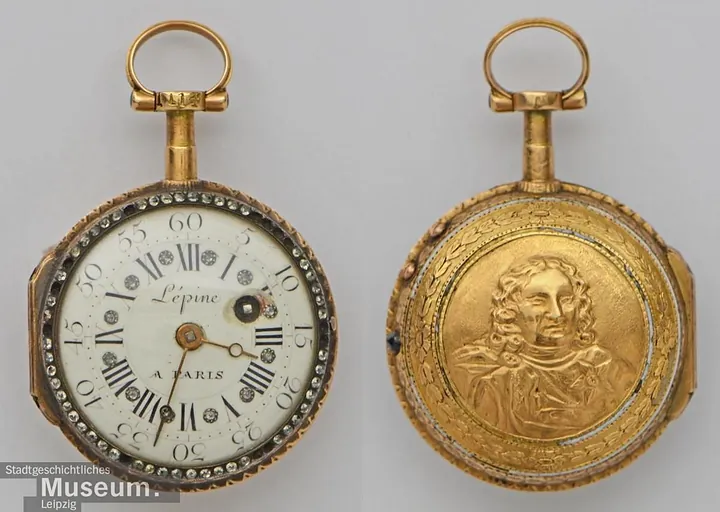
Pocket Watches · 1770–1780
Pocket watch by Lepine, France, 1770–1780
Museum of City History Leipzig