
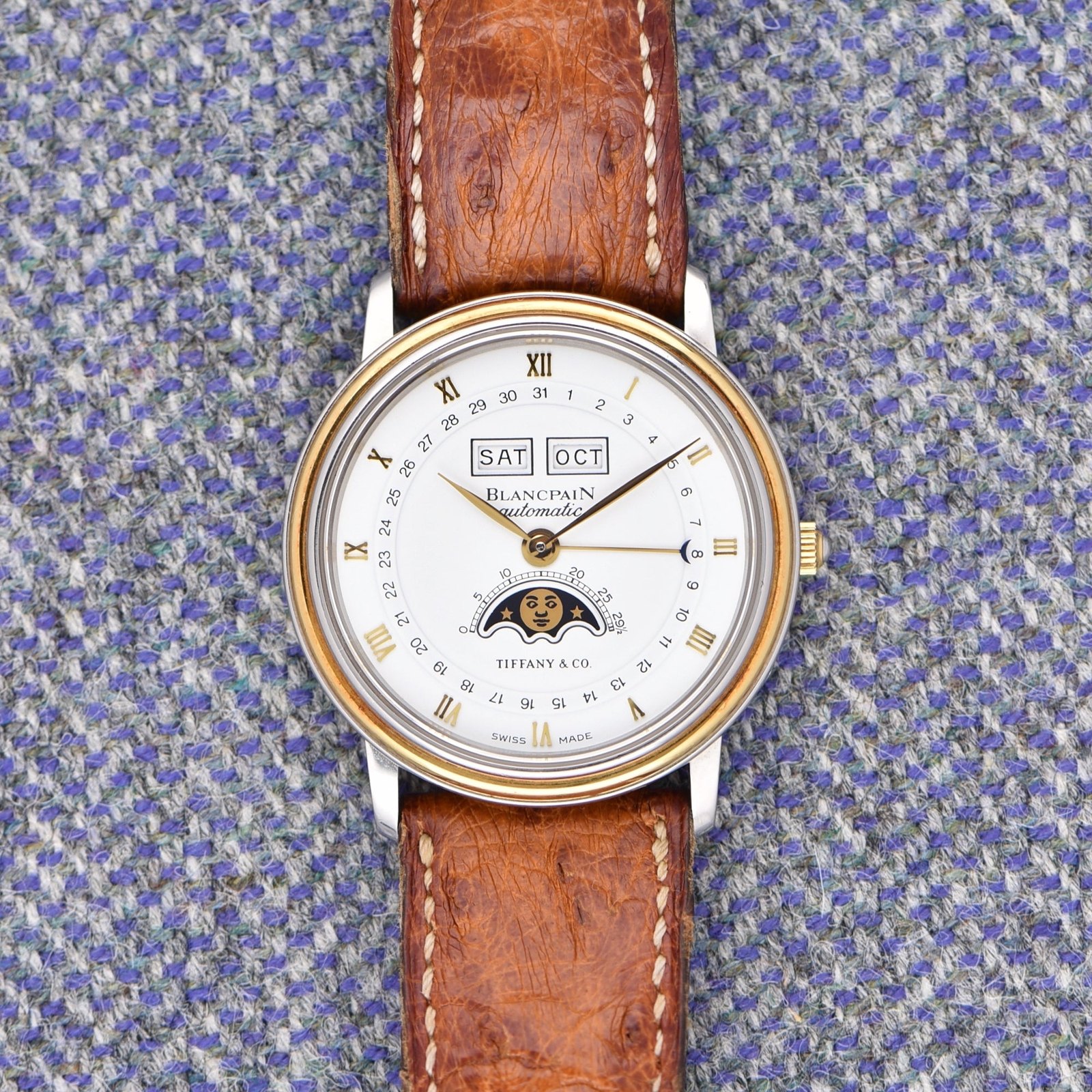
Wristwatches · Wristwatch
Blancpain Tiffany & Co Triple Calander Moonphase, 1988
- Maker / attribution
- Blancpain (maker)
- Date
- 1988
- Historical period
- Quartz Revolution (1969 – 1990)
- Country of origin
- Switzerland
- Object type
- Wristwatch
- Dimensions
- Case 34 mm
- Stock no.
- Product 7368572076215
- Credit line
- Dealer listing, Huntington Company (product 7368572076215)
- Catalogue title (original)
- 1988 Blancpain Tiffany & Co Triple Calander Moonphase With Box and Booklets (English)
View the source record (dealer listing) ↗ (opens another website in a new tab)Suggest a correction
Record summary
Catalogued by Huntington Company (dealer) (stock number Product 7368572076215), this is a wristwatch by Blancpain, made in Switzerland, dated 1988. The Atlas places it in the Quartz Revolution period (1969 – 1990) of its Wristwatches collection. Recorded dimensions: Case 34 mm. The record is illustrated with 6 photographs.
Assembled from the source record's structured fields. Dates and attributions are given as the source states them; where a field is missing the Atlas leaves it blank rather than estimating.
Catalogue description
Dealer description — Huntington Company
Reference 6595 Tiffany & Co Box, Blancpain Booklets, Push Pin Specifications Year: 1988 Model: 6595 Case Diameter: 34mm Lug to Lug: 38mm Case: Rose gold Condition: No significant wear as seen Dial: good condition Movement: Automatic Condition Rarity aside, the condition of this Blancpain is as you would suspect. A well-preserved Blancpain with its original strap, 18K buckle, booklets, Tiffany stamped box, and pusher. The ostrich Blancpain strap has noticeable wear but is still wearable. The case is nice and clean with no major dents as seen in the photos. The stark white dial is nice and clean with gold hour markers. The Story In 1981, Jean-Claude Biver and Jacques Piguet decided to launch a range of high-end mechanical complications under the name Blancpain, a brand with historical and horological importance. They purchased the rights to Blancpain and worked in a farmhouse in Le Brassus, the Joux Valley, on the historic farm of Louis-Elisée Piguet, adjacent to the Frédéric Piguet workshop. Biver headed marketing and sales, while Piguet led manufacturing, they began creating what is now known as 'the six masterpieces'. The first model, the Complete Calendar Moon Phase, featured the Cal. 6395 and Cal. 6595, bringing back traditional complications while the watch market shifted to quartz movements. The Cal. 6395/6595 set a record for the smallest complete calendar moon phase plate in history. The model was designed to be complicated high-end watchmaking, unlike quartz pieces. The case, measuring 34mm, was available in various metals and bands, and was attached to a Gay Freres bracelet. This refernece 6595 is just a bit more special because of the name printed under the moonphase complication. Retailed by Tiffany & Co., this example was purchased in the late 80s with a beautiful love note engraved on the caseback. The Brand The Blancpain brand, established in 1735 by Jehan-Jacques Blancpain, is the oldest watch brand in existence. However, it experienced significant changes during the 20th century. In 1932, the company was sold to Betty Fiechter and André Léal, leading to the creation of the Rayville brand. In 1962, Blancpain became part of SSIH (Sociéte Suisse pour l’Industrie Horlogère), joining Lemania, Omega, and Tissot. During this period, the company produced significant volumes of watches, with annual sales reaching 220,000 units in 1971. Fréderic Piguet, a prominent movement manufacturer located in the Vallée de Joux, acquired the brand name Rayville-Blancpain from SSIH in 1982. The following year, Blancpain was established as a separate company under the direction of Jacques Piguet. The company entered a frenetic period of innovation, releasing numerous models that embraced the regional prowess for crafting ultra-thin and complicated watches. In 1992, Jacques Piguet decided to sell both Fréderic Piguet and Blancpain, which were later acquired by SMH, the company that would ultimately become Swatch Group. Today, Blancpain continues to have its production facilities within the Vallée de Joux, both in Le Brassus and nearby Le Sentier. The iconic Fifty Fathoms collection stands out among Blancpain's collections, including Le Brassus, Léman, L-evolution, and Villeret. The Fifty Fathoms, a diver's watch, was launched in 1953, the same year the Rolex Submariner was released. The original model was equipped with a stainless steel case and domed crystal, capable of withstanding depths of at least 50 fathoms (91 meters). A self-winding movement was included to mitigate the need to use the crown for winding, and a soft-iron core shrouded the movement to protect the inner workings against damage or unwanted influence from magnetic fields. Blancpain has extended the collection to appeal to a broader audience who appreciate the model's robust design. The range now includes a flyback chronograph and even a tourbillon. In 2011, Blancpain revealed the X Fathoms, equipped with a mechanical depth gauge using liquid metal technology. Most recently, the Fifty Fathoms Bathyscaphe watches were released, which are smaller in stature but no less alluring. Blancpain is a historical name in the field of haute horlogerie, offering a diverse range of timepieces with peerless finishing and a myriad of complications.
Historical context
Quartz Revolution (1969 – 1990)
Seiko's Astron begins mass quartz timekeeping; traditional industries contract sharply.
Quartz and digital watches transformed the market after 1969. Swiss employment collapsed, Japanese and Hong Kong production soared, and the Swatch (1983) helped the Swiss industry recover; mechanical watches survived as luxury goods.
Read the period in the timelineMore wristwatches from this periodEarlier: Modern Mechanical Horology
Atlas type guide
Calendar, moon-phase and perpetual calendar watches
Calendar complications range from a simple date to the perpetual calendar, which automatically allows for months of different lengths and leap years until 2100. Pocket watches with perpetual calendars were made in the eighteenth and nineteenth centuries; Patek Philippe made the first perpetual calendar wristwatch in 1925, and series production followed in 1941. The annual calendar (Patek Philippe, 1996) needs correction only once a year.
Moon-phase displays use a disc with two moons and 59 teeth advanced daily, approximating the 29.5-day lunation; more precise trains reduce the error to one day in over a century.
What to look for
- Apertures or subsidiary dials for day, date, month and leap year.
- Moon disc under a 'bosom' shaped aperture.
- Recessed correctors on the case band for setting the calendar.
Dating clues
- Triple-date wristwatches: popular c. 1940–1955.
- Perpetual calendar wristwatches: from 1925 (unique) and 1941 (series).
General guidance written by the Atlas editors about this kind of object. It is not a statement about this particular piece; for that, rely on the source record above and on physical examination.
Related records
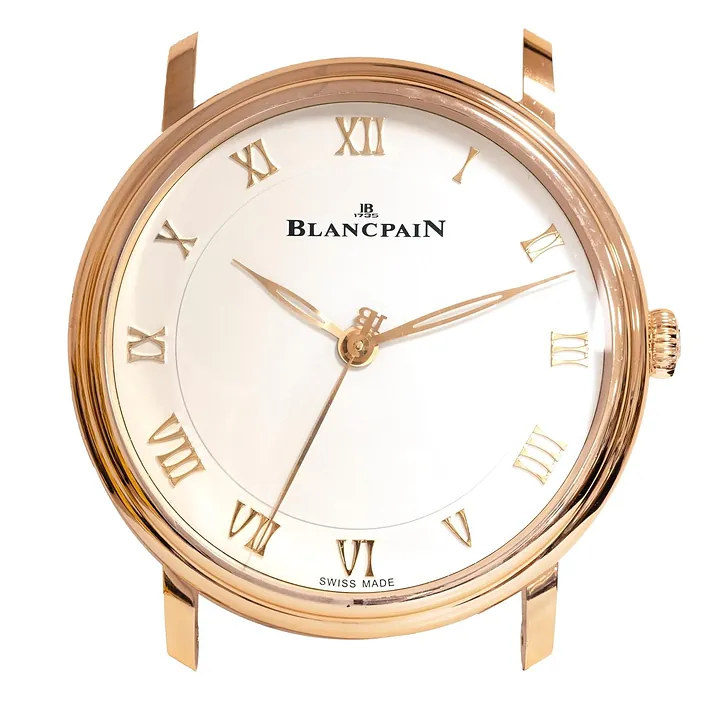
Clocks · c. 2010
Blancpain clock, c. 2010
Antiquorum auction archive, Geneva
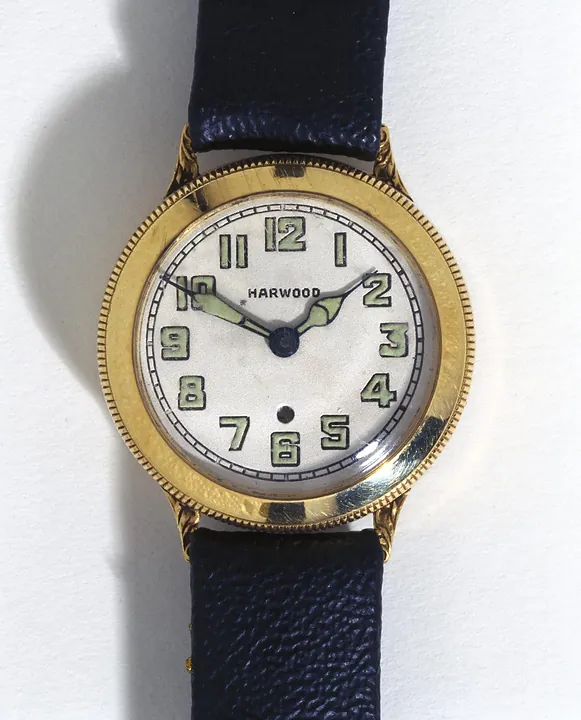
Wristwatches · c. 1930
Wristwatch by J. Harwood and Son and Blancpain, Switzerland, c. 1930
Science Museum Group, London
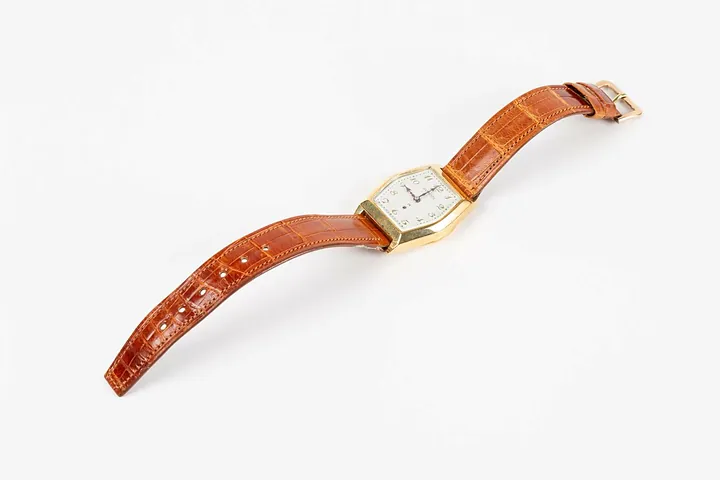
Wristwatches · c. 1930
Wristwatch by Harwood (Société Centrale de la Montre Sans Remontoir), Switzerland, c. 1930 (no. 58042)
German Clock Museum
Wristwatches · c. 1932
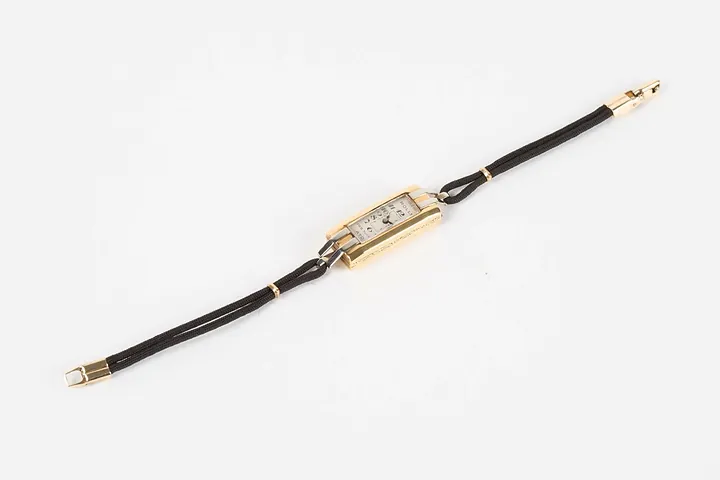
Wristwatch by Blancpain, Switzerland, c. 1932
German Clock Museum

Wristwatches · 1970
Wristwatch by Heno, Switzerland, 1970
Museum Rotterdam

Wristwatches · 1960–1986
'Tri-Compax' calendar chronograph wristwatch in gold case, by Universal, Geneva, Switzerland, 1960–1986.
Science Museum Group, London

Wristwatches · 1969–1970
Beta 21 Quartz wristwatch movement, made in Switzerland, 1970.
Science Museum Group, London

Wristwatches · c. 1969
Omega Speedmaster Moonwatch, ref. 145022-69st, c. 1969
Antiquorum auction archive, Geneva