
Wristwatches · Wristwatch
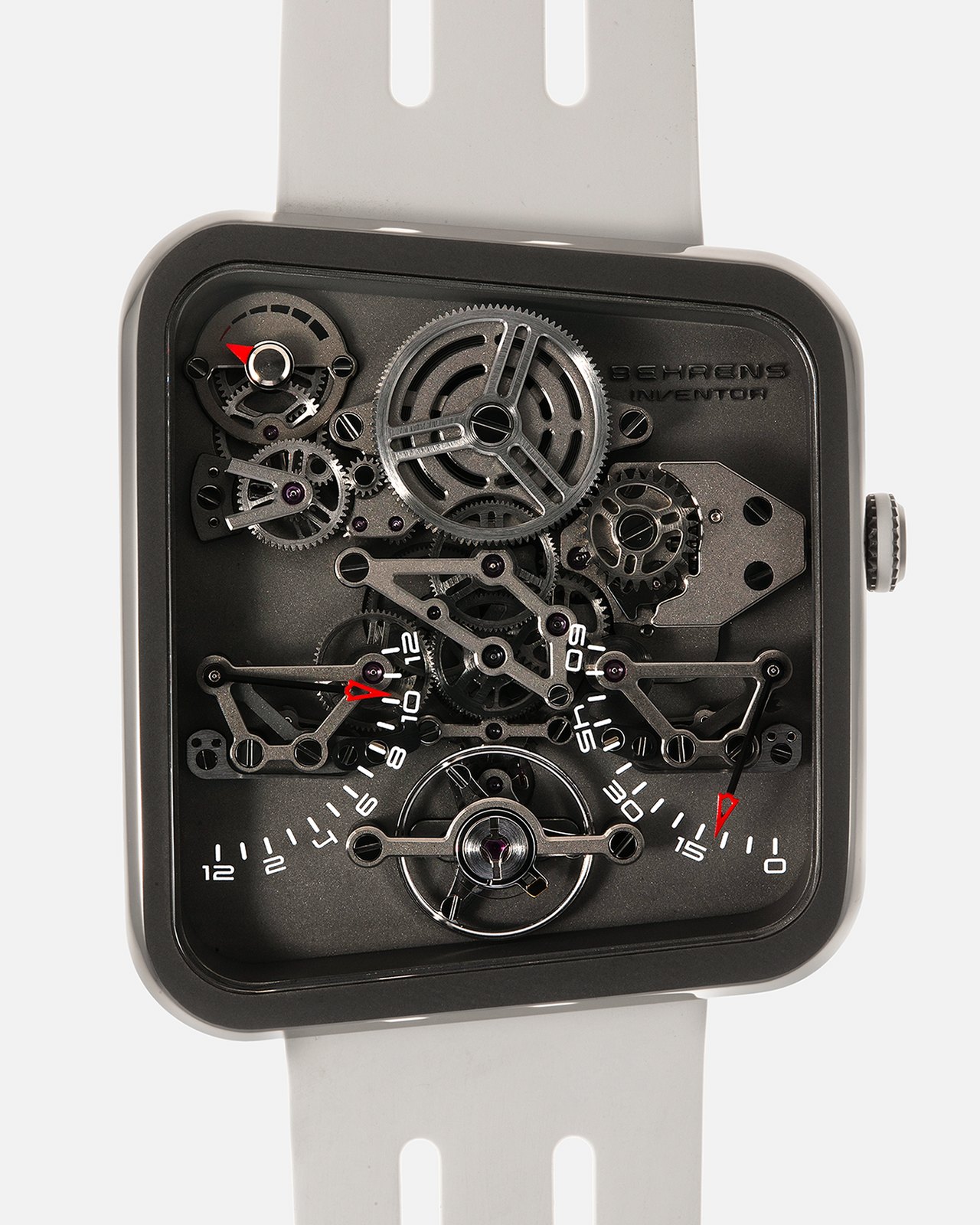
Behrens BH030 Ultralight 20g, 2024
- Maker / attribution
- Behrens (maker)
- Date
- 2024
- Historical period
- Contemporary Horology (2010 – Present)
- Country of origin
- Unrecorded in source
- Object type
- Wristwatch
- Dimensions
- Case 42.6 mm
- Stock no.
- Product 7382615261271
- Credit line
- Dealer listing, S.Song Watches (product 7382615261271)
- Catalogue title (original)
- Behrens BH030 Ultralight 20g (English)
View the source record (dealer listing) ↗ (opens another website in a new tab)Suggest a correction
Record summary
Catalogued by S.Song Watches (dealer), Seattle (stock number Product 7382615261271), this is a wristwatch by Behrens, dated 2024. The Atlas places it in the Contemporary Horology period (2010 – Present) of its Wristwatches collection. Recorded dimensions: Case 42.6 mm. The record is illustrated with 6 photographs.
Assembled from the source record's structured fields. Dates and attributions are given as the source states them; where a field is missing the Atlas leaves it blank rather than estimating.
Catalogue description
Dealer description — S.Song Watches
When it comes to unconventional and whimsical independent watch brands, Behrens is certainly a young brand that fits the bill. Founded in 2012 in Shenzhen, China, Behrens, like many independent watch brands today, isn’t afraid to push the technical boundaries of what’s possible. One standout example of their remarkable work is the Behrens BH030 Ultralight 20g, which, I must say, is a polarizing watch—in the best way possible. First unveiled at Watches and Wonders 2023, it features an asymmetrical trapezoidal case shape—a detail that even extends to its presentation box. As someone who has heard a lot about Behrens but has yet to encounter much of their work, everything about this watch feels both foreign and oddly familiar—fresh, yet reminiscent of a design concept I’ve seen before. Take, for example, its feather-light construction and semi-aggressive styling, which evoke a conceptual and almost spiritual resemblance to the more technical, high-end titanium and carbon sports watches from brands like Richard Mille, F.P. Journe, Rebellion, and even De Bethune, to some extent. At first glance, you’ll notice that the case is longer on the left side and gradually narrows down towards the right. On paper, the case measures 42.6mm x 38.2mm x 6mm, with a subtle downward arch that enhances its overall wearability. According to Behrens, the provocative case design was inspired by the concept of a ceremonial tool called the ‘Hu’ (笏 in Mandarin), with a history dating back to the Zhou Dynasty (1046–256 BCE) of ancient China. Before the widespread use of paper, this scepter-like object was used by court officials and ministers to record official notes, orders, and important instructions from the emperor. As its name suggests, the BH030’s ‘Ultralight’ quality comes from the use of grade 5 titanium in both the case and the movement. While I’m not usually a fan of ultra-light watches, as I tend to prefer timepieces with a bit more heft, the BH030 is an exception for me due to how natural and seamless the entire design feels on the wrist. Visually, there’s a lot going on, but at the same time, every component of the BH030 feels thoughtfully designed and never forced. From how the watch sits comfortably on the wrist to the soft Fluoroelastomer rubber strap that secures it snugly—even though it’s a massive 23mm in width—the slim case, thin strap, and flushed lugs help offset much of the perceived visual bulk. This is a plus if you plan to wear the BH030 for extended periods throughout the day. Powering the BH030 from within is a uniquely manufactured in-house, manual-winding Cal. BM02 with a double retrograde function and a 38-hour power reserve. If you look closer, you’ll notice that the movement essentially doubles as the dial. In the pursuit of ultra-lightness, Behrens took an innovative approach by printing all the markings directly onto the underside of the curved sapphire crystal, eliminating the need for a traditional dial to host these details. All of this results in a layout comprising a double retrograde display, with the hours on the left and minutes on the right, both indicated by hands with bright red tips for legibility. The two indications are individually separated by an exposed, free-sprung balance wheel at 6:00, beating methodically at 28,800 bph. A power reserve indicator is also discreetly tucked away at 11:00. It’s worth noting that the combination here of industrial grey titanium, intricately polished hands and wheels, and the solid titanium caseback as a backdrop comes together beautifully. That said, the most impressive aspect of the Cal. BM02 for me, is that the movement is deliberately curved to fit perfectly within the slim 6mm, 15-degree arched case. How insane is that? Time and time again, it’s offerings like these from small yet incredibly passionate brands like Behrens that make the independent watchmaking scene so exciting and dynamic. Sure, the BH030’s aesthetics may not resonate with everyone, but I think that’s exactly what makes it so novel and intriguing. It appeals to a certain type of connoisseur—one who’s in the market for a wildcard piece or perhaps an enthusiast looking for something off the beaten path. If that sounds like you, the BH030 Ultralight 20g could be the perfect addition to your watch box: sleek, thin, yet mighty in both concept and design.
Historical context
Contemporary Horology (2010 – Present)
Silicon components, connected watches, optical-lattice research clocks and a thriving independent scene.
Smartwatches became the world's best-selling watches, while mechanical watchmaking focuses on craft, innovation (silicon components, new escapements) and independent makers.
Read the period in the timelineMore wristwatches from this periodEarlier: Mechanical Renaissance
Atlas type guide
Wristwatches
Bracelet watches were worn by women from the early nineteenth century — Breguet made one for Caroline Murat, Queen of Naples, in 1810–12 — but the wristwatch only became a man's instrument with military use and aviation in the early twentieth century. Between the World Wars it overtook the pocket watch; the 1920s and 1930s brought rectangular Art Deco cases, water-resistant cases and the first automatic winding systems.
After 1945 the wristwatch became a carrier of identity — dress watches, sports and dive watches, chronographs, calendars — produced by Swiss, American, Japanese, German, Soviet and Chinese industries. The quartz revolution after 1969 and the mechanical renaissance since the 1990s, including the rise of independent watchmakers, complete the story.
What to look for
- The reference number (between the lugs or inside the case back) and serial number, the starting point for dating.
- The calibre: its maker and number are often stamped under the dial or on the bridge.
- Originality of dial, hands and crown — refinished ('redial') dials are common.
- Case material marks: 18K/750, 14K/585, stainless steel, gold-filled, plated.
Dating clues
- Wire-lug cases: before c. 1925.
- Water-resistant screw-down cases: from 1926.
- Quartz movements: from 1969; sapphire crystals widespread after c. 1980.
General guidance written by the Atlas editors about this kind of object. It is not a statement about this particular piece; for that, rely on the source record above and on physical examination.
Related records
Wristwatches · 2010
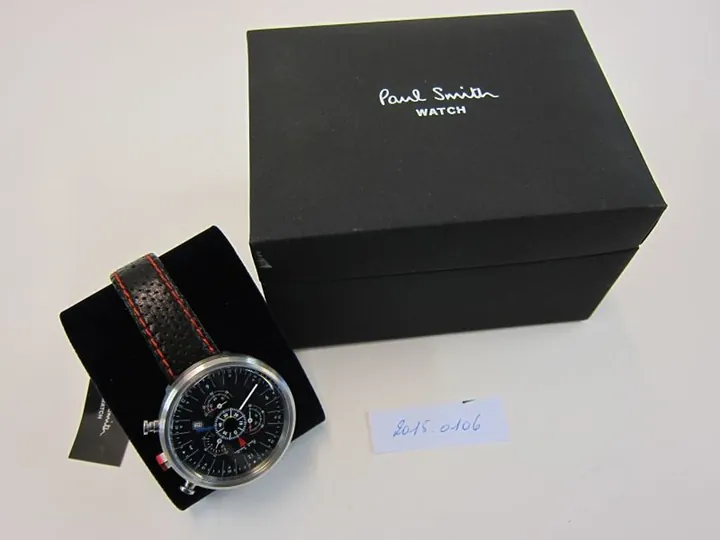
Wristwatch, 2010
Modemuseum Hasselt
Wristwatches · 2018 (Series 4 released in September 2018; '1977' in the source is the model number A1977)
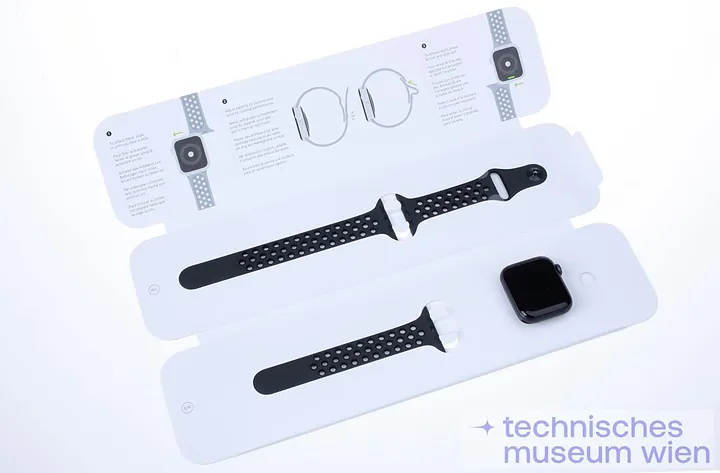
Apple Watch Series 4 (GPS, 40 mm, model A1977), 2018
Vienna Museum of Science and Technology
Wristwatches · c. 2010s
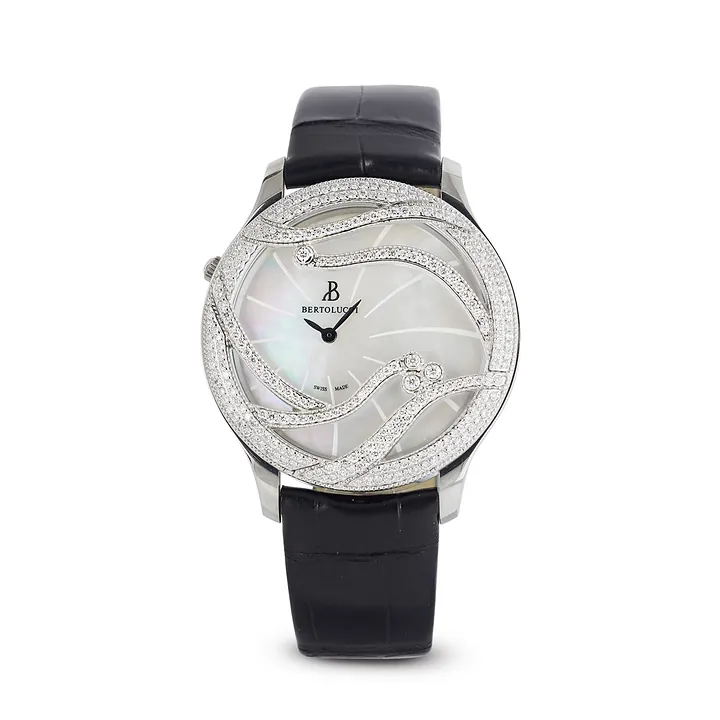
Bertolucci Stria III, ref. 11513.50.45.B88.6C1.501, c. 2010s
Antiquorum auction archive, Geneva
Wristwatches · c. 2010s
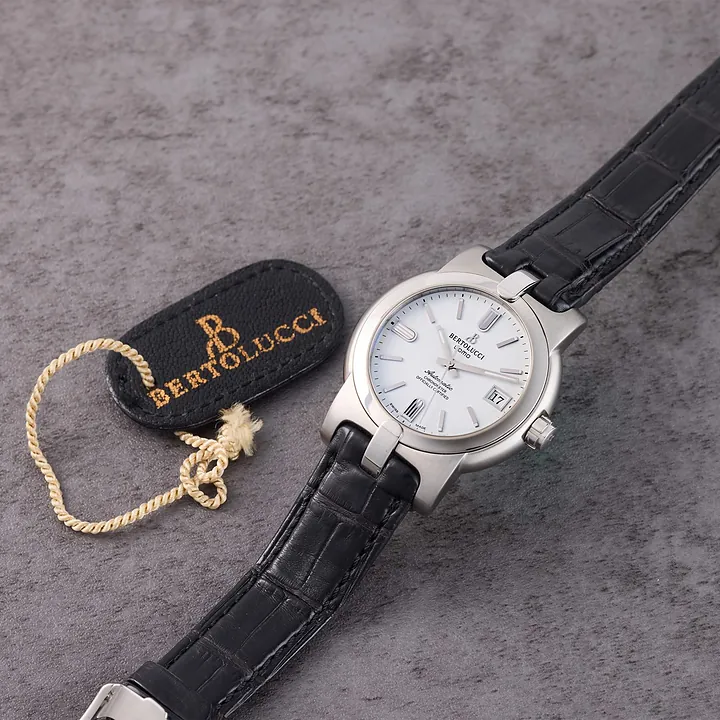
Bertolucci Uoma, ref. 824.51.41.10B, c. 2010s
Antiquorum auction archive, Geneva

Wristwatches · c. 2010s
Breguet Type XXI, ref. 3810, c. 2010s (Antiquorum Lot 381-24)
Antiquorum auction archive, Geneva

Wristwatches · c. 2010s
Breguet Type XXI, ref. 3810, c. 2010s (Antiquorum Lot 386-229)
Antiquorum auction archive, Geneva

Wristwatches · Sold in September 2010
Breitling Cosmonaute, ref. A 22322, Sold in September 2010
Antiquorum auction archive, Geneva
Wristwatches · c. 2010s
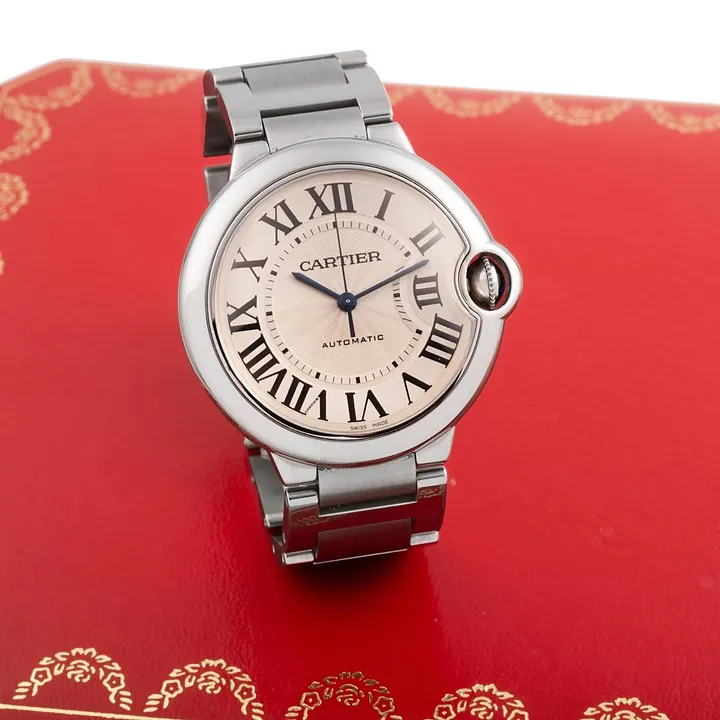
Cartier Ballon Bleu, ref. 3284, c. 2010s
Antiquorum auction archive, Geneva