
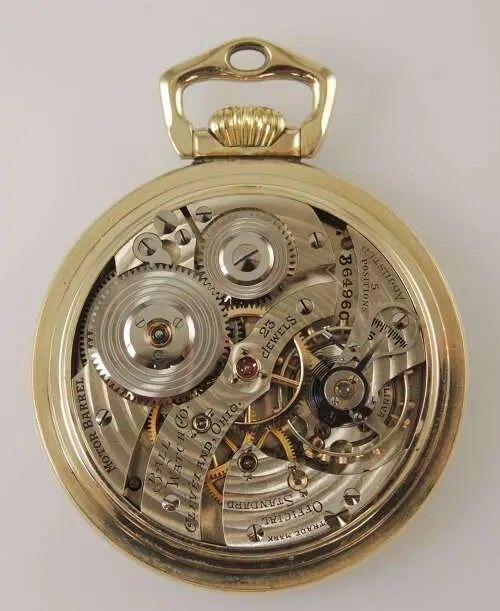
Pocket Watches · Railroad pocket watch
Ball Watch Co. 16-size 23-jewel 998 Elinvar railroad pocket watch
- Maker / attribution
- Ball Watch Co. / Hamilton (source attribution)
- Date
- c. 1941
- Historical period
- Golden Age of Mechanical Watchmaking (1900 – 1945)
- Country of origin
- United States
- Object type
- Railroad pocket watch
- Materials / technique
- Yellow 10K gold filled
- Dimensions
- 51mm x 13mm deep
- Holding institution
- Atlam Watches
- Accession / object no.
- 4.68 (AB-219857)
- Credit line
- Atlam Watches
- Catalogue title (original)
- Pristine 16 Size 23 Jewel 998 Elinvar Ball Hamilton Pocket Watch c1941 in Antique Mens Watches (English)
View the source record ↗ (opens another website in a new tab)Suggest a correction
Record summary
Held and catalogued by Atlam Watches (object number 4.68 (AB-219857)), this is a railroad pocket watch attributed to Ball Watch Co. / Hamilton, made in United States, dated c. 1941. The Atlas places it in the Golden Age of Mechanical Watchmaking period (1900 – 1945) of its Pocket Watches collection. Materials and techniques recorded by the source: Yellow 10K gold filled. Recorded dimensions: 51mm x 13mm deep. The record is illustrated with 1 photograph.
Assembled from the source record's structured fields. Dates and attributions are given as the source states them; where a field is missing the Atlas leaves it blank rather than estimating.
Catalogue description
Original object description
Originating in the United States and assigned to circa 1941, this 16-size open-face railroad pocket watch was distributed by the Ball Watch Company. It is powered by a 23-jewel grade 998 nickel bridge movement produced by Hamilton, bearing the serial number B64969. The damascened mechanism incorporates circular patterning, raised gold settings, gold train gearing, a motor barrel, jeweled winding wheels, and a gold cap on the escape wheel. Its lever escapement operates alongside an overcoil Elinvar hairspring governed by a whiplash micrometer regulator, with factory adjustments calibrated to five positions. Engravings on the bridges include the serial number # B64969, designations for the Ball Watch Co. of Cleveland, Ohio, the jewel count, positional adjustments, and notations acknowledging its motor barrel, Elinvar spring, trademark status, and alignment with railroad inspection standards. The mechanism is housed in a yellow 10K gold-filled Ball Model case spanning 51 mm in diameter and 13 mm in depth. The housing is constructed with threaded screw-off bezels, carved bezel detailing, an engine-turned back cover, a beveled mineral glass crystal, a fluted crown, and a patented stirrup bow. Operation is handled via stem winding and lever setting. Dealer documentation cites case markings referencing official railroad standards. Catalogue listings also describe a white enamel dial with blued steel hands and Cleveland railroad markings; nevertheless, existing photographic evidence portrays merely the movement, leaving the dial appearance, case exterior, and internal case stamps unverified. Furthermore, the circa 1941 date and the reported production run of 2,700 units are dealer claims that await corroboration from historical Hamilton manufacturing registers.
Inscriptions & marks
B64969
Historical context
Golden Age of Mechanical Watchmaking (1900 – 1945)
The wristwatch displaces the pocket watch; waterproof cases, self-winding and grand complications.
The pocket watch reached technical maturity and then began to give way to the wristwatch after the First World War. Complicated watches for collectors such as Henry Graves Jr. and James Ward Packard, railroad watches, and slim Art Deco dress watches are characteristic.
Read the period in the timelineMore pocket watches from this periodEarlier: Industrial Revolution
Atlas type guide
Railroad and railway watches
Timetables made accurate timekeeping a matter of safety. After a fatal collision at Kipton, Ohio, in 1891, American railroads adopted strict standards: open-face watches, lever setting, at least 17 jewels, adjustment to temperature and five positions, and a performance within 30 seconds a week, inspected regularly by approved watch inspectors. Waltham, Elgin, Hamilton, Illinois and Ball made railroad-grade watches in large numbers.
European railways issued service watches to guards, drivers and station staff, often engraved with the railway's initials and a staff number. Such watches link industrial timekeeping with the standardisation of time zones (Greenwich Mean Time adopted by British railways in 1847; North American standard time in 1883).
What to look for
- Open-face cases with the crown at 12 and lever setting under the bezel.
- Montgomery dials with every minute numbered, or bold Arabic numerals.
- 'Railroad grade', '21 Jewels', 'Adjusted 5 positions' on the movement.
- Railway initials and issue numbers engraved on the case back.
Dating clues
- American railroad standards: from 1891–93, revised c. 1908.
- Serial numbers of American makers allow dating to within a year.
General guidance written by the Atlas editors about this kind of object. It is not a statement about this particular piece; for that, rely on the source record above and on physical examination.
Related records
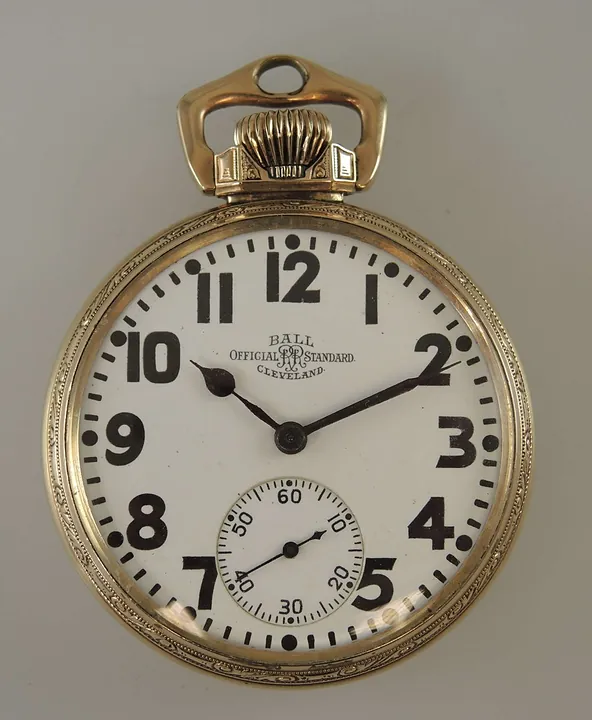
Pocket Watches · c. 1928
Ball Hamilton 999P Official Railroad Grade Pocket Watch
Atlam Watches
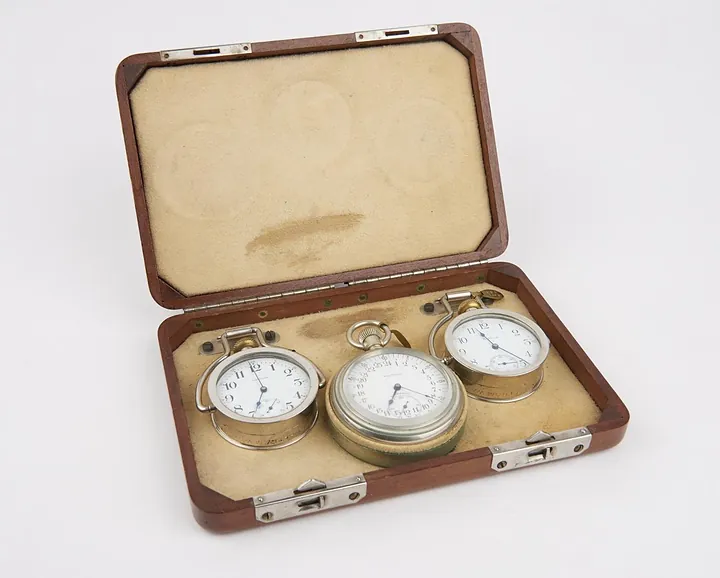
Pocket Watches · c. 1900
Pocket watch by American Waltham Watch Company, United States, c. 1900
Science Museum Group, London
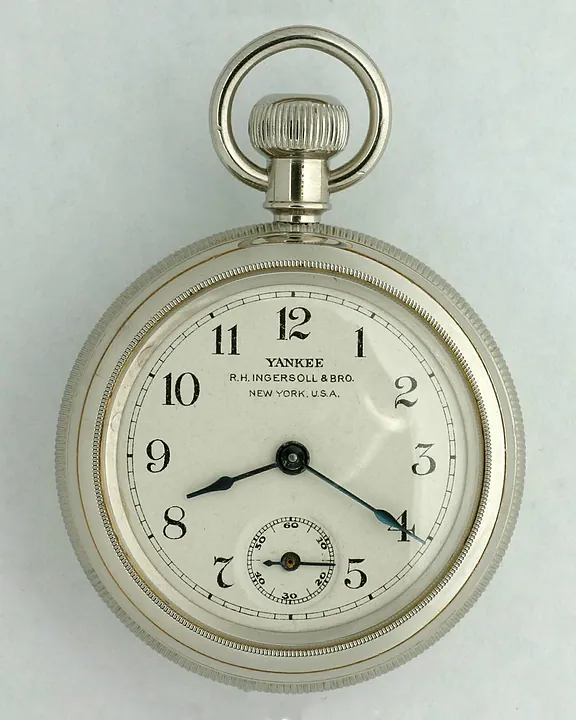
Pocket Watches · c. 1900
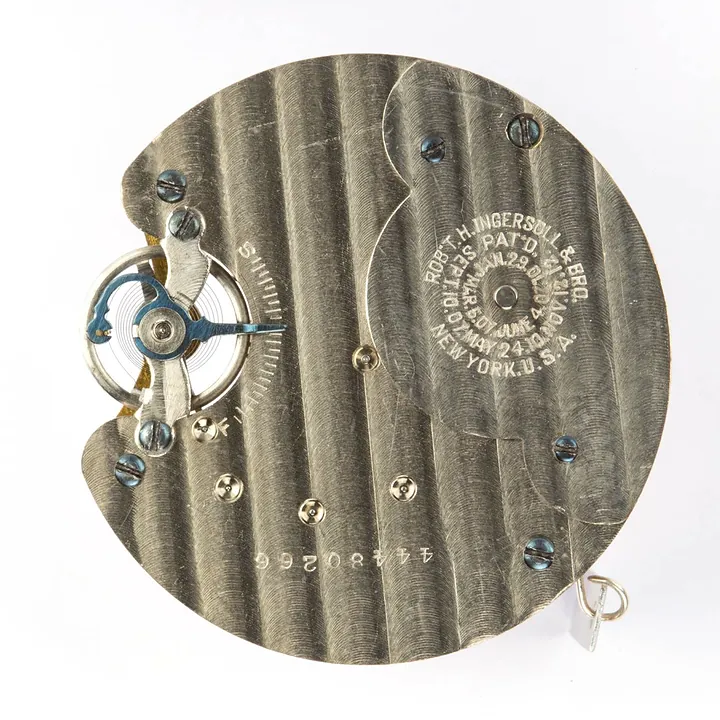
Pocket watch by Robt. H. und Bro. Ingersoll, United States, c. 1900
German Clock Museum
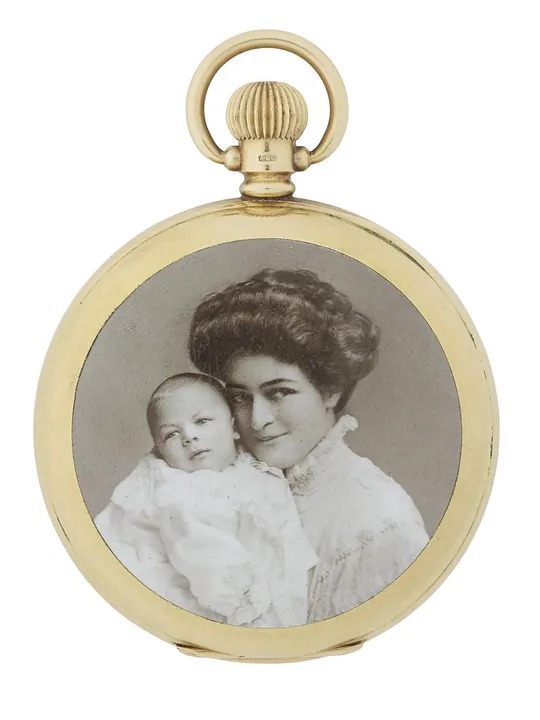
Pocket Watches · 1904
Pocket watch by American Waltham Watch Company and Dennison Watch Case Co, United States, 1904
Science Museum Group, London
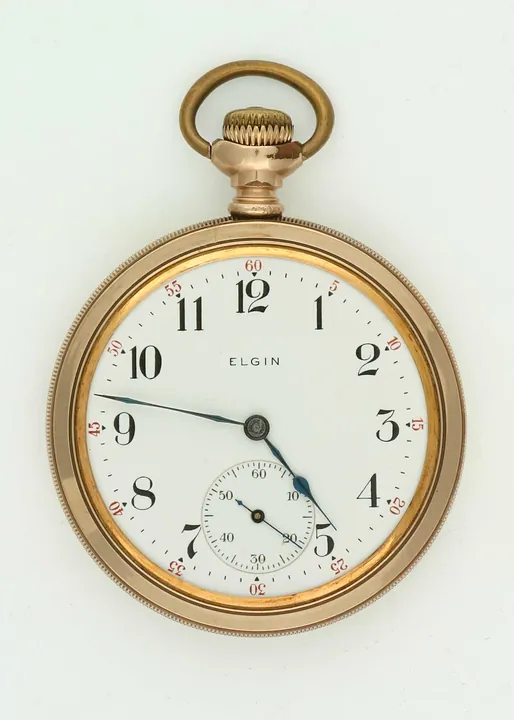
Pocket Watches · c. 1905
Pocket watch by Brooklyn Watch Case Co. B. W. C., United States, c. 1905
German Clock Museum
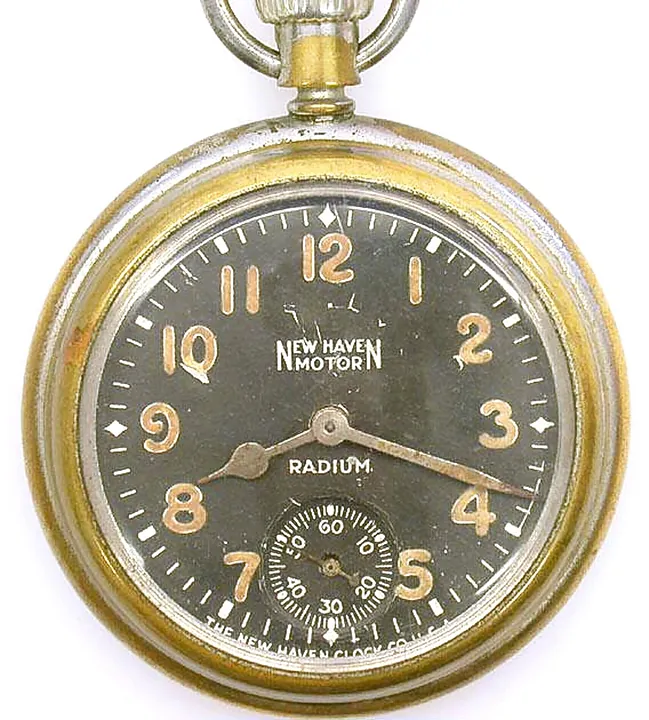
Pocket Watches · c. 1910
Pocket watch by New Haven Clock Co., United States, c. 1910
German Clock Museum
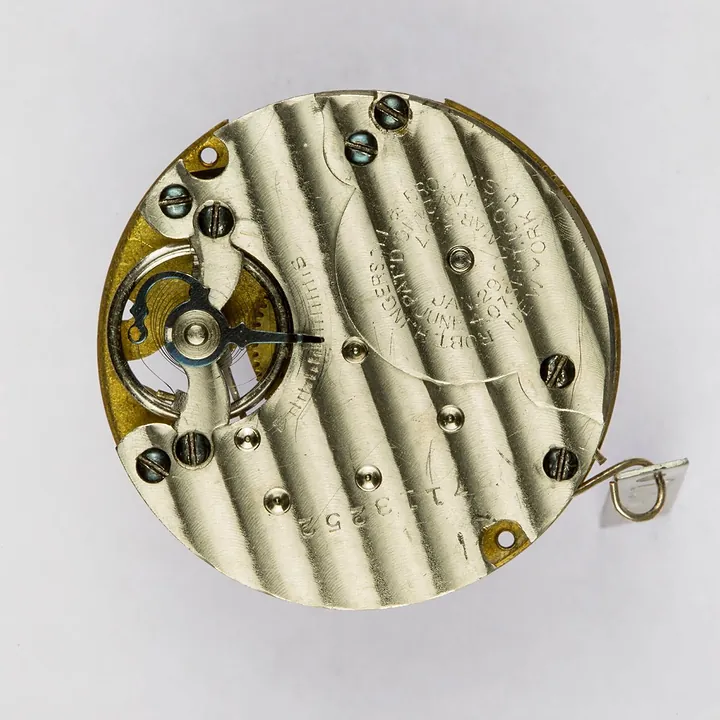
Pocket Watches · c. 1910
Pocket watch by Robt. H. und Bro. Ingersoll, United States, c. 1910
German Clock Museum
Pocket Watches · c. 1915
Pocket watch by Robt. H. und Bro. Ingersoll, United States, c. 1915
German Clock Museum