
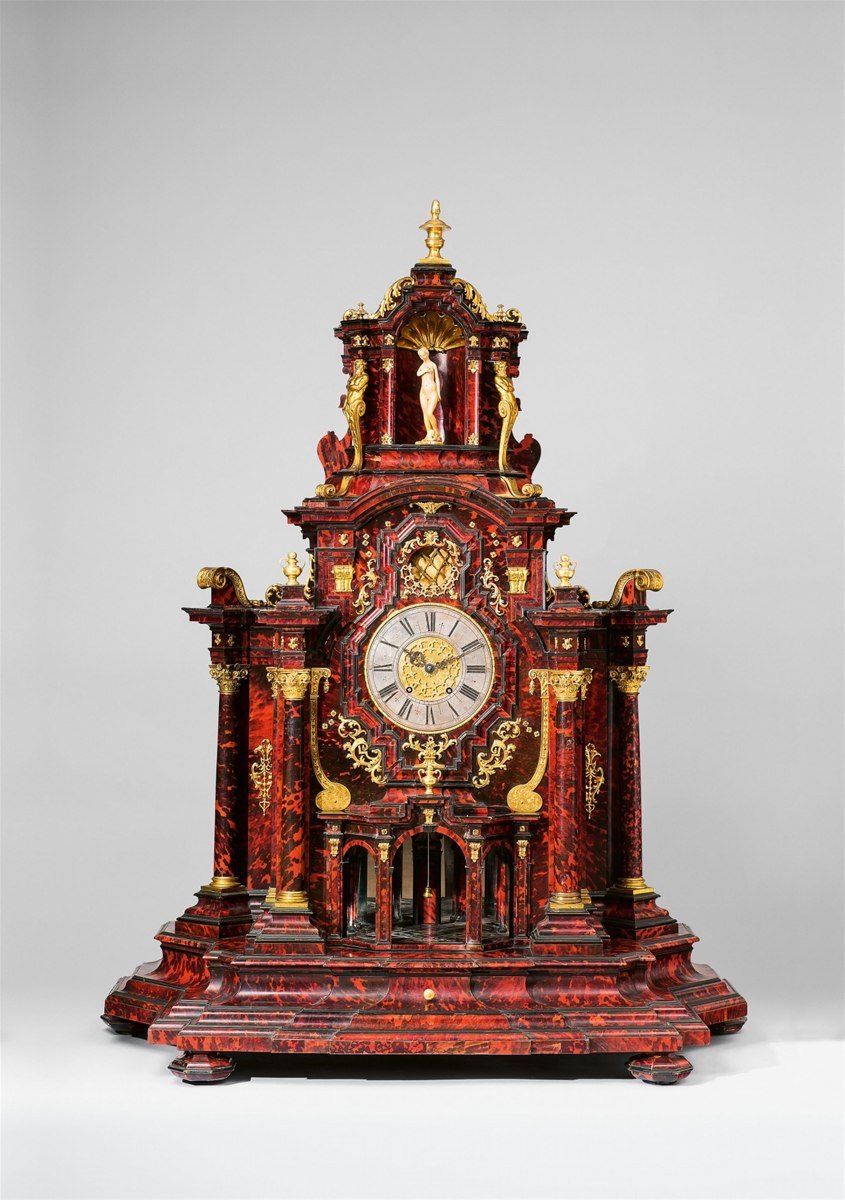
Clocks · Architectural cabinet clock
Augsburg tortoiseshell veneer cabinet and clock
- Maker / attribution
- Heinrich Eichler the Elder (workshop)
- Date
- Late 17th /early 18th c.
- Historical period
- Early Modern Horology (1600 – 1750)
- Country of origin
- Germany
- Object type
- Architectural cabinet clock
- Materials / technique
- Tortoiseshell, palisander, and ebony veneer on oak; ormolu mountings
- Dimensions
- H 135.5, W 106.5, D 44 cm
- Holding institution
- Lempertz
- Accession / object no.
- 707
- Credit line
- Lempertz
- Catalogue title (original)
- A splendid Augsburg tortoiseshell veneer cabinet and clock - Lot 707 (English)
View the source record ↗ (opens another website in a new tab)Suggest a correction
Record summary
Held and catalogued by Lempertz (object number 707), this is an architectural cabinet clock by Heinrich Eichler the Elder, made in Germany, dated Late 17th /early 18th c.. The Atlas places it in the Early Modern Horology period (1600 – 1750) of its Clocks collection. Materials and techniques recorded by the source: Tortoiseshell, palisander, and ebony veneer on oak; ormolu mountings. Recorded dimensions: H 135.5, W 106.5, D 44 cm. The record is illustrated with 1 photograph.
Assembled from the source record's structured fields. Dates and attributions are given as the source states them; where a field is missing the Atlas leaves it blank rather than estimating.
Catalogue description
Original object description
Structured in three architectural tiers over an oak carcass, this large Baroque cabinet clock from the late 17th or early 18th century is finished in red tortoiseshell, ebony, and palisander veneers with gilt-bronze mounts. Its unveneered back shows it was conceived for placement against a wall. The breakfront base rests on four octagonal bun feet and contains a central drawer, surmounted by a mirrored loggia accented with scrolling tin arabesques. Above sits a detachable niche flanked by herm pilasters that shelters an ivory figure of Venus beside a dolphin lacking its tail. Surrounding an engraved gilt central plaque, the tin chapter ring displays Roman hour numerals and Arabic five-minute markings. The eight-day movement features curved baluster pillars, a verge escapement, a pear-shaped pendulum, an hourly bell strike, an indirect half-hour strike, and a lateral repeating device. Based on preparatory drawings inscribed 'Henricum Eichler Aug.' preserved in the Augsburg Museum graphic arts collection, Christine Kowalski attributed the case to the workshop of Heinrich Eichler the Elder. Recorded later interventions include replacements of the vase finial, sounding bell, ivory carving, and likely the pendulum mechanism.
Historical context
Early Modern Horology (1600 – 1750)
Huygens' pendulum and balance spring transform accuracy; English makers develop the anchor and deadbeat escapements.
Huygens's pendulum (1656–57) improved clock accuracy from about a quarter of an hour to under a minute a day. The anchor escapement (c. 1670) and the long seconds pendulum created the longcase clock; London makers such as Fromanteel, Knibb, Tompion and Quare led European clockmaking, and French makers created the Boulle pendule.
Read the period in the timelineMore clocks from this periodEarlier: Renaissance Horology
Atlas type guide
Bracket, table and spring-driven clocks
Spring-driven clocks freed timekeeping from the hanging weight. The coiled mainspring, documented from the fifteenth century, made portable table clocks possible; to even out its declining force, makers used the fusee, a conical pulley connected to the barrel by a gut line or chain. Renaissance table clocks from Augsburg and Nuremberg — drum-shaped, square or tower-shaped in gilt brass — were luxury scientific objects, often with astronomical dials and alarms.
After the pendulum, English makers developed the bracket clock: a wooden case with a carrying handle, a short pendulum with a verge escapement, and often repeating work to sound the hours on demand at night. Later examples use the anchor escapement. In the nineteenth century, 'table clock' became a broad term for spring clocks of every nationality.
What to look for
- A fusee in the movement (cone-shaped pulley) and the type of line — gut or chain.
- Verge escapement with a short bob pendulum, often with a decoratively engraved backplate.
- Repeat cords or buttons that make the clock strike again on demand.
- Gilt-brass engraved cases and horizontal dials on Renaissance pieces.
- Case shapes: inverted bell, bell top, break-arch, lancet or balloon.
Dating clues
- Drum and tower table clocks: c. 1520–1650.
- Ebony veneered English bracket clocks with verge escapements: c. 1670–1800.
- Engraved backplates were usual on English clocks until c. 1800, then generally plain.
General guidance written by the Atlas editors about this kind of object. It is not a statement about this particular piece; for that, rely on the source record above and on physical examination.
Read next:FuseeAnchor (recoil) escapement
Related records
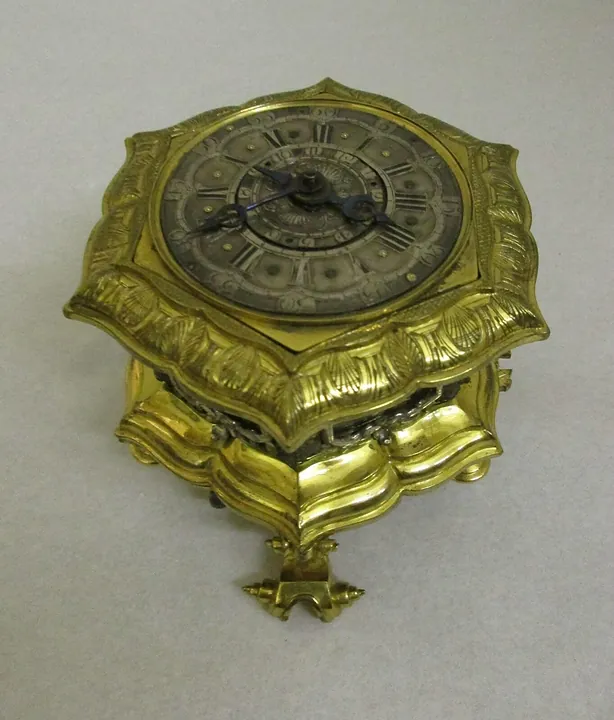
Clocks · 1600–1700
Clock, Germany, 1600–1700
Victoria and Albert Museum, London
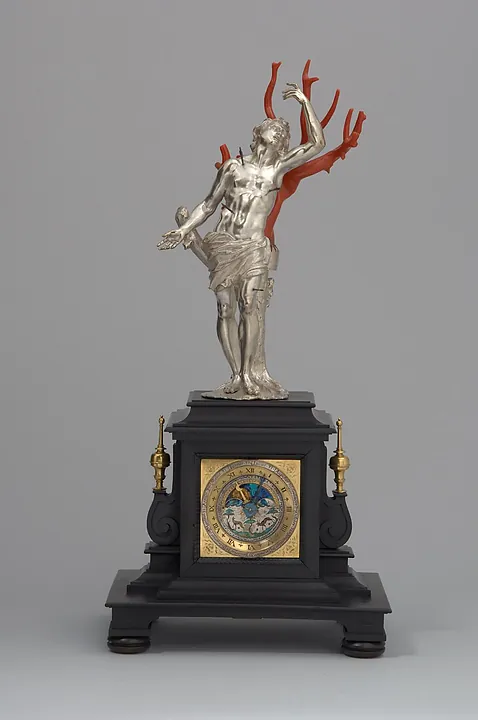
Clocks · 1600–1699
Table clock by Hans Christoph II. Fesenmair, Germany, 1600–1699
Fine Arts Museum Vienna
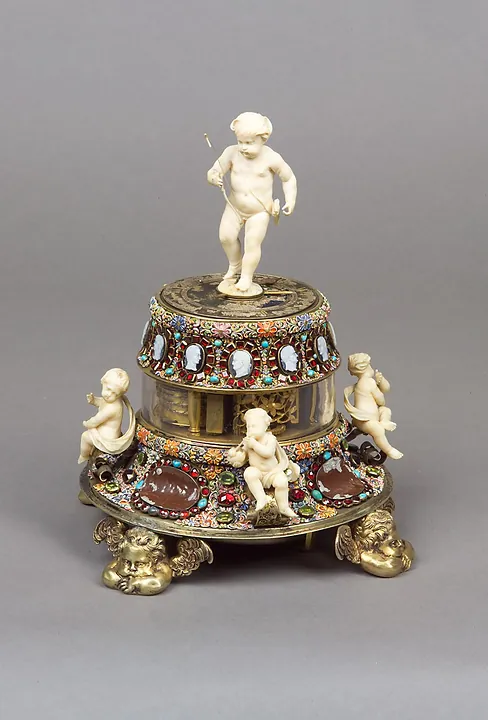
Clocks · 1600–1699
Table clock by Hans Jakob Mair, Germany, 1600–1699
Fine Arts Museum Vienna
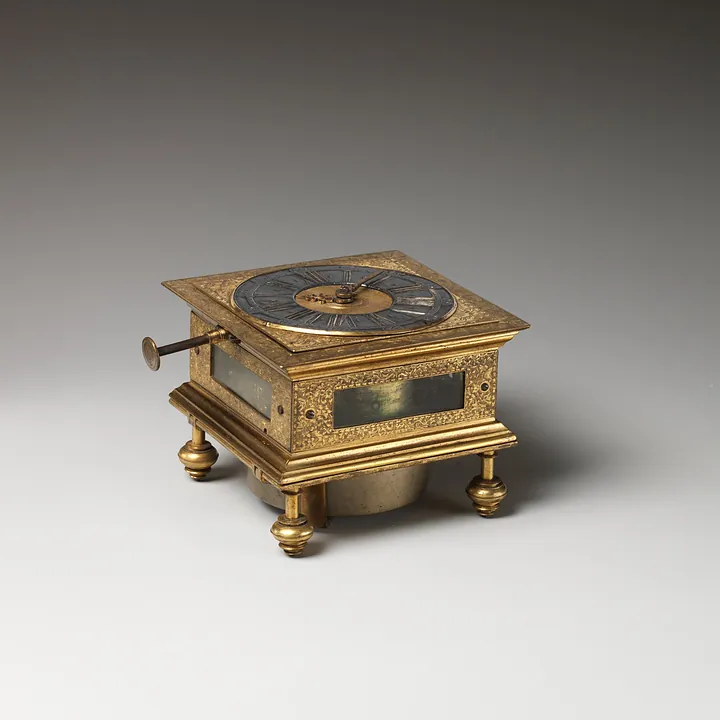
Clocks · 17th century
Table clock by Johann Heinrich Kleinschmidt, Germany, 17th century
The Metropolitan Museum of Art, New York
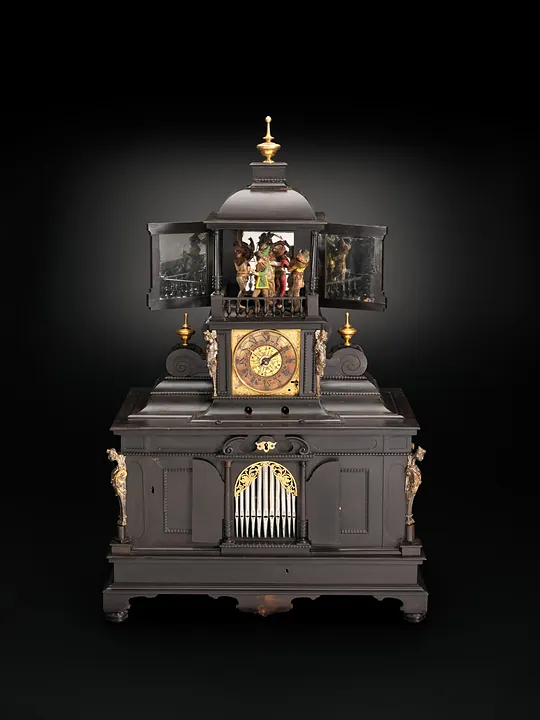
Clocks · c. 1625
Musical clock with spinet and organ by Veit Langenbucher, Germany, c. 1625
The Metropolitan Museum of Art, New York
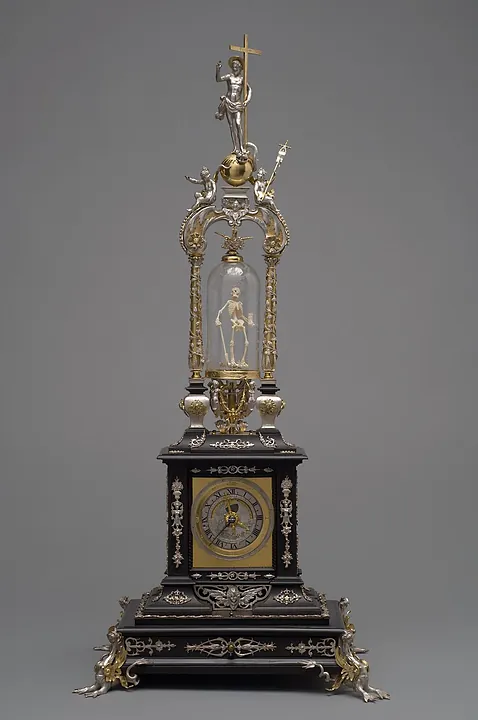
Clocks · 1624–1630
Table clock by Christoph Angermair, Germany, 1624–1630
Fine Arts Museum Vienna
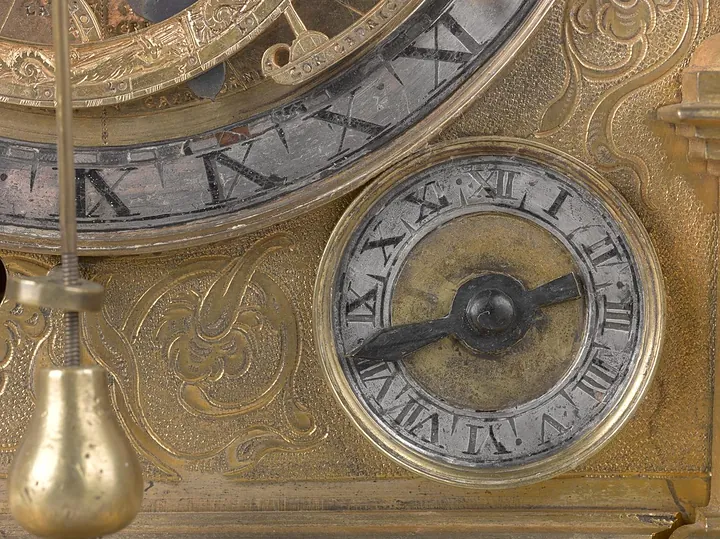
Clocks · 1625–1635
Upright table clock with winding key, by unknown maker, made in Augsburg, Germany, 1625–1635
Science Museum Group, London
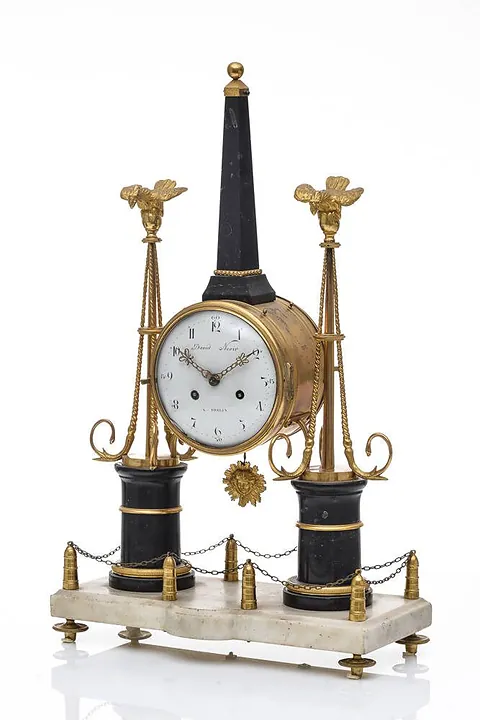
Clocks · 1700–1799
Mantel clock by David Nevir, Germany, 1700–1799
City Museum Berlin