
Wristwatches · Wristwatch
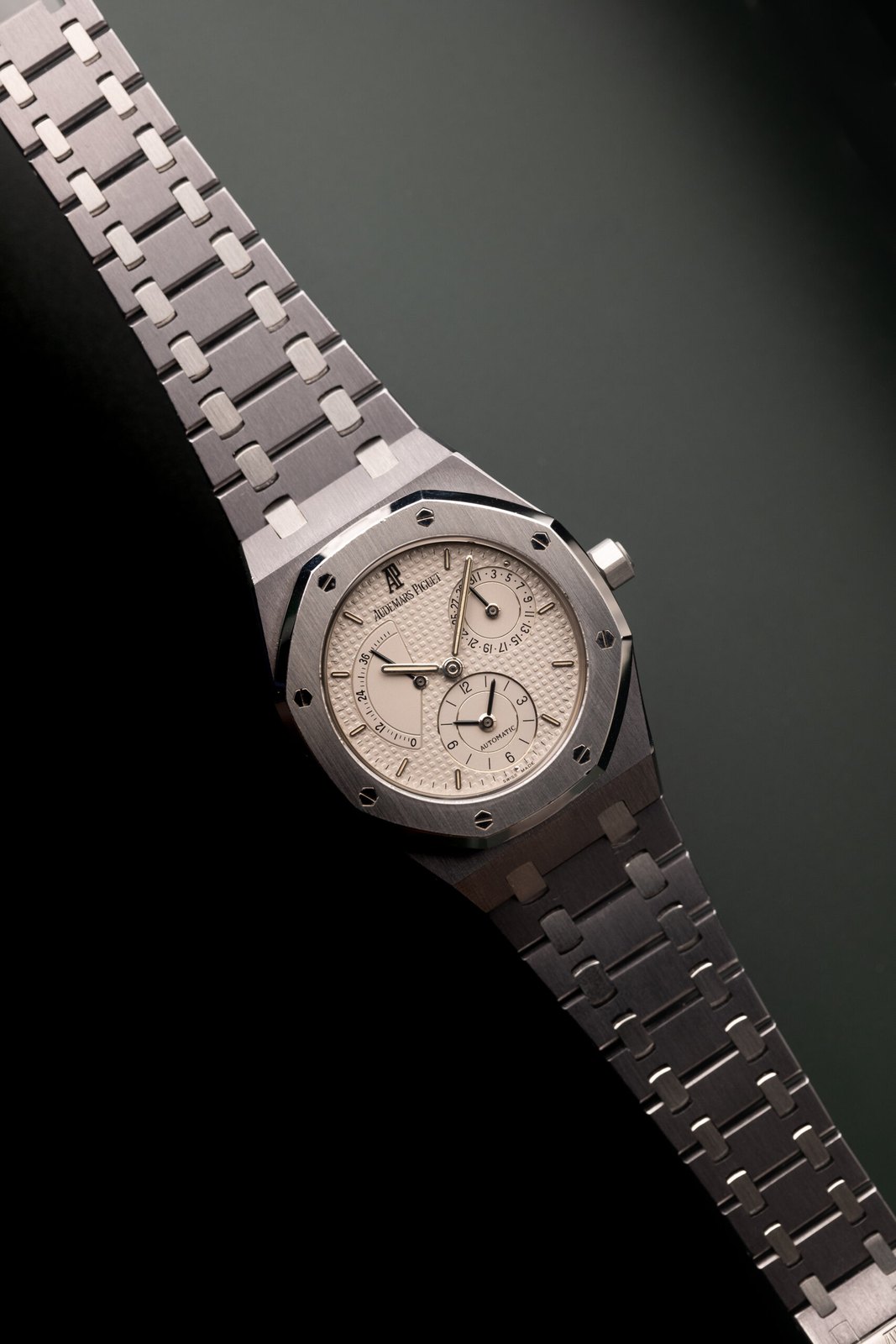
Audemars Piguet Tantalum Royal Oak Dual Time, ref. 25730TT, 2002
- Maker / attribution
- Audemars Piguet (maker)
- Date
- 2002
- Historical period
- Mechanical Renaissance (1990 – 2010)
- Country of origin
- Switzerland
- Object type
- Wristwatch
- Materials / technique
- Tantalum
- Stock no.
- Product 31988
- Credit line
- Dealer listing, Grey & Patina (product 31988)
- Catalogue title (original)
- 2002 Audemars Piguet 25730TT Tantalum Royal Oak Dual Time W/Booklet (English)
View the source record (dealer listing) ↗ (opens another website in a new tab)Suggest a correction
Record summary
Catalogued by Grey & Patina (dealer), Los Angeles (stock number Product 31988), this is a wristwatch by Audemars Piguet, made in Switzerland, dated 2002. The Atlas places it in the Mechanical Renaissance period (1990 – 2010) of its Wristwatches collection. Materials and techniques recorded by the source: Tantalum. The record is illustrated with 6 photographs.
Assembled from the source record's structured fields. Dates and attributions are given as the source states them; where a field is missing the Atlas leaves it blank rather than estimating.
Catalogue description
Dealer description — Grey & Patina
Description : Earliest iterations of the ‘Dual-Time’ came with AP at twelve and ‘all-capital’ signature below, its smooth sub-faces recessed into a small hobnail dial; found at two is the date wheel, with 31 / 1 compacted in a single color; the Dual-Time function sits at six, the secondary hours on an outer ring; last, a power-reserve meter at nine, numerated in intervals of twelve hours ending on 48. Changes between these details varies greatly, often coinciding with another, making for a complicated complication. Tantalum weighs and wears near as much as gold, and, while resembling an aged-blue steel, is much more stubborn to manufacture and machine. Audemars, elevating stainless steel into precious metal territory, was challenged to make something more robust and so sought ways to forge the rarer 73rd element. Early units broke the mills, but the strain resulted in a unique stronger-than-steel case and bracelet utilized by no other manufacturer – further augmenting Audemars Piguet as the industry leader in metalworks. Our example features a variegation that occurred in an extremely narrow window right before the use of an in-house Audemars ‘Grand Tapisserie’ dial and an integrated forth ‘Day-Night’ sub-dial (it’s with this addition the Dual-Time became a true GMT). The 25730 was AP’s first attempt at a GMT, and, after a twenty trial, their last. This neo-vintage timepiece with Patek-family-made dial, JLC movement, and Audemars metal-work is a tour of Switzerland’s finest manufacturing capabilities, a rarity and aberrant within the venerated watch maker’s history. This 25730 seen today is adorned with a rare dial made just before a time when the larger hobnail designs of today were integrated, and on a reference within the Audemars Piguet catalogue when Tantalum cases almost exclusively utilized Tantalum faces. The original white color of the dial has become a soft cream, and the case remains pristine and unpolished. Case : Unpolished Tantalum, chamfered bezel edges transition evenly into the case surround Dial : Stern Creation’s ‘Petite Tapisserie’ brass dial, ‘Alternating Caps’ signature and AP at twelve, ‘Missing 48’ power reserve meter, baton style hands and markers, whose original white color has churned into a muted cream. Bracelet : Integrated AP H-link, unpolished, taper between links remains even with no steps felt between
Historical context
Mechanical Renaissance (1990 – 2010)
Mechanical watches return as cultural objects; independent watchmaking flourishes.
Mechanical watches returned as cultural and luxury objects. Complications, tourbillons and new materials proliferated; independent watchmakers such as George Daniels, F.P. Journe and Philippe Dufour revived artisanal watchmaking; collecting vintage watches became a major field.
Read the period in the timelineMore wristwatches from this periodEarlier: Quartz Revolution
Atlas type guide
Military, pilot and travel watches
The wristwatch owes much of its adoption by men to warfare and aviation. Wristlets — small pocket watches soldered with lugs and worn on a strap — were used in colonial campaigns and became standard equipment in the First World War, with protective grilles over the crystal ('shrapnel guards'). Louis Cartier's Santos (1904), designed for the aviator Alberto Santos-Dumont, is often cited as an early purpose-made pilot's watch.
In the Second World War governments specified watches in detail: the German B-Uhr observation watches, the American A-11, and the British 'W.W.W.' (the 'Dirty Dozen' set of 1945). After the war, jet travel brought GMT and world-time watches, which show two or more time zones at once — Louis Cottier's world-time mechanism and the Rolex GMT-Master (1955) are examples.
What to look for
- Military markings on the case back: broad arrow, issue numbers, 'W.W.W.', 'A.T.P.'
- High-legibility black dials with luminous Arabic numerals; oversized crowns for gloved hands.
- 24-hour hands and rotating 24-hour bezels or city rings on GMT/world-time watches.
- Wire lugs on early wristlets converted from pocket watches.
Dating clues
- Wire-lug wristlets: c. 1900–1925.
- Military specifications of the Second World War: 1939–1945.
- GMT and world-time wristwatches: mainly after 1950.
General guidance written by the Atlas editors about this kind of object. It is not a statement about this particular piece; for that, rely on the source record above and on physical examination.
Related records
Clocks · c. 1990s
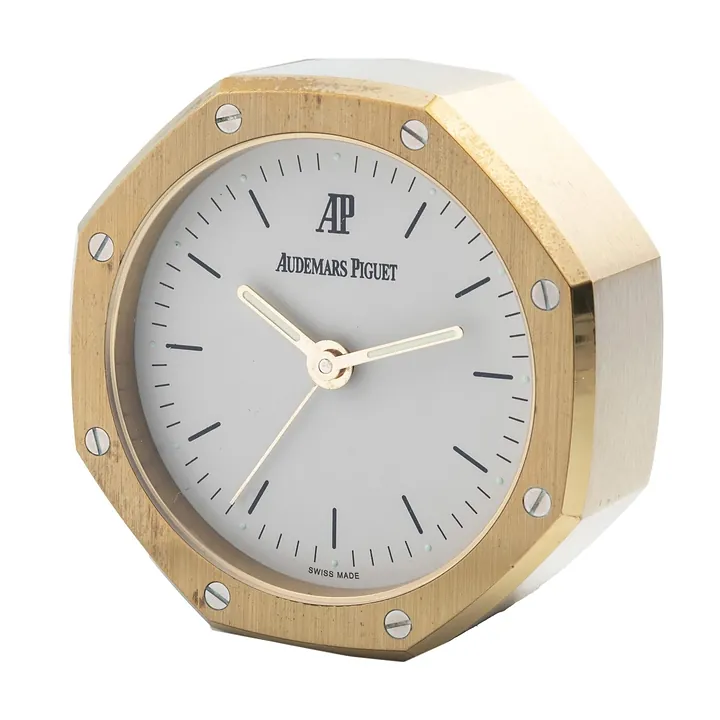
Audemars Piguet Royal Oak, c. 1990s
Antiquorum auction archive, Geneva
Pocket Watches · c. 1960
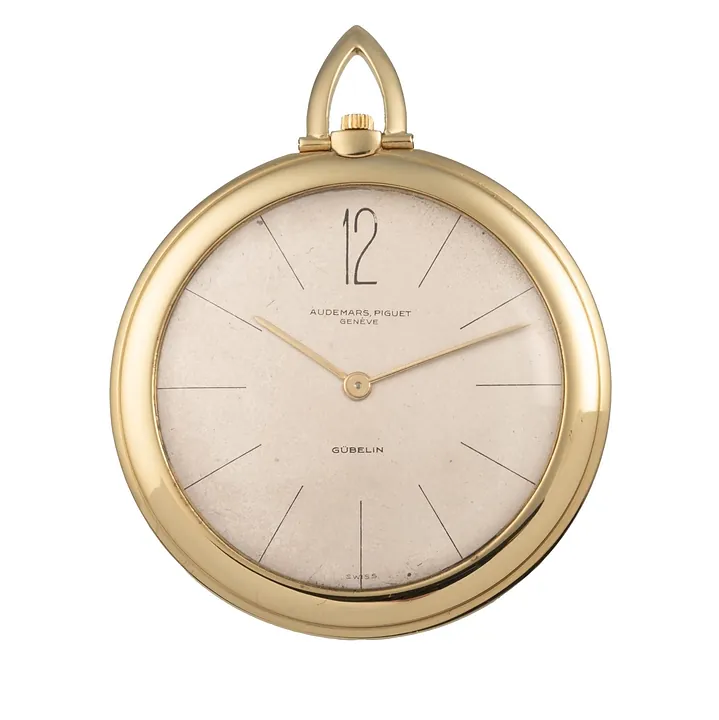
Audemars Piguet ''couteau'', c. 1960
Antiquorum auction archive, Geneva
Pocket Watches · originally sold in November 1961 (per the lot record)
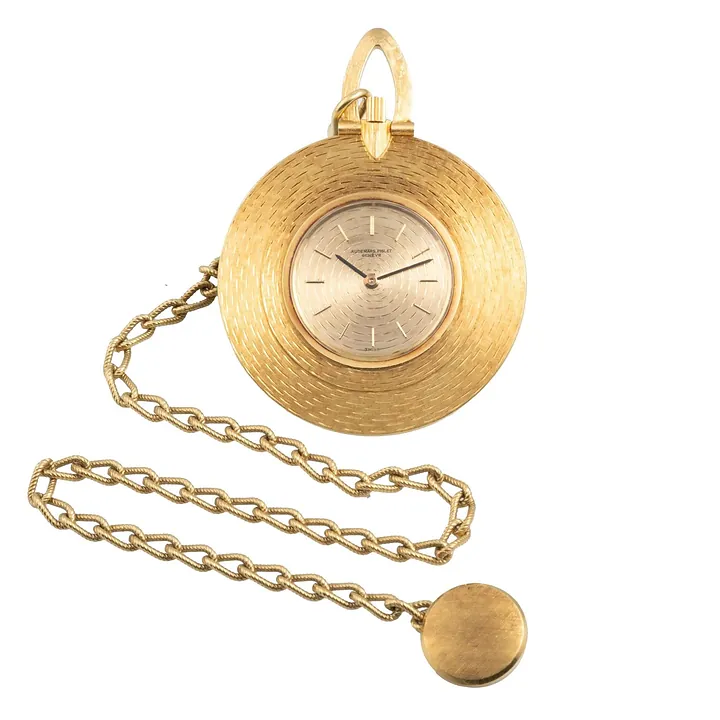
Audemars Piguet "extra Plate", ref. 5633 BA, originally sold in November 1961
Antiquorum auction archive, Geneva
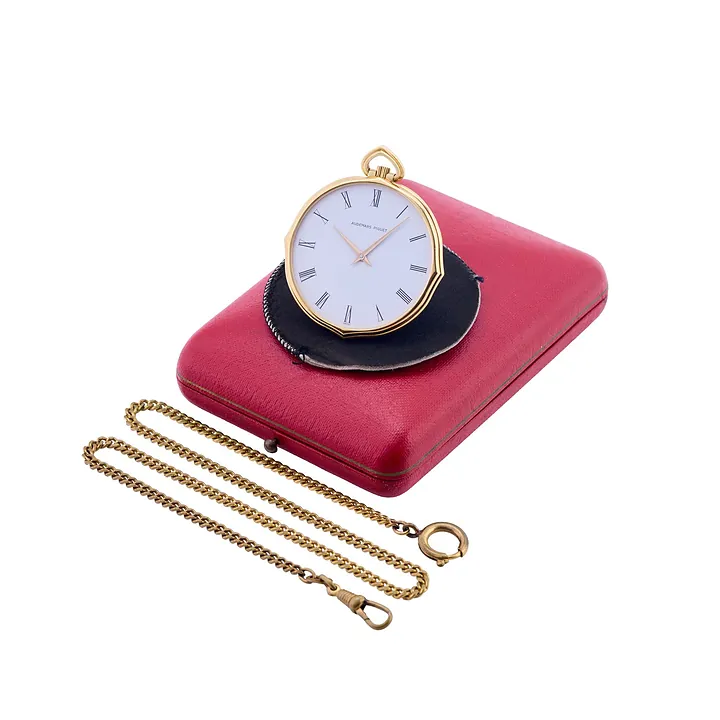
Pocket Watches · c. 1980
Audemars Piguet pocket watch, c. 1980
Antiquorum auction archive, Geneva

Wristwatches · 2008
Wristwatch by Breitling?, 2008
Museum Rotterdam

Wristwatches · c. 1990s
Audemars Piguet Bamboo, c. 1990s
Antiquorum auction archive, Geneva

Wristwatches · c. 1990
Audemars Piguet Huitieme Perpetual Calendar, ref. 25696PT, c. 1990
Antiquorum auction archive, Geneva

Wristwatches · c. 1990
Breitling Chronomat, ref. b13050.1, c. 1990
Antiquorum auction archive, Geneva