
Wristwatches · Wristwatch
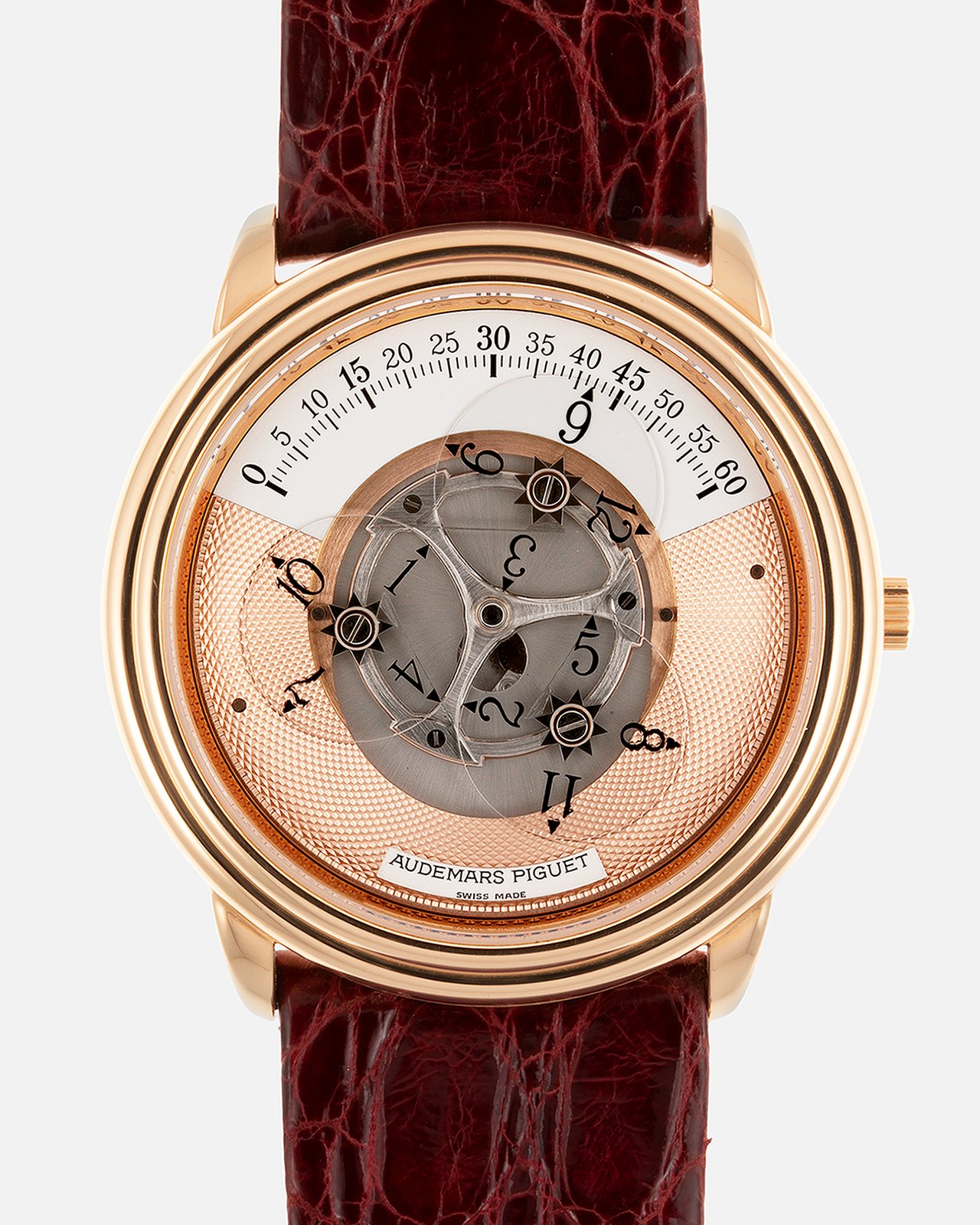
Audemars Piguet Star Wheel 25720OR, 2000
- Maker / attribution
- Audemars Piguet (maker)
- Date
- 2000
- Historical period
- Mechanical Renaissance (1990 – 2010)
- Country of origin
- Switzerland
- Object type
- Wristwatch
- Dimensions
- Case 36 mm
- Stock no.
- Product 6824041742423
- Credit line
- Dealer listing, S.Song Watches (product 6824041742423)
- Catalogue title (original)
- Audemars Piguet Star Wheel 25720OR (English)
View the source record (dealer listing) ↗ (opens another website in a new tab)Suggest a correction
Record summary
Catalogued by S.Song Watches (dealer), Seattle (stock number Product 6824041742423), this is a wristwatch by Audemars Piguet, made in Switzerland, dated 2000. The Atlas places it in the Mechanical Renaissance period (1990 – 2010) of its Wristwatches collection. Recorded dimensions: Case 36 mm. The record is illustrated with 6 photographs.
Assembled from the source record's structured fields. Dates and attributions are given as the source states them; where a field is missing the Atlas leaves it blank rather than estimating.
Catalogue description
Dealer description — S.Song Watches
Famed as one of watchmaking's most successful risk-takers, Audemars Piguet are rightfully renowned for incredible avant-garde timepieces that push horological boundaries far beyond what most would consider reasonable. While the Royal Oak springs to mind as a whacky release given the prevailing market conditions that surrounded it due to the Quartz Crisis and the general lack of stainless steel in most luxury brands' portfolios, the watch I have here is probably even more interesting due to the sheer originality of its design and novel display. Nicknamed the "Star Wheel," the ref. 25720OR has influenced modern brands like Urwerk with its unique layout and thus grown a cult following for its place within AP's hallowed halls as yet another industry trend that they can lay claim to. Launched in 1991, the Audemars Piguet ref. 25720OR "Star Wheel" was a rather unconventional timepiece in the 90s (given the shift growing towards sports watches) that now seems to have been far ahead of its time. Taking inspiration from the wandering hours complication that dates back to the 17th century, the Star Wheel displays the time by using three sapphire disks that rotate along the top of the dial. The minutes are displayed on a separate linear track in the upper portion of the dial, as highlighted by the white backdrop over which the black numerals on the disks and chapter ring are legible. As each hourly disk passes under the chapter ring, the very movement of time is realized, and the next hour slowly takes the previous hours' spot along the chapter ring. Produced only in precious metals and in extremely limited quantities, the Star Wheel features a stepped bezel and an entirely-polished surface alongside a small winding crown and unimposing lugs to complete its physical construction. A wonderful watch on the wrist, the 18kt rose gold ref. 25720OR that I have here measures 36mm in diameter and wears rather neatly. With its beautiful dial sporting a wonderfully textured guilloche golden section along its southern hemisphere, the ref. 25720OR is genuinely captivating in hand. While finding any Star Wheel is no easy feat by any means, the example I have here today is made even more special by the fact is crafted in rose gold. Made in much lower numbers than the more common yellow gold variant, there is a huge visual difference as the guilloched gold dial is also matching in rose gold. The pink-on-pink look is highly sought after and it is easy to see why. Powered by the automatic cal. 2224, which is visible behind an exhibition caseback, the Star Wheel continues the fine craftsmanship and attention to detail visible in its dial and case through to its movement in a rather unsurprising display of impressive watchmaking from Audemars Piguet. While we might expect it from the Holy Trinity member, it's always a pleasure to enjoy nonetheless.
Historical context
Mechanical Renaissance (1990 – 2010)
Mechanical watches return as cultural objects; independent watchmaking flourishes.
Mechanical watches returned as cultural and luxury objects. Complications, tourbillons and new materials proliferated; independent watchmakers such as George Daniels, F.P. Journe and Philippe Dufour revived artisanal watchmaking; collecting vintage watches became a major field.
Read the period in the timelineMore wristwatches from this periodEarlier: Quartz Revolution
Atlas type guide
Wristwatches
Bracelet watches were worn by women from the early nineteenth century — Breguet made one for Caroline Murat, Queen of Naples, in 1810–12 — but the wristwatch only became a man's instrument with military use and aviation in the early twentieth century. Between the World Wars it overtook the pocket watch; the 1920s and 1930s brought rectangular Art Deco cases, water-resistant cases and the first automatic winding systems.
After 1945 the wristwatch became a carrier of identity — dress watches, sports and dive watches, chronographs, calendars — produced by Swiss, American, Japanese, German, Soviet and Chinese industries. The quartz revolution after 1969 and the mechanical renaissance since the 1990s, including the rise of independent watchmakers, complete the story.
What to look for
- The reference number (between the lugs or inside the case back) and serial number, the starting point for dating.
- The calibre: its maker and number are often stamped under the dial or on the bridge.
- Originality of dial, hands and crown — refinished ('redial') dials are common.
- Case material marks: 18K/750, 14K/585, stainless steel, gold-filled, plated.
Dating clues
- Wire-lug cases: before c. 1925.
- Water-resistant screw-down cases: from 1926.
- Quartz movements: from 1969; sapphire crystals widespread after c. 1980.
General guidance written by the Atlas editors about this kind of object. It is not a statement about this particular piece; for that, rely on the source record above and on physical examination.
Related records
Clocks · c. 1990s
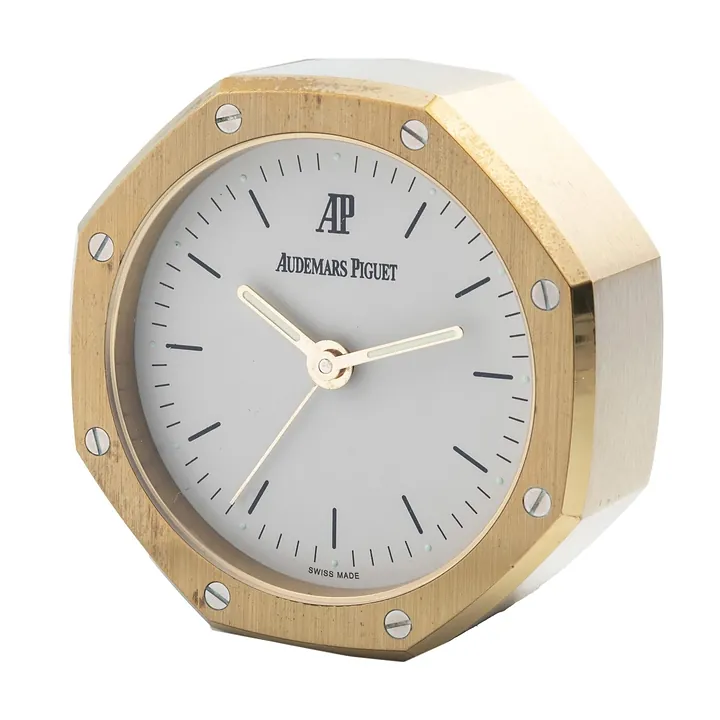
Audemars Piguet Royal Oak, c. 1990s
Antiquorum auction archive, Geneva
Pocket Watches · c. 1960
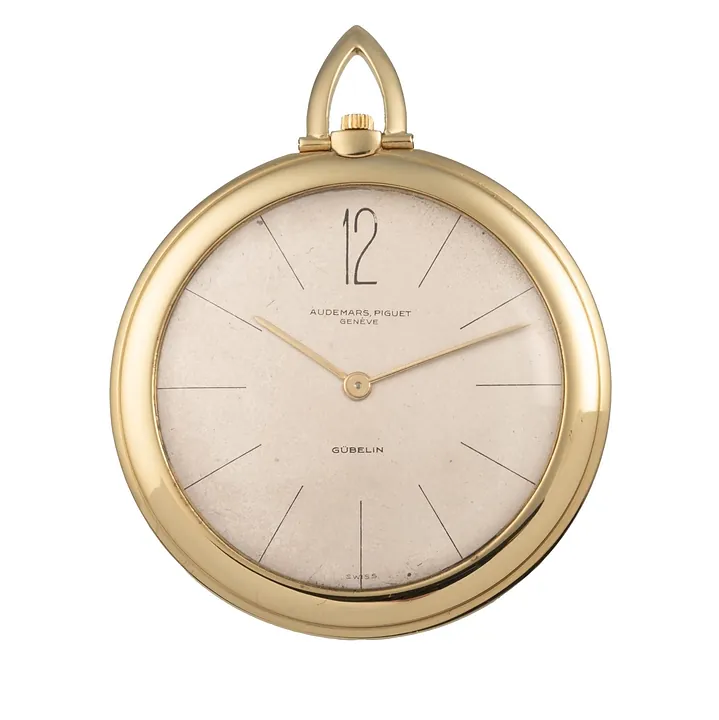
Audemars Piguet ''couteau'', c. 1960
Antiquorum auction archive, Geneva
Pocket Watches · originally sold in November 1961 (per the lot record)
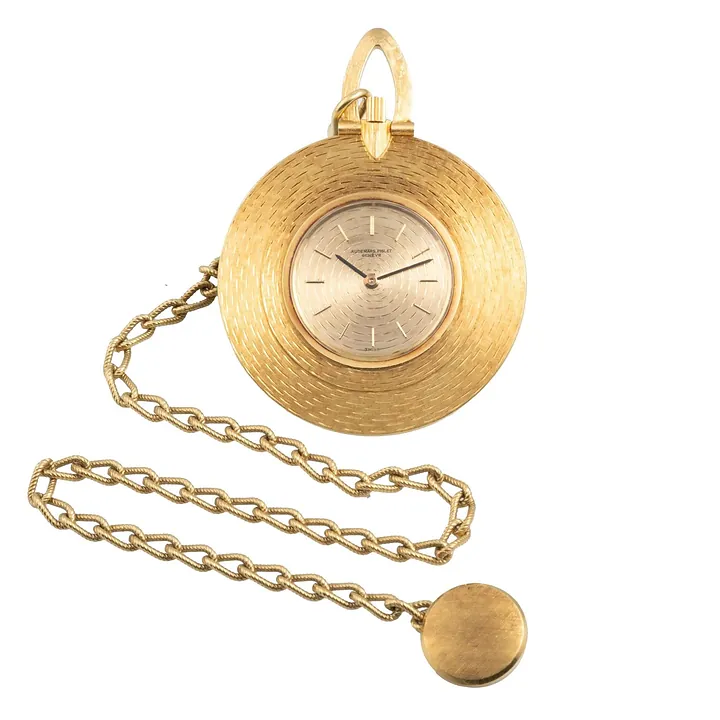
Audemars Piguet "extra Plate", ref. 5633 BA, originally sold in November 1961
Antiquorum auction archive, Geneva
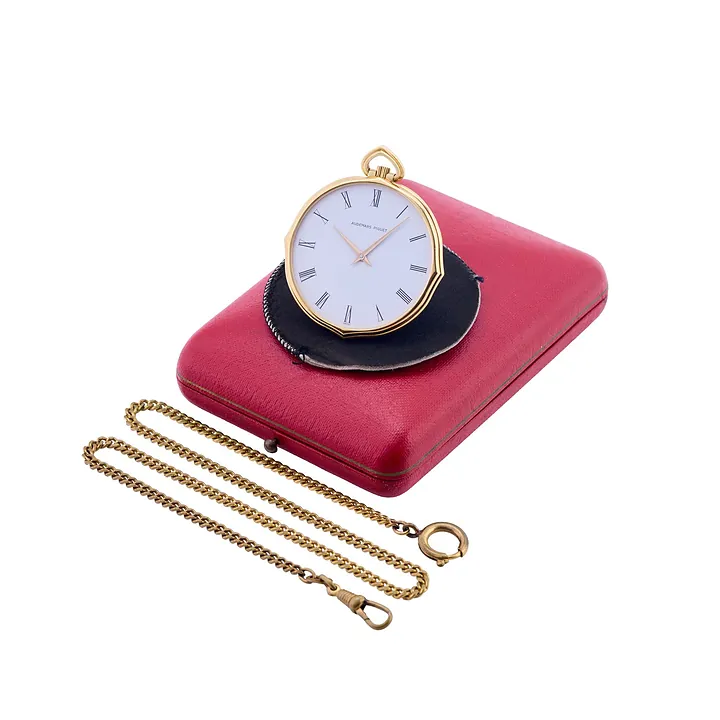
Pocket Watches · c. 1980
Audemars Piguet pocket watch, c. 1980
Antiquorum auction archive, Geneva

Wristwatches · 2008
Wristwatch by Breitling?, 2008
Museum Rotterdam

Wristwatches · c. 1990s
Audemars Piguet Bamboo, c. 1990s
Antiquorum auction archive, Geneva

Wristwatches · c. 1990
Audemars Piguet Huitieme Perpetual Calendar, ref. 25696PT, c. 1990
Antiquorum auction archive, Geneva

Wristwatches · c. 1990
Breitling Chronomat, ref. b13050.1, c. 1990
Antiquorum auction archive, Geneva