
Wristwatches · Wristwatch
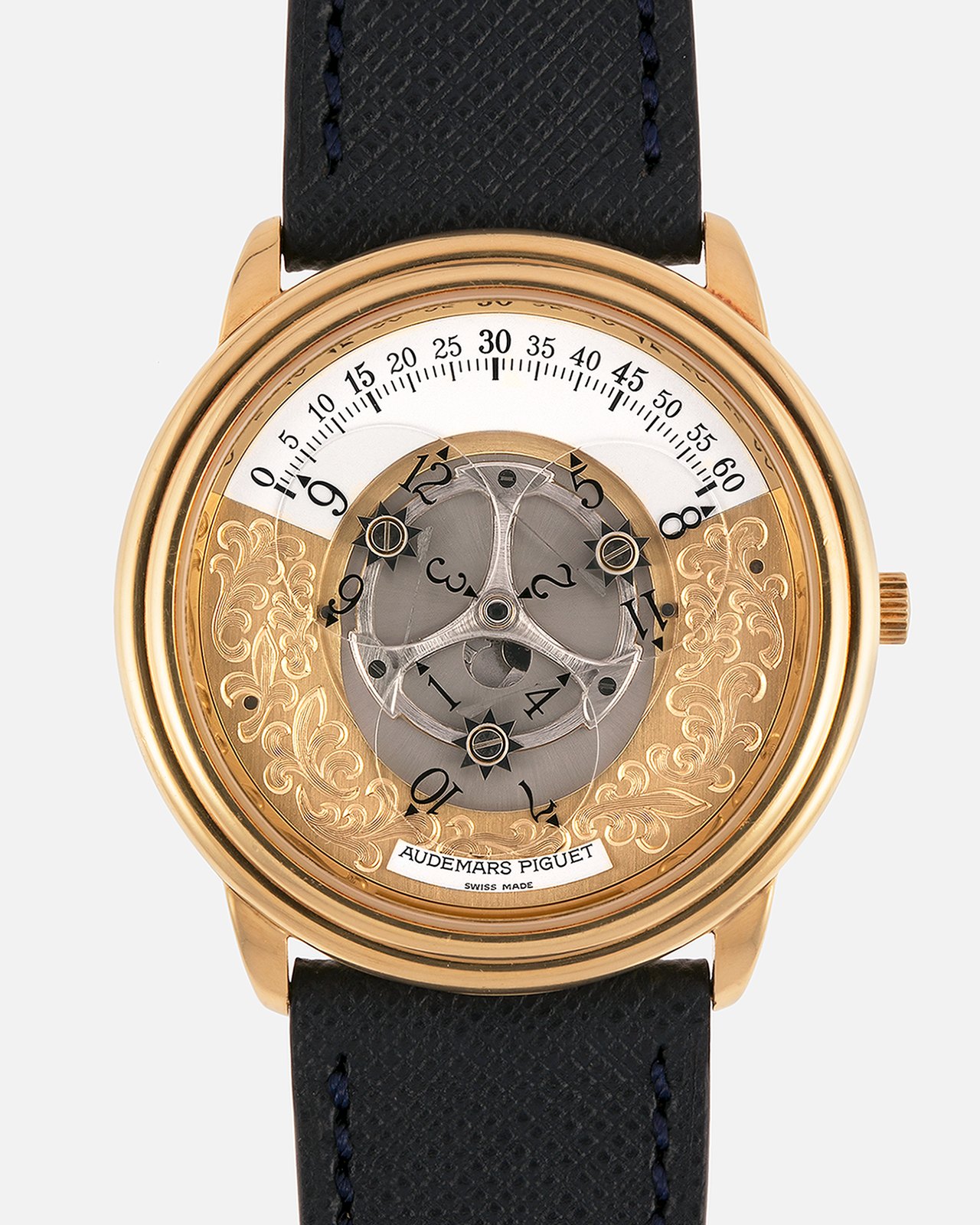
Audemars Piguet Star Wheel 25720BA Engraved Dial, 1990s
- Maker / attribution
- Audemars Piguet (maker)
- Date
- 1990s
- Historical period
- Mechanical Renaissance (1990 – 2010)
- Country of origin
- Switzerland
- Object type
- Wristwatch
- Dimensions
- Case 36 mm
- Stock no.
- Product 7773218537559
- Credit line
- Dealer listing, S.Song Watches (product 7773218537559)
- Catalogue title (original)
- Audemars Piguet Star Wheel 25720BA Engraved Dial (English)
View the source record (dealer listing) ↗ (opens another website in a new tab)Suggest a correction
Record summary
Catalogued by S.Song Watches (dealer), Seattle (stock number Product 7773218537559), this is a wristwatch by Audemars Piguet, made in Switzerland, dated 1990s. The Atlas places it in the Mechanical Renaissance period (1990 – 2010) of its Wristwatches collection. Recorded dimensions: Case 36 mm. The record is illustrated with 6 photographs.
Assembled from the source record's structured fields. Dates and attributions are given as the source states them; where a field is missing the Atlas leaves it blank rather than estimating.
Catalogue description
Dealer description — S.Song Watches
The 1990s were an especially creative period for Audemars Piguet, with the manufacture producing a number of unconventional watches that today sit somewhat in the shadow of the Royal Oak. Few capture that era better than the Star Wheel, a watch that revived the centuries-old wandering hours display and presented it in an entirely new form. Introduced in 1991, the Star Wheel was inspired by wandering hour clocks dating back to 17th-century Rome. Rather than displaying the time through conventional hands, Audemars Piguet developed a system of three transparent sapphire discs, each carrying four hour numerals. These discs rotate around a central mechanism while simultaneously turning on their own axes. As the relevant hour travels across the upper portion of the dial, a pointer beneath it indicates the minutes along a 60-minute arc. Despite its mechanical complexity, reading the time becomes remarkably intuitive once understood. The name Star Wheel comes directly from the mechanism itself. Beneath each of the three sapphire hour discs sits an eight-toothed, star-shaped wheel responsible for rotating the discs into the correct position as they travel around the dial. Rather than concealing this mechanism, Audemars Piguet placed much of it on full display, making the wandering hours mechanism the visual centrepiece of the watch. This Ref. 25720BA is housed in a beautifully proportioned 36mm case crafted from 18k yellow gold. Its stepped bezel, short downturned lugs and relatively slim profile are characteristic of Audemars Piguet's classical watches from the period, providing an interesting contrast against the highly unconventional display. More importantly, this particular example features the considerably less common engraved dial. The Ref. 25720BA was produced with both traditional guilloché and hand-engraved dial finishes, with the latter featuring an elaborate foliate pattern across the exposed gold surface. The engraving gives the watch a much more ornate character and provides a beautiful backdrop to the sapphire discs and exposed wandering hours mechanism. Powering the Star Wheel is the automatic Calibre 2124, a 33-jewel movement modified to accommodate the wandering hours mechanism. Visible through the sapphire caseback, it is finished in the traditional Audemars Piguet manner and provides an interesting contrast to the much more expressive mechanics visible from the front. The original Star Wheel remained in production for only a relatively short period during the 1990s, yet it has become one of the most recognisable examples of Audemars Piguet's creativity outside of the Royal Oak. The Ref. 25720BA is particularly compelling in this engraved configuration, combining a highly unusual wandering hours display with traditional hand-engraving and the restrained proportions of a classical 36mm yellow gold dress watch.
Historical context
Mechanical Renaissance (1990 – 2010)
Mechanical watches return as cultural objects; independent watchmaking flourishes.
Mechanical watches returned as cultural and luxury objects. Complications, tourbillons and new materials proliferated; independent watchmakers such as George Daniels, F.P. Journe and Philippe Dufour revived artisanal watchmaking; collecting vintage watches became a major field.
Read the period in the timelineMore wristwatches from this periodEarlier: Quartz Revolution
Atlas type guide
Wristwatches
Bracelet watches were worn by women from the early nineteenth century — Breguet made one for Caroline Murat, Queen of Naples, in 1810–12 — but the wristwatch only became a man's instrument with military use and aviation in the early twentieth century. Between the World Wars it overtook the pocket watch; the 1920s and 1930s brought rectangular Art Deco cases, water-resistant cases and the first automatic winding systems.
After 1945 the wristwatch became a carrier of identity — dress watches, sports and dive watches, chronographs, calendars — produced by Swiss, American, Japanese, German, Soviet and Chinese industries. The quartz revolution after 1969 and the mechanical renaissance since the 1990s, including the rise of independent watchmakers, complete the story.
What to look for
- The reference number (between the lugs or inside the case back) and serial number, the starting point for dating.
- The calibre: its maker and number are often stamped under the dial or on the bridge.
- Originality of dial, hands and crown — refinished ('redial') dials are common.
- Case material marks: 18K/750, 14K/585, stainless steel, gold-filled, plated.
Dating clues
- Wire-lug cases: before c. 1925.
- Water-resistant screw-down cases: from 1926.
- Quartz movements: from 1969; sapphire crystals widespread after c. 1980.
General guidance written by the Atlas editors about this kind of object. It is not a statement about this particular piece; for that, rely on the source record above and on physical examination.
Related records
Clocks · c. 1990s
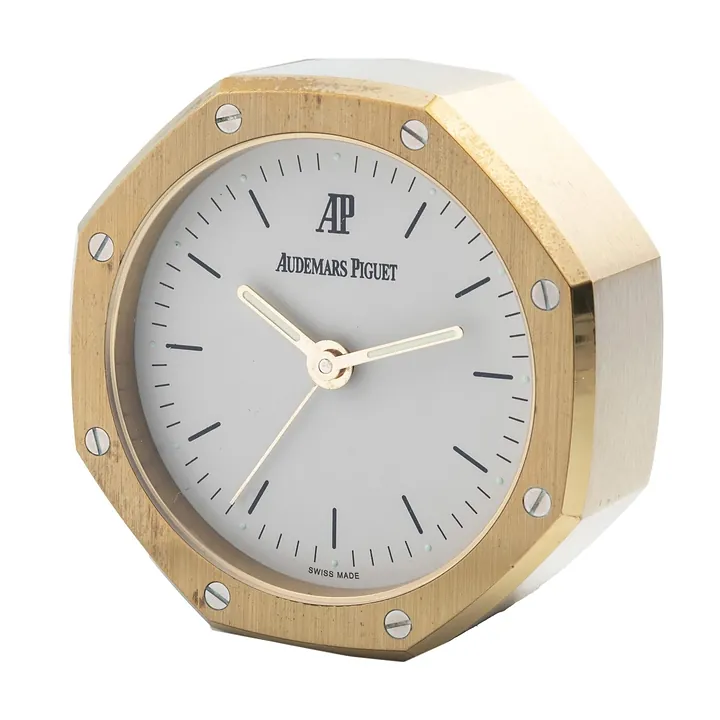
Audemars Piguet Royal Oak, c. 1990s
Antiquorum auction archive, Geneva
Pocket Watches · c. 1960
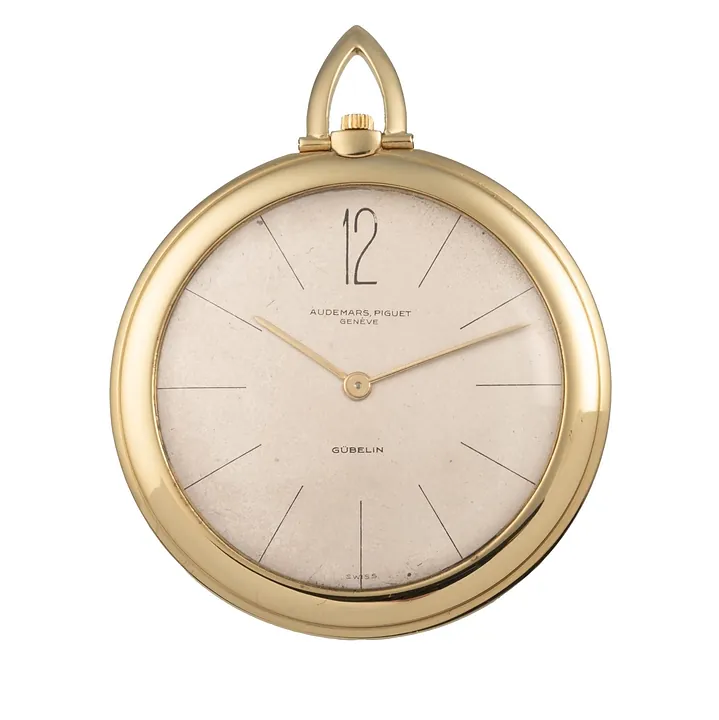
Audemars Piguet ''couteau'', c. 1960
Antiquorum auction archive, Geneva
Pocket Watches · originally sold in November 1961 (per the lot record)
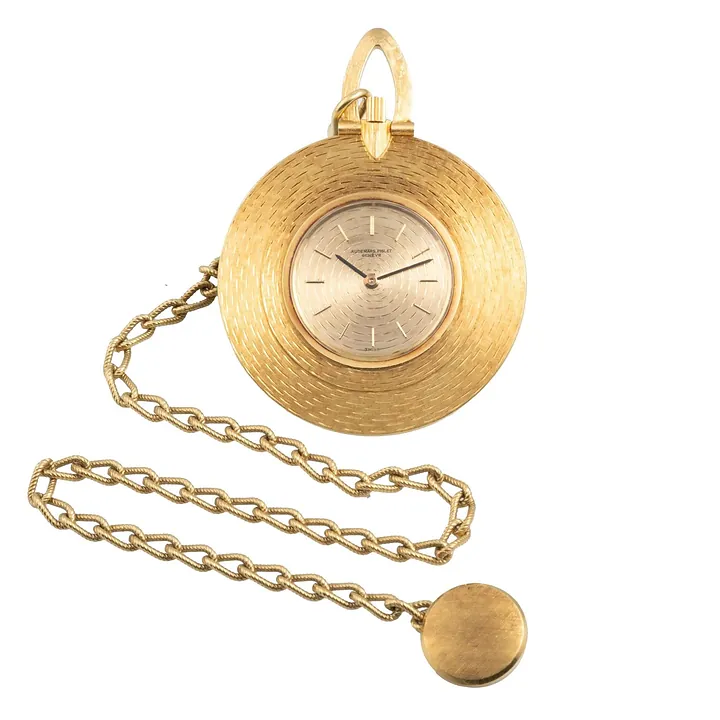
Audemars Piguet "extra Plate", ref. 5633 BA, originally sold in November 1961
Antiquorum auction archive, Geneva
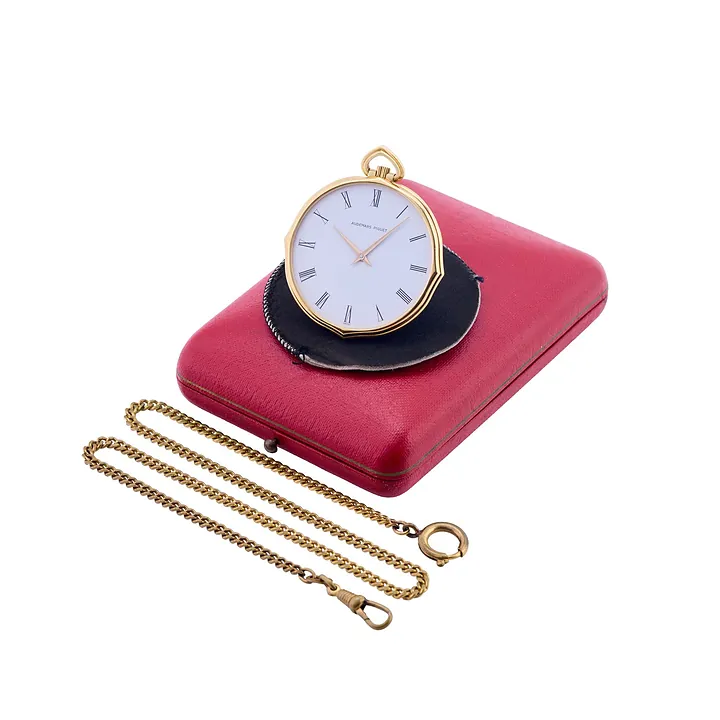
Pocket Watches · c. 1980
Audemars Piguet pocket watch, c. 1980
Antiquorum auction archive, Geneva

Wristwatches · 2008
Wristwatch by Breitling?, 2008
Museum Rotterdam

Wristwatches · c. 1990s
Audemars Piguet Bamboo, c. 1990s
Antiquorum auction archive, Geneva

Wristwatches · c. 1990
Audemars Piguet Huitieme Perpetual Calendar, ref. 25696PT, c. 1990
Antiquorum auction archive, Geneva

Wristwatches · c. 1990
Breitling Chronomat, ref. b13050.1, c. 1990
Antiquorum auction archive, Geneva