
Wristwatches · Wristwatch
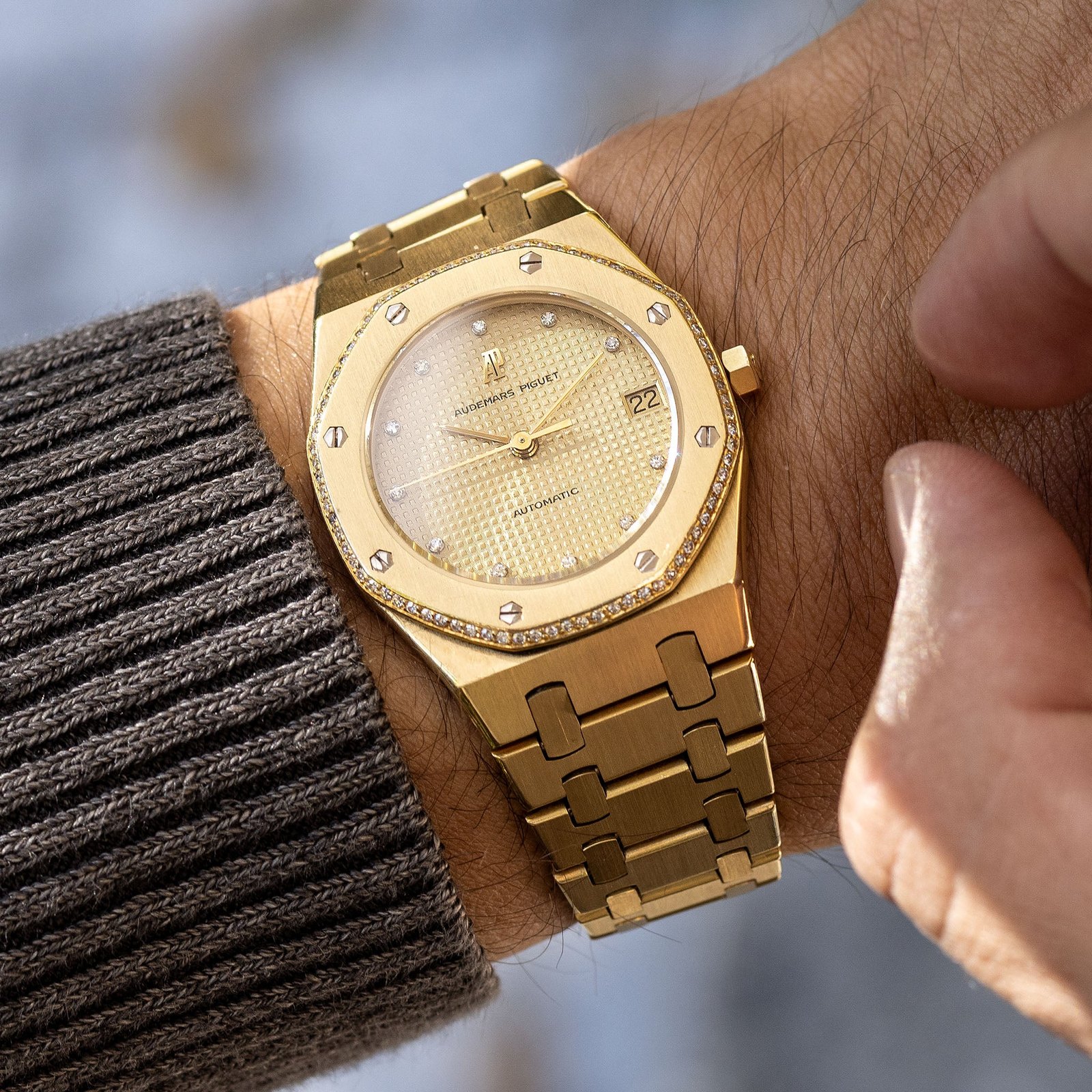
Audemars Piguet Royal Oak ref. 4153/477BA Brilliant Cut Diamond Bezel and Dial with Box and Certificate of Origin, early 1980
- Maker / attribution
- Audemars Piguet (maker)
- Date
- early 1980
- Historical period
- Quartz Revolution (1969 – 1990)
- Country of origin
- Switzerland
- Object type
- Wristwatch
- Dimensions
- Case 35 mm
- Stock no.
- W-3889
- Credit line
- Dealer listing, Bulang & Sons (W-3889)
- Catalogue title (original)
- Audemars Piguet Royal Oak ref. 4153/477BA Brilliant Cut Diamond Bezel and Dial with Box and Certificate of Origin (English)
View the source record (dealer listing) ↗ (opens another website in a new tab)Suggest a correction
Record summary
Catalogued by Bulang & Sons (dealer), Copenhagen (stock number W-3889), this is a wristwatch by Audemars Piguet, made in Switzerland, dated early 1980. The Atlas places it in the Quartz Revolution period (1969 – 1990) of its Wristwatches collection. Recorded dimensions: Case 35 mm. The record is illustrated with 6 photographs.
Assembled from the source record's structured fields. Dates and attributions are given as the source states them; where a field is missing the Atlas leaves it blank rather than estimating.
Catalogue description
Dealer description — Bulang & Sons
Audemars Piguet is a Swiss watch manufacture founded in 1875 in Le Brassus by Jules Louis Audemars and Edward Auguste Piguet. It belongs to watchmaking's prestigious "Holy Trinity" and, uniquely among its peers, remains under the ownership of its founding families to this day. By the early 1970s, Audemars Piguet faced mounting pressure from the emerging Quartz Crisis. In response, Managing Director Georges Golay challenged legendary designer Gérald Genta to create an entirely new kind of watch—an elegant luxury sports watch in stainless steel. According to watchmaking lore, Genta completed the initial design overnight, drawing inspiration from a traditional diver's helmet. The result was the Royal Oak reference 5402ST. What began as a daring horological gamble would go on to redefine the luxury watch industry. Over the decades, the Audemars Piguet Royal Oak evolved from a controversial high-end sports watch into one of the world's most recognisable timepieces—a true pop culture icon embraced by Hollywood, elite athletes, musicians, and collectors alike. Offered here is a particularly rare and elegant mid-sized Royal Oak, as per information by AP; “Sales from 1978 to 1983: 131 units in all” ! Derived from the Royal Oak reference 4100, the reference 4153—renamed 14153 following Audemars Piguet's revised reference numbering system in 1984/1985—is distinguished by its bezel, which is set with 80 brilliant-cut diamonds. This style of gem-setting is characteristic of the earliest diamond-set Royal Oaks. Rather than being set into the top surface of the bezel, the diamonds were carefully positioned around its outer edge. The exceptionally thin profile of the Royal Oak bezel left insufficient material for traditional top-setting without compromising the watch's water resistance. This ingenious solution not only preserved the integrity of the case but also beautifully emphasized the Royal Oak's signature octagonal silhouette and its eight exposed white gold screws. According to Audemars Piguet's archives, only 176 examples of the reference 4153/14153 were sold between 1978 and 1985. Although these watches carry consecutive case numbers from the reference 4100 series, the manufacture's records identify them as the distinct reference 4153, making them among the rarest early gem-set Royal Oaks. The 35 mm 18k yellow gold case remains in beautiful condition, retaining the crisp contrast between its satin-brushed surfaces and polished bevels exactly as collectors like to see. The golden Petite Tapisserie dial is equally impressive, featuring the classic small Audemars Piguet signature, diamond-set hour markers, and elegant non-luminous baton hands. The integrated 18k yellow gold bracelet is in equally fine and tight condition and currently fits wrists up to 17.5 cm. The accessories accompanying this Royal Oak are just as remarkable as the watch itself. It is offered with its original green Audemars Piguet presentation box, leather document holder, two booklets, and its original Certificate of Origin. And there is even more. Before this watch left the manufacture in Le Brassus, Audemars Piguet photographed the actual watch—bearing the very same serial number—and included these original factory photographs with the delivery. As these references were produced in extremely small numbers, it is believed many were manufactured only upon special order, making these photographs an exceptionally charming and rarely encountered addition to an already outstanding set. Powering this Royal Oak is the automatic calibre 2123, which has been fully serviced by our watchmaker and is running beautifully, ready to be enjoyed for many years to come. Some watches tell time; others tell a story. This Royal Oak does both. One of only 131 examples sold, complete with an extraordinary original set and the factory photographs taken before it left Le Brassus, it represents a rare opportunity to acquire one of Audemars Piguet's most fascinating Royal Oaks. We'd be happy to hear from you. Specifications: Audemars Piguet Royal Oak reference 153/477BA 35mm 18k Gold case with 80 brilliant cut diamonds around the bezel Gold Petite Tapisserie dial, with diamond hour markers and black text Serial No 9xx dating to the early 1980’s Integrated 18k gold bracelet Ultra thin cal.2123 automatic Fully serviced by our watch maker Original AP box , AP leather paper holder , two booklets , original Certificate of origin and two photographs of the actual watch
Historical context
Quartz Revolution (1969 – 1990)
Seiko's Astron begins mass quartz timekeeping; traditional industries contract sharply.
Quartz and digital watches transformed the market after 1969. Swiss employment collapsed, Japanese and Hong Kong production soared, and the Swatch (1983) helped the Swiss industry recover; mechanical watches survived as luxury goods.
Read the period in the timelineMore wristwatches from this periodEarlier: Modern Mechanical Horology
Atlas type guide
Wristwatches
Bracelet watches were worn by women from the early nineteenth century — Breguet made one for Caroline Murat, Queen of Naples, in 1810–12 — but the wristwatch only became a man's instrument with military use and aviation in the early twentieth century. Between the World Wars it overtook the pocket watch; the 1920s and 1930s brought rectangular Art Deco cases, water-resistant cases and the first automatic winding systems.
After 1945 the wristwatch became a carrier of identity — dress watches, sports and dive watches, chronographs, calendars — produced by Swiss, American, Japanese, German, Soviet and Chinese industries. The quartz revolution after 1969 and the mechanical renaissance since the 1990s, including the rise of independent watchmakers, complete the story.
What to look for
- The reference number (between the lugs or inside the case back) and serial number, the starting point for dating.
- The calibre: its maker and number are often stamped under the dial or on the bridge.
- Originality of dial, hands and crown — refinished ('redial') dials are common.
- Case material marks: 18K/750, 14K/585, stainless steel, gold-filled, plated.
Dating clues
- Wire-lug cases: before c. 1925.
- Water-resistant screw-down cases: from 1926.
- Quartz movements: from 1969; sapphire crystals widespread after c. 1980.
General guidance written by the Atlas editors about this kind of object. It is not a statement about this particular piece; for that, rely on the source record above and on physical examination.
Related records
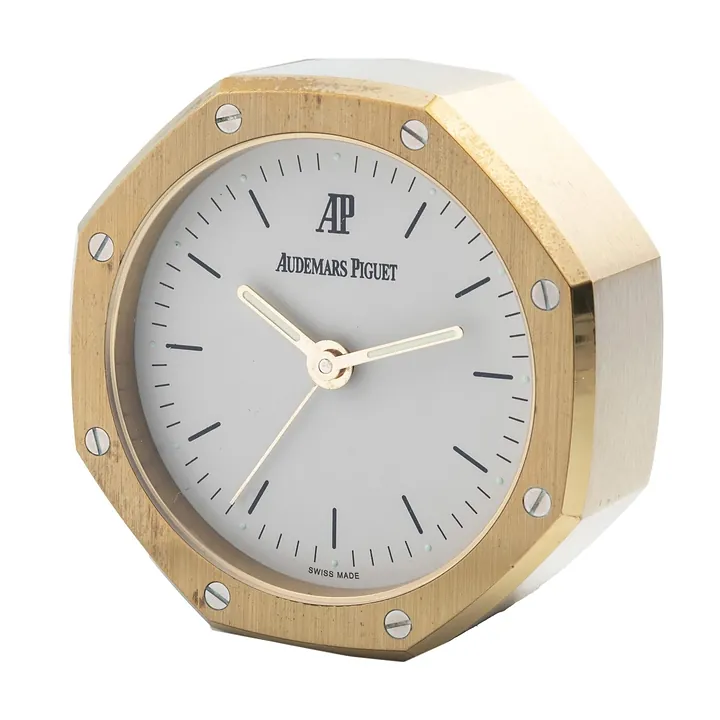
Clocks · c. 1990s
Audemars Piguet Royal Oak, c. 1990s
Antiquorum auction archive, Geneva
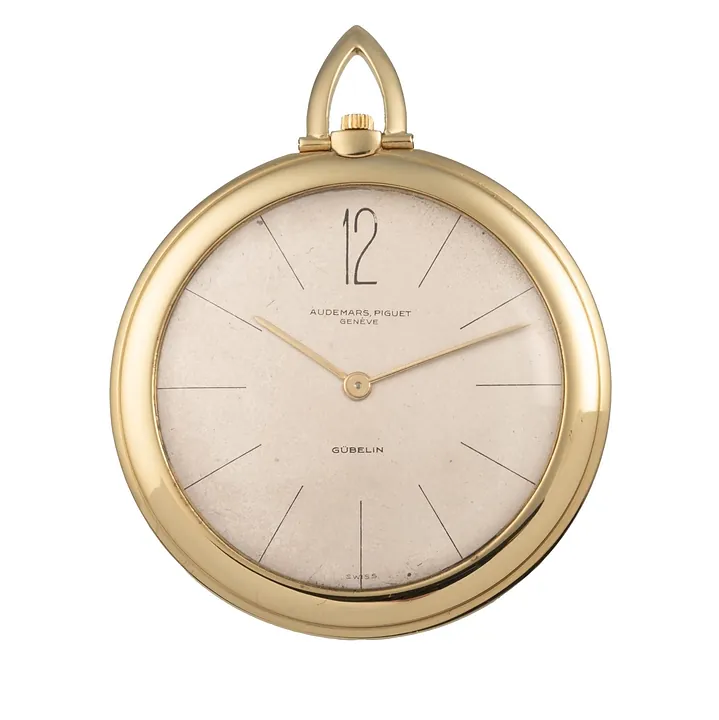
Pocket Watches · c. 1960
Audemars Piguet ''couteau'', c. 1960
Antiquorum auction archive, Geneva
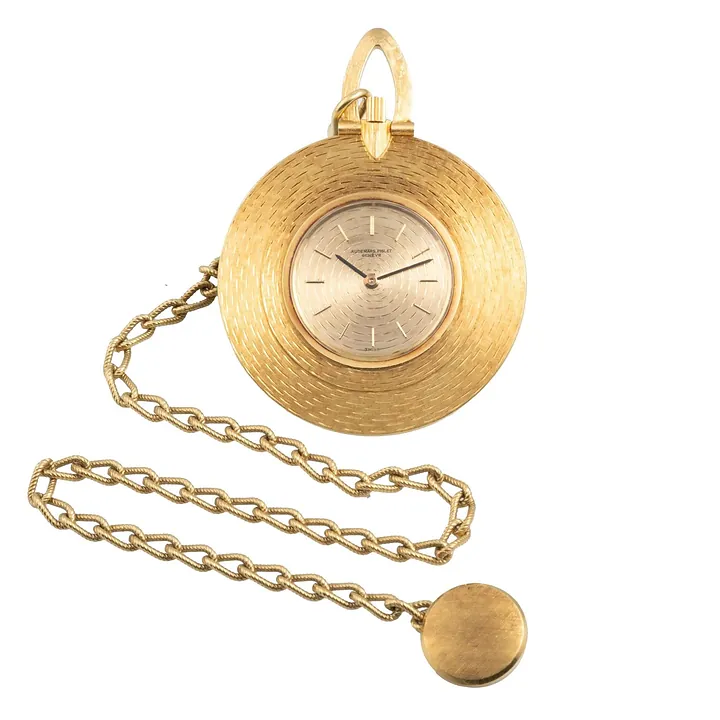
Pocket Watches · originally sold in November 1961 (per the lot record)
Audemars Piguet "extra Plate", ref. 5633 BA, originally sold in November 1961
Antiquorum auction archive, Geneva
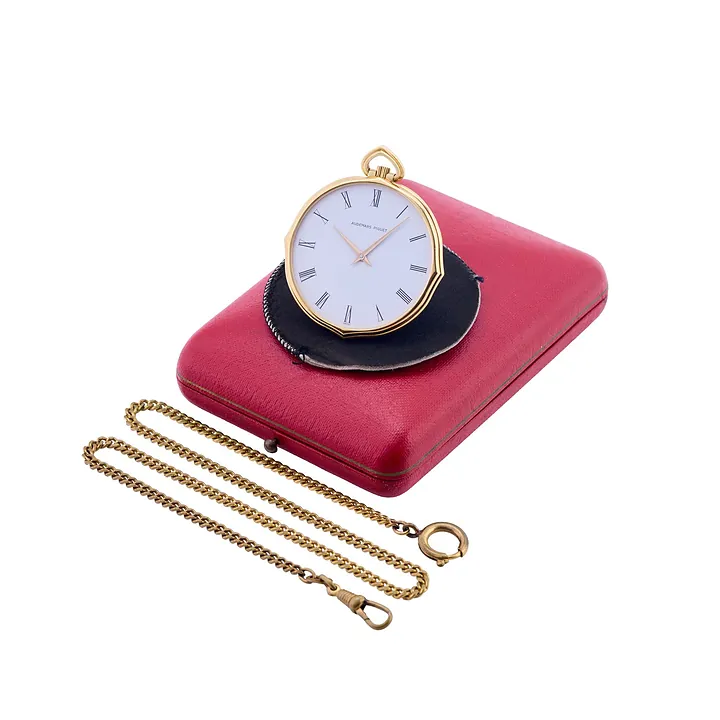
Pocket Watches · c. 1980
Audemars Piguet pocket watch, c. 1980
Antiquorum auction archive, Geneva

Wristwatches · 1970
Wristwatch by Heno, Switzerland, 1970
Museum Rotterdam

Wristwatches · 1960–1986
'Tri-Compax' calendar chronograph wristwatch in gold case, by Universal, Geneva, Switzerland, 1960–1986.
Science Museum Group, London

Wristwatches · 1969–1970
Beta 21 Quartz wristwatch movement, made in Switzerland, 1970.
Science Museum Group, London

Wristwatches · c. 1969
Omega Speedmaster Moonwatch, ref. 145022-69st, c. 1969
Antiquorum auction archive, Geneva