
Wristwatches · Wristwatch
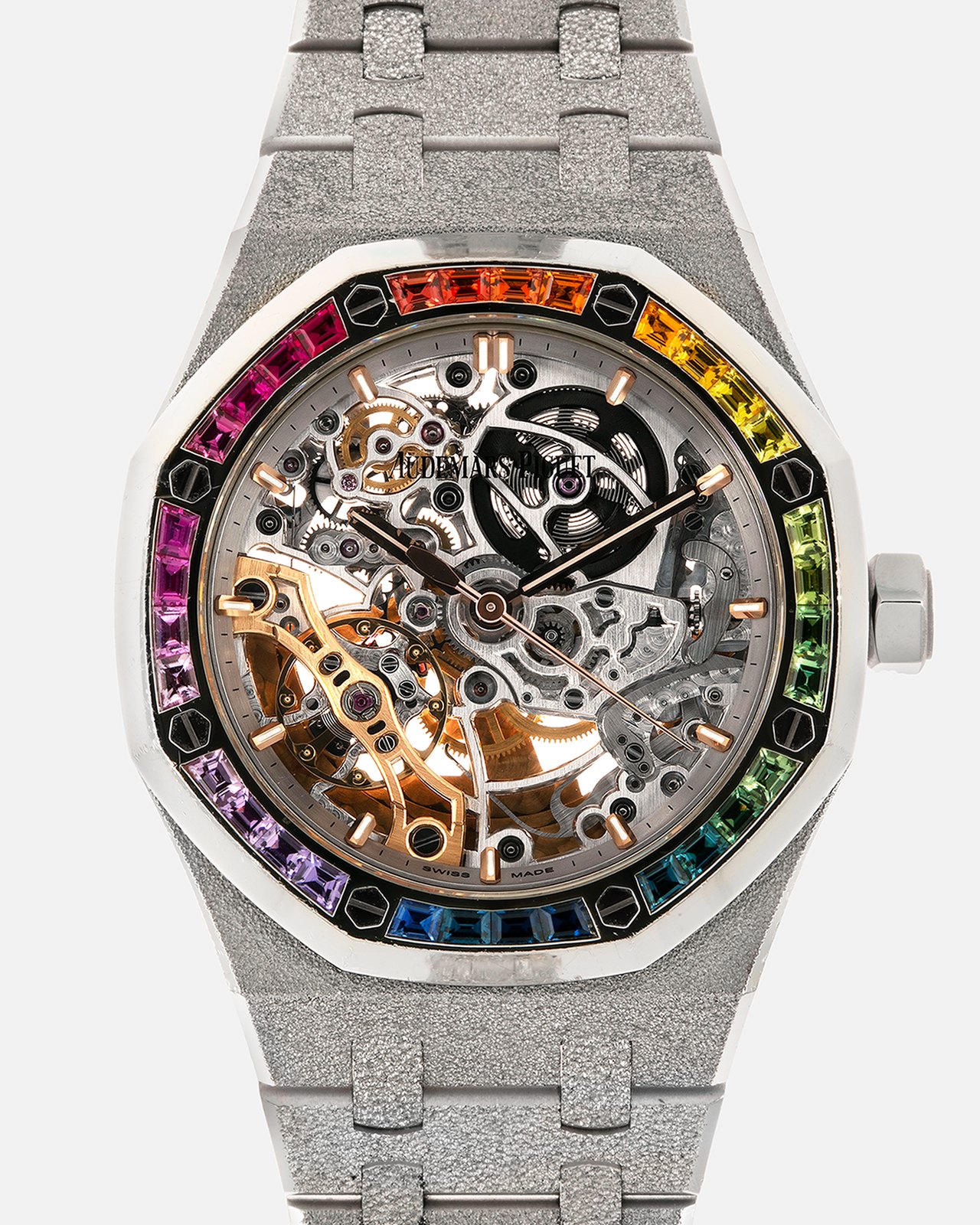
Audemars Piguet Royal Oak Rainbow Double Balance Openworked Frosted Gold 15468BC, 2019
- Maker / attribution
- Audemars Piguet (maker)
- Date
- 2019
- Historical period
- Contemporary Horology (2010 – Present)
- Country of origin
- Switzerland
- Object type
- Wristwatch
- Materials / technique
- gold
- Dimensions
- Case 37 mm
- Stock no.
- Product 7276033769559
- Credit line
- Dealer listing, S.Song Watches (product 7276033769559)
- Catalogue title (original)
- Audemars Piguet Royal Oak Rainbow Double Balance Openworked Frosted Gold 15468BC (English)
View the source record (dealer listing) ↗ (opens another website in a new tab)Suggest a correction
Record summary
Catalogued by S.Song Watches (dealer), Seattle (stock number Product 7276033769559), this is a wristwatch by Audemars Piguet, made in Switzerland, dated 2019. The Atlas places it in the Contemporary Horology period (2010 – Present) of its Wristwatches collection. Materials and techniques recorded by the source: gold. Recorded dimensions: Case 37 mm. The record is illustrated with 6 photographs.
Assembled from the source record's structured fields. Dates and attributions are given as the source states them; where a field is missing the Atlas leaves it blank rather than estimating.
Catalogue description
Dealer description — S.Song Watches
The Royal Oak, with its masculine octagonal case, exposed screws, and integrated bracelet is one of the most distinctive watches in the market today. It is imposing and recognizable, and in my opinion, one of the best statement watches money can buy. On top of this, with the current craze for integrated bracelet sports watches and many brands producing their own version, it was the Royal Oak that started it all. What we have here today is perhaps, one of the most lavish-looking Royal Oaks to date—a reference that merges Audemars Piguet's technical prowess with artfully ornate embellishments and finishing techniques. This is the Royal Oak Frosted Gold Double Balance Wheel Openworked Ref. 15468BC (a mouthful, we know), first introduced at SIHH 2019, and was the standout Royal Oak of that year. The Ref. 15468BC is truly a high-end luxury watch, and it has every right to be called one. The frosted case and bracelet are technical marvels in their own right. This distinctive frosted finish, also known as the ‘Florentine Finish,’ is created by the acclaimed Florentine jeweller Carolina Bucci. It involves a meticulous technique where a special diamond-tipped tool is used to repeatedly and consistently hammer the surface of the bracelet’s exterior, resulting in a captivating, gem-like sparkle. This entire process is done by hand, with each component receiving individual attention, reflecting the immense time and effort involved. Personally, I very much prefer this finishing technique to the flashy aftermarket diamond setting we usually see on the wrists of some artists on social media. While diamond setting is an art form in itself, the frosted finish represents a different level of artistry and craftsmanship. It is also worth noting that despite the elaborate frosted finish, both the case and bracelet still showcase the classic hallmarks of a Royal Oak, such as the mirror-polished bevels as well as the brushed texture on the mid-case. Moving on, the Ref. 15468BC’s exquisite open-worked dial takes centre stage. From the photographs, you’ll see that the dial showcases rhodium-toned bridges with impeccable finishing throughout, as well as a double balance mechanism which has been elegantly accentuated by a distinctive bridge crafted from solid gold. An absolute feast for the eyes, the see-through dial unveils a plethora of mechanical components in full uncluttered view, fully embodying the "Openworked" essence in its name. The visually stunning movement (more on this later) can also be admired not only through the dial but also through the transparent caseback, which boasts stunning finishing and a splendid gold rotor with an engraved ‘AP’ logo. Adding to this ensemble is the Royal Oak’s signature porthole-inspired octagonal bezel, embellished with 32 individual multi-colored baguette-cut sapphires that produce a dazzling rainbow effect from a distance. As seen here, each chosen sapphire is moderate in size to ensure that it complements the iconic bezel rather than overshadow it altogether. As far as proportions go, the case of this Ref. 15468BC features a very wearable size with modest dimensions of 37mm x 10mm, making it an exceptionally sized watch for most modern wrists. Encased within the Ref. 15468BC is Audemars Piguet’s very own self-winding Cal. 3132, which is essentially a workhorse Cal. 3130 with the incorporation of a double balance module. For further context, the double balance mechanism was introduced and patented by Audemars Piguet back in 2016. By having a setup of two individual free-sprung balance wheels, the rotational inertia of the oscillator will also increase accordingly, resulting in a more stable, synchronized and regulated output of power, as well as reduced sensitivity to shocks. On a full wind, the Cal. 3132 can hold up to 45 hours of power reserve. When it comes to artisanal embellishments on watches (especially those in a similar design realm as this), I frequently find that many brands tend to veer towards the excess, utilizing an overzealous amount of ornate elements (e.g. diamonds, etc) that often can detract from the purity of the original design and disrupt the overall visual balance. However, the Ref. 15468BC stands out with its impeccable aesthetic arrangement. It might seem ironic to say, but there's a remarkable sense of equilibrium and structure in the way the intricately skeletonized dial, frosted bracelet, and well-proportioned case all come together visually, ensuring that the Ref. 15468BC’s lavish appearance remains well-balanced throughout. After spending some time with it, it’s clear that the Ref. 15468BC is a masterclass in balancing some of Audemars Piguet’s mastery in artisanal and technical design. Once again, while the Ref. 15468BC might initially seem visually overwhelming at first glance, we assure you that it is a sensory overload in the most delightful way possible, and one that will continuously draw you back in for more.
Historical context
Contemporary Horology (2010 – Present)
Silicon components, connected watches, optical-lattice research clocks and a thriving independent scene.
Smartwatches became the world's best-selling watches, while mechanical watchmaking focuses on craft, innovation (silicon components, new escapements) and independent makers.
Read the period in the timelineMore wristwatches from this periodEarlier: Mechanical Renaissance
Atlas type guide
Wristwatches
Bracelet watches were worn by women from the early nineteenth century — Breguet made one for Caroline Murat, Queen of Naples, in 1810–12 — but the wristwatch only became a man's instrument with military use and aviation in the early twentieth century. Between the World Wars it overtook the pocket watch; the 1920s and 1930s brought rectangular Art Deco cases, water-resistant cases and the first automatic winding systems.
After 1945 the wristwatch became a carrier of identity — dress watches, sports and dive watches, chronographs, calendars — produced by Swiss, American, Japanese, German, Soviet and Chinese industries. The quartz revolution after 1969 and the mechanical renaissance since the 1990s, including the rise of independent watchmakers, complete the story.
What to look for
- The reference number (between the lugs or inside the case back) and serial number, the starting point for dating.
- The calibre: its maker and number are often stamped under the dial or on the bridge.
- Originality of dial, hands and crown — refinished ('redial') dials are common.
- Case material marks: 18K/750, 14K/585, stainless steel, gold-filled, plated.
Dating clues
- Wire-lug cases: before c. 1925.
- Water-resistant screw-down cases: from 1926.
- Quartz movements: from 1969; sapphire crystals widespread after c. 1980.
General guidance written by the Atlas editors about this kind of object. It is not a statement about this particular piece; for that, rely on the source record above and on physical examination.
Related records

Clocks · c. 1990s
Audemars Piguet Royal Oak, c. 1990s
Antiquorum auction archive, Geneva

Pocket Watches · c. 1960
Audemars Piguet ''couteau'', c. 1960
Antiquorum auction archive, Geneva
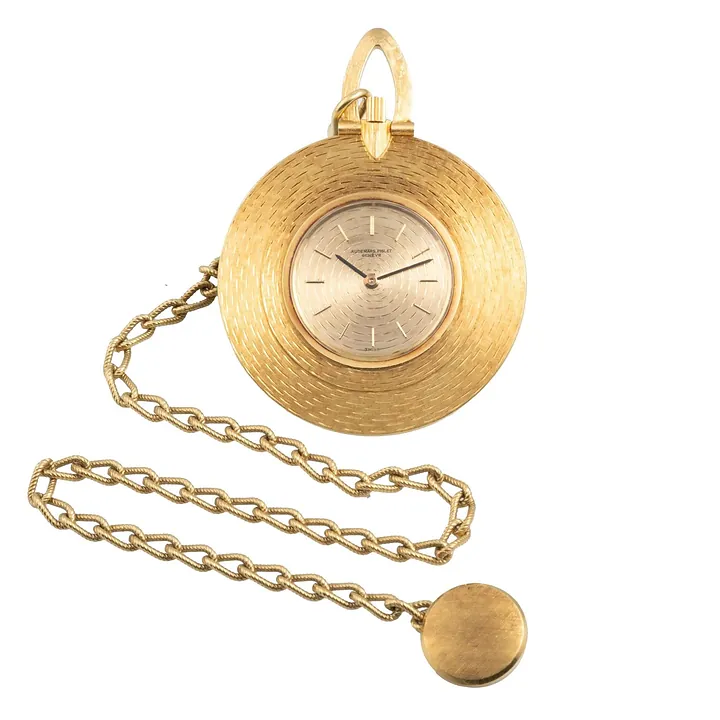
Pocket Watches · originally sold in November 1961 (per the lot record)
Audemars Piguet "extra Plate", ref. 5633 BA, originally sold in November 1961
Antiquorum auction archive, Geneva

Pocket Watches · c. 1980
Audemars Piguet pocket watch, c. 1980
Antiquorum auction archive, Geneva

Wristwatches · c. 2010s
Breguet Type XXI, ref. 3810, c. 2010s (Antiquorum Lot 381-24)
Antiquorum auction archive, Geneva

Wristwatches · c. 2010s
Breguet Type XXI, ref. 3810, c. 2010s (Antiquorum Lot 386-229)
Antiquorum auction archive, Geneva

Wristwatches · Sold in September 2010
Breitling Cosmonaute, ref. A 22322, Sold in September 2010
Antiquorum auction archive, Geneva

Wristwatches · c. 2010
Corum Bubble Chrono, ref. 396.150.20, c. 2010
Antiquorum auction archive, Geneva