
Wristwatches · Wristwatch
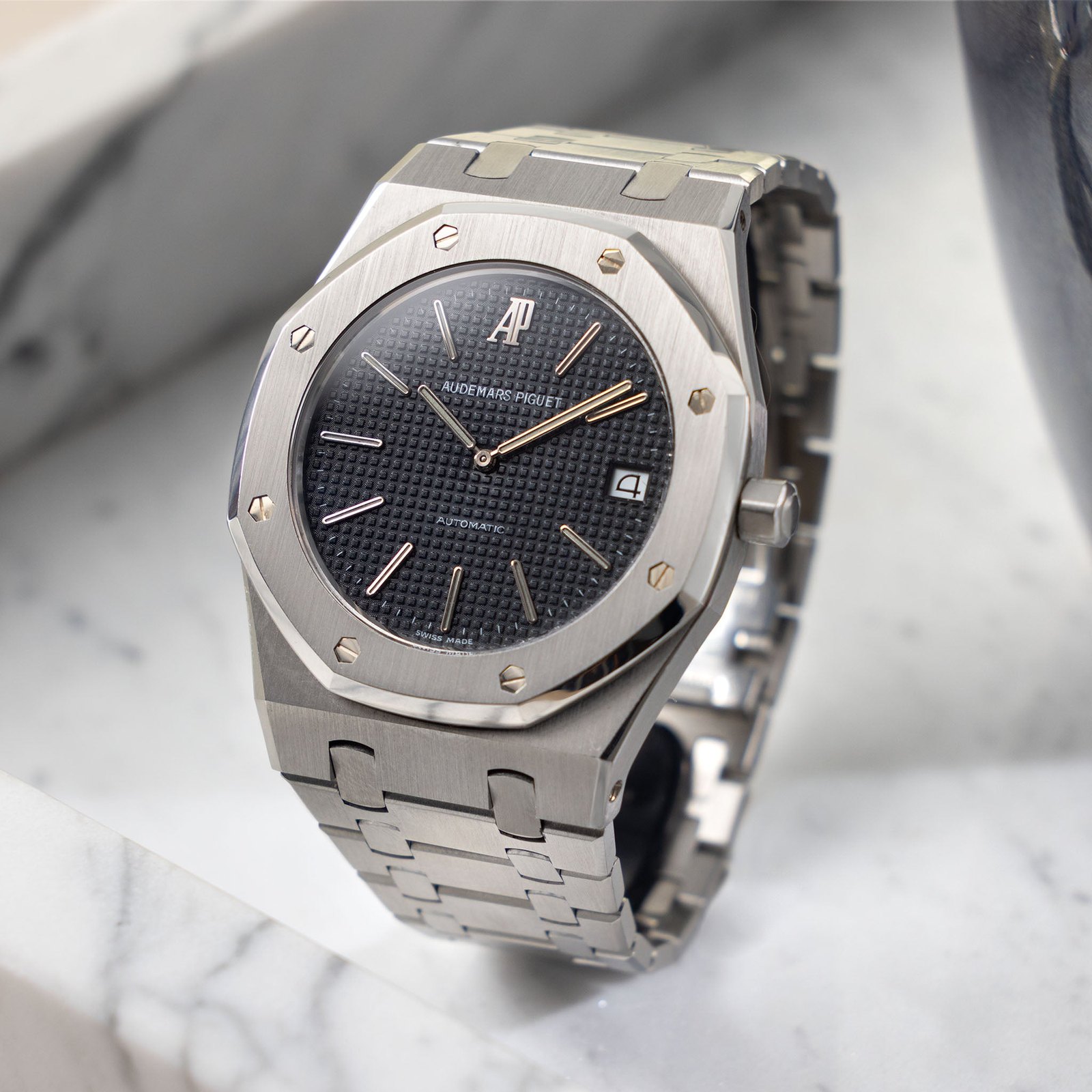
Audemars Piguet Royal-Oak Jumbo Ultra-thin 14802ST Jubilee with Extract of the Archives, 1997
- Maker / attribution
- Audemars Piguet (maker)
- Date
- 1997
- Historical period
- Mechanical Renaissance (1990 – 2010)
- Country of origin
- Switzerland
- Object type
- Wristwatch
- Dimensions
- Case 39 mm
- Stock no.
- W-3636
- Credit line
- Dealer listing, Bulang & Sons (W-3636)
- Catalogue title (original)
- Audemars Piguet Royal-Oak Jumbo Ultra-thin 14802ST Jubilee with Extract of the Archives (English)
View the source record (dealer listing) ↗ (opens another website in a new tab)Suggest a correction
Record summary
Catalogued by Bulang & Sons (dealer), Copenhagen (stock number W-3636), this is a wristwatch by Audemars Piguet, made in Switzerland, dated 1997. The Atlas places it in the Mechanical Renaissance period (1990 – 2010) of its Wristwatches collection. Recorded dimensions: Case 39 mm. The record is illustrated with 6 photographs.
Assembled from the source record's structured fields. Dates and attributions are given as the source states them; where a field is missing the Atlas leaves it blank rather than estimating.
Catalogue description
Dealer description — Bulang & Sons
In 1971, amid the Quartz Crisis — which saw traditional Swiss watchmaking threatened by inexpensive Japanese quartz timepieces — Audemars Piguet sought a truly disruptive design. Managing Director Georges Golay famously called legendary designer Gerald Genta on the eve of the Basel Fair, tasking him with creating an unprecedented steel sports watch for the Italian market by the following morning. Launched in 1972, the Audemars Piguet Royal Oak would go on to revolutionise the industry as the world’s first luxury sports watch crafted in stainless steel. In 1992, to celebrate the 20th anniversary of the Royal Oak, Audemars Piguet introduced the Royal Oak Jubilee, reference 14802. This model marked only the second “Jumbo” in the history of the collection. It distinguished itself from its illustrious predecessor through a three-part case construction, allowing for a sapphire display caseback that reveals a special oscillating weight created exclusively for the Jubilee edition. Production of the Jubilee was limited to 1,000 pieces: 700 in stainless steel, 280 in yellow gold, and just 20 in platinum. Although conceived as an anniversary edition, production spanned several years, with sales extending over nearly a decade. The present example is the stainless steel “Jumbo,” housed in the iconic 39mm case. It is offered in excellent condition, retaining sharp lines and a strong, well-defined octagonal bezel. The dial is equally impressive, featuring the petite tapisserie pattern in a rich anthracite tone, with the same hour markers and signature layout as found on the original reference 5402 — a faithful nod to the very first Royal Oak. The bracelet remains in great condition and currently fits wrists up to approximately 19 cm. The watch is accompanied by an Extract from the Archives from Audemars Piguet, noting a registered date of 1997. The watch and its automatic calibre 2121 have been fully serviced and are running as they should. An exceptional anniversary “Jumbo” — a true tribute to one of the greatest icons in horology and a reference well worth considering for anyone seeking a pure, time-only Royal Oak. Should you wish to learn more or arrange a viewing, feel free to get in touch. Specifications: Audemars Piguet Royal-Oak reference 14802ST “20 years Jubilee” 39mm steel case with integrated steel bracelet and display case back Serial no D-405xx dating to 1997 Anthracite toned petite tapisserie pattern dial Automatic calibre 2121 with special ,gold hand finished rotor Fully serviced by our watchmaker Audemars Piguet extract of the archives, mentioning a registered date in 1997.
Historical context
Mechanical Renaissance (1990 – 2010)
Mechanical watches return as cultural objects; independent watchmaking flourishes.
Mechanical watches returned as cultural and luxury objects. Complications, tourbillons and new materials proliferated; independent watchmakers such as George Daniels, F.P. Journe and Philippe Dufour revived artisanal watchmaking; collecting vintage watches became a major field.
Read the period in the timelineMore wristwatches from this periodEarlier: Quartz Revolution
Atlas type guide
Wristwatches
Bracelet watches were worn by women from the early nineteenth century — Breguet made one for Caroline Murat, Queen of Naples, in 1810–12 — but the wristwatch only became a man's instrument with military use and aviation in the early twentieth century. Between the World Wars it overtook the pocket watch; the 1920s and 1930s brought rectangular Art Deco cases, water-resistant cases and the first automatic winding systems.
After 1945 the wristwatch became a carrier of identity — dress watches, sports and dive watches, chronographs, calendars — produced by Swiss, American, Japanese, German, Soviet and Chinese industries. The quartz revolution after 1969 and the mechanical renaissance since the 1990s, including the rise of independent watchmakers, complete the story.
What to look for
- The reference number (between the lugs or inside the case back) and serial number, the starting point for dating.
- The calibre: its maker and number are often stamped under the dial or on the bridge.
- Originality of dial, hands and crown — refinished ('redial') dials are common.
- Case material marks: 18K/750, 14K/585, stainless steel, gold-filled, plated.
Dating clues
- Wire-lug cases: before c. 1925.
- Water-resistant screw-down cases: from 1926.
- Quartz movements: from 1969; sapphire crystals widespread after c. 1980.
General guidance written by the Atlas editors about this kind of object. It is not a statement about this particular piece; for that, rely on the source record above and on physical examination.
Related records

Clocks · c. 1990s
Audemars Piguet Royal Oak, c. 1990s
Antiquorum auction archive, Geneva

Pocket Watches · c. 1960
Audemars Piguet ''couteau'', c. 1960
Antiquorum auction archive, Geneva
Pocket Watches · originally sold in November 1961 (per the lot record)
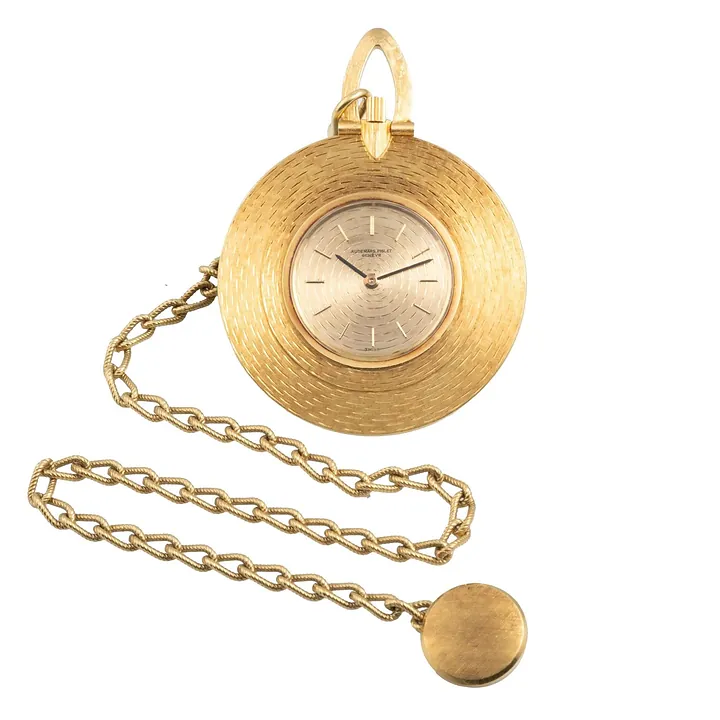
Audemars Piguet "extra Plate", ref. 5633 BA, originally sold in November 1961
Antiquorum auction archive, Geneva

Pocket Watches · c. 1980
Audemars Piguet pocket watch, c. 1980
Antiquorum auction archive, Geneva

Wristwatches · 2008
Wristwatch by Breitling?, 2008
Museum Rotterdam

Wristwatches · c. 1990s
Audemars Piguet Bamboo, c. 1990s
Antiquorum auction archive, Geneva

Wristwatches · c. 1990
Audemars Piguet Huitieme Perpetual Calendar, ref. 25696PT, c. 1990
Antiquorum auction archive, Geneva

Wristwatches · c. 1990
Breitling Chronomat, ref. b13050.1, c. 1990
Antiquorum auction archive, Geneva