

Wristwatches · Wristwatch
Audemars Piguet Royal Oak Day Date 26330ST, 2012
- Maker / attribution
- Audemars Piguet (maker)
- Date
- 2012
- Historical period
- Contemporary Horology (2010 – Present)
- Country of origin
- Switzerland
- Object type
- Wristwatch
- Dimensions
- Case 39 mm
- Stock no.
- Product 7508626899031
- Credit line
- Dealer listing, S.Song Watches (product 7508626899031)
- Catalogue title (original)
- Audemars Piguet Royal Oak Day Date 26330ST (English)
View the source record (dealer listing) ↗ (opens another website in a new tab)Suggest a correction
Record summary
Catalogued by S.Song Watches (dealer), Seattle (stock number Product 7508626899031), this is a wristwatch by Audemars Piguet, made in Switzerland, dated 2012. The Atlas places it in the Contemporary Horology period (2010 – Present) of its Wristwatches collection. Recorded dimensions: Case 39 mm. The record is illustrated with 6 photographs.
Assembled from the source record's structured fields. Dates and attributions are given as the source states them; where a field is missing the Atlas leaves it blank rather than estimating.
Catalogue description
Dealer description — S.Song Watches
The Royal Oak, with its masculine octagonal case, exposed screws, and integrated bracelet, is one of the most visually distinctive watches in the market today. It is imposing and recognisable, and easily one of the best statement watches money can buy. On top of this, with the current craze for integrated bracelet sports watches and many brands producing their own version, it was the Royal Oak that started it all. What we have here today is an intriguing example of a rarely seen Royal Oak reference—the 26330ST in 39mm. For some context, not long after the introduction of the original 5402, Audemars Piguet began extensively experimenting with ways to expand on the Royal Oak blueprint by incorporating different types of complications. From perpetual calendars to chronographs, the Royal Oak gradually evolved into a versatile platform that reflected collectors’ growing appetite for more complex yet functional timepieces. Among the earliest of these efforts was the introduction of a combined day and date display, which appeared sometime in the early 1980s. For many years, this complication was reserved for the 36mm case (known as the 5572ST), a size that widely resonated with the broader market at the time. Eventually, Audemars Piguet adapted the day-date function to the full-sized format with the 26330ST, which is the watch offered here. Measuring 39mm x 10.5mm across, it faithfully preserved the proportions of the original 5402 while adding a more contemporary visual presence. Produced for a short period before being discontinued, the 26330ST remains the only 39mm Royal Oak Day-Date ever made. As expected of any Royal Oak, the 26330ST carries that unmistakable blend of sportiness and elegance. Its angular case, sharply bevelled edges, and the interplay between brushed and polished finishes give it a refined, architectural presence on the wrist. Adding to this, the day-date complication brings a distinct personality through its twin subdial layout at 3:00 and 9:00, each with contrasting silver concentric rings to display the day and date, which is an eye-catching symmetry that earned it the affectionate nickname “the Owl” among collectors. The black Grande Tapisserie dial further enhances the effect as its geometric weave interacts subtly with the light, while its applied 18-carat white gold hour markers and luminous Royal Oak hands ensure crisp legibility. Powering the 26330ST from within is Audemars Piguet’s Cal. 2325/2810, a self-winding movement equipped with a day-date complication derived from the Jaeger-LeCoultre Cal. 889. When fully wound, it delivers a total power reserve of approximately 40 hours. To adjust the day and date indicators, the crown must be pulled to its outermost position. The date is set by moving the hands back and forth between the 10:00 and 2:00 positions, while the day is adjusted in the same manner, but between 11:00 and 1:00. It’s also worth pointing out that this particular example features an especially interesting detail on its caseback—an extremely early case production number in the single digits (No.2). It’s safe to say that, given the already limited production run of this reference (although never officially confirmed, but estimated at just two to three years), such an early number only adds to its overall intrigue and collectability. Overall, I think the Royal Oak 26330ST nails that sweet spot—practical enough to be used regularly, refined enough to remain elegant, and interesting enough to keep you looking twice, maybe even more; it is truly a balanced and distinctive watch in every sense.
Historical context
Contemporary Horology (2010 – Present)
Silicon components, connected watches, optical-lattice research clocks and a thriving independent scene.
Smartwatches became the world's best-selling watches, while mechanical watchmaking focuses on craft, innovation (silicon components, new escapements) and independent makers.
Read the period in the timelineMore wristwatches from this periodEarlier: Mechanical Renaissance
Atlas type guide
Wristwatches
Bracelet watches were worn by women from the early nineteenth century — Breguet made one for Caroline Murat, Queen of Naples, in 1810–12 — but the wristwatch only became a man's instrument with military use and aviation in the early twentieth century. Between the World Wars it overtook the pocket watch; the 1920s and 1930s brought rectangular Art Deco cases, water-resistant cases and the first automatic winding systems.
After 1945 the wristwatch became a carrier of identity — dress watches, sports and dive watches, chronographs, calendars — produced by Swiss, American, Japanese, German, Soviet and Chinese industries. The quartz revolution after 1969 and the mechanical renaissance since the 1990s, including the rise of independent watchmakers, complete the story.
What to look for
- The reference number (between the lugs or inside the case back) and serial number, the starting point for dating.
- The calibre: its maker and number are often stamped under the dial or on the bridge.
- Originality of dial, hands and crown — refinished ('redial') dials are common.
- Case material marks: 18K/750, 14K/585, stainless steel, gold-filled, plated.
Dating clues
- Wire-lug cases: before c. 1925.
- Water-resistant screw-down cases: from 1926.
- Quartz movements: from 1969; sapphire crystals widespread after c. 1980.
General guidance written by the Atlas editors about this kind of object. It is not a statement about this particular piece; for that, rely on the source record above and on physical examination.
Related records
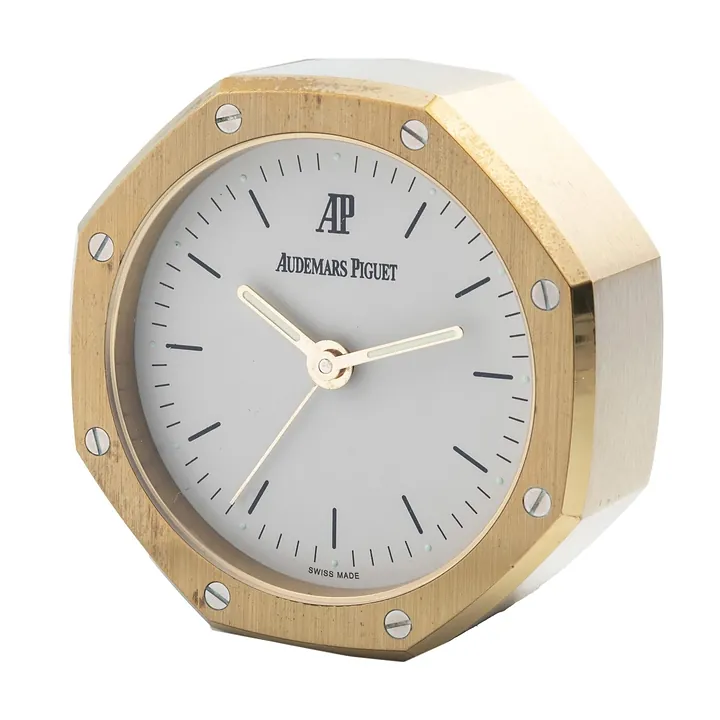
Clocks · c. 1990s
Audemars Piguet Royal Oak, c. 1990s
Antiquorum auction archive, Geneva
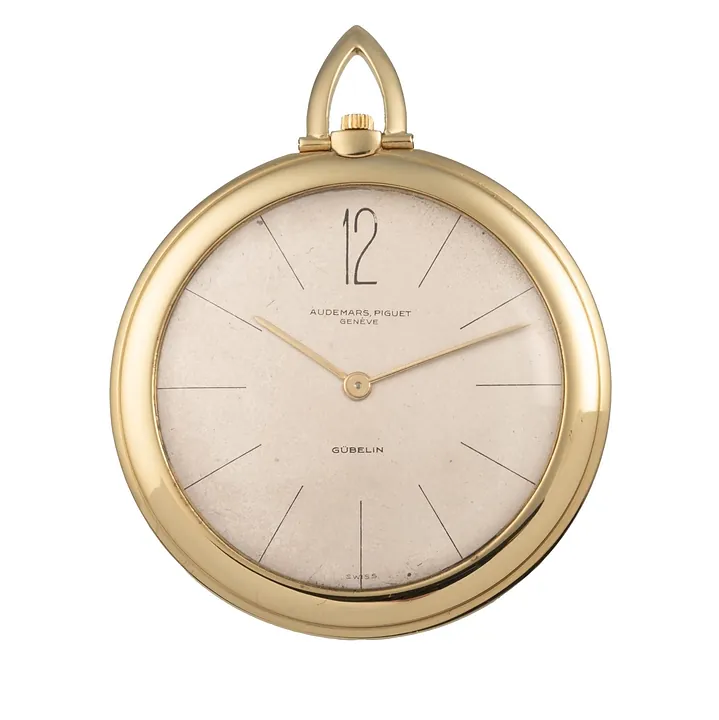
Pocket Watches · c. 1960
Audemars Piguet ''couteau'', c. 1960
Antiquorum auction archive, Geneva
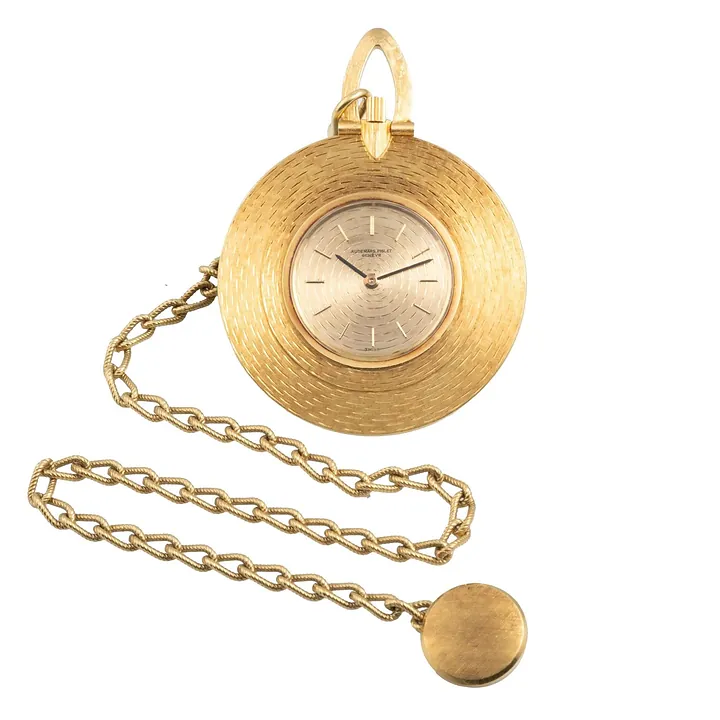
Pocket Watches · originally sold in November 1961 (per the lot record)
Audemars Piguet "extra Plate", ref. 5633 BA, originally sold in November 1961
Antiquorum auction archive, Geneva
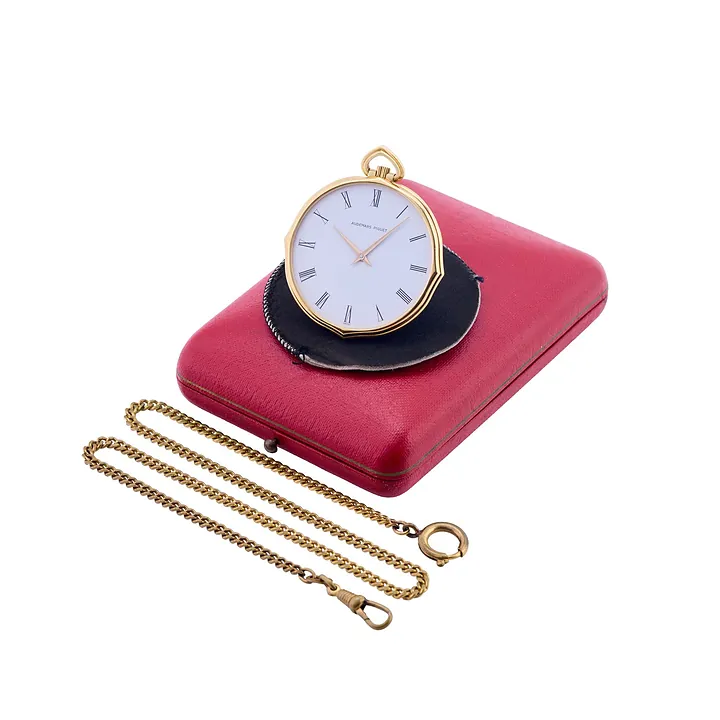
Pocket Watches · c. 1980
Audemars Piguet pocket watch, c. 1980
Antiquorum auction archive, Geneva

Wristwatches · c. 2010s
Breguet Type XXI, ref. 3810, c. 2010s (Antiquorum Lot 381-24)
Antiquorum auction archive, Geneva

Wristwatches · c. 2010s
Breguet Type XXI, ref. 3810, c. 2010s (Antiquorum Lot 386-229)
Antiquorum auction archive, Geneva

Wristwatches · Sold in September 2010
Breitling Cosmonaute, ref. A 22322, Sold in September 2010
Antiquorum auction archive, Geneva

Wristwatches · c. 2010
Corum Bubble Chrono, ref. 396.150.20, c. 2010
Antiquorum auction archive, Geneva