
Wristwatches · Wristwatch
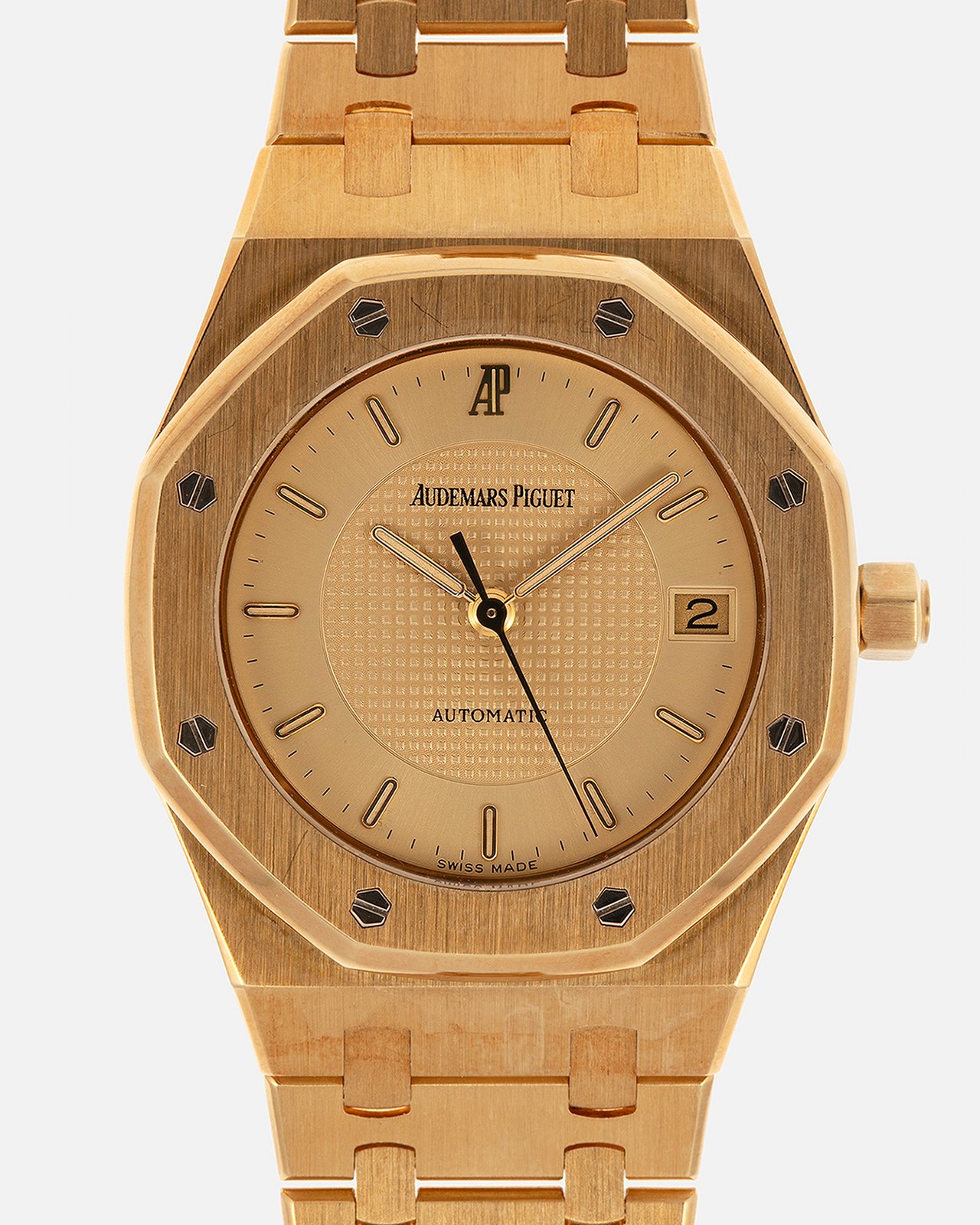
Audemars Piguet Royal Oak 15090BA 'Nick Faldo', 1992
- Maker / attribution
- Audemars Piguet (maker)
- Date
- 1992
- Historical period
- Mechanical Renaissance (1990 – 2010)
- Country of origin
- Switzerland
- Object type
- Wristwatch
- Dimensions
- Case 36 mm
- Stock no.
- Product 7561606692951
- Credit line
- Dealer listing, S.Song Watches (product 7561606692951)
- Catalogue title (original)
- Audemars Piguet Royal Oak 15090BA 'Nick Faldo' (English)
View the source record (dealer listing) ↗ (opens another website in a new tab)Suggest a correction
Record summary
Catalogued by S.Song Watches (dealer), Seattle (stock number Product 7561606692951), this is a wristwatch by Audemars Piguet, made in Switzerland, dated 1992. The Atlas places it in the Mechanical Renaissance period (1990 – 2010) of its Wristwatches collection. Recorded dimensions: Case 36 mm. The record is illustrated with 6 photographs.
Assembled from the source record's structured fields. Dates and attributions are given as the source states them; where a field is missing the Atlas leaves it blank rather than estimating.
Catalogue description
Dealer description — S.Song Watches
The Royal Oak, with its masculine octagonal case, exposed screws, and integrated bracelet, is one of the most visually distinctive watches in the market today. It is imposing and recognisable, and easily one of the best statement watches money can buy. On top of this, with the current craze for integrated bracelet sports watches and many brands producing their own version, it was the Royal Oak that started it all. What we have here is an intriguing and seldom seen Royal Oak from Audemars Piguet’s early Nick Faldo commemorative period. In 1992, AP introduced the first of three special editions, the 15090, celebrating the career and legacy of the legendary golfer. It was followed by the 15097OR in 1997, produced exclusively in rose gold with 375 pieces, and the 15190SP in 2002, a steel and platinum model with an exhibition caseback limited to 500 pieces. The most clearly documented reference from the initial release is the stainless steel 15090ST, limited to only 175 pieces. Yellow gold examples, such as the one seen here, are far less clearly recorded in AP literature. While their exact status and production numbers remain largely unconfirmed, their near absence from the secondary market strongly suggests that only very few were ever produced. Aesthetically, there is just no mistaking a Royal Oak like this for anything else. This 15090BA, measuring 36mm x 8mm, belongs to the mid-sized Royal Oak family, a case size segment long overlooked but now gradually becoming increasingly valued by collectors. Like the early Royal Oaks, it retains the sportiness of the original 5402, but in a format that feels a bit more wearable and balanced on the wrist. Other signature elements, such as the octagonal bezel, integrated bracelet, and textured dial, combined with a full precious metal execution, enhances its visual appeal, while the angular case, sharply bevelled edges, and contrast between brushed and polished surfaces give it a refined, architectural presence. Moving on to its dial design, I think the dial of this Royal Oak immediately sets it apart. It begins with a case-matching gold dial with a wide, flat sunburst chapter ring and a circular central zone embossed with AP’s signature Tapisserie pattern, evoking the texture of a golf ball; a subtle and clever nod to its namesake. The chapter ring also hosts ten applied hour markers and a discreet date window aperture at 3:00, complemented by a set of rounded baton hands that echo the shape of the markers. On the reverse, the caseback bears a stylistic engraving of Nick Faldo’s signature. Powering the 15090BA from within is Audemars Piguet’s Cal. 2225, a self-winding movement that is derived from the Jaeger-LeCoultre Cal. 889. When fully wound, it delivers a total power reserve of approximately 40 hours. It’s also worth pointing out that this particular example features a particularly intriguing detail on its caseback—an exceptionally early production number in the single digits (No. 8). As noted earlier, while the exact production figures for the 15090BA remain unconfirmed, it remains far rarer and more elusive than its stainless steel counterpart. An early number like this only heightens its overall allure and collectability. As a whole, I genuinely think that this 15090BA is a compelling expression of the Royal Oak lineage. With its exceedingly rare provenance, strikingly beautiful dial, and elegant proportions, it strikes a perfect balance of being practical enough for regular wear, refined enough to remain elegant, and interesting enough to keep you looking twice, maybe even more.
Historical context
Mechanical Renaissance (1990 – 2010)
Mechanical watches return as cultural objects; independent watchmaking flourishes.
Mechanical watches returned as cultural and luxury objects. Complications, tourbillons and new materials proliferated; independent watchmakers such as George Daniels, F.P. Journe and Philippe Dufour revived artisanal watchmaking; collecting vintage watches became a major field.
Read the period in the timelineMore wristwatches from this periodEarlier: Quartz Revolution
Atlas type guide
Wristwatches
Bracelet watches were worn by women from the early nineteenth century — Breguet made one for Caroline Murat, Queen of Naples, in 1810–12 — but the wristwatch only became a man's instrument with military use and aviation in the early twentieth century. Between the World Wars it overtook the pocket watch; the 1920s and 1930s brought rectangular Art Deco cases, water-resistant cases and the first automatic winding systems.
After 1945 the wristwatch became a carrier of identity — dress watches, sports and dive watches, chronographs, calendars — produced by Swiss, American, Japanese, German, Soviet and Chinese industries. The quartz revolution after 1969 and the mechanical renaissance since the 1990s, including the rise of independent watchmakers, complete the story.
What to look for
- The reference number (between the lugs or inside the case back) and serial number, the starting point for dating.
- The calibre: its maker and number are often stamped under the dial or on the bridge.
- Originality of dial, hands and crown — refinished ('redial') dials are common.
- Case material marks: 18K/750, 14K/585, stainless steel, gold-filled, plated.
Dating clues
- Wire-lug cases: before c. 1925.
- Water-resistant screw-down cases: from 1926.
- Quartz movements: from 1969; sapphire crystals widespread after c. 1980.
General guidance written by the Atlas editors about this kind of object. It is not a statement about this particular piece; for that, rely on the source record above and on physical examination.
Related records

Clocks · c. 1990s
Audemars Piguet Royal Oak, c. 1990s
Antiquorum auction archive, Geneva

Pocket Watches · c. 1960
Audemars Piguet ''couteau'', c. 1960
Antiquorum auction archive, Geneva
Pocket Watches · originally sold in November 1961 (per the lot record)
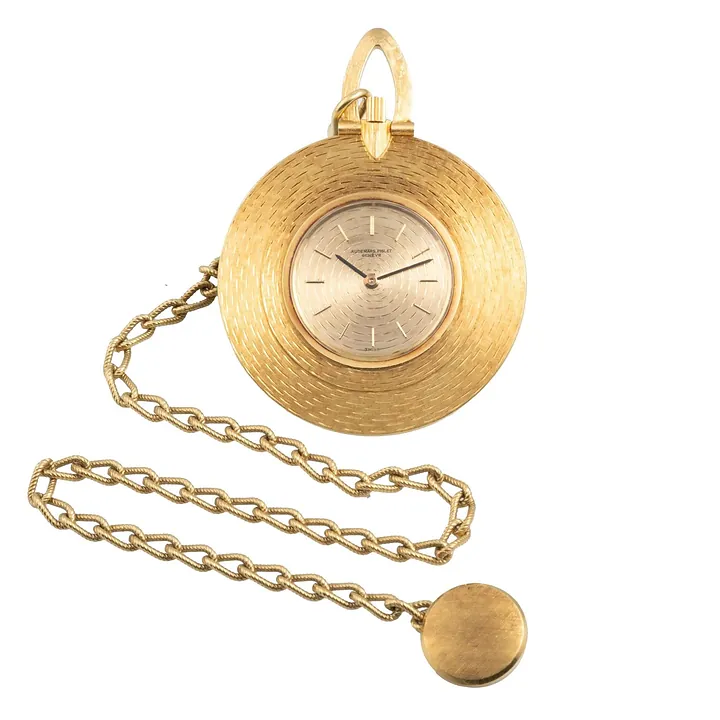
Audemars Piguet "extra Plate", ref. 5633 BA, originally sold in November 1961
Antiquorum auction archive, Geneva

Pocket Watches · c. 1980
Audemars Piguet pocket watch, c. 1980
Antiquorum auction archive, Geneva

Wristwatches · 2008
Wristwatch by Breitling?, 2008
Museum Rotterdam

Wristwatches · c. 1990s
Audemars Piguet Bamboo, c. 1990s
Antiquorum auction archive, Geneva

Wristwatches · c. 1990
Audemars Piguet Huitieme Perpetual Calendar, ref. 25696PT, c. 1990
Antiquorum auction archive, Geneva

Wristwatches · c. 1990
Breitling Chronomat, ref. b13050.1, c. 1990
Antiquorum auction archive, Geneva