
Wristwatches · Wristwatch
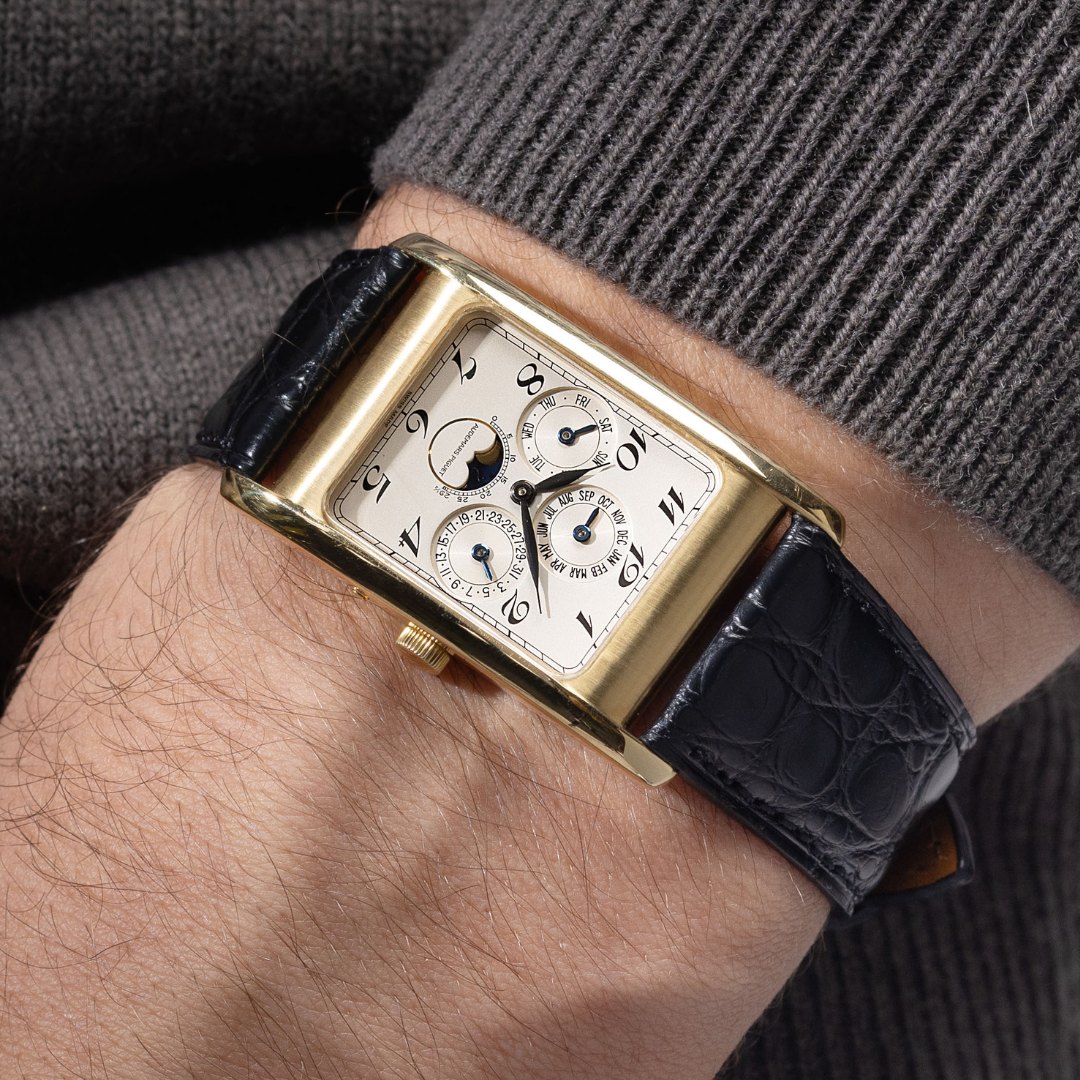
Audemars Piguet Quantième Perpetual Edward Piguet silver Dial ref 25682BA in 18 k yellow gold, 1980s
- Maker / attribution
- Audemars Piguet (maker)
- Date
- 1980s
- Historical period
- Quartz Revolution (1969 – 1990)
- Country of origin
- Switzerland
- Object type
- Wristwatch
- Materials / technique
- yellow gold
- Dimensions
- Case 45 mm
- Stock no.
- W-3466
- Credit line
- Dealer listing, Bulang & Sons (W-3466)
- Catalogue title (original)
- Audemars Piguet Quantième Perpetual Edward Piguet silver Dial ref 25682BA in 18 k yellow gold (English)
View the source record (dealer listing) ↗ (opens another website in a new tab)Suggest a correction
Record summary
Catalogued by Bulang & Sons (dealer), Copenhagen (stock number W-3466), this is a wristwatch by Audemars Piguet, made in Switzerland, dated 1980s. The Atlas places it in the Quartz Revolution period (1969 – 1990) of its Wristwatches collection. Materials and techniques recorded by the source: yellow gold. Recorded dimensions: Case 45 mm. The record is illustrated with 6 photographs.
Assembled from the source record's structured fields. Dates and attributions are given as the source states them; where a field is missing the Atlas leaves it blank rather than estimating.
Catalogue description
Dealer description — Bulang & Sons
In 1875, Jules Louis Audemars and Edward Auguste Piguet founded the Swiss watchmaking house Audemars Piguet in Le Brassus, nestled in the Vallée de Joux. A pioneer in haute horlogerie, the brand made history in 1955 by releasing its first series of perpetual calendar wristwatches with a leap year indication. The Quantième Perpétuel 25682 belongs to the Edward Piguet collection—named in honor of one of the brand’s founders. Its design draws inspiration from a distinctive rectangular “tank-style” watch created by Audemars Piguet in the mid-1920s. This QP 25682BA features a contemporary 45mm by 27mm rectangular case that delivers a refined and unmistakable wrist presence. Its elongated lugs extend in smooth, continuous lines, adding to the watch’s architectural elegance. From the bezel to the gently contoured lugs, the case finishing is thoughtfully executed, offering a soft sophistication and a more approachable aesthetic. The dial maintains the traditional perpetual calendar layout, thoughtfully reimagined to suit the rectangular format. The date appears at 3 o’clock in a recessed sub-dial that adds depth to the smooth silver surface. Opposite, the day of the week sits at 9 o’clock, with the month at 12, and a moon phase display at 6—complete with a moon age scale above it. Each sub-dial features fine concentric graining, creating visual texture and elevating the watch’s sense of complexity and charm. Painted Breguet numerals add a nostalgic nod to classic perpetual calendars, infusing the silver dial with vintage character—an increasingly rare and desirable detail among collectors. Elegant leaf-shaped hands mark the hours and minutes, while the sub-dials are accented with blued steel hands for a subtle yet striking contrast. Powering the 25682 is the manual-winding calibre 2003 with a 2805 QP perpetual calendar module—an ultra-thin movement based on a legendary Jaeger-LeCoultre ébauche. The watch has been fully serviced by our watchmaker. It is paired with a Bulang and Sons leather strap, which we believe is a perfect match for this timeless piece. We think these represent true value in today’s market. Don’t hesitate to reach out! Specifications: Audemars Piguet Edward Piguet Quantième Perpetuel reference 25682 BA 27x45 mm, 18k yellow gold elongated case Case number C98xxx, dating to the 1980s Matte silver dial with calendar registers and phase of moon, painted Breguet numerals and blued hands Hand wound caliber 2003 with 2805 QP perpetual calendar module Comes on the pictured Bulang and sons leather strap Fully serviced by our watchmaker
Historical context
Quartz Revolution (1969 – 1990)
Seiko's Astron begins mass quartz timekeeping; traditional industries contract sharply.
Quartz and digital watches transformed the market after 1969. Swiss employment collapsed, Japanese and Hong Kong production soared, and the Swatch (1983) helped the Swiss industry recover; mechanical watches survived as luxury goods.
Read the period in the timelineMore wristwatches from this periodEarlier: Modern Mechanical Horology
Atlas type guide
Calendar, moon-phase and perpetual calendar watches
Calendar complications range from a simple date to the perpetual calendar, which automatically allows for months of different lengths and leap years until 2100. Pocket watches with perpetual calendars were made in the eighteenth and nineteenth centuries; Patek Philippe made the first perpetual calendar wristwatch in 1925, and series production followed in 1941. The annual calendar (Patek Philippe, 1996) needs correction only once a year.
Moon-phase displays use a disc with two moons and 59 teeth advanced daily, approximating the 29.5-day lunation; more precise trains reduce the error to one day in over a century.
What to look for
- Apertures or subsidiary dials for day, date, month and leap year.
- Moon disc under a 'bosom' shaped aperture.
- Recessed correctors on the case band for setting the calendar.
Dating clues
- Triple-date wristwatches: popular c. 1940–1955.
- Perpetual calendar wristwatches: from 1925 (unique) and 1941 (series).
General guidance written by the Atlas editors about this kind of object. It is not a statement about this particular piece; for that, rely on the source record above and on physical examination.
Related records

Clocks · c. 1990s
Audemars Piguet Royal Oak, c. 1990s
Antiquorum auction archive, Geneva

Pocket Watches · c. 1960
Audemars Piguet ''couteau'', c. 1960
Antiquorum auction archive, Geneva
Pocket Watches · originally sold in November 1961 (per the lot record)
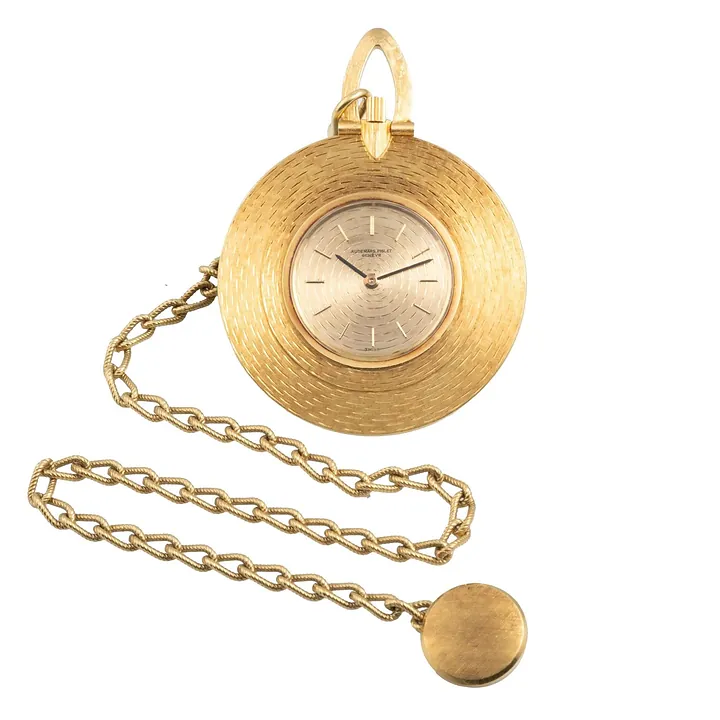
Audemars Piguet "extra Plate", ref. 5633 BA, originally sold in November 1961
Antiquorum auction archive, Geneva

Pocket Watches · c. 1980
Audemars Piguet pocket watch, c. 1980
Antiquorum auction archive, Geneva

Wristwatches · 1970
Wristwatch by Heno, Switzerland, 1970
Museum Rotterdam

Wristwatches · 1960–1986
'Tri-Compax' calendar chronograph wristwatch in gold case, by Universal, Geneva, Switzerland, 1960–1986.
Science Museum Group, London

Wristwatches · 1969–1970
Beta 21 Quartz wristwatch movement, made in Switzerland, 1970.
Science Museum Group, London

Wristwatches · c. 1969
Omega Speedmaster Moonwatch, ref. 145022-69st, c. 1969
Antiquorum auction archive, Geneva