
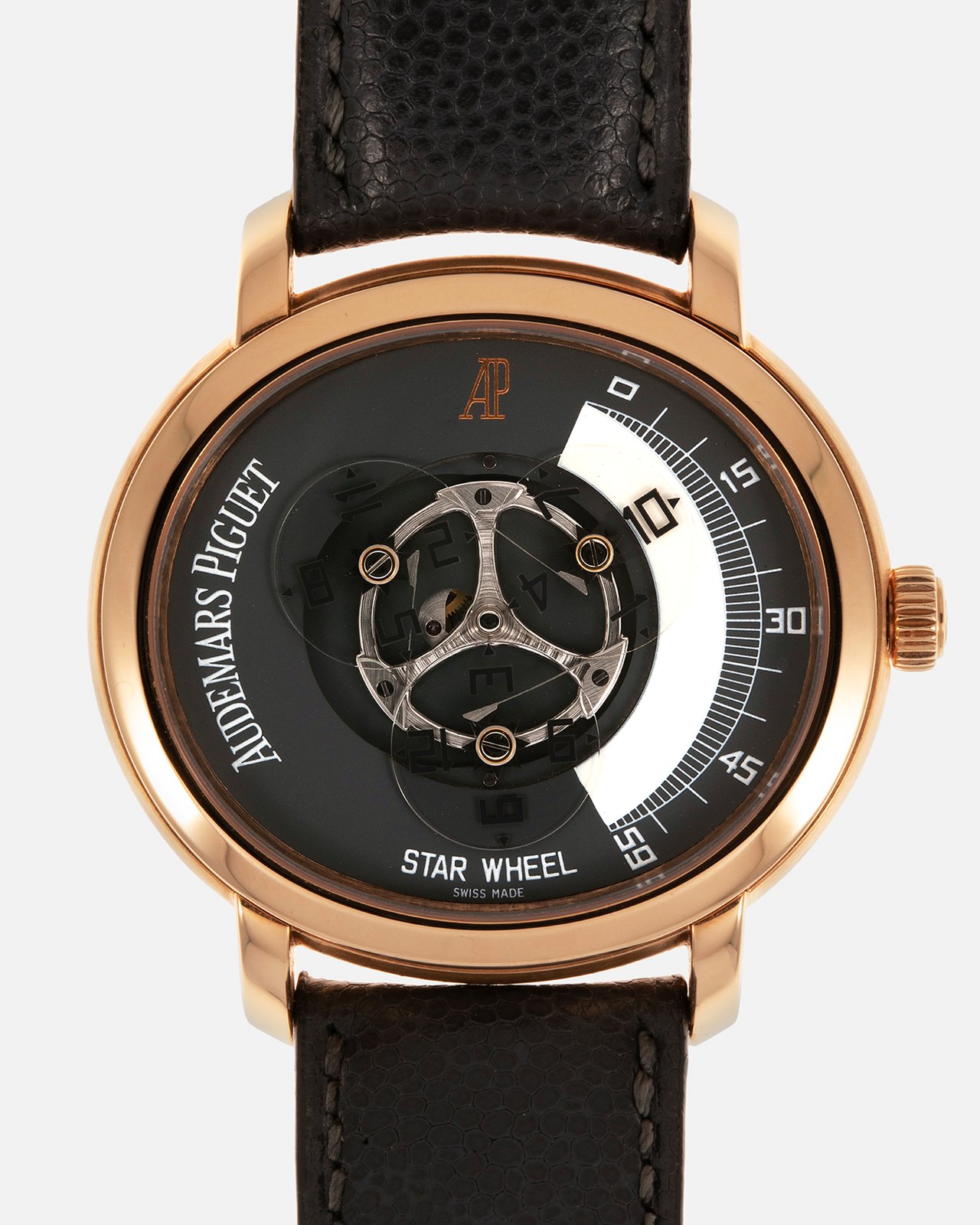
Wristwatches · Wristwatch
Audemars Piguet Millenary Star Wheel 25898OR, 2000
- Maker / attribution
- Audemars Piguet (maker)
- Date
- 2000
- Historical period
- Mechanical Renaissance (1990 – 2010)
- Country of origin
- Switzerland
- Object type
- Wristwatch
- Dimensions
- Case 41 mm
- Stock no.
- Product 7261132292183
- Credit line
- Dealer listing, S.Song Watches (product 7261132292183)
- Catalogue title (original)
- Audemars Piguet Millenary Star Wheel 25898OR (English)
View the source record (dealer listing) ↗ (opens another website in a new tab)Suggest a correction
Record summary
Catalogued by S.Song Watches (dealer), Seattle (stock number Product 7261132292183), this is a wristwatch by Audemars Piguet, made in Switzerland, dated 2000. The Atlas places it in the Mechanical Renaissance period (1990 – 2010) of its Wristwatches collection. Recorded dimensions: Case 41 mm. The record is illustrated with 6 photographs.
Assembled from the source record's structured fields. Dates and attributions are given as the source states them; where a field is missing the Atlas leaves it blank rather than estimating.
Catalogue description
Dealer description — S.Song Watches
Famed as one of watchmaking's most successful risk-takers, Audemars Piguet is rightfully renowned for incredible avant-garde timepieces that push horological boundaries far beyond what most would consider reasonable. While the Royal Oak springs to mind as an unusual release given the prevailing market conditions that surrounded it due to the Quartz Crisis and the general lack of stainless steel in most luxury brands' portfolios, the watch I have here represents perhaps one of the more interesting offerings by Audemars Piguet due to the sheer originality of its design and novel display – the Audemars Piguet Millenary Ref. 25898 ‘Star Wheel’. First introduced in 1991, its inaugural version (the Ref. 25720, which we have also previously listed in the past) represented a highly unconventional watch design for its era, especially amidst the increasing popularity and the market’s preferential shift towards sports watches. This design, which now appears remarkably ahead of its time, drew inspiration from the historical wandering hours complication dating back to the 17th century. The Star Wheel showcases this innovation through three rotating sapphire disks positioned at the top of its dial. Even to this day, the Ref. 25720 continues to influence contemporary brands such as Urwerk due to its distinctive layout, garnering a dedicated following and solidifying its place within Audemars Piguet's esteemed history as another groundbreaking industry trendsetter. However, the Star Wheel Ref. 25720 had a brief production run of only 5 years before being discontinued. It later reappeared in Audemars Piguet's lineup in the form of the Millenary. The specific example offered here today, the Ref. 25898OR in resplendent 18-carat rose gold, is part of a trio of limited editions in stainless steel, yellow gold and rose gold that was released back in 2000 to commemorate Audemars Piguet's 125th anniversary as a watch manufacture. In stainless steel, 125 pieces were produced, in yellow gold 50 pieces and the rose gold example we have here today was made in 75 pieces, making it a very rare piece to come across. Based on my observations over the years, opinions on the Millenary’s case design vary greatly—it's either loved or disliked without much middle ground. Personally, I find myself among its admirers, appreciating its balanced and unconventional appearance, especially considering Audemars Piguet's renowned association with the Royal Oak. The Millenary stands out positively for me as an exception. I think it is also worth mentioning that Audemars Piguet made an excellent choice in selecting this case to house a technically complex ‘wandering hours’ mechanism like the Star Wheel. Traditionally, non-circular cases present significant geometric challenges in watch design. However, in this design, I find that the oval shape of the case and its subtly stepped conical bezel actually contribute to a sense of visual coherence across the entire mechanism. Moreover, it contributes to its overall wearability; despite its 41mm diameter on paper, it wears more compactly than one might expect from the specifications alone. Nestled within its radiant 18-carat yellow gold oval case is a slate grey dial accented by a contrasting bright white sector that highlights the hours. Positioned on the right side of the dial is a linear track dedicated to displaying the minutes. The movement of time is realized as each hour disk containing numerals of 1 to 12 with a small arrow on each end, traverses through the bright white sector, marking the transition of hours with each disk seamlessly taking its place along the track. Looking at the dial, Audemars Piguet has also achieved impeccable visual balance on this unconventional dial by placing a vertically arching ‘Audemars Piguet’ signature on the left portion of the dial with the 'AP' logo at 12:00, as well as ‘Star Wheel’ at the 6:00. Powering the Ref. 25898OR from within is Audemars Piguet’s self-winding Cal. 2224, a 36-jewelled caliber based on the Jaeger-Lecoultre Cal. 889. For all of the reasons I have elaborated above, this Millenary Star Wheel Ref. 25898OR is undeniably a charming watch that you don’t typically see on wrists very often. While the case profile of the Millenary may not resonate universally with everyone, I think that is precisely what makes the watch so intriguing, particularly for those who are seeking a unique piece of watch design from a member of the Holy Trinity in watchmaking.
Historical context
Mechanical Renaissance (1990 – 2010)
Mechanical watches return as cultural objects; independent watchmaking flourishes.
Mechanical watches returned as cultural and luxury objects. Complications, tourbillons and new materials proliferated; independent watchmakers such as George Daniels, F.P. Journe and Philippe Dufour revived artisanal watchmaking; collecting vintage watches became a major field.
Read the period in the timelineMore wristwatches from this periodEarlier: Quartz Revolution
Atlas type guide
Wristwatches
Bracelet watches were worn by women from the early nineteenth century — Breguet made one for Caroline Murat, Queen of Naples, in 1810–12 — but the wristwatch only became a man's instrument with military use and aviation in the early twentieth century. Between the World Wars it overtook the pocket watch; the 1920s and 1930s brought rectangular Art Deco cases, water-resistant cases and the first automatic winding systems.
After 1945 the wristwatch became a carrier of identity — dress watches, sports and dive watches, chronographs, calendars — produced by Swiss, American, Japanese, German, Soviet and Chinese industries. The quartz revolution after 1969 and the mechanical renaissance since the 1990s, including the rise of independent watchmakers, complete the story.
What to look for
- The reference number (between the lugs or inside the case back) and serial number, the starting point for dating.
- The calibre: its maker and number are often stamped under the dial or on the bridge.
- Originality of dial, hands and crown — refinished ('redial') dials are common.
- Case material marks: 18K/750, 14K/585, stainless steel, gold-filled, plated.
Dating clues
- Wire-lug cases: before c. 1925.
- Water-resistant screw-down cases: from 1926.
- Quartz movements: from 1969; sapphire crystals widespread after c. 1980.
General guidance written by the Atlas editors about this kind of object. It is not a statement about this particular piece; for that, rely on the source record above and on physical examination.
Related records
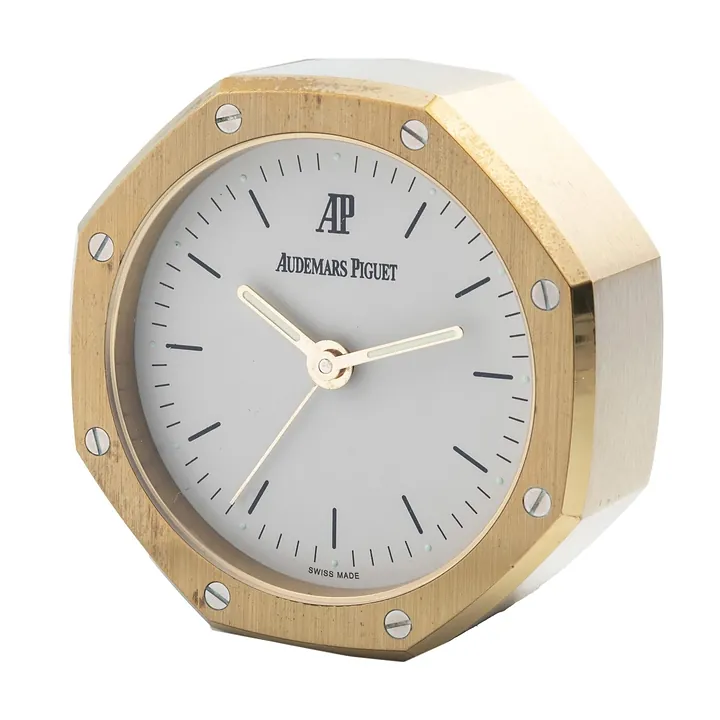
Clocks · c. 1990s
Audemars Piguet Royal Oak, c. 1990s
Antiquorum auction archive, Geneva
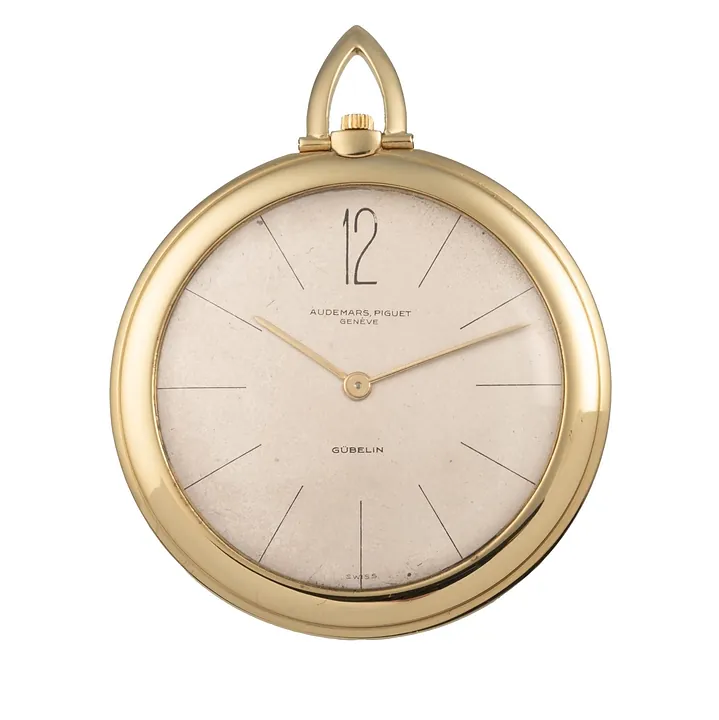
Pocket Watches · c. 1960
Audemars Piguet ''couteau'', c. 1960
Antiquorum auction archive, Geneva
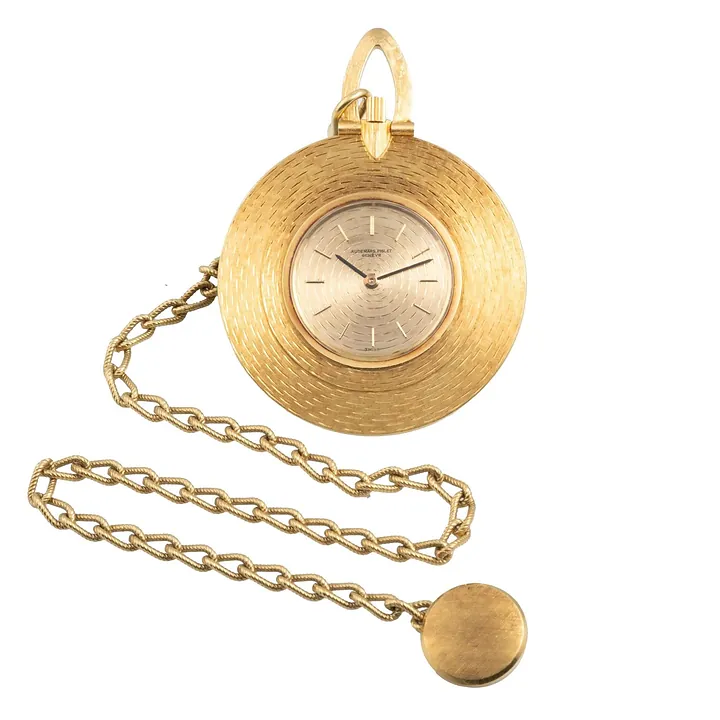
Pocket Watches · originally sold in November 1961 (per the lot record)
Audemars Piguet "extra Plate", ref. 5633 BA, originally sold in November 1961
Antiquorum auction archive, Geneva
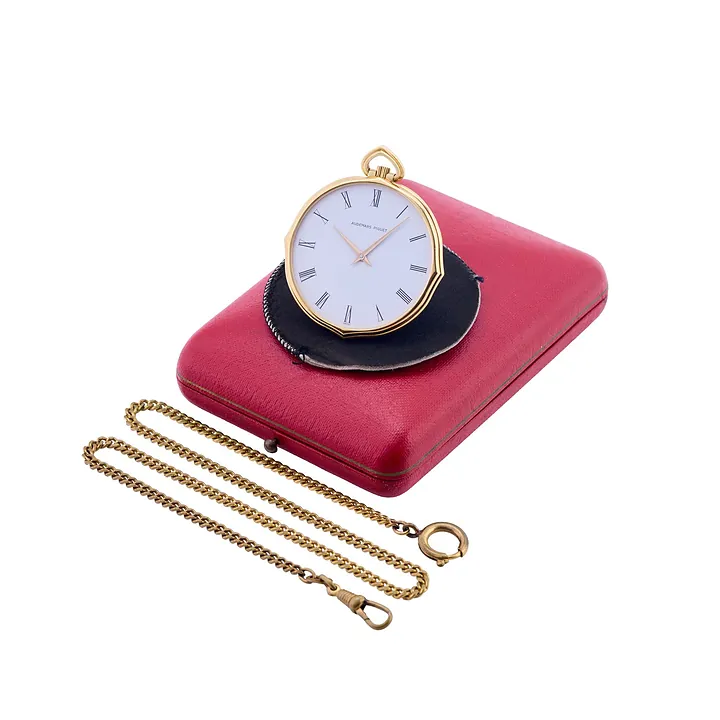
Pocket Watches · c. 1980
Audemars Piguet pocket watch, c. 1980
Antiquorum auction archive, Geneva

Wristwatches · 2008
Wristwatch by Breitling?, 2008
Museum Rotterdam

Wristwatches · c. 1990s
Audemars Piguet Bamboo, c. 1990s
Antiquorum auction archive, Geneva

Wristwatches · c. 1990
Audemars Piguet Huitieme Perpetual Calendar, ref. 25696PT, c. 1990
Antiquorum auction archive, Geneva

Wristwatches · c. 1990
Breitling Chronomat, ref. b13050.1, c. 1990
Antiquorum auction archive, Geneva