
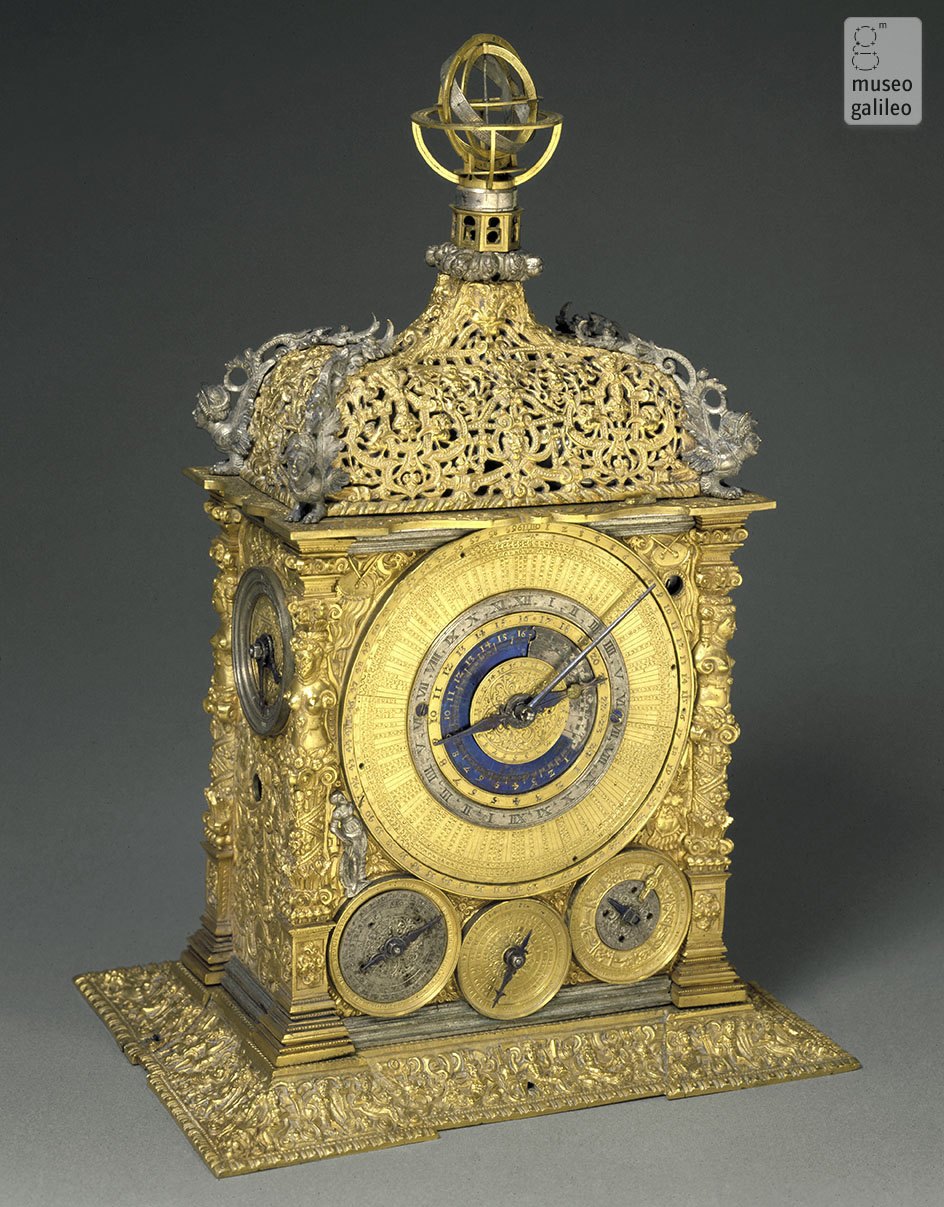
Clocks · Astronomical clock
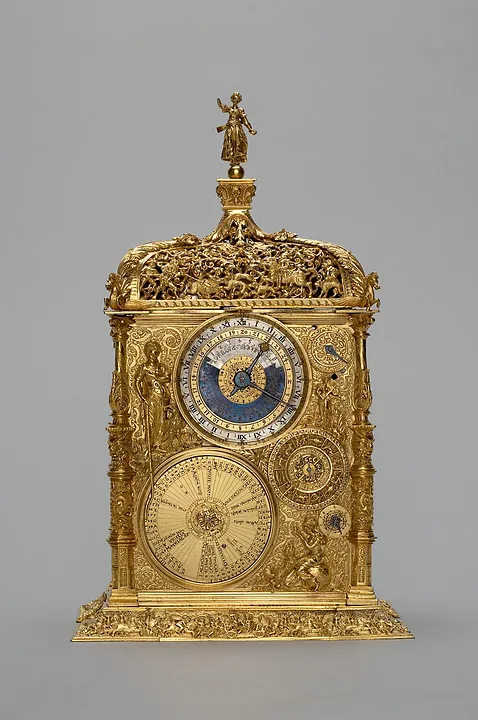
Astronomical clock attributed to Caspar Rauber, Germany, c. 1575
- Maker / attribution
- Caspar Rauber (attributed)
- Date
- c. 1575
- Historical period
- Renaissance Horology (1400 – 1600)
- Country of origin
- Germany
- Place
- German
- Object type
- Astronomical clock
- Materials / technique
- gilt and silvered brass; case: glass, velvet
- Dimensions
- 214x323x151 mm; height 400 mm
- Holding institution
- Museo Galileo, Florence
- Accession / object no.
- Inv. 3370
- Credit line
- Museo Galileo, Florence
- Catalogue title (original)
- Astronomical clock (English)
View the source record ↗ (opens another website in a new tab)Suggest a correction
Record summary
Held and catalogued by Museo Galileo, Florence (object number Inv. 3370), this is an astronomical clock attributed to Caspar Rauber, made in German, Germany, dated c. 1575. The Atlas places it in the Renaissance Horology period (1400 – 1600) of its Clocks collection. Materials and techniques recorded by the source: gilt and silvered brass; case: glass, velvet. Recorded dimensions: 214x323x151 mm; height 400 mm. The record is illustrated with 2 photographs.
Assembled from the source record's structured fields. Dates and attributions are given as the source states them; where a field is missing the Atlas leaves it blank rather than estimating.
Catalogue description
Catalogue description — Museo Galileo
This table clock has a richly decorated pavilion-shaped case, with a fretworked dome surmounted by an armillary sphere. Each side of the clock carries dials with different functions, operated by gear mechanisms inside the case. Of the two larger dials, one is of the planispheric astrolabe type, with an external hour circle numbered from I to XII twice and a reversible tympanum for locating star positions and determining the planetary hours. It is preset for latitude 48° on one side and latitude 40° on the other. Above this dial, a pendulum was hooked on at a later date (17th C.). The other larger dial, also reversible, displays months, dates, major saints' days, the seasonally changing duration of light and darkness from dawn to sunset, and some hour computations. The armillary sphere, with the Earth placed at the center and a small magnetic compass in the base, is operated manually. The chime for the hours, quarter-hours, and minutes is under the dome. The alarm mechanism is missing. The iron movement has three trains driven by springs inside barrels with a fusee: one train is for timekeeping, one for the hours chime, and one for the minutes chime. The back of the astrolabe dial is stamped twice with the initials CR joined inside a shield: the letters may stand for Caspar Rauber. The original leather case is lined on the inside and outside with red velvet. There are six openings protected by crystals. The globe-shaped top, also covered in leather, protects the armillary sphere. The case is divided into three parts: the base, with a drawer for the keys, and two façade covers. Possibly the clock made in Florence for Maria Cristina of Lorraine, wife of Grand Duke Ferdinand I de' Medici. Remained in the possession of the Medici and was later exhibited in the Tribuna di Galileo. Restored to working order in 1878.
Historical context
Renaissance Horology (1400 – 1600)
Spring power makes clocks portable; Nuremberg and Augsburg produce the first watches; the Prague Orloj is built.
Spring power made the domestic clock portable. Augsburg and Nuremberg produced gilt-brass table clocks, often with astronomical dials and alarms; weight-driven Gothic wall clocks and English lantern clocks served households. Clocks of this period have foliot or balance-wheel control and usually only an hour hand.
Read the period in the timelineMore clocks from this periodEarlier: Medieval Period
Atlas type guide
Astronomical, musical and automaton clocks
Astronomical clocks display more than the hour: the positions of the sun and moon in the zodiac, the phase of the moon, the calendar, sometimes the planets and eclipses. From Richard of Wallingford's and Giovanni de' Dondi's fourteenth-century clocks to the Prague Orloj and the Strasbourg cathedral clocks, they demonstrated the order of the cosmos. Renaissance makers in Augsburg and Nuremberg built celestial globe clocks and monstrance clocks as princely treasures.
Automaton and musical clocks entertained as well as informed: figures move, birds sing, organs and carillons play tunes from pinned cylinders. The eighteenth-century trade with China ('sing-songs') and Ottoman Turkey created a market for elaborate English, Swiss and French automata.
What to look for
- Subsidiary dials for moon phase, calendar, zodiac and planetary positions.
- Celestial globes or armillary spheres turned by the movement.
- Pinned cylinders, bellows and pipes or bells for music.
- Figures on cams and levers; separate trains for automaton work.
Dating clues
- Renaissance astronomical table and globe clocks: c. 1550–1650.
- English and Swiss automaton clocks for the Chinese market: c. 1760–1820.
- Picture clocks (clockwork pictures) are mostly nineteenth century.
General guidance written by the Atlas editors about this kind of object. It is not a statement about this particular piece; for that, rely on the source record above and on physical examination.
Read next:Verge escapement
Related records
Clocks · 1400–1499
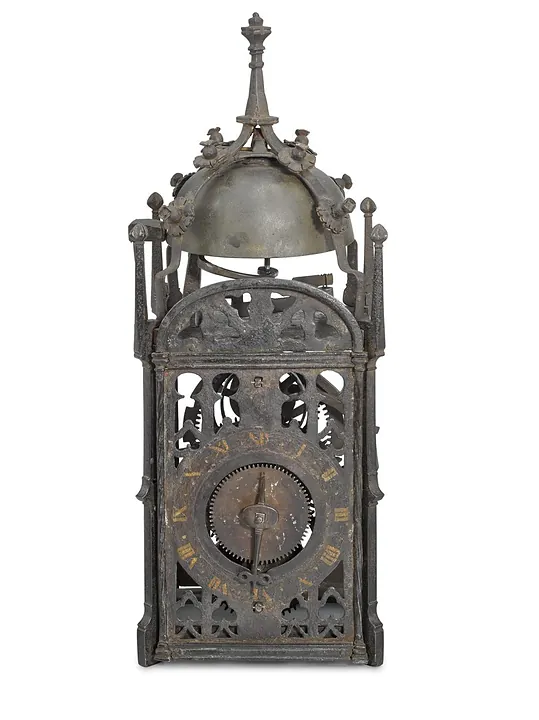
Lantern clock, Germany, 1400–1499
Science Museum Group, London
Clocks · 1500–1599
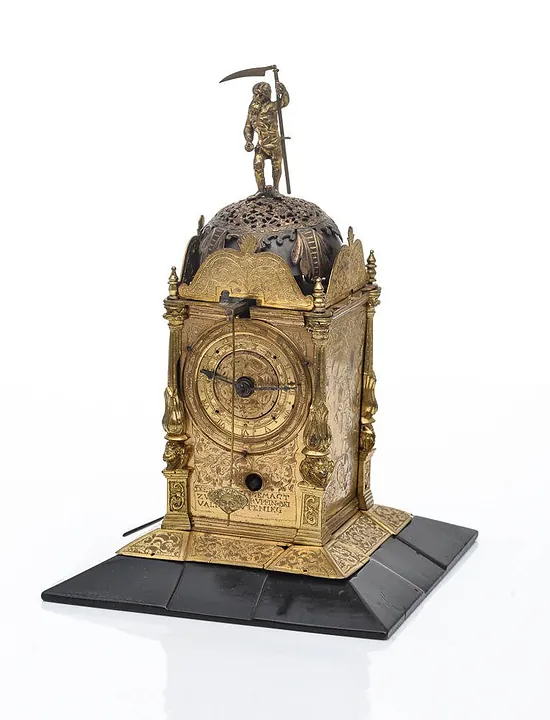
Table clock by Valentin Rutenieg, Germany, 1500–1599
City Museum Berlin
Clocks · 1501–1600
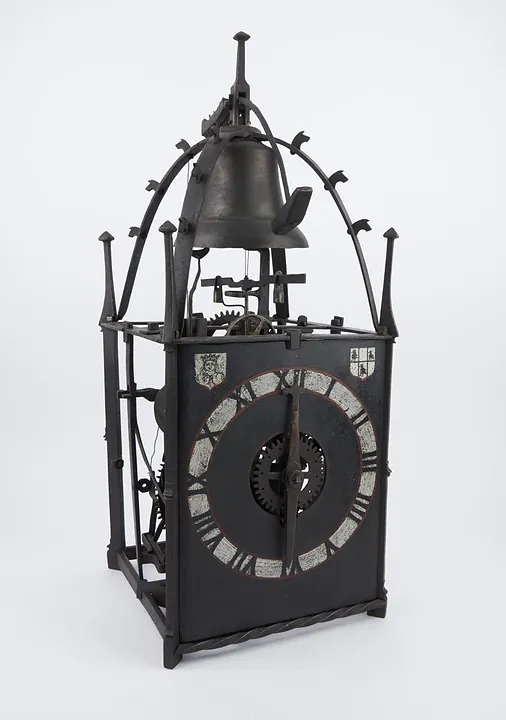
German 16th century iron chamber clock
Science Museum Group, London
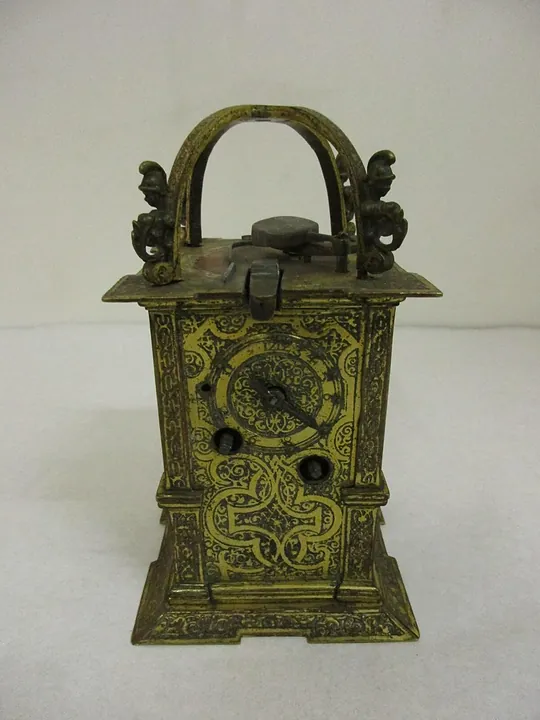
Clocks · c.1550
Clock, a striking alarm clock in a gilt brass case, Germany, c.1550.
Victoria and Albert Museum, London
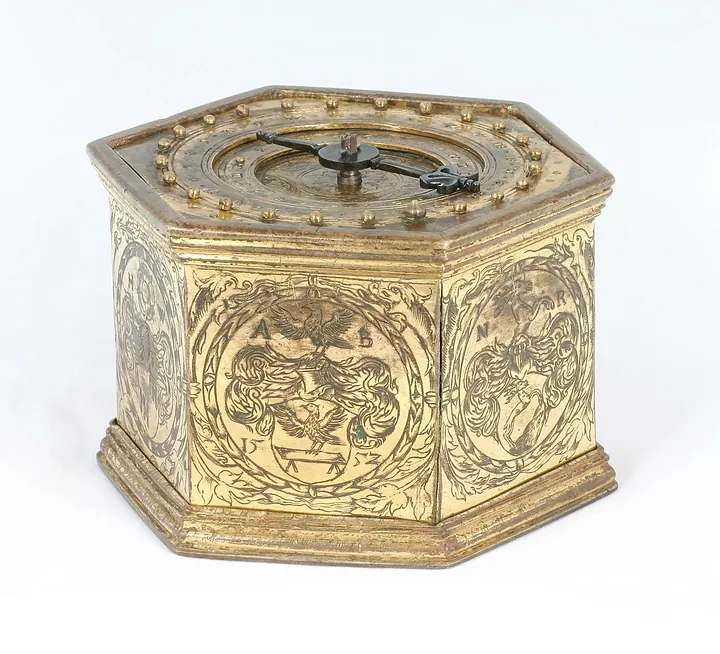
Clocks · 1552
Carriage / travel clock, Germany, 1552
German Clock Museum
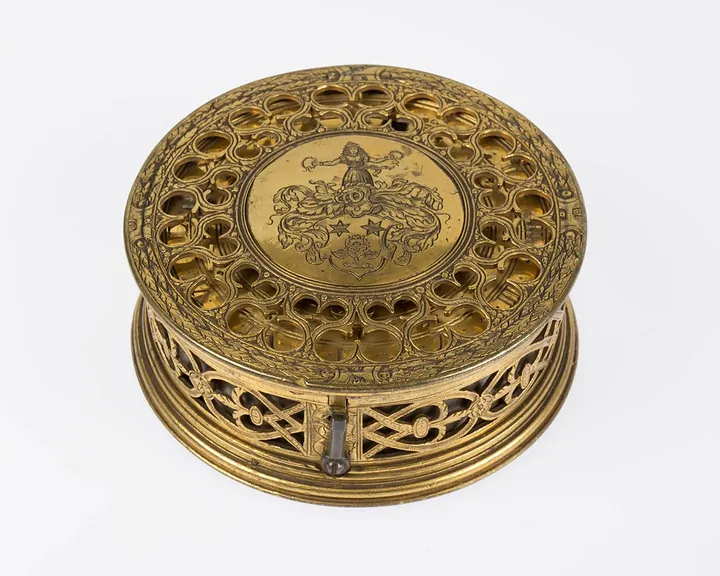
Clocks · c. 1560
Carriage / travel clock by HG, probably Germany, c. 1560
German Clock Museum
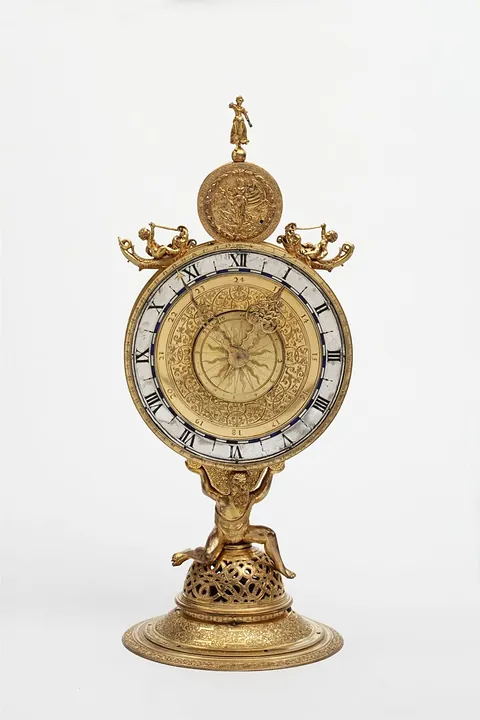
Clocks · 1564
Clock, gilt brass with enamelled silver dial ring, signed by Jeremias Metzger, Augsburg, southern Germany, dated 1564
Victoria and Albert Museum, London
Clocks · 1564
Table clock by Jeremias Metzker, Germany, 1564
Fine Arts Museum Vienna