
Clocks · Desk weather station clock
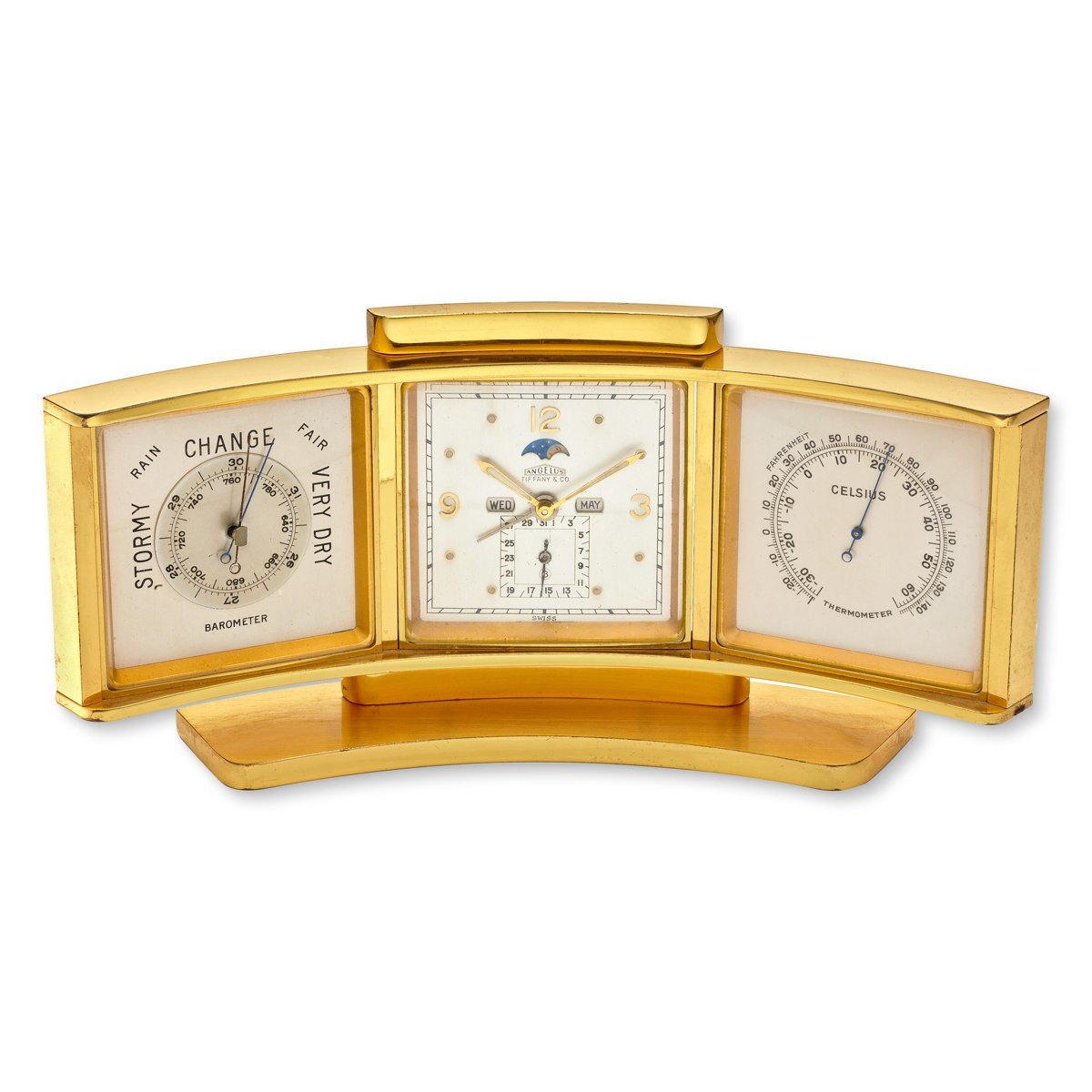
Angelus Alarm Clock and Weather Station, Retailed by Tiffany & Co
- Maker / attribution
- Angelus (source attribution)
- Date
- c. 1950s
- Historical period
- Modern Mechanical Horology (1945 – 1969)
- Country of origin
- Switzerland
- Object type
- Desk weather station clock
- Materials / technique
- Gilt brass
- Auction house
- Christie's
- Lot
- 144
- Credit line
- Christie's
- Catalogue title (original)
- ANGELUS, ALARM CLOCK AND WEATHER STATION, RETAILED BY TIFFANY & CO., | Christie’s (English)
View the source record (auction lot) ↗ (opens another website in a new tab)Suggest a correction
Record summary
Catalogued by Christie's (lot 144), this is a desk weather station clock attributed to Angelus, made in Switzerland, dated c. 1950s. The Atlas places it in the Modern Mechanical Horology period (1945 – 1969) of its Clocks collection. Materials and techniques recorded by the source: Gilt brass. The record is illustrated with 1 photograph.
Assembled from the source record's structured fields. Dates and attributions are given as the source states them; where a field is missing the Atlas leaves it blank rather than estimating.
Catalogue description
Original object description
Constructed by Angelus around the 1950s for retail by Tiffany & Co., this desk weather station comprises three gilt-brass instruments set in an arc atop a curved base. The central square module features a silvered dial showing the time and alarm, supplemented by displays for the day, month, and moon phase, framed by an exterior date ring. Positioned to the left is an aneroid barometer, while the right instrument is a thermometer with nested Fahrenheit and Celsius scales read by blued steel hands. Wear includes surface scratches on the brass housing, scraping around the center of the clock hands (which exhibit signs of renewed luminous material), and oxidation along the edges of the dial. During cataloguing, the day, date, alarm, and thermometer functioned, but the barometer did not operate; evaluation of the hand-wound clock movement remains ambiguous due to contradictory notations of 'not working' and 'in working order', with no regulation testing performed.
Historical context
Modern Mechanical Horology (1945 – 1969)
Tool watches for divers, pilots and astronauts; electric watches anticipate the electronic age.
Post-war clocks combined new materials and industrial design: plastic and metal cases, battery-powered transistor movements from the late 1950s, and design classics by George Nelson, Max Bill and others. The first caesium atomic clock (1955) moved the definition of time from astronomy to physics.
Read the period in the timelineMore clocks from this periodEarlier: Golden Age of Mechanical Watchmaking
Atlas type guide
Turret, tower and public clocks
The first mechanical clocks of the late thirteenth and fourteenth centuries were large iron striking clocks in towers, monasteries and cathedrals, driven by falling weights and controlled by a verge escapement with a foliot or wheel balance. They struck a bell rather than displaying the time, and only gradually acquired dials. Public clocks ordered civic life, regulating markets, work and worship.
From the seventeenth century the pendulum and then the anchor and pinwheel escapements made turret clocks far more accurate. In the nineteenth century firms such as Dent, Smith of Derby, Gillett & Johnston, J. F. Weule and Collin made cast-iron flatbed movements, and Edmund Beckett Denison's gravity escapement for the Great Clock of Westminster (1859) became the standard for accurate tower clocks.
What to look for
- Frame construction: early wrought-iron 'birdcage' or posted frames versus later cast-iron flatbed or plate-and-spacer frames.
- The escapement: verge and foliot, anchor, pinwheel or double three-legged gravity escapement.
- Striking and chiming trains with count wheels or rack striking.
- Maker's plates and dates cast or engraved on the frame.
Dating clues
- Wedged and riveted wrought-iron frames generally predate 1700.
- Flatbed cast-iron movements date from about 1840 onward.
- Electrical synchronisation and electric winding appear from about 1900.
General guidance written by the Atlas editors about this kind of object. It is not a statement about this particular piece; for that, rely on the source record above and on physical examination.
Related records
Clocks · c. 1950
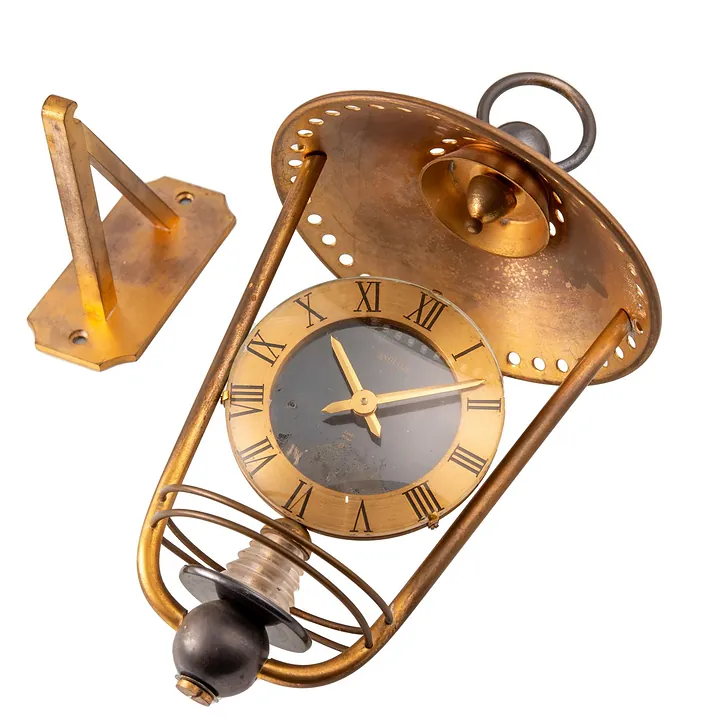
Angelus Retailed by Gobbi, Milano, c. 1950
Antiquorum auction archive, Geneva
Clocks · c. 1940s
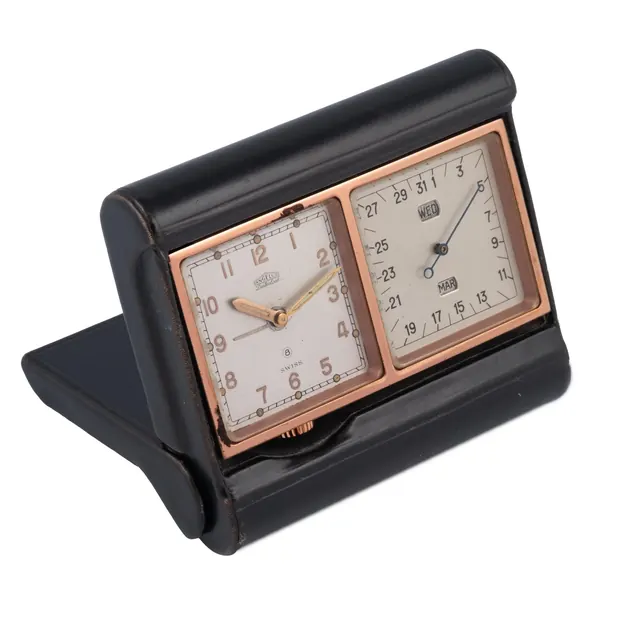
Angelus clock, Dateclock Gilt Brass, circa 1940's
Antiquorum auction archive, Geneva
Wristwatches · c. 1950
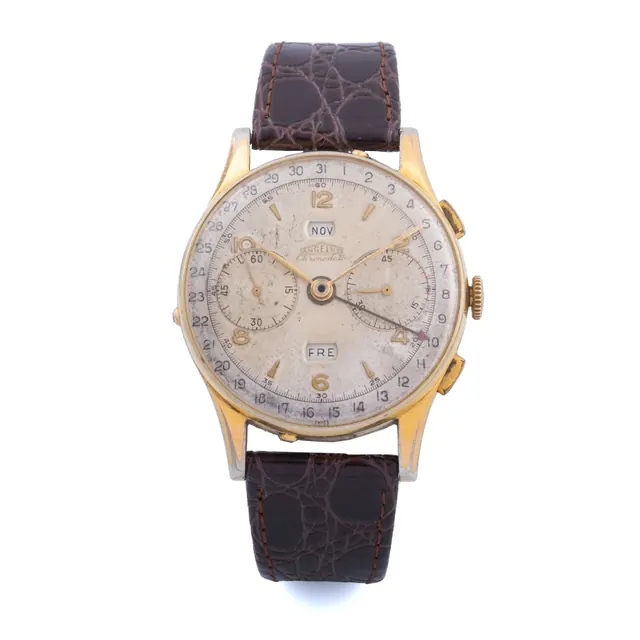
Angelus wristwatch, Swiss Crhronodato, circa 1950
Antiquorum auction archive, Geneva
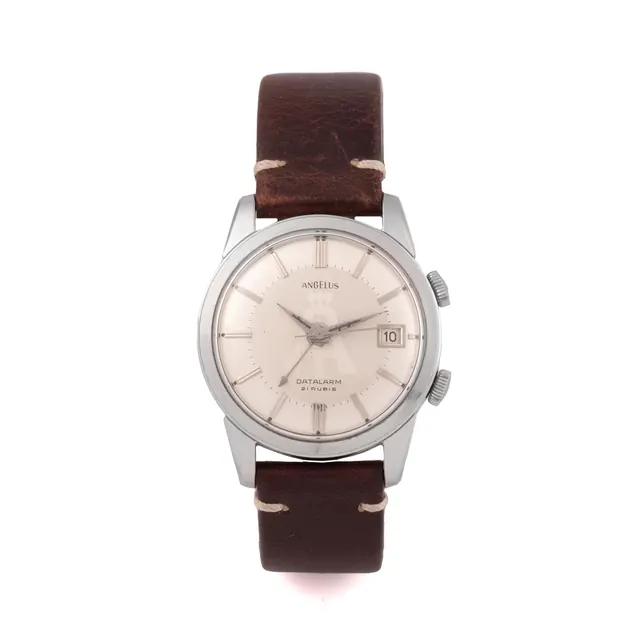
Wristwatches · c. 1960
Angelus wristwatch, ref. 10/11, Datalarm with Angelus Bell Logo On the Dial, circa 1960
Antiquorum auction archive, Geneva
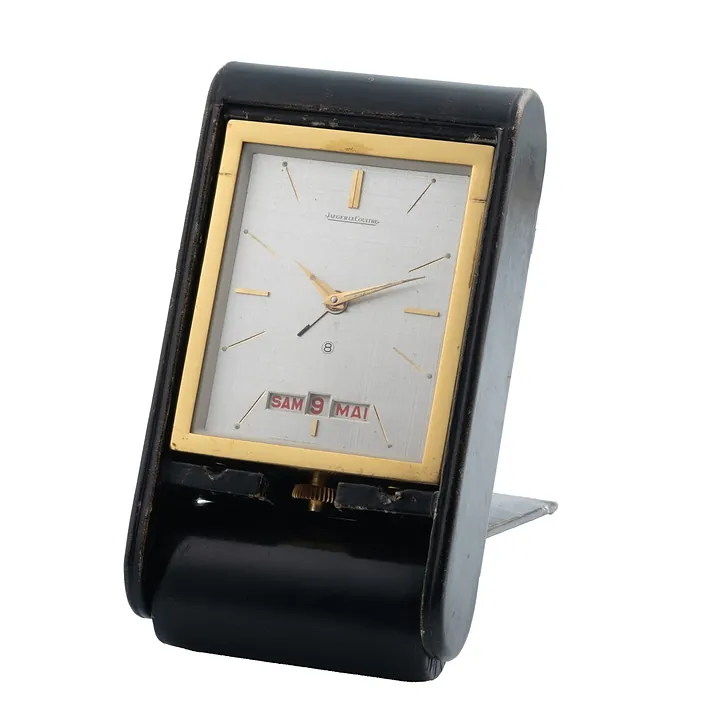
Clocks · c. 1960s
Jaeger Lecoultre Ados Calendrier, c. 1960s
Antiquorum auction archive, Geneva
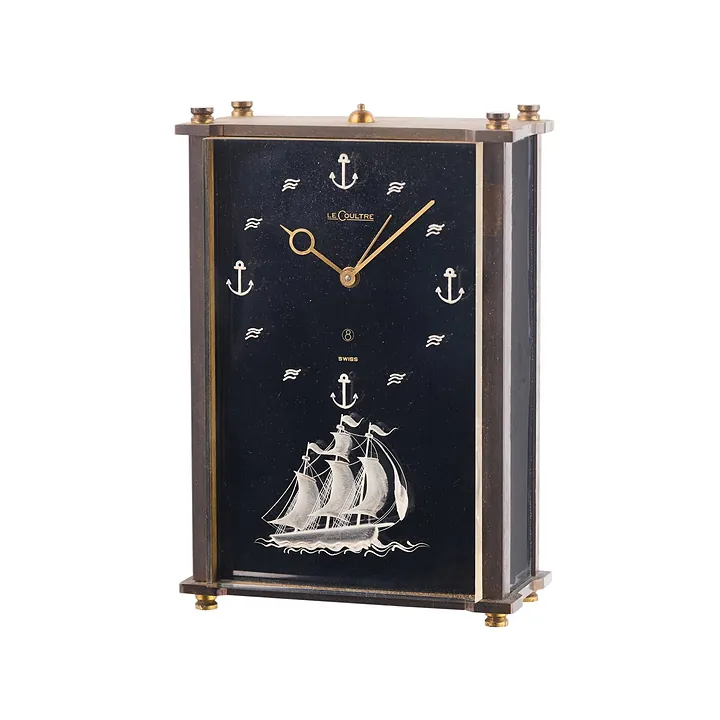
Clocks · c. 1960s
Lecoultre Music Alarm, ref. 2163, c. 1960s
Antiquorum auction archive, Geneva
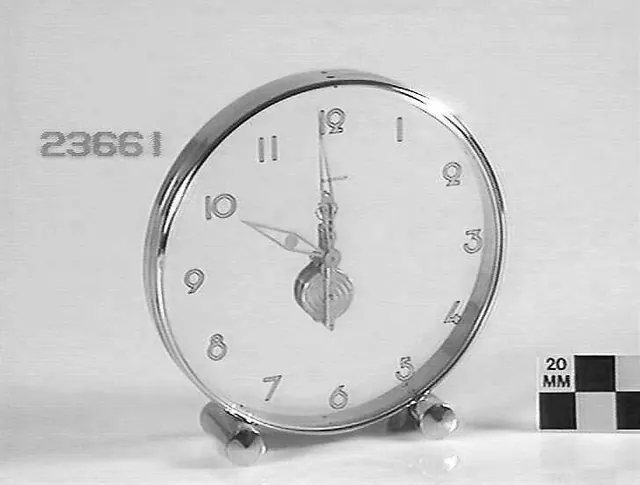
Clocks · 1953
Mantel Clock - Jaeger-LeCoultre, Switzerland, 1953
Museums Victoria, Melbourne
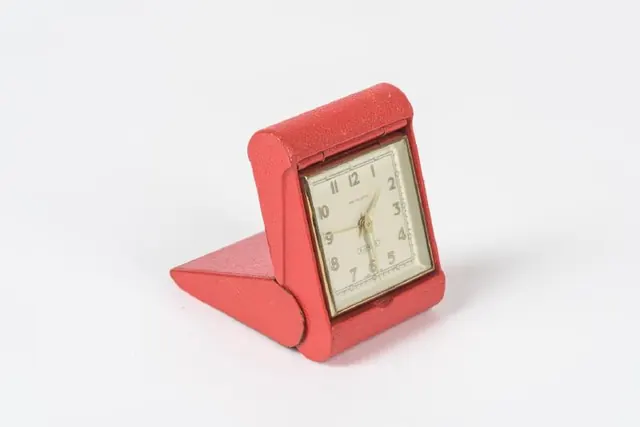
Clocks · 1950 (estimated) - 1960 (estimated)
Alarm clock, Switzerland, 1950 (estimated) - 1960 (estimated)
Keski-Suomen museo