
Wristwatches · Wristwatch
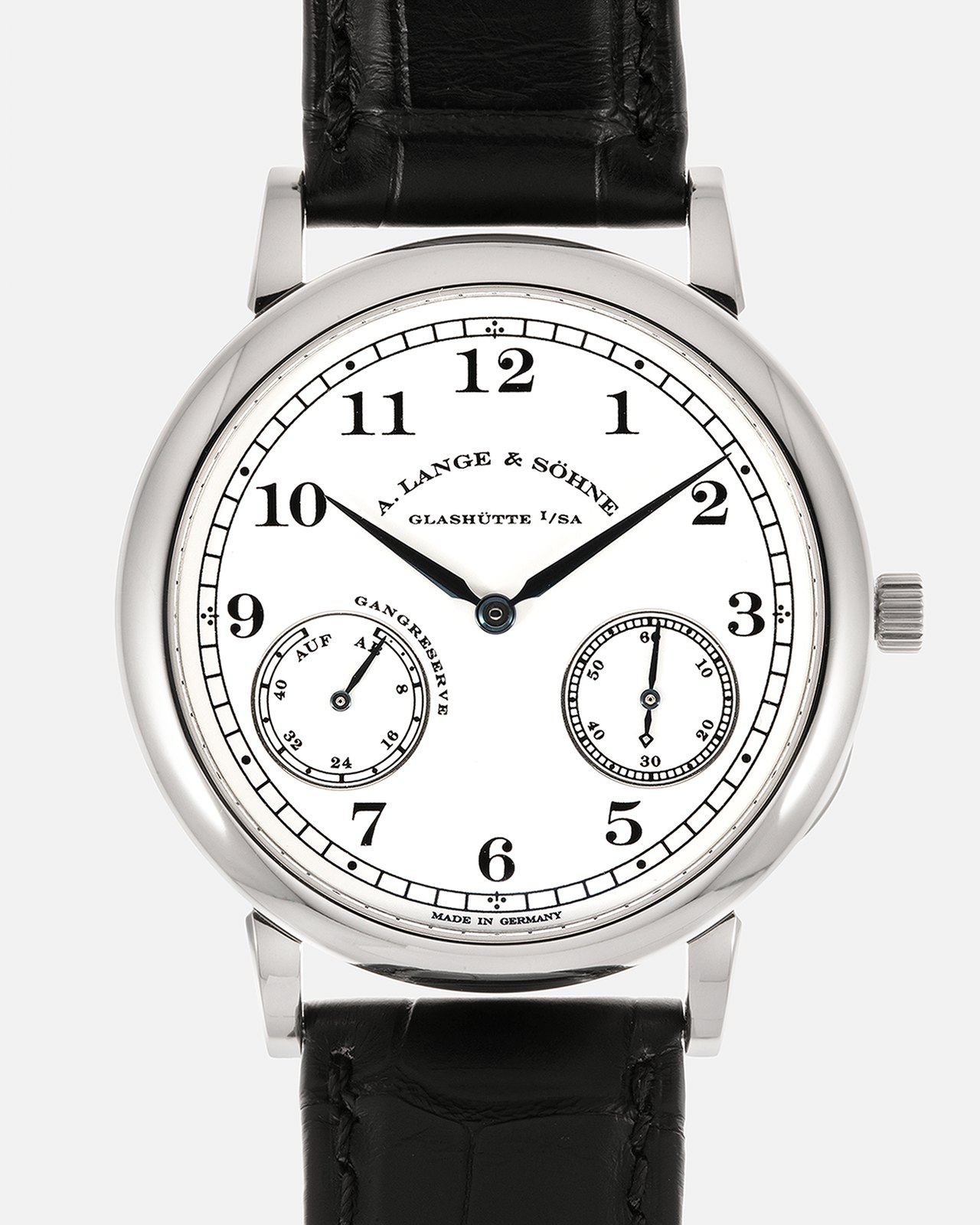
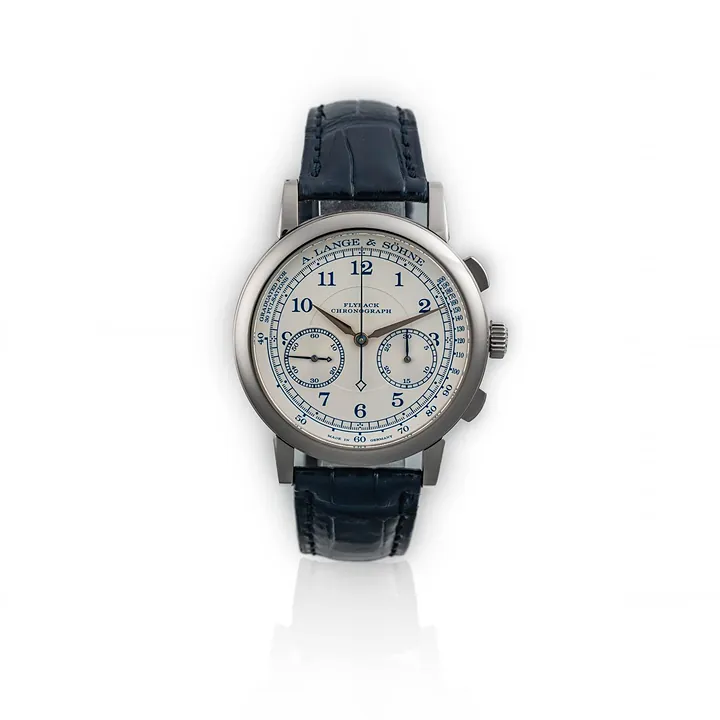
A. Lange & Sohne 1815 Up & Down ‘Walter Lange’ 223.026 Limited Edition, 2009
- Maker / attribution
- A. Lange & Sohne (maker)
- Date
- 2009
- Historical period
- Mechanical Renaissance (1990 – 2010)
- Country of origin
- Germany
- Object type
- Wristwatch
- Dimensions
- Case 37.5 mm
- Stock no.
- Product 7250431344727
- Credit line
- Dealer listing, S.Song Watches (product 7250431344727)
- Catalogue title (original)
- A. Lange & Sohne 1815 Up & Down ‘Walter Lange’ 223.026 Limited Edition (English)
View the source record (dealer listing) ↗ (opens another website in a new tab)Suggest a correction
Record summary
Catalogued by S.Song Watches (dealer), Seattle (stock number Product 7250431344727), this is a wristwatch by A. Lange & Sohne, made in Germany, dated 2009. The Atlas places it in the Mechanical Renaissance period (1990 – 2010) of its Wristwatches collection. Recorded dimensions: Case 37.5 mm. The record is illustrated with 6 photographs.
Assembled from the source record's structured fields. Dates and attributions are given as the source states them; where a field is missing the Atlas leaves it blank rather than estimating.
Catalogue description
Dealer description — S.Song Watches
When considering the leading players in the realm of high-end watchmaking, only a handful of prestigious brands come to mind: Patek Philippe, Vacheron Constantin, Audemars Piguet, and, of course, the neighbouring German brand from Glashütte, A. Lange & Söhne. While Swiss watches are often regarded as the epitome of watchmaking, A. Lange & Söhne stands as a testament to the fact that this perception is not universally true. One can even say that in some areas, A. Lange & Söhne is considered much better than its Swiss counterparts. What we have on offer today is a stunning and special example of an A. Lange & Söhne 1815 Up/Down Ref. 223.026, crafted in 18-carat white gold and produced in a limited edition of 50 pieces back in 2006. For those unaware, this limited edition is a tribute to the late Walter Lange, a pivotal figure in the re-establishment of the Saxon watchmaker. To understand the lineage of this beautiful work of mechanical art, we must go back to the ‘90s. Just three years after A. Lange & Söhne re-established itself in 1994, the renowned Saxon watchmaker decided to broaden its watchmaking portfolio with the introduction of the 1815 Up/Down—a design that embodies their modern interpretation of the elegant dress watch aesthetic. Featuring a utilitarian design and no-frills execution, the 1815 Up/Down draws inspiration from one of the earliest patents (No. 9349) the brand acquired in 1879. For context, the title description of this historical patent translates to "Device on pocket watches to detect whether the watch is wound up or wound down, or how long it has to run until it is completely out of time.", laying the foundation for the implementation of the Up/Down power reserve indicator seen in modern iterations of A. Lange & Söhne watches, such as this particular reference. Beginning with its 18-carat white gold case in 37.5mm, the 1815 Up/Down is executed with clever details that may not be immediately obvious but embody the distinctive Lange character beloved by enthusiasts. It showcases a classical tri-stepped case construction comprising the caseback, mid-case band, and bezel, each meticulously and alternately finished to create visual contrast, as well as its signature flared lugs which feature a slight downward curve for wearability and wrist ergonomics. Encased within its elegant white gold case is a beautifully refined silver dial. True to its classical styling, its silver dial is elegantly simplistic in design and features a railroad minutes track along its periphery, where each 5-minute interval is marked by a thick black dot and 15 minutes distinguished by a distinct tri-dot pattern—a design reminiscent of the Saxon Floral pattern typically seen on the region's famed porcelain. The dial is also graced with faceted, blued steel hands and black-painted Arabic numerals, followed by a running seconds indication via the off-centered and slightly recessed sub-dial on the right, while the other on the left indicates the power reserve (here: AB means empty, and AUF means full). Just like any other A. Lange & Söhne timepiece, collectors all know that one of the best things about owning one is the opportunity to just turn the watch on its back and admire its movement in all of its glory. In the case of this Ref. 223.026, the exceptional manual-winding Cal. L942.1, is discreetly hidden from plain sight beneath a hunter-style caseback, which is hinged onto the case itself. Opening it reveals the Cal. L942.1 in all its splendor, as well as an engraving of Walter Lange’s signature on the inner section of the caseback. Crafted from German silver, the Cal. L942.1 and has a traditional three-quarter plate which hosts a myriad of high-level finishes and a hand-engraved balance cock to contrast the uniformity of the movement. It is also worth mentioning that the Cal. 942.1 holds a 45-hour power reserve on a full wind. When discussing special editions from A. Lange & Söhne, the 1815 Up & Down ‘Walter Lange’ Ref. 223.026 undoubtedly ranks among the most coveted. It is undoubtedly a rare reference and I haven’t seen too many of these in the wild. Needless to say, the Ref. 223.026 is at its very core, an exemplary work of German horological artistry —a testament to A. Lange & Söhne’s uncompromising dedication to watch design and craftsmanship.
Historical context
Mechanical Renaissance (1990 – 2010)
Mechanical watches return as cultural objects; independent watchmaking flourishes.
Mechanical watches returned as cultural and luxury objects. Complications, tourbillons and new materials proliferated; independent watchmakers such as George Daniels, F.P. Journe and Philippe Dufour revived artisanal watchmaking; collecting vintage watches became a major field.
Read the period in the timelineMore wristwatches from this periodEarlier: Quartz Revolution
Atlas type guide
Wristwatches
Bracelet watches were worn by women from the early nineteenth century — Breguet made one for Caroline Murat, Queen of Naples, in 1810–12 — but the wristwatch only became a man's instrument with military use and aviation in the early twentieth century. Between the World Wars it overtook the pocket watch; the 1920s and 1930s brought rectangular Art Deco cases, water-resistant cases and the first automatic winding systems.
After 1945 the wristwatch became a carrier of identity — dress watches, sports and dive watches, chronographs, calendars — produced by Swiss, American, Japanese, German, Soviet and Chinese industries. The quartz revolution after 1969 and the mechanical renaissance since the 1990s, including the rise of independent watchmakers, complete the story.
What to look for
- The reference number (between the lugs or inside the case back) and serial number, the starting point for dating.
- The calibre: its maker and number are often stamped under the dial or on the bridge.
- Originality of dial, hands and crown — refinished ('redial') dials are common.
- Case material marks: 18K/750, 14K/585, stainless steel, gold-filled, plated.
Dating clues
- Wire-lug cases: before c. 1925.
- Water-resistant screw-down cases: from 1926.
- Quartz movements: from 1969; sapphire crystals widespread after c. 1980.
General guidance written by the Atlas editors about this kind of object. It is not a statement about this particular piece; for that, rely on the source record above and on physical examination.
Related records
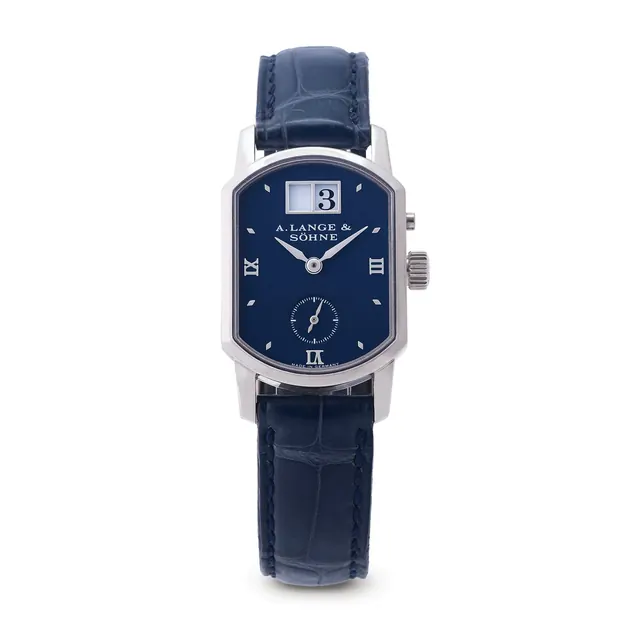
Wristwatches · originally sold on 16 December 2001 (per the lot record)
A. Lange & Sohne wristwatch, ref. 103.027, Arkade, originally sold on 16 December 2001
Antiquorum auction archive, Geneva
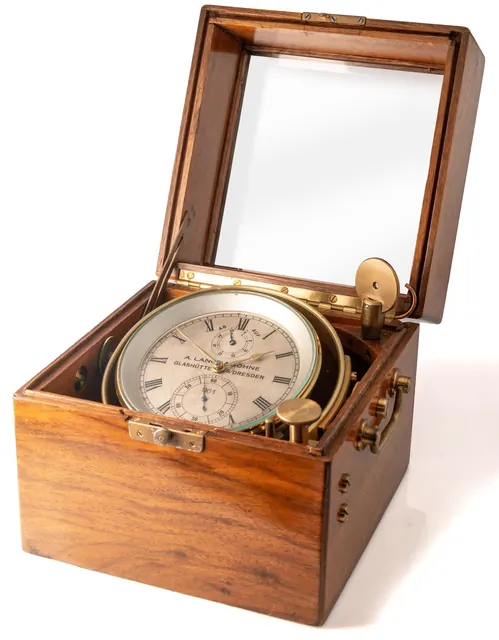
Instruments · c. 1942
A. Lange & Sohne marine chronometer, Germany Wood, circa 1942
Antiquorum auction archive, Geneva
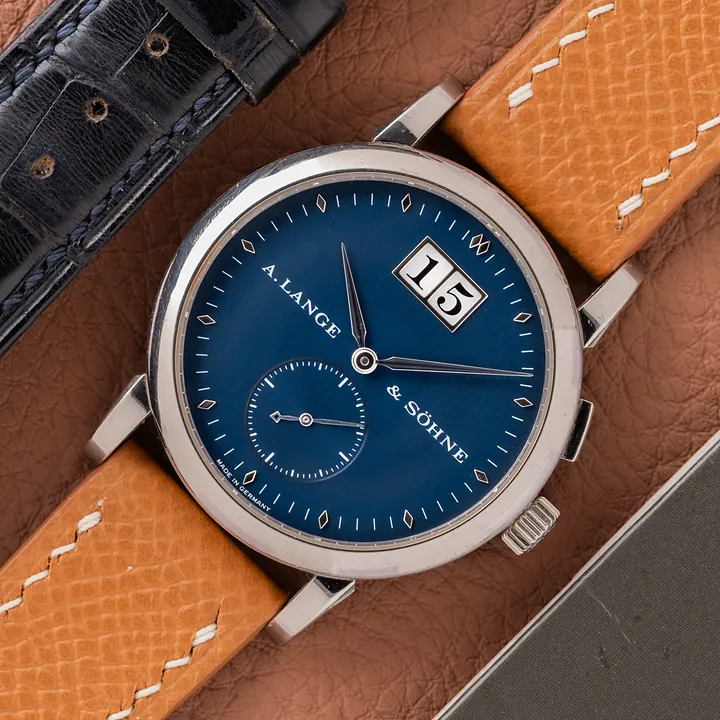
Wristwatches · 2004
A. Lange & Söhne Saxonia Oversized Date Blue (Ref. 105.027), 2004
Huntington Company (dealer)
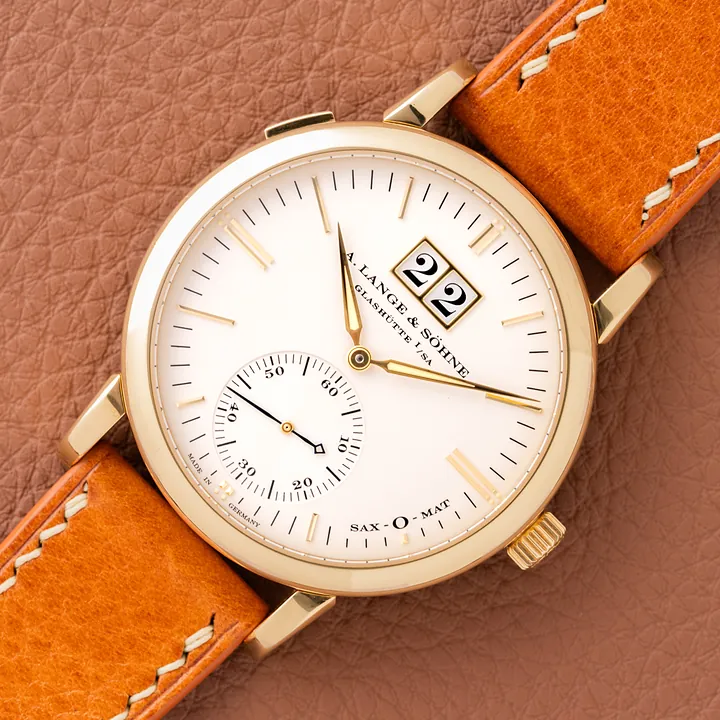
Wristwatches · 2000s
A. Lange & Söhne Langematik Oversized Date (Ref. 308.021), 2000s
Huntington Company (dealer)
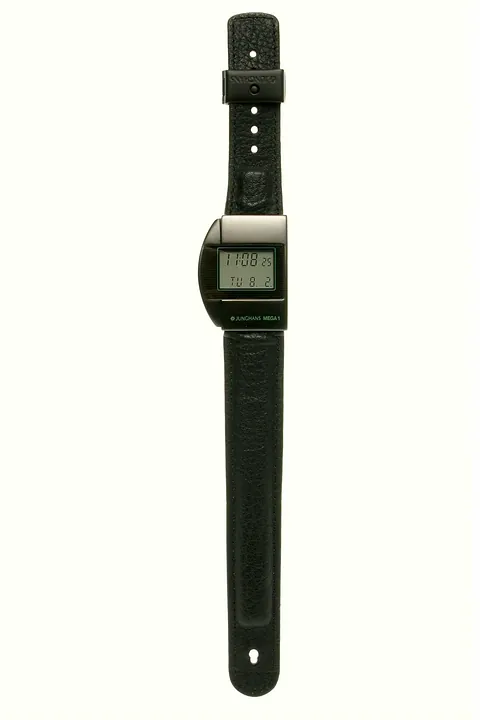
Wristwatches · c. 1990
Wristwatch, Germany, c. 1990 (no. 29875)
German Clock Museum
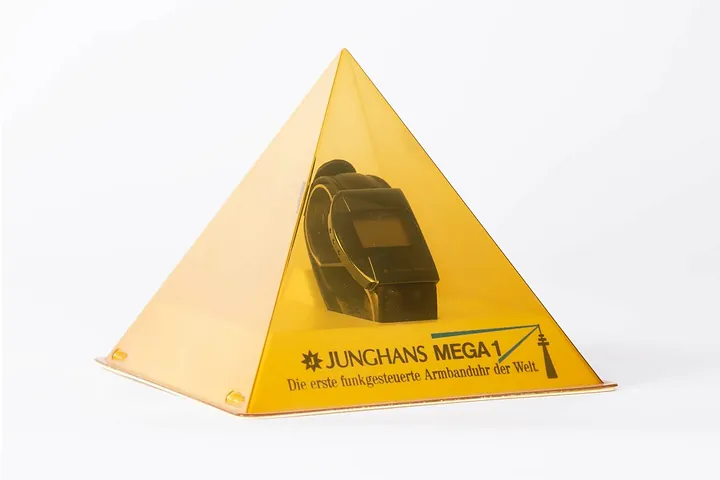
Wristwatches · 1990
Wristwatch, Germany, 1990 (no. 59620)
German Clock Museum
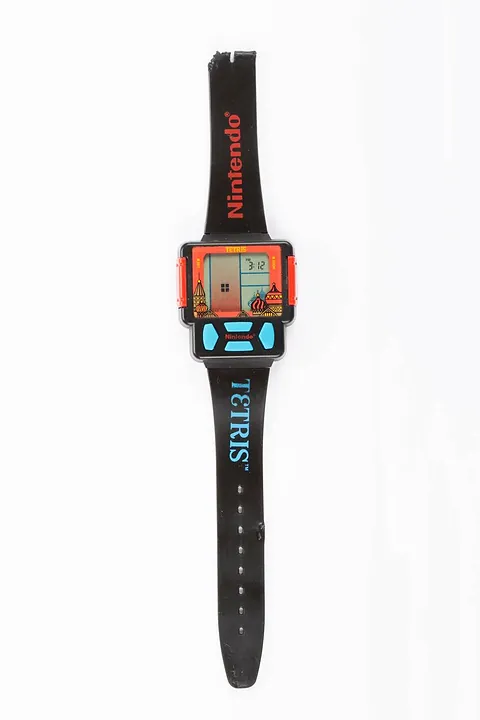
Wristwatches · c. 1991
Wristwatch by EM-Entertainment München, Merchandising, Film und Fernseh GmbH, Germany, c. 1991
German Clock Museum
Wristwatches · c. 2000
A.Lange & Söhne 1815 Chronograph, ref. 414.026, c. 2000
Antiquorum auction archive, Geneva