
Wristwatches · Wristwatch
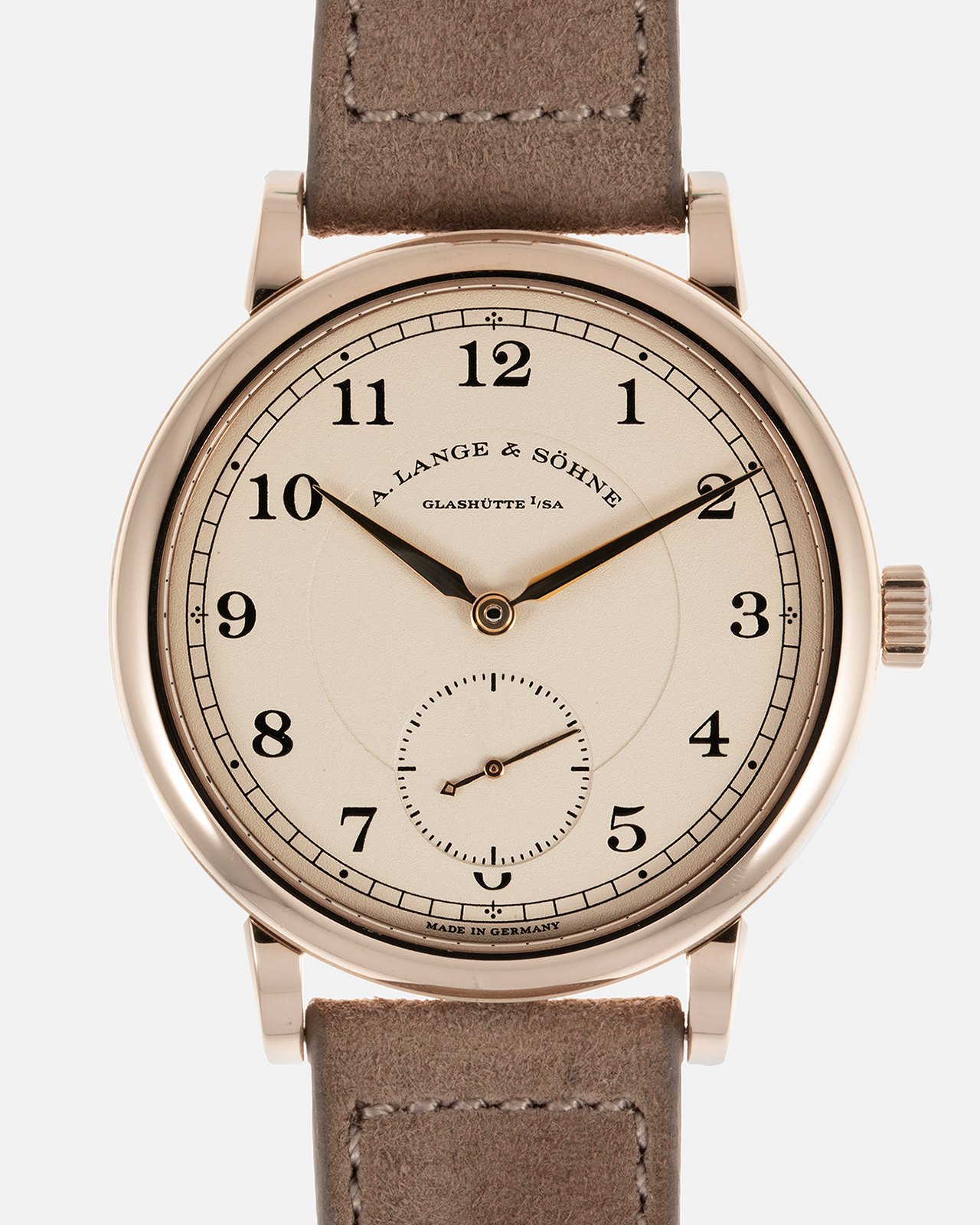
A. Lange & Sohne 1815 200th Anniversary F.A. Lange Ref. 236.050 Honeygold, 2015
- Maker / attribution
- A. Lange & Sohne (maker)
- Date
- 2015
- Historical period
- Contemporary Horology (2010 – Present)
- Country of origin
- Germany
- Object type
- Wristwatch
- Materials / technique
- gold
- Stock no.
- Product 6923654004823
- Credit line
- Dealer listing, S.Song Watches (product 6923654004823)
- Catalogue title (original)
- A. Lange & Sohne 1815 200th Anniversary F.A. Lange Ref. 236.050 Honeygold (English)
View the source record (dealer listing) ↗ (opens another website in a new tab)Suggest a correction
Record summary
Catalogued by S.Song Watches (dealer), Seattle (stock number Product 6923654004823), this is a wristwatch by A. Lange & Sohne, made in Germany, dated 2015. The Atlas places it in the Contemporary Horology period (2010 – Present) of its Wristwatches collection. Materials and techniques recorded by the source: gold. The record is illustrated with 6 photographs.
Assembled from the source record's structured fields. Dates and attributions are given as the source states them; where a field is missing the Atlas leaves it blank rather than estimating.
Catalogue description
Dealer description — S.Song Watches
When considering the leading players in the world of high-end watchmaking, only a handful of prestigious brands come to mind: Patek Philippe, Vacheron Constantin, Audemars Piguet, and, of course, the neighbouring German brand from Glashütte, A. Lange & Söhne. While Swiss watches are often regarded as the epitome of watchmaking, A. Lange & Söhne stands as a testament to the fact that this perception is not universally true. In fact, it can be argued that in certain aspects, A. Lange & Söhne surpasses its Swiss counterparts, establishing itself as a superior contender. Originally presented in 1999, 9 years after A. Lange & Söhne was re-launched in 1990, the A. Lange & Söhne 1815 is the physical embodiment of the refined dress watch aesthetic on which the Saxon watchmaker has established their modern identity. With its clean utilitarian design and no-frills execution, the 1815 collection lends from the design choices afforded to pocket watches during Ferdinand Adolph Lange’s time, who was born in the collection's eponymous year of 1815. The 1815 we have on offer here today is no ordinary 1815 though, it is in fact, a special limited edition Ref. 236.050 in Honeygold to mark the 200 th anniversary of the birth of Ferdinand Adolph Lange. Before we begin, allow me to emphasize that A. Lange & Söhne special editions are genuinely noteworthy and hold a deep sense of significance. To me, they strike a perfect balance, being released sparingly enough to maintain your anticipation and excitement, while avoiding the risk of becoming commonplace and losing their allure. Beginning with the Ref. 236.050’s stunning case crafted out of A. Lange & Söhne’s proprietary Honeygold. It’s important to note that Honeygold is used extremely sparingly by the brand and only for very, very special occasions, making any Honeygold A. Lange & Sohne of any model special in its own right. I must say that words alone cannot fully capture its charm and splendour. If I were to even attempt to describe it, it has a slightly muted demeanour with a subtle reddish undertone - a crossover between rose gold and white gold, if you will. Though one thing is for sure, it is absolutely stunning. Beyond its aesthetic appeal, Honeygold boasts exceptional durability. With a remarkable Vickers rating (Hv) of slightly over 300 Hv, it surpasses the hardness of other commonly used precious metals. For comparison, rose gold typically has a Vickers rating of 140 Hv, yellow gold stands at 155 Hv, and white gold reaches around 210 Hv. Even stainless steel, renowned for its robustness, has a Vickers rating of approximately 200 Hv. Moving on to its dial design, the 1815 Ref. 236.050 features a grained silver/ivory dial with a subtle honey-coloured tone, completed with a railroad minute track along its periphery as a subtle hint at its design origin. Fitted with alpha-style gold hands and black-painted, bold Arabic numerals, the 1815 combines the collection's historical inspiration with a legible design that is incredibly functional for a truly timeless aesthetic. The dial is also tiered with a stepped midsection and running seconds sub-dial at 6 o'clock to provide yet another understated hint to the careful considerations made when designing this beautiful watch. Powering this mechanical beauty from within is A. Lange & Söhne’s very own 21-jewelled, manual-winding Cal. L051.1 movement with a 55-hour power reserve and 188 individual parts. On display behind a sapphire exhibition caseback, the Cal. L051.1 is crafted from German silver and has a traditional three-quarter plate with a host of high-level finishes and a hand-engraved balance cock to contrast the uniformity of the three-quarter plate. A sight to behold, as all A. Lange & Söhne fans know, the Cal. L051.1 is a marvellous movement befitting of a timepiece as beautiful as this limited-edition 1815 Ref. 236.050, with its refined design matching that of the watch's entire spirit as a watch paying homage to the pocket watches of yesteryear. If you ask me, this 200-piece anniversary limited edition is probably one of the best 1815 variants to ever come out of the hallowed halls of A. Lange & Söhne. It is a design that is undeniably fitting as a special anniversary limited edition, as well as an exemplary work of German horological art that eloquently illustrates A. Lange & Söhne’s no-compromise approach to watch design and construction.
Historical context
Contemporary Horology (2010 – Present)
Silicon components, connected watches, optical-lattice research clocks and a thriving independent scene.
Smartwatches became the world's best-selling watches, while mechanical watchmaking focuses on craft, innovation (silicon components, new escapements) and independent makers.
Read the period in the timelineMore wristwatches from this periodEarlier: Mechanical Renaissance
Atlas type guide
Wristwatches
Bracelet watches were worn by women from the early nineteenth century — Breguet made one for Caroline Murat, Queen of Naples, in 1810–12 — but the wristwatch only became a man's instrument with military use and aviation in the early twentieth century. Between the World Wars it overtook the pocket watch; the 1920s and 1930s brought rectangular Art Deco cases, water-resistant cases and the first automatic winding systems.
After 1945 the wristwatch became a carrier of identity — dress watches, sports and dive watches, chronographs, calendars — produced by Swiss, American, Japanese, German, Soviet and Chinese industries. The quartz revolution after 1969 and the mechanical renaissance since the 1990s, including the rise of independent watchmakers, complete the story.
What to look for
- The reference number (between the lugs or inside the case back) and serial number, the starting point for dating.
- The calibre: its maker and number are often stamped under the dial or on the bridge.
- Originality of dial, hands and crown — refinished ('redial') dials are common.
- Case material marks: 18K/750, 14K/585, stainless steel, gold-filled, plated.
Dating clues
- Wire-lug cases: before c. 1925.
- Water-resistant screw-down cases: from 1926.
- Quartz movements: from 1969; sapphire crystals widespread after c. 1980.
General guidance written by the Atlas editors about this kind of object. It is not a statement about this particular piece; for that, rely on the source record above and on physical examination.
Related records
Wristwatches · originally sold on 16 December 2001 (per the lot record)
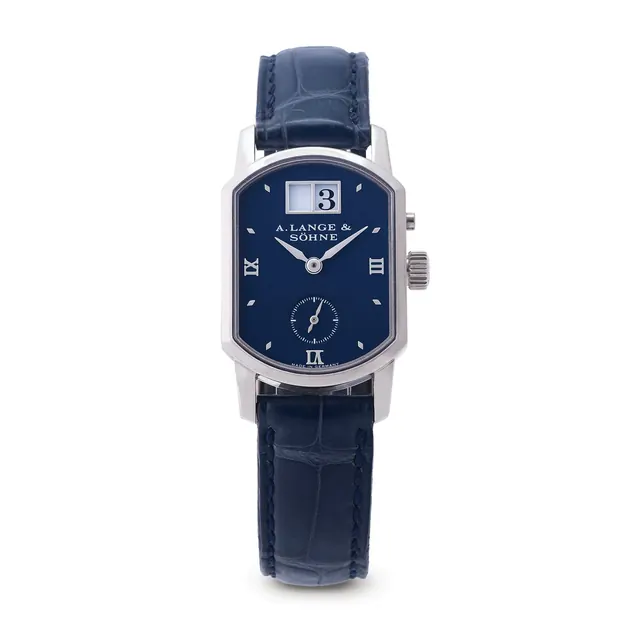
A. Lange & Sohne wristwatch, ref. 103.027, Arkade, originally sold on 16 December 2001
Antiquorum auction archive, Geneva
Instruments · c. 1942
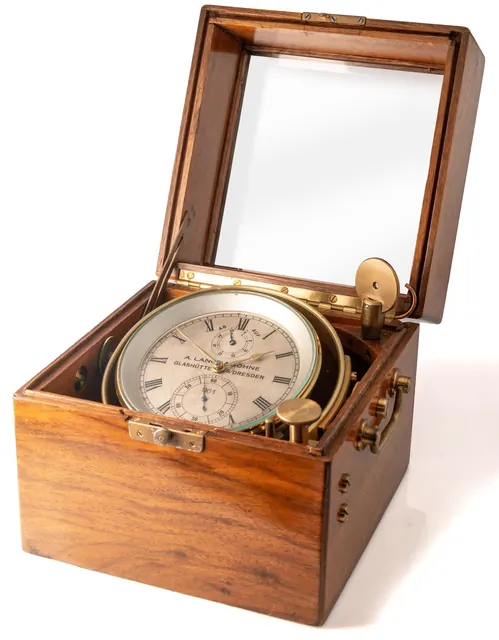
A. Lange & Sohne marine chronometer, Germany Wood, circa 1942
Antiquorum auction archive, Geneva
Wristwatches · 2004
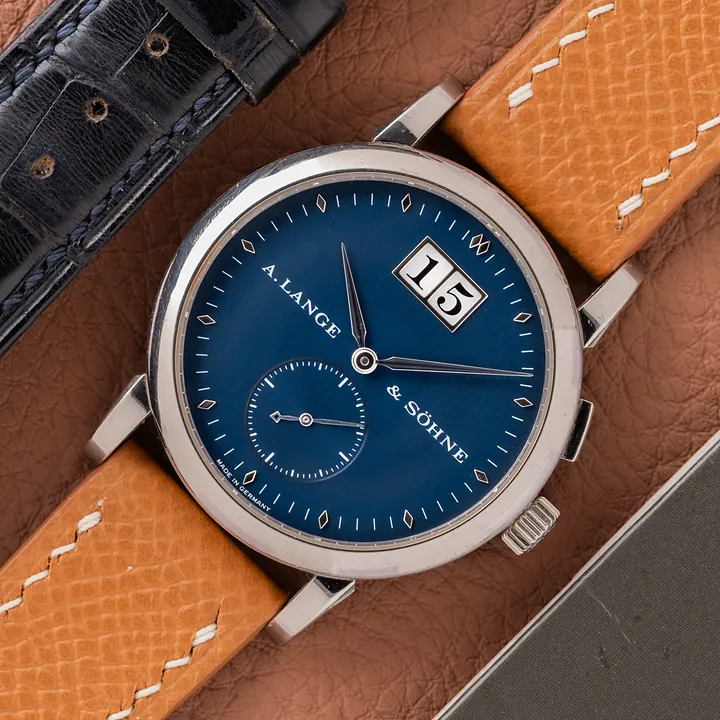
A. Lange & Söhne Saxonia Oversized Date Blue (Ref. 105.027), 2004
Huntington Company (dealer)
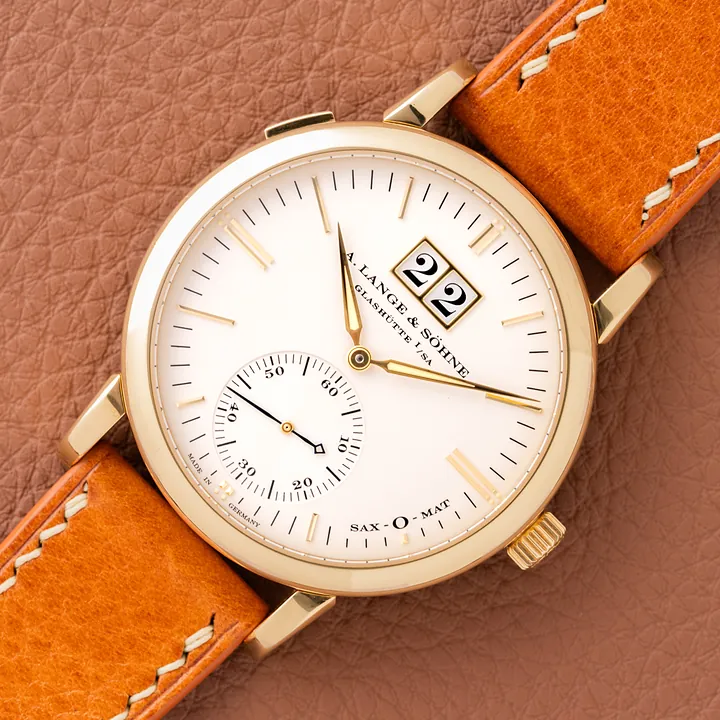
Wristwatches · 2000s
A. Lange & Söhne Langematik Oversized Date (Ref. 308.021), 2000s
Huntington Company (dealer)
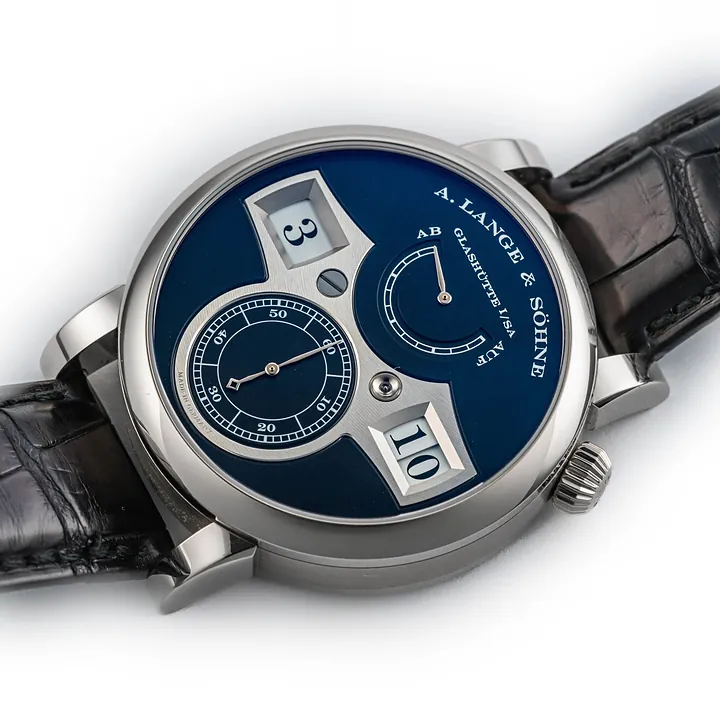
Wristwatches · c. 2018
A.Lange & Söhne Zeitwerk, ref. 140.029, c. 2018
Antiquorum auction archive, Geneva
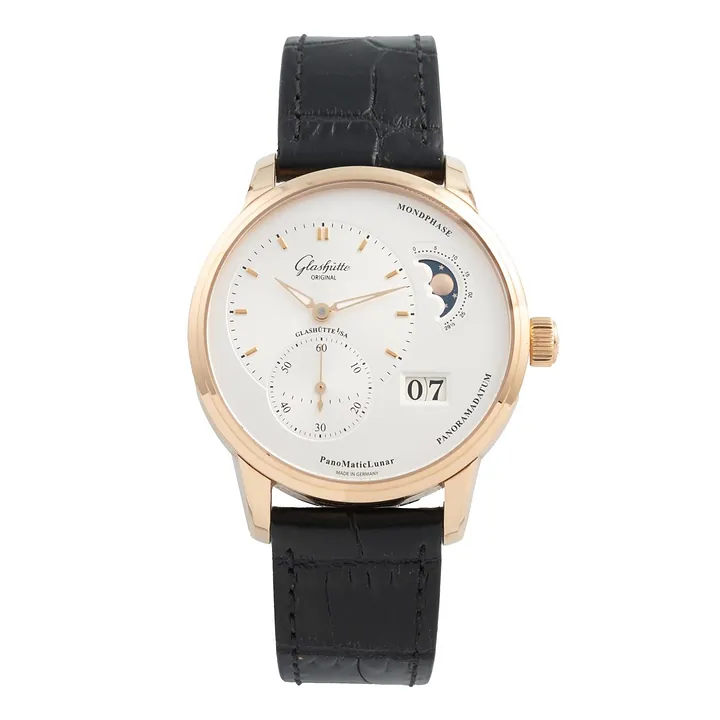
Wristwatches · originally sold in April 2022 (per the lot record)
Glashã¼tte Original Panomaticlunar, ref. 1-90-02-45-35-04, originally sold in April 2022
Antiquorum auction archive, Geneva
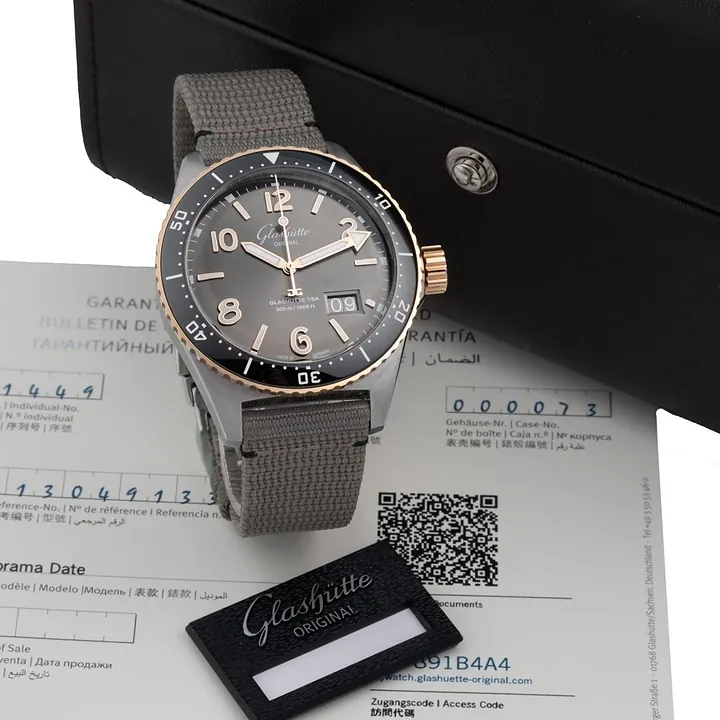
Wristwatches · c. 2022
Glashütte Original Seaq Panorama Date, ref. 1-36-13-04-91-33, c. 2022
Antiquorum auction archive, Geneva
Wristwatches · originally sold in December 2021 (per the lot record)
Glashütte Original wristwatch, ref. W23947090204, Sixities Panorama Date Annual Edition, originally sold in December 2021 (per the lot record)
Antiquorum auction archive, Geneva