
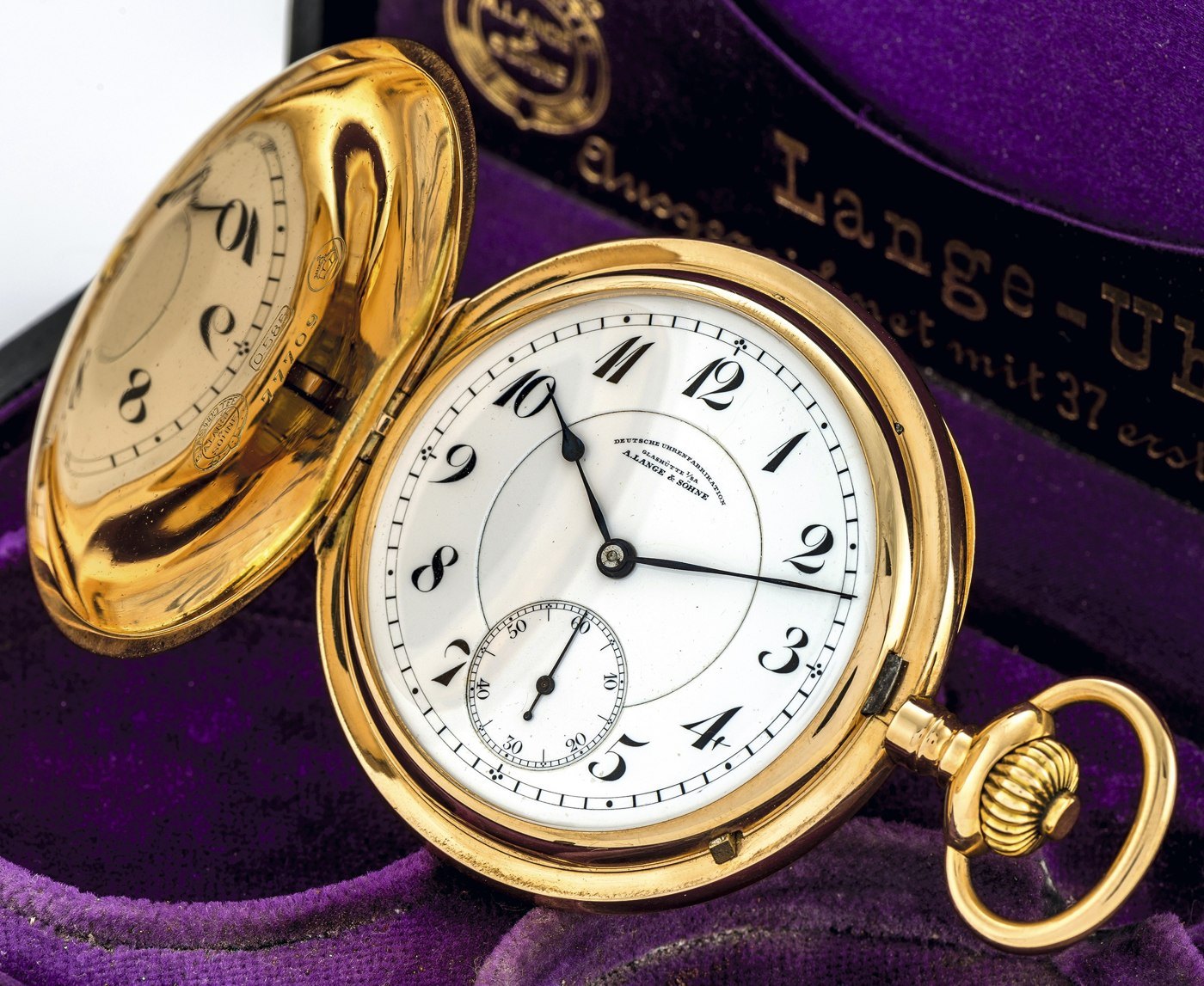
Pocket Watches · Hunting-cased pocket watch
A. Lange & Söhne 14K Pink Gold Hunting Cased Pocket Watch
- Maker / attribution
- A. Lange & Söhne (source attribution)
- Date
- c. 1910
- Historical period
- Golden Age of Mechanical Watchmaking (1900 – 1945)
- Country of origin
- Germany
- Object type
- Hunting-cased pocket watch
- Materials / technique
- 14K pink gold
- Holding institution
- Antiquorum
- Accession / object no.
- 201
- Credit line
- Antiquorum
- Catalogue title (original)
- A. LANGE & SÖHNE POCKET WATCH PINK GOLD \nDeutsche Uhrenfabrikation, A. Lange & Söhne, Glashütte \nI/Sa, No. 77709. Made circa 1910. \nFine, keyless, 14K pink gold hunting cased pocket watch \nwith La (English)
View the source record ↗ (opens another website in a new tab)Suggest a correction
Record summary
Held and catalogued by Antiquorum (object number 201), this is a hunting-cased pocket watch attributed to A. Lange & Söhne, made in Germany, dated c. 1910. The Atlas places it in the Golden Age of Mechanical Watchmaking period (1900 – 1945) of its Pocket Watches collection. Materials and techniques recorded by the source: 14K pink gold. The record is illustrated with 1 photograph.
Assembled from the source record's structured fields. Dates and attributions are given as the source states them; where a field is missing the Atlas leaves it blank rather than estimating.
Catalogue description
Original object description
Dating to roughly 1910, this hunting-case pocket watch by A. Lange & Söhne of Glashütte is executed in 14-karat pink gold under serial number 77709. Its polished bassine four-body case measures 53 mm in diameter and contains a hinged gold cuvette protecting the movement. The three-part white enamel dial is appointed with blued steel spade hands, an auxiliary seconds register, black Arabic hour figures, and an exterior minute ring. It is driven by a 16-jewel, frosted gilt Glashütte three-quarter plate caliber incorporating a straight-line Glashütte escapement, a gold pallet fork, a Guillaume-type balance with adjustment screws, a blued steel overcoil balance spring, and a swan-neck micrometer regulator. Complete with matching manufacturer signatures across the movement, dial, and case, it comes with a fitted presentation box; auction assessments record a faint hairline across the enamel dial and suggest the movement is due for maintenance.
Case and Dial
The 53 mm four-tier bassine enclosure is rendered in mirror-polished 14-karat pink gold and houses an inner hinged protective gold cuvette. Black Arabic numerals and an outer minute track articulate the three-tiered white enamel dial, which positions an auxiliary seconds register at 6 o'clock. Original blued steel hands in a spade profile indicate the time, while a hairline flaw is visible on the enamel surface.
Movement and Escapement
This stem-wound, keyless 16-jewel mechanism is constructed on a frosted gilt Glashütte three-quarter plate. Escapement components include a gold pallet lever within a straight-line Glashütte layout, paired with a Guillaume-style compensated balance with perimeter timing screws, an overcoil hairspring of blued steel, and a swan-neck index for precision regulation. The case, dial, and movement all bear the manufacturer's signature, and the auction evaluation states that mechanical servicing is needed.
Provenance and Condition
Catalogued as Lot 201 alongside its original Lange-branded box, the watch received auction condition marks of 'very good' for its exterior case, 'good' (3*) for its mechanical state, and 'good' for its dial. While all signatures are intact and the blued spade hands are original, the documentation explicitly notes the fine crack running through the enamel dial and the necessity of a movement overhaul.
Inscriptions & marks
77709
Historical context
Golden Age of Mechanical Watchmaking (1900 – 1945)
The wristwatch displaces the pocket watch; waterproof cases, self-winding and grand complications.
The pocket watch reached technical maturity and then began to give way to the wristwatch after the First World War. Complicated watches for collectors such as Henry Graves Jr. and James Ward Packard, railroad watches, and slim Art Deco dress watches are characteristic.
Read the period in the timelineMore pocket watches from this periodEarlier: Industrial Revolution
Atlas type guide
Hunter, half-hunter and open-face watches
In the nineteenth century the pocket watch case settled into a few standard forms. The hunter (French savonnette) has a hinged front lid protecting the crystal — reputedly for riders who could not risk broken glass — and is opened by pressing the crown or a push-piece. The half-hunter has a small window in the lid so the hands can be read when closed. The open-face (lépine) watch has no front cover, with the crown at 12; hunters normally carry the crown at 3.
Case types also changed with winding: key-wound watches gave way to keyless (stem-wound) mechanisms after Adrien Philippe's and others' designs of the 1840s, with pendant setting or lever setting.
What to look for
- Crown position relative to the seconds dial: at 3 for hunters, at 12 for open-face watches.
- Spring-loaded front cover with a push-piece in the pendant.
- Half-hunter chapter ring enamelled on the lid.
- Key holes in the inner dome (cuvette) versus keyless winding.
Dating clues
- Keyless winding spread after c. 1850 and became standard by c. 1890.
- English hallmarks inside gold and silver cases give the year of assay.
General guidance written by the Atlas editors about this kind of object. It is not a statement about this particular piece; for that, rely on the source record above and on physical examination.
Read next:Detached lever escapement
Related records
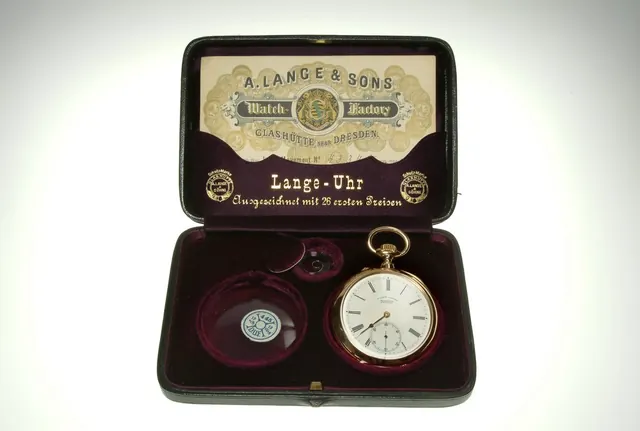
Movements & Components · 1900
Pocket watch by A. Lange & Söhne, Germany, 1900
Kulturstiftung Sachsen-Anhalt - Museum Schloss Neuenburg
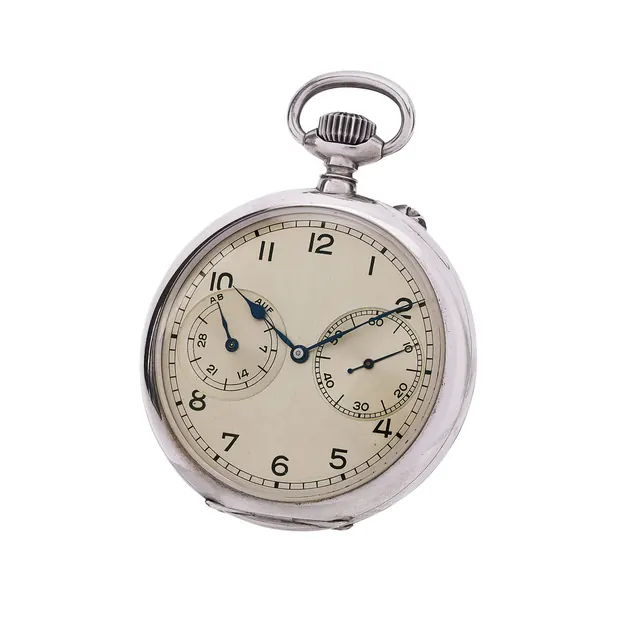
Pocket Watches · c. 1941
A. Lange & Söhne pocket watch, Observation Pocket Watch, circa 1941
Antiquorum auction archive, Geneva
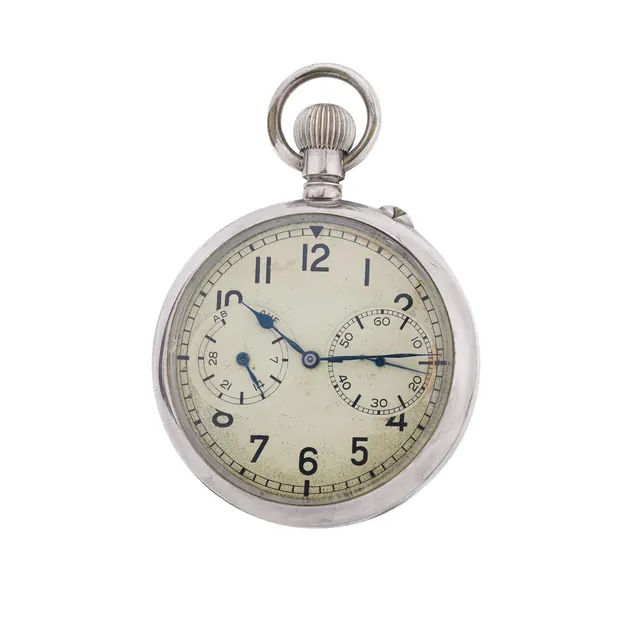
Pocket Watches · c. 1946
A. Lange & Söhne pocket watch, Military Observation Pocket Watch, circa 1946
Antiquorum auction archive, Geneva
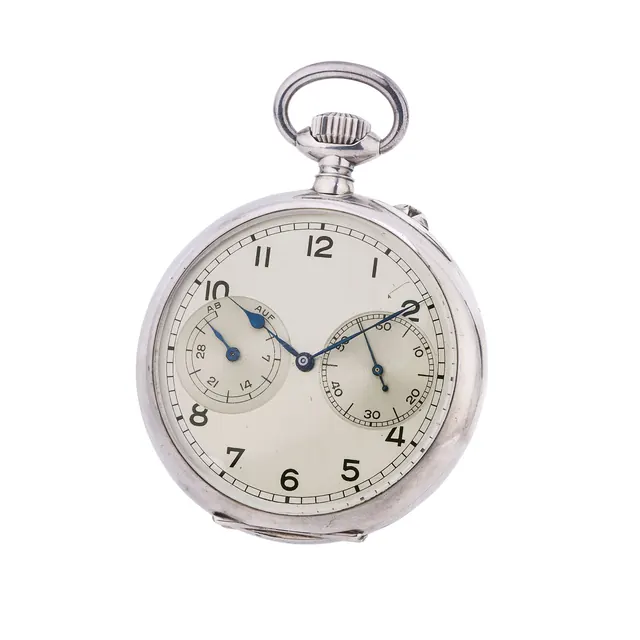
Pocket Watches · c. 1942
A. Lange & Söhne pocket watch, Military Observation Pocket Watch, circa 1942
Antiquorum auction archive, Geneva
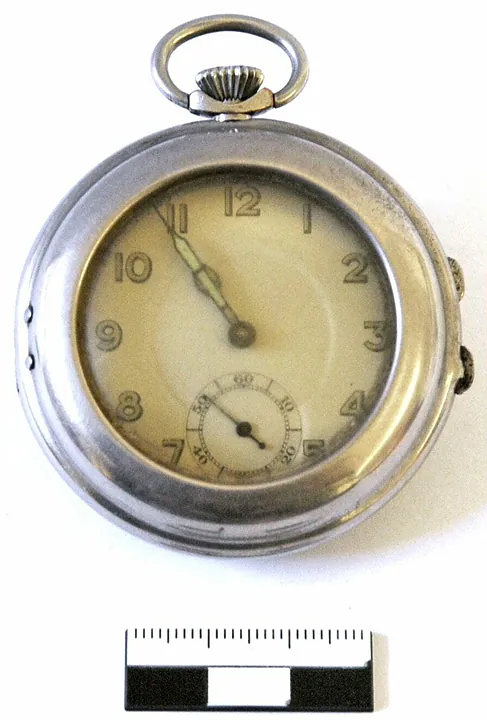
Pocket Watches · 1891–1945
Pocket watch, Germany, 1891–1945
Montanhistorisches Dokumentationszentrum
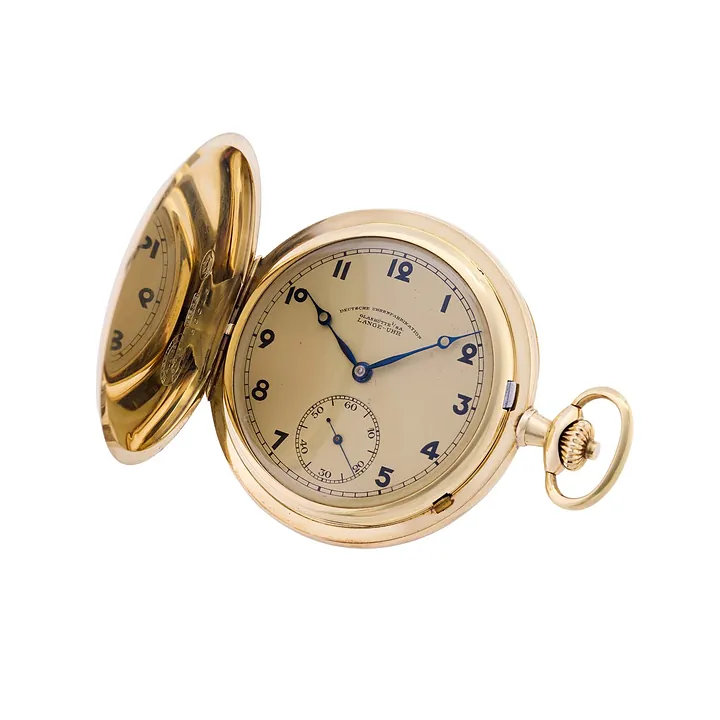
Pocket Watches · c. 1900
A.Lange & Söhne pocket watch, c. 1900
Antiquorum auction archive, Geneva
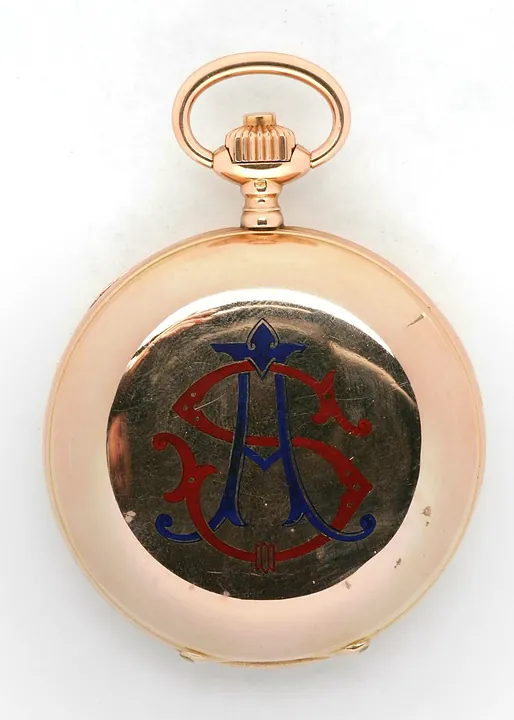
Pocket Watches · c. 1900
Pocket watch by A. Eppner und Co., Germany, c. 1900
German Clock Museum
Pocket Watches · c. 1900
Pocket watch by Gebrüder Thiel, Germany, c. 1900 (no. 29965)
German Clock Museum