
Clocks · Carriage clock
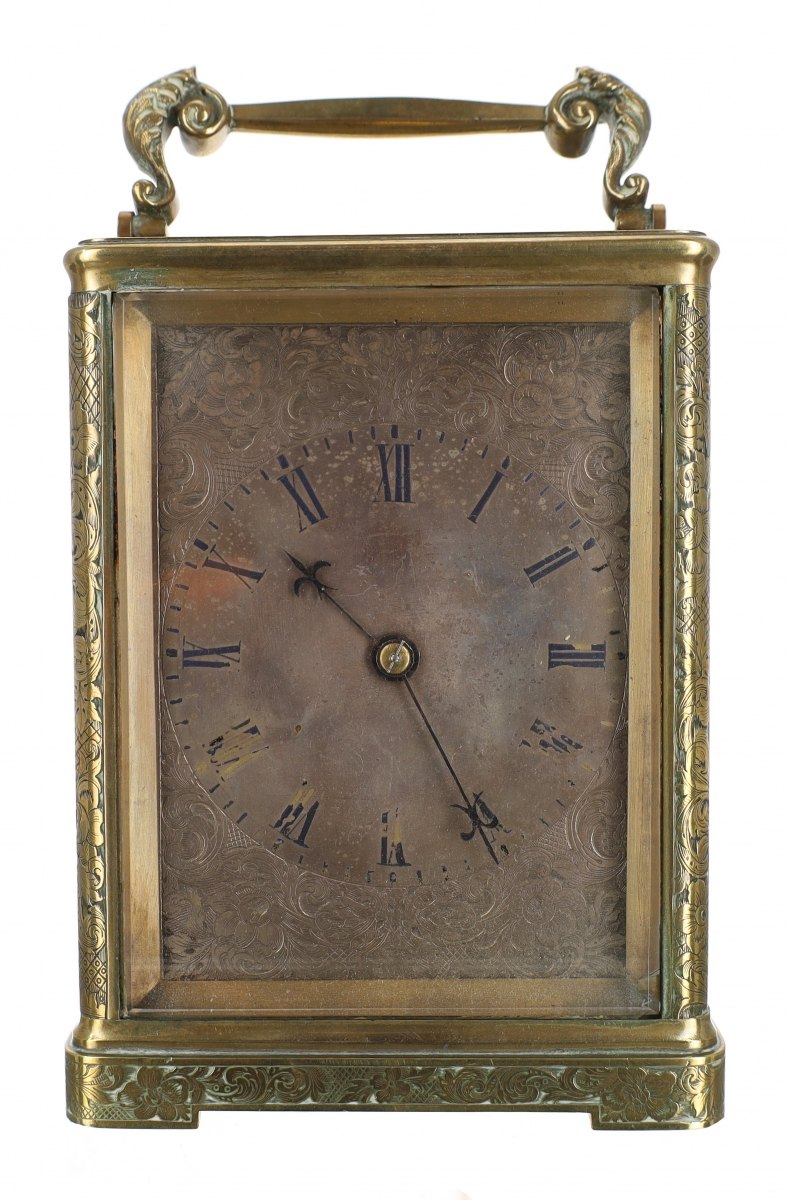
19th century English eight-day twin fusee striking carriage clock by Desbois
- Maker / attribution
- Desbois (maker)
- Date
- 19th century
- Historical period
- Precision & Scientific Horology (1750 – 1850)
- Country of origin
- England
- Object type
- Carriage clock
- Dimensions
- Height 7 in (18 cm)
- Auction house
- Gardiner Houlgate (auction house), Corsham
- Lot
- Sale 41, lot 1029
- Credit line
- Auction lot record: lot 1029, Fine Clocks & Related Items, Gardiner Houlgate (21st May 2026)
- Catalogue title (original)
- Fine 19th century English eight-day twin fusee striking carriage clock by Desbois, with a foliate engraved silvered Roman numeral dial with outer minute markers and fleur-de-lys ornate hands, the twin (English)
View the source record (auction lot) ↗ (opens another website in a new tab)Suggest a correction
Record summary
Catalogued by Gardiner Houlgate (auction house), Corsham (lot Sale 41, lot 1029), this is a carriage clock by Desbois, made in England, dated 19th century. The Atlas places it in the Precision & Scientific Horology period (1750 – 1850) of its Clocks collection. Recorded dimensions: Height 7 in (18 cm). The record is illustrated with 1 photograph.
Assembled from the source record's structured fields. Dates and attributions are given as the source states them; where a field is missing the Atlas leaves it blank rather than estimating.
Catalogue description
Lot description — Gardiner Houlgate
Fine 19th century English eight-day twin fusee striking carriage clock by Desbois, with a foliate engraved silvered Roman numeral dial with outer minute markers and fleur-de-lys ornate hands, the twin chain fusee movement signed 'Desbois to the back plate beneath the bell, with an English gilt platform lever escapement and striking the half hours and hours on a single bell, within a foliate bevelled glazed one-piece case, 7" high with the handle raised ** the repeat mechanism has been removed
Historical context
Precision & Scientific Horology (1750 – 1850)
Harrison solves longitude; Mudge invents the lever; Breguet's Paris workshop defines the modern watch.
The age of the deadbeat escapement, compensated pendulums and observatory regulators. Domestic clocks spread through the middle classes: English longcase and bracket clocks, French gilt-bronze mantel clocks, Viennese Biedermeier wall clocks, Black Forest painted-shield clocks, and the first American shelf clocks.
Read the period in the timelineMore clocks from this periodEarlier: Early Modern Horology
Atlas type guide
Carriage and travel clocks
The carriage clock is a portable spring clock with a balance-wheel escapement and a brass case with glass panels and a carrying handle. Abraham-Louis Breguet made early examples around 1800, and from the 1830s Paul Garnier and other French makers industrialised production, with the small towns of Saint-Nicolas-d'Aliermont and the Franche-Comté supplying movements for retailers worldwide.
Typical features include a platform escapement mounted horizontally on top of the movement (usually a lever, sometimes cylinder or Garnier's chaff-cutter), striking or repeating work, and alarms. English carriage clocks, generally larger and with fusees, were made by firms such as Frodsham and Dent. Travel clocks in folding leather cases became popular in the twentieth century.
What to look for
- A platform escapement visible through the top glass.
- Case styles: corniche, gorge, anglaise, obis or engraved cases.
- Repeat buttons on top and strike/silent levers.
- Stamps of movement makers (e.g. Drocourt, Jacot, Margaine, Richard & Co.) on the backplate.
Dating clues
- Early carriage clocks with Breguet or Garnier features: c. 1800–1850.
- Mass-produced French carriage clocks: c. 1850–1914.
- Folding travel clocks and alarm travel clocks: mostly 1920–1970.
General guidance written by the Atlas editors about this kind of object. It is not a statement about this particular piece; for that, rely on the source record above and on physical examination.
Related records
Clocks · c. 1850
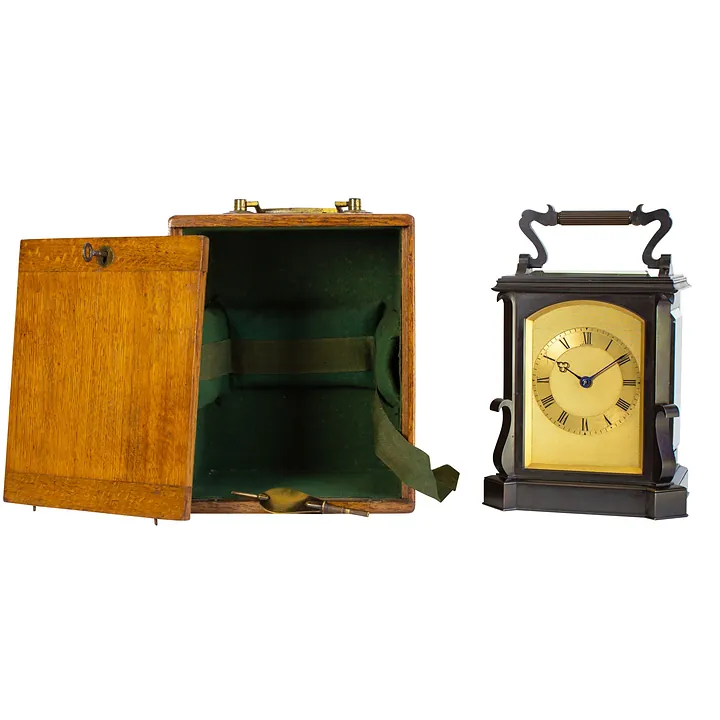
English giant repeating carriage clock by Desbois, London
The Antique Clock Company (dealer), Dorset
Clocks · 1740–1760
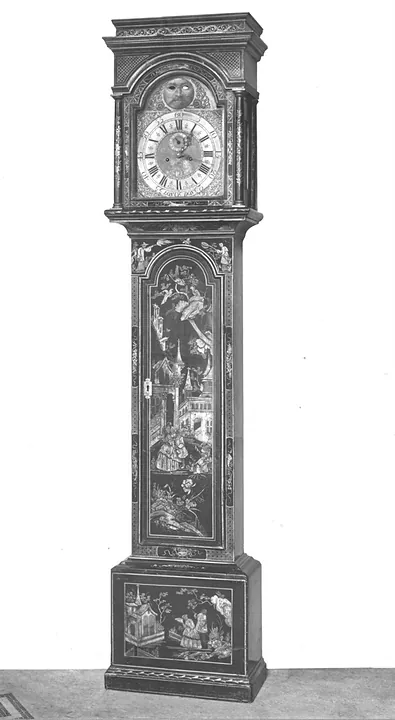
Longcase clock, English, 1740–1760, japanned wood, John Ellicott
Victoria and Albert Museum, London
Clocks · c.1750
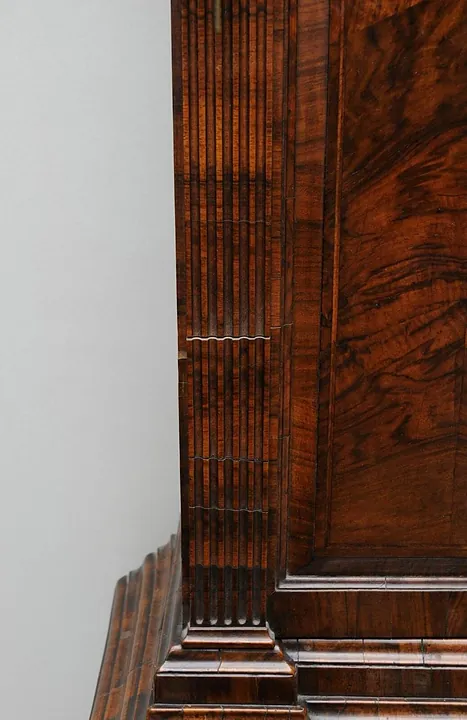
Long-case clock, English, ca. 1750, by Richard Peyton of Gloucester
Victoria and Albert Museum, London
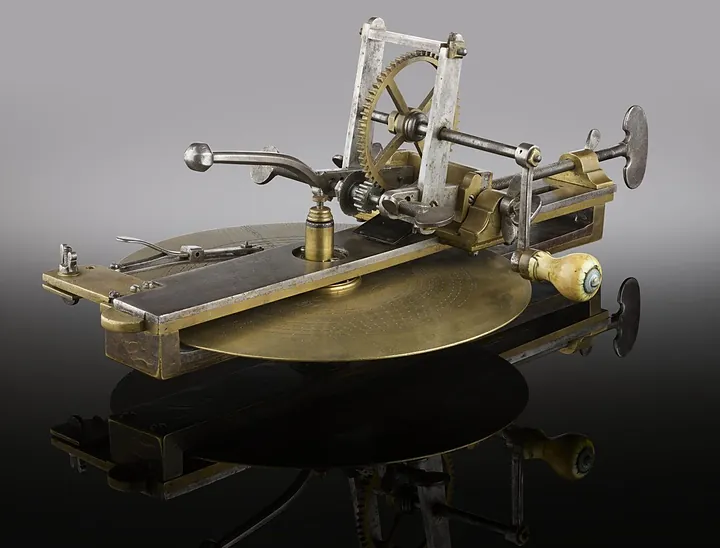
Clocks · 1751
Large wheel engine, signed and dated "John Tipping, Whildon Green, 1751".
Science Museum Group, London
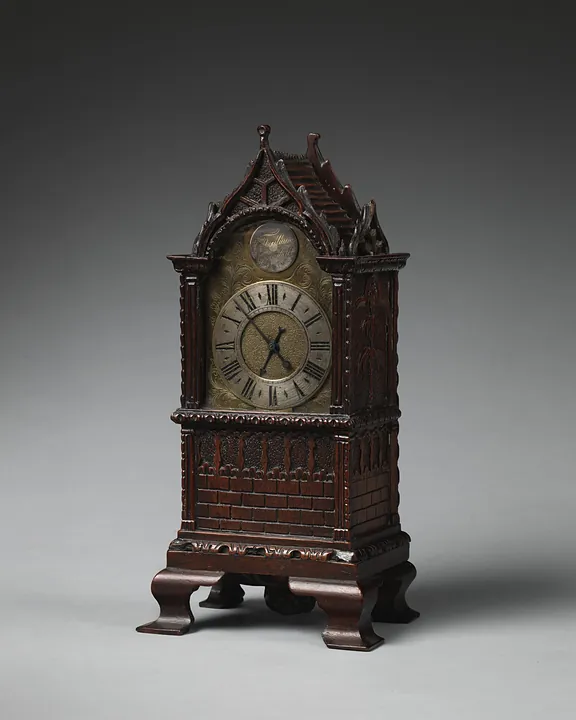
Clocks · 1755
Bracket clock by John Fordham, England, 1755
The Metropolitan Museum of Art, New York
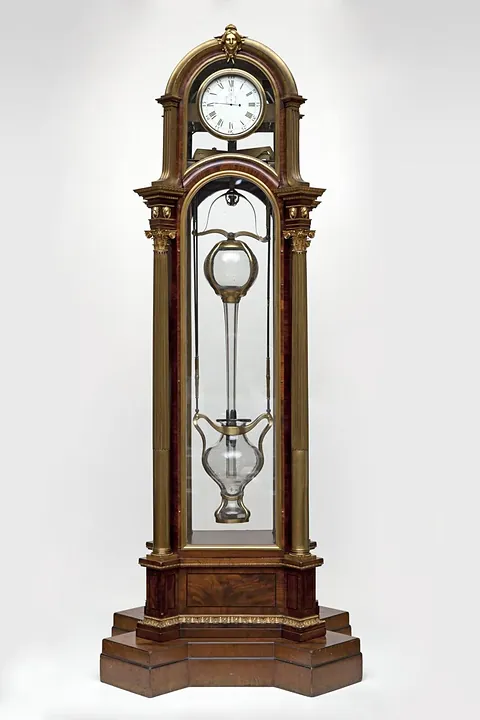
Clocks · c. 1760
Longcase clock by James Cox, England, c. 1760
Victoria and Albert Museum, London
Clocks · 1766
Clock by Alexander Cumming, England, 1766
Science Museum Group, London
Clocks · 1768–1769
Regulator clock by John Shelton, England, 1768–1769
Science Museum Group, London