
Calibre record · Hand-wound chronograph
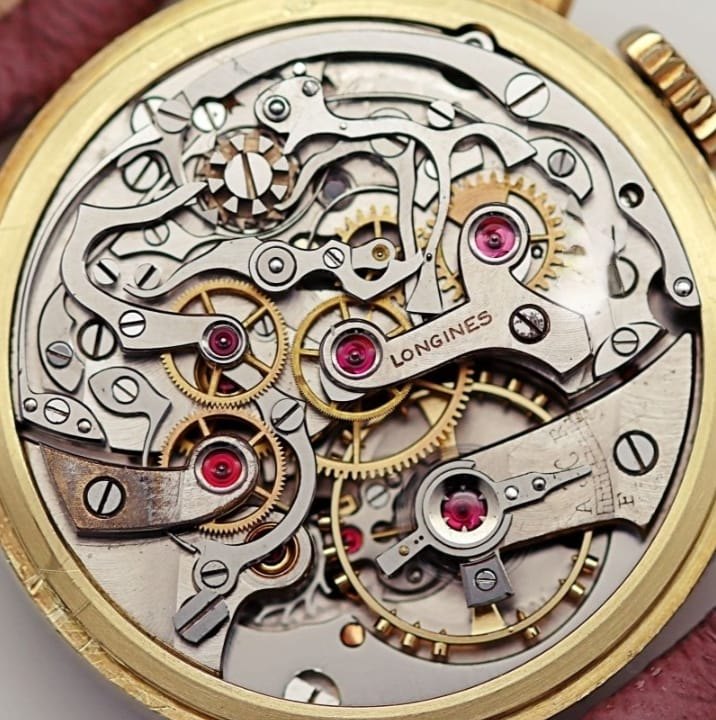
Longines calibre 13ZN
Longines' in-house column-wheel chronograph of 1936, one of the first wristwatch movements with a flyback function — admired as one of the most beautiful chronograph movements ever made.
- Manufacturer
- Longines
- Type
- Hand-wound chronograph
- Winding
- Manual
- Production
- 1936–early 1950s
- Country
- Switzerland
- Diameter
- 29.8 mm (13¼ lignes)
- Height
- 6.05 mm
- Jewels
- 17 (some sources give 18)
- Frequency
- 18,000 vph (2.5 Hz)
- Power reserve
- Undocumented here
- Oscillator / escapement
- Detached lever escapement
- Complications
- Column-wheel chronograph with flyback and 30-minute counter; small seconds
Figures are those commonly published for the standard version; individual versions and grades differ. “Undocumented here” means the value has not yet been confirmed for this record.
How it is built
A 13¼-ligne hand-wound chronograph with a column wheel and a lever escapement beating at 18,000. The plates follow the lépine (open-faced) layout with separate bridges, and the chronograph works are finished with the care of a high-grade watch.
Its flyback lets the reset pusher return the running chronograph to zero and start it again in one action — a pilot's feature that only a few movements of the 1930s offered.
History
Longines was one of the few firms of its time that designed and made its own chronograph movements; the 13ZN grew out of work that began in the 1920s. It was launched in 1936 with a flyback function aimed at pilots and navigators, who needed to time one leg of a flight after another without three separate presses. Watches made after about 1938 gained shock protection, and the finish changed from gilt to rhodium plating. The 13ZN was succeeded by the calibre 30CH in the late 1940s.
Watches fitted with it
- Longines chronographs of the later 1930s and 1940s, including pilots' models and retailer-signed dials such as Giudici of Milan
The numbers explained
- 18,000 vibrations per hour means the balance makes 5 beats (ticks) every second — 2.5 complete back-and-forth oscillations, or 2.5 Hz.
- A sweeping seconds hand therefore advances in 5 small steps per second.
- That is 432,000 beats a day. A watch that gains one second a day is out by about 1 part in 86,400 — roughly 11.6 parts per million.
- Faster balances resist knocks and changes of position better but wear their pivots and need fresh oil sooner.
Convert beat rates and daily error with the Atlas tools · See a balance and escapement in the lab
How to recognise it
- Longines signature and '13ZN' on the movement, with an exposed column wheel and gilt (early) or rhodium-plated (later) finish.
- Two pushers, often of the round 'mushroom' type on early examples, with a 30-minute counter at 3 and small seconds at 9.
- A genuine flyback: with the chronograph running, the reset pusher returns the hand to zero and it restarts. Never force the reset on a watch that resists — on an ordinary chronograph that can damage it.
For collectors
Longines' heritage department can confirm from the serial number how a movement left the factory, which is valuable for a calibre this sought-after. Look for the original dial and pushers, and check that the flyback works.
Versions and derivatives
| Calibre | Difference |
|---|---|
| 30CH | Longines' successor chronograph calibre of the late 1940s. |
Compared with related calibres
| Calibre | Type | Frequency | Jewels | Power reserve | Diameter | Production |
|---|---|---|---|---|---|---|
| Longines calibre 13ZN | Hand-wound chronograph | 18,000 vph (2.5 Hz) | 17 (some sources give 18) | Undocumented here | 29.8 mm (13¼ lignes) | 1936–early 1950s |
| Valjoux 72 | Hand-wound chronograph | 18,000 vph (2.5 Hz) | 17 | c. 48 h | 29.5 mm (13 lignes) | 1938–1974 (some sources date its introduction to 1946) |
| UROFA calibre 59 | Hand-wound pilot's chronograph | Undocumented here | 17 | Undocumented here | 34 mm (15 lignes) | 1941–1945 |
| Omega calibre 321 | Manual chronograph | 18,000 vph (2.5 Hz) | 17 | c. 44 h | 27 mm (12 lignes) | 1946–1968; re-introduced 2019 |
Mechanisms in this calibre
Related calibres
Related records in the catalogue
Records whose titles name this calibre or a model family that used it. Earlier or later examples of a model may contain a different calibre, so check each record's description for the movement actually fitted.
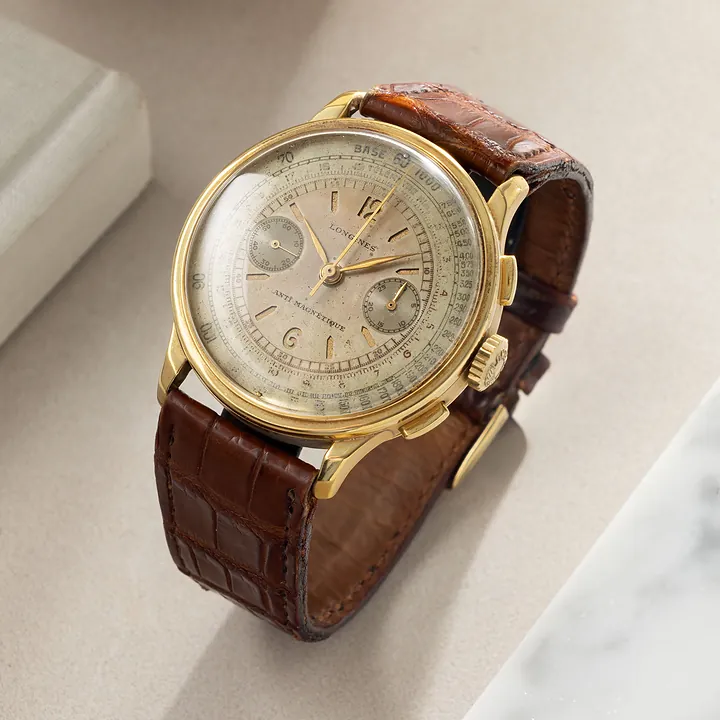
Wristwatches · 1930
Longines 13ZN Chronograph Sandwich Dial in 18k Yellow Gold, 1930
Bulang & Sons (dealer), Copenhagen
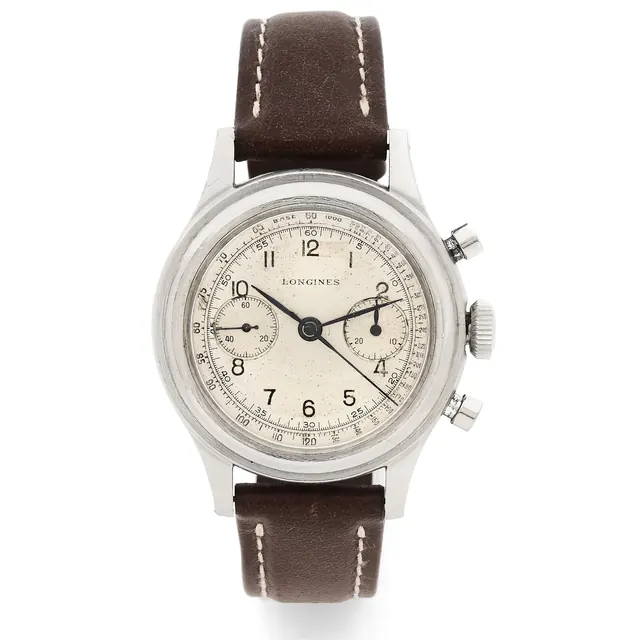
Wristwatches · 1940s
Longines wristwatch, ref. 23248, Chronograph 13Zn, 1940s
Antiquorum auction archive, Geneva
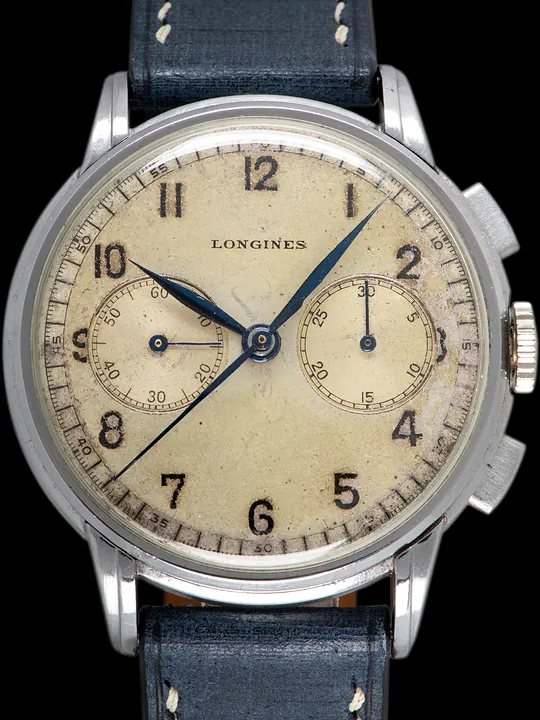
Wristwatches · 1944
Longines Flyback Chronograph 'Cal. 13ZN' (Ref. 5449), 1944
Craft & Tailored (dealer), Los Angeles
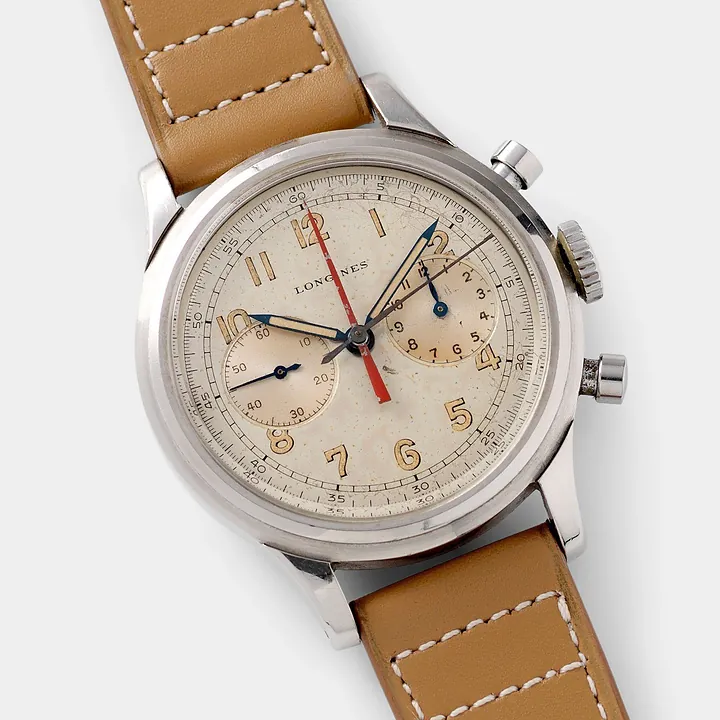
Wristwatches · 1945
Longines 5699 Sommatore Steel Chronograph 13ZN Calibre, 1945
Bulang & Sons (dealer), Copenhagen
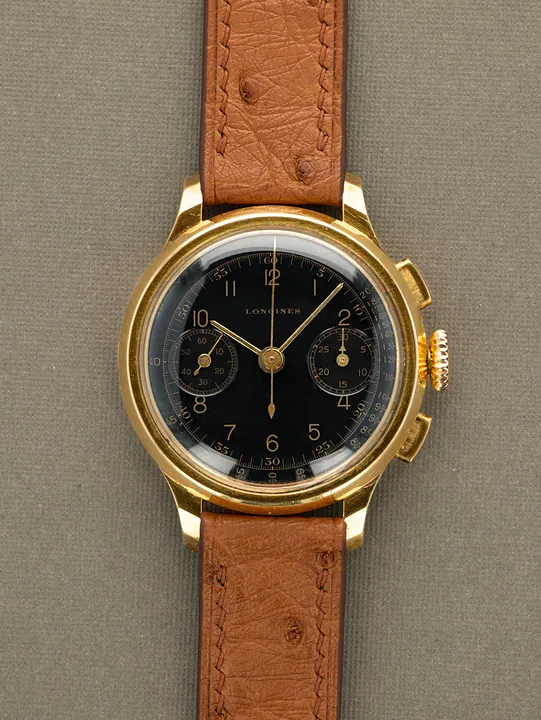
Wristwatches · c. 1938
Longines '13.ZN' Chronograph ref. 3721, Black 'Gilt' Dial
Oliver & Clarke (dealer), United Kingdom
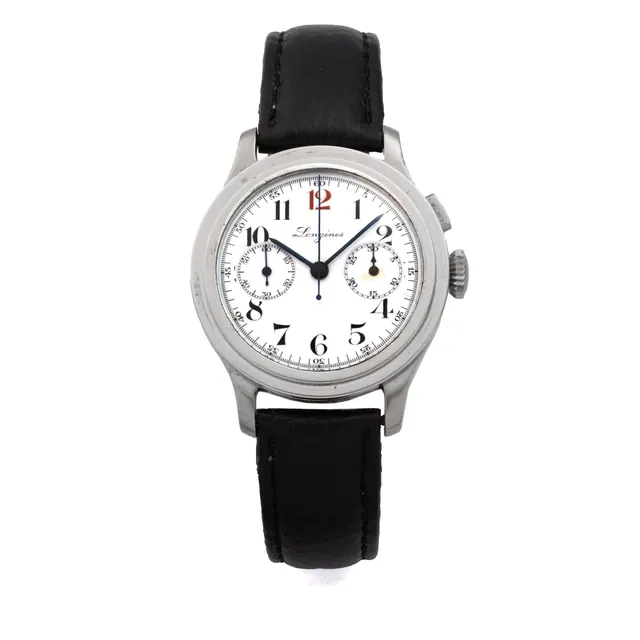
Wristwatches · sold in 1939 to Perusset the Longines agent in Argentina
Longines wristwatch, ref. 20285, 13 Zn, sold in 1939 to Perusset the Longines agent in Argentina
Antiquorum auction archive, Geneva
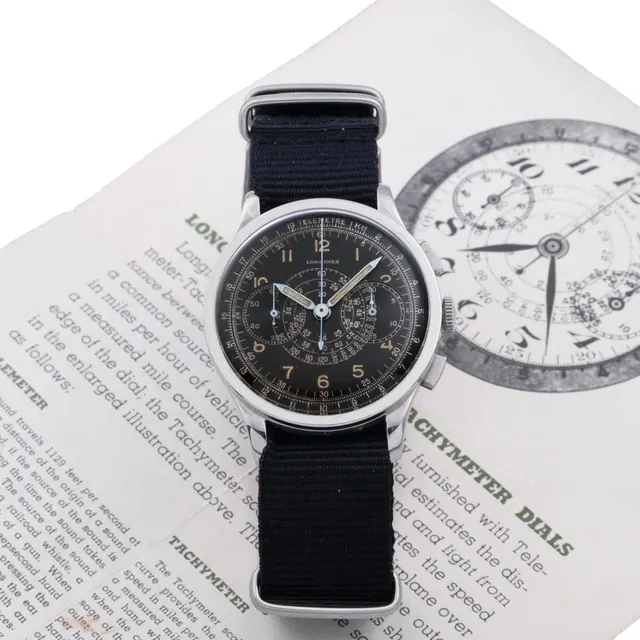
Wristwatches · Sold in June 1942 to Terrasse Watch agent for Sweden and Norway
Longines wristwatch, ref. 21837, 13 Zn Black Dial, Sold in June 1942 to Terrasse Watch agent for Sweden and Norway
Antiquorum auction archive, Geneva