
Wristwatches · Wristwatch
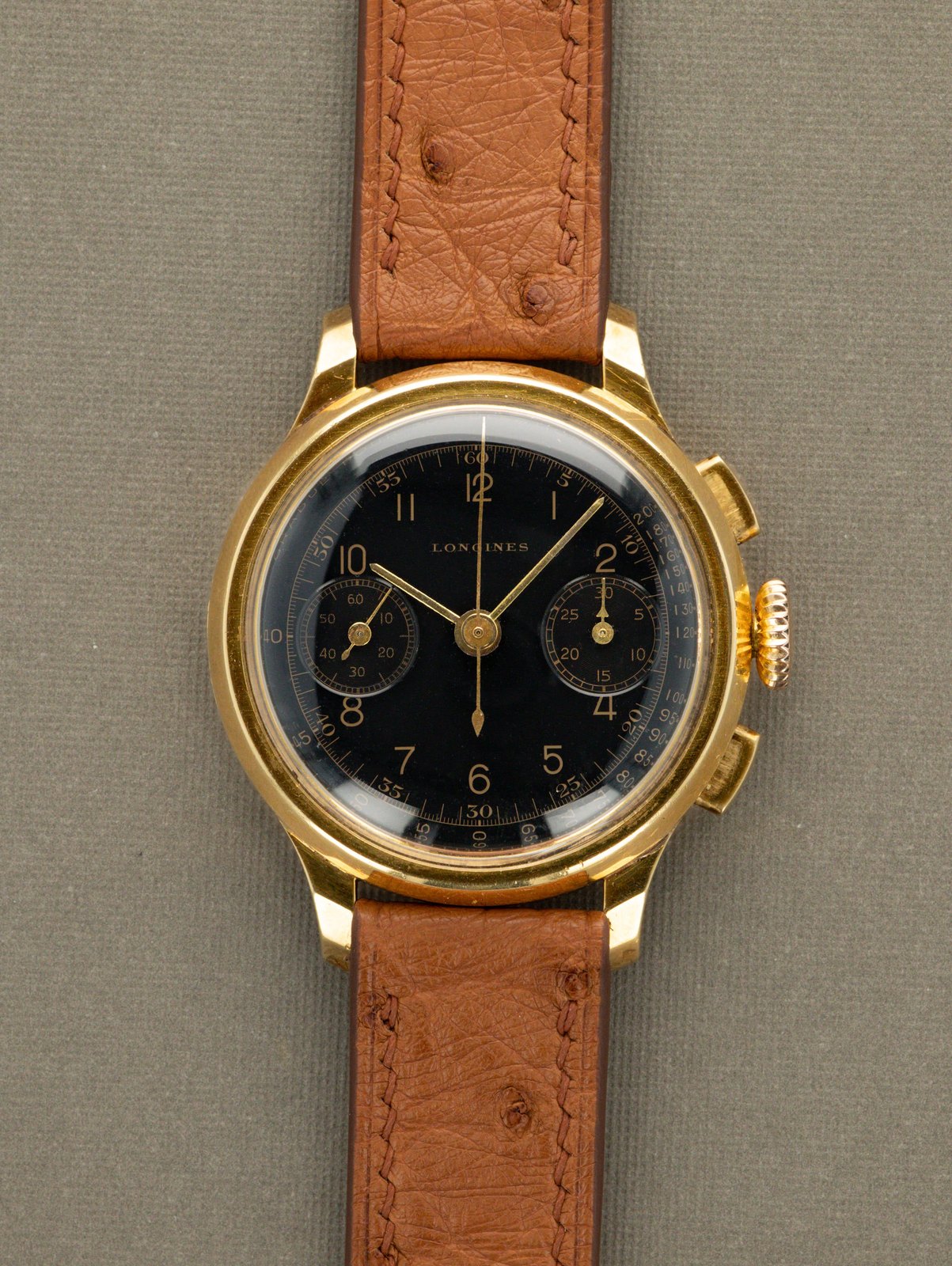
Longines '13.ZN' Chronograph ref. 3721, Black 'Gilt' Dial
- Maker / attribution
- Longines (maker)
- Date
- c. 1938
- Historical period
- Golden Age of Mechanical Watchmaking (1900 – 1945)
- Country of origin
- Switzerland
- Object type
- Wristwatch
- Dimensions
- Case 34 mm
- Stock no.
- OC3426
- Credit line
- Dealer listing, Oliver & Clarke (OC3426)
- Catalogue title (original)
- Longines '13.ZN' Chronograph Ref. 3721 - Black 'Gilt' Dial w/ Extract (English)
View the source record (dealer listing) ↗ (opens another website in a new tab)Suggest a correction
Record summary
Catalogued by Oliver & Clarke (dealer), United Kingdom (stock number OC3426), this is a wristwatch by Longines, made in Switzerland, dated c. 1938. The Atlas places it in the Golden Age of Mechanical Watchmaking period (1900 – 1945) of its Wristwatches collection. Recorded dimensions: Case 34 mm. The record is illustrated with 6 photographs.
Assembled from the source record's structured fields. Dates and attributions are given as the source states them; where a field is missing the Atlas leaves it blank rather than estimating.
Catalogue description
Dealer description — Oliver & Clarke
Longines is one of the most well respected manufacturers of the 20th century, full stop. Founded in 1832 in Saint-Imier, Switzerland, the company built a name for themselves early on as a manufacturer of quality in-house movements right from the start. Throughout the late 19th and early 20th centuries, Longines also built a reputation for precision timekeeping, earning accolades at international exhibitions and becoming a trusted name in sports timing, particularly in horse racing and aviation — an association which continues today. By the mid-20th century, especially from the 1930s to the 1960s, Longines was at the peak of its technical and aesthetic prowess, producing a range of high-grade wristwatches admired today by collectors and vintage enthusiasts. The brand was known for its beautifully finished in-house movements, such as the 13ZN and 30CH chronographs, which are considered some of the finest column-wheel chronographs ever produced. The piece that we have here, a chronograph Ref. 3721, dates to circa 1938 and is more commonly known to collectors by the name of the calibre powering it: '13.ZN.' It hails from what many seasoned collectors of vintage watches consider to be the golden era of chronographs and well, just look at it. The yellow gold case comes in at 34mm in diameter with 'rectangular' pushers, an oversized crown, and of course, the namesake movement inside. The dial is what really elevates this piece. Black in color, it features a gilt surface with gorgeous typefaces throughout, recessed subsidiary registers, and a matching gold-tone handset. Accompanying this piece is an extract from Longines archives, confirming the original date of sale in 1938. This then is, for many, checks a heck of a lot of boxes as it pertains to vintage collecting. A storied brand, excellent condition, and its a wonderfully-sized chronograph to boot.
Historical context
Golden Age of Mechanical Watchmaking (1900 – 1945)
The wristwatch displaces the pocket watch; waterproof cases, self-winding and grand complications.
The wristwatch overtook the pocket watch. Military use in the First World War, aviation, water-resistant cases (1926), automatic winding (1923–31), rectangular Art Deco designs and early chronographs and calendars defined the period.
Read the period in the timelineMore wristwatches from this periodEarlier: Industrial Revolution
Atlas type guide
Chronographs and split-seconds watches
A chronograph is a watch with an additional seconds hand that can be started, stopped and returned to zero independently of the timekeeping. Louis Moinet built an early example in 1816 and Nicolas Rieussec a recording 'chronographe' in 1821; Adolphe Nicole's heart-shaped reset cam (patented 1862) made the modern return-to-zero possible. Split-seconds (rattrapante) chronographs add a second hand that can be stopped for intermediate times; flyback chronographs restart instantly.
Chronographs were essential tools for doctors (pulsometer scales), artillery (telemeter), engineers and sport. In wristwatches, Valjoux, Venus, Lemania and later the automatic chronographs of 1969 (Zenith El Primero, the Chronomatic Calibre 11 group and Seiko 6139) are milestones.
What to look for
- Push-pieces on the case band or a single button in the crown (monopusher).
- Subsidiary registers for minutes and hours; tachymeter, telemeter or pulsometer scales.
- Column wheel versus cam control visible in the movement.
- Calibre markings of specialist makers (Valjoux, Lemania, Venus, Landeron).
Dating clues
- Pocket chronographs with heart cam reset: after 1862.
- Wrist chronographs: from c. 1910; two-button designs from the 1930s.
- Automatic chronographs: from 1969.
General guidance written by the Atlas editors about this kind of object. It is not a statement about this particular piece; for that, rely on the source record above and on physical examination.
Read next:Flyback chronographChronograph
Related records
Instruments · c. 1940
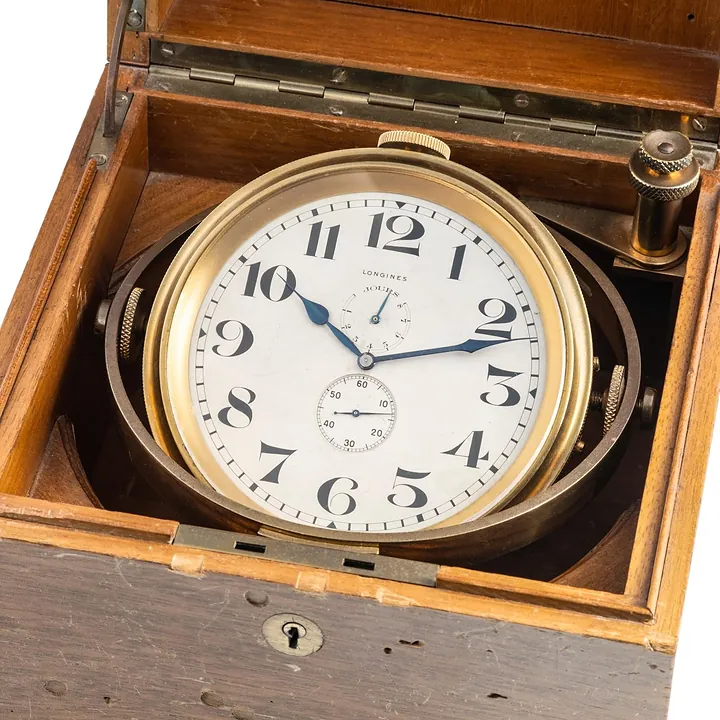
Longines marine chronometer, c. 1940
Antiquorum auction archive, Geneva
Pocket Watches · c. 1910-1920s
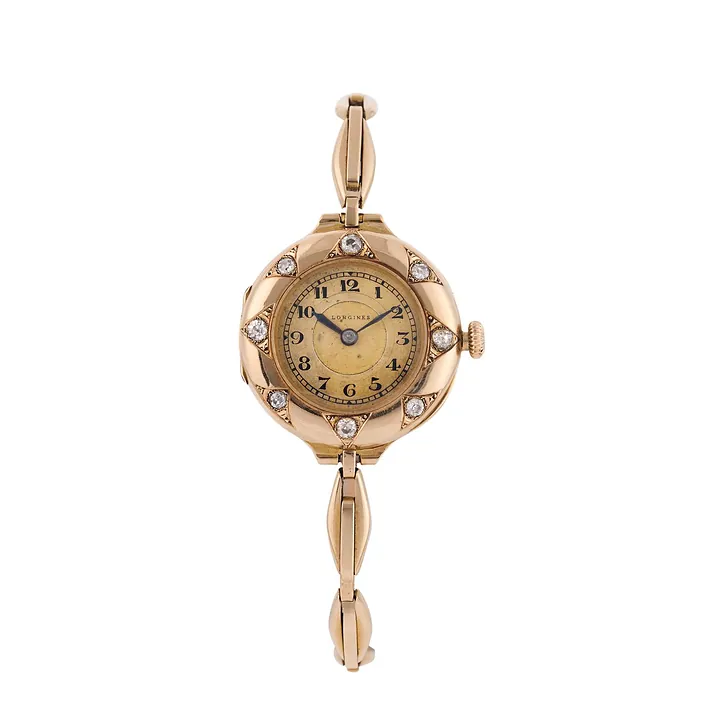
Longines watch, c. 1910-1920s
Antiquorum auction archive, Geneva
Pocket Watches · c. 1915
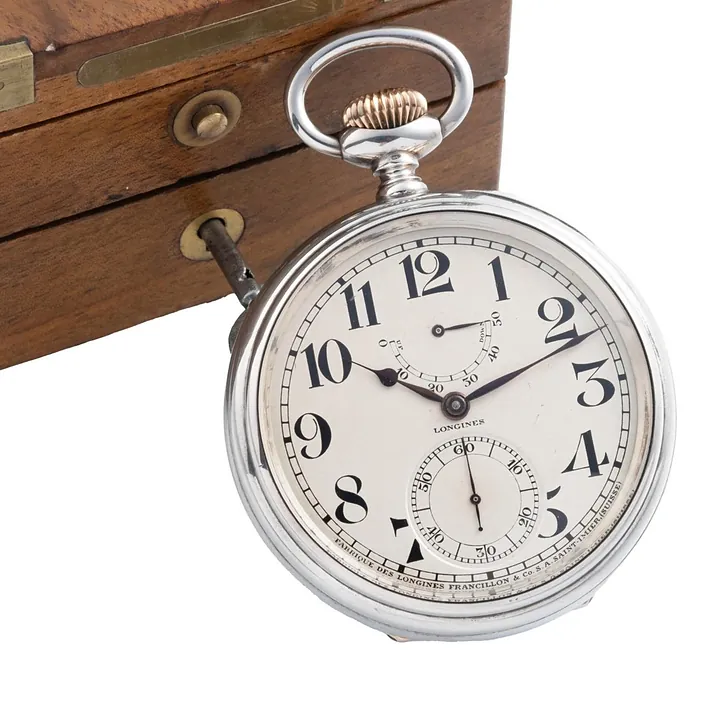
Longines ''torpedo-Boat Watch'', c. 1915
Antiquorum auction archive, Geneva
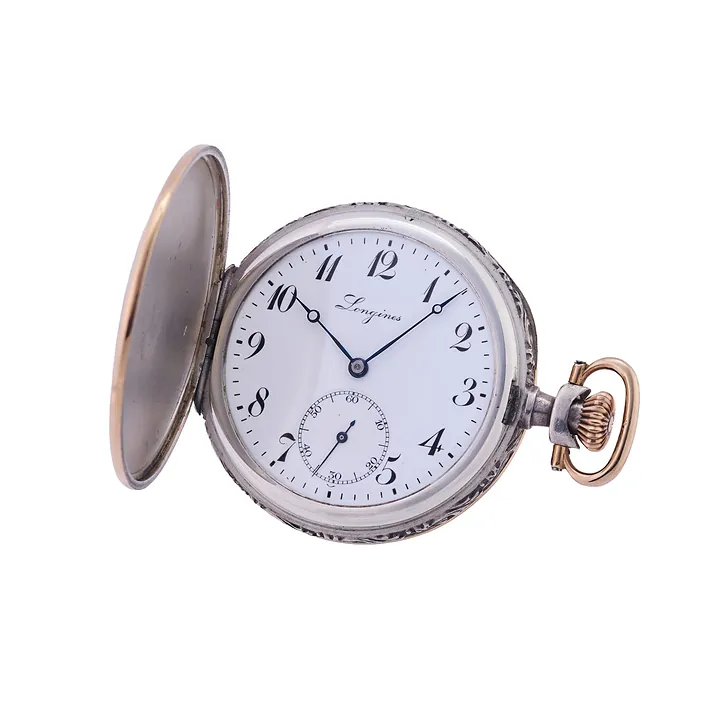
Pocket Watches · c. 1920s
Longines pocket watch, c. 1920s (Antiquorum Lot 389-59)
Antiquorum auction archive, Geneva

Wristwatches · 1931
Rolex 'Oyster Perpetual' rotor self-winding wrist-watch, lever escapement, in steel case with glass in back, Montres Rolex SA, Geneva, Switzerland, 1931
Science Museum Group, London

Wristwatches · 1900–1999
Wristwatch by Certina, Switzerland, 1900–1999
Nordic Museum Foundation
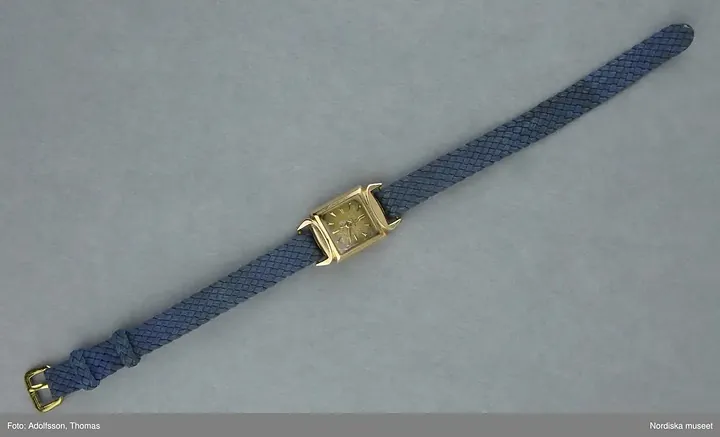
Wristwatches · 1900–1999
Wristwatch by Omega, Västerås, 1900–1999
Nordic Museum Foundation
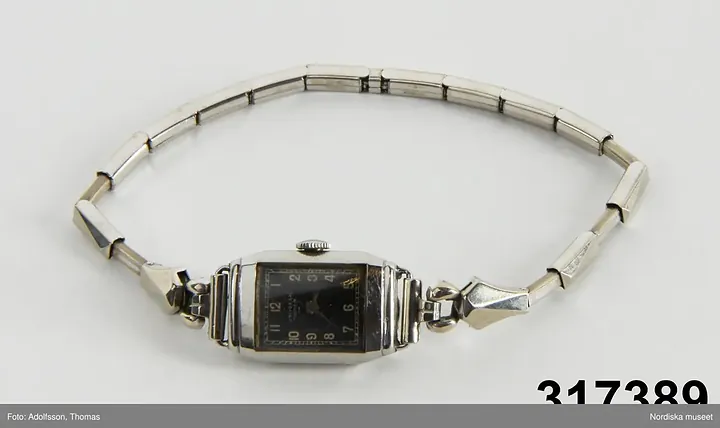
Wristwatches · 1900–1999
Wristwatch by Universal, Switzerland, 1900–1999
Nordic Museum Foundation