Calibre record · Hand-wound pilot's chronograph
UROFA calibre 59
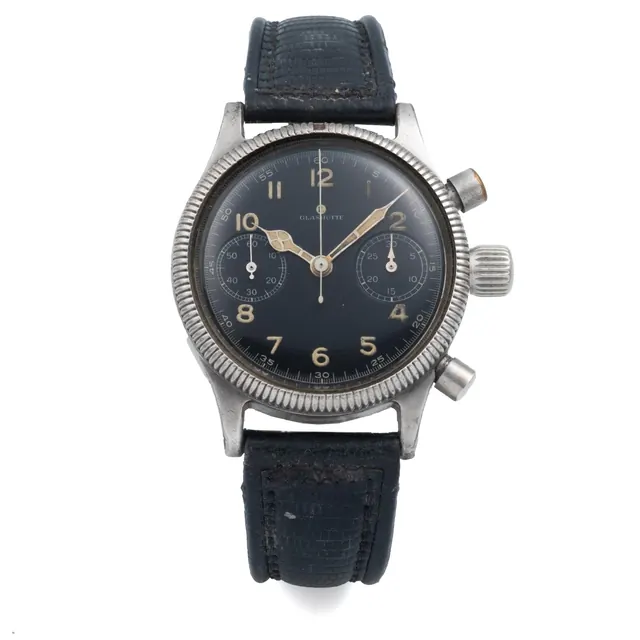
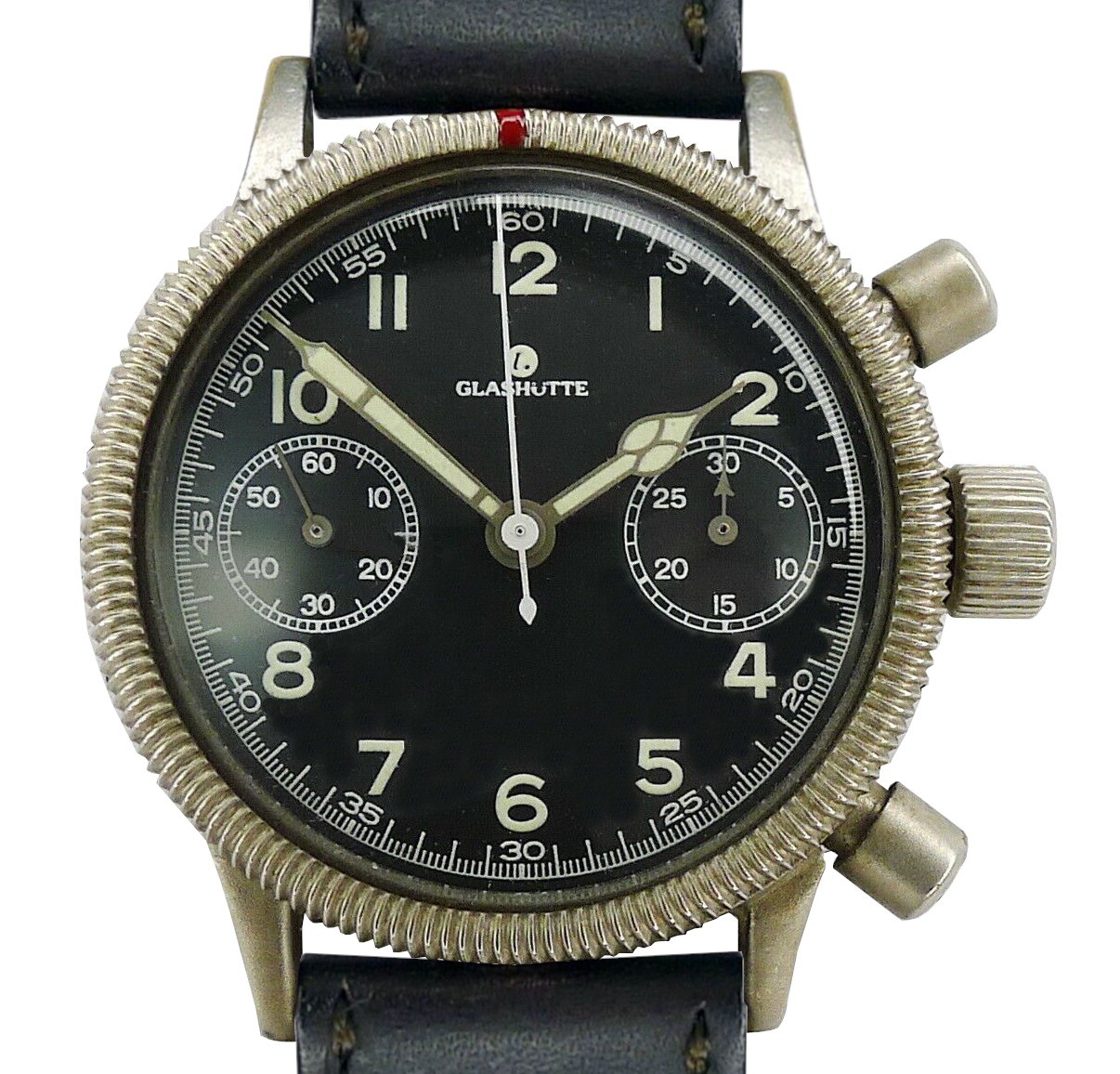
The movement of the Tutima pilot's chronograph made at Glashütte for the Luftwaffe from 1941 — a flyback chronograph that could be reset and restarted with a single push.
- Manufacturer
- UROFA (Uhren-Rohwerke-Fabrik Glashütte AG)
- Type
- Hand-wound pilot's chronograph
- Winding
- Manual
- Production
- 1941–1945
- Country
- Germany
- Diameter
- 34 mm (15 lignes)
- Height
- 5.4 mm
- Jewels
- 17
- Frequency
- Undocumented here
- Power reserve
- Undocumented here
- Oscillator / escapement
- Detached lever escapement
- Complications
- Chronograph with flyback and 30-minute counter; small seconds
Figures are those commonly published for the standard version; individual versions and grades differ. “Undocumented here” means the value has not yet been confirmed for this record.
How it is built
A 15-ligne (34 mm), 5.4 mm-high hand-wound chronograph with 17 jewels. Unlike most Glashütte movements it is a bridge construction rather than a three-quarter-plate calibre, with a screw balance and Breguet balance spring.
Its chronograph has a flyback (Fly Back) function and an additive stop: a pilot could stop and restart a timing without resetting, or press the reset pusher while the chronograph was running to return the hands to zero and start a new timing at once — useful for timing successive legs of a flight. A 30-minute counter sits at 3 o'clock and small seconds at 9.
History
UROFA was classed as a defence works in 1938 and asked to develop a pilot's wristwatch chronograph. After about two years' development the calibre 59 went into production in 1941 and was fitted by its sister company UFAG into Tutima chronographs. Movement numbers from about 200,000 to 218,000 were made in Glashütte; higher numbers are found in watches assembled after the war, in the west by Ernst Kurtz's new firm and in Moscow from captured stock. Some 15,000–20,000 watches were made in all.
Watches fitted with it
- Tutima Fliegerchronograph (pilot's chronograph) delivered to the Luftwaffe from 1941
- Watches assembled after 1945 from remaining movements, in the west and in Moscow
How to recognise it
- A Tutima pilot's chronograph signed 'Glashütte' or 'Tutima Glashütte', with luminous Arabic numerals, a turning bezel with a reference marker, two pushers and a large crown.
- Movement finish changed during production: frosted gilt first, then silvered, then nickel-plated in late examples.
- Most movements have no shock protection; a few have a shock-resistant balance setting.
- Movement numbers from about 200,000 to 218,000 for watches made in Glashütte up to 1945.
For collectors
Wartime pilot's chronographs are widely faked and frequently restored. Compare the movement number with the published ranges, check that the case, dial and hands belong together, and be cautious of 'new old stock' examples.
Compared with related calibres
| Calibre | Type | Frequency | Jewels | Power reserve | Diameter | Production |
|---|---|---|---|---|---|---|
| UROFA calibre 59 | Hand-wound pilot's chronograph | Undocumented here | 17 | Undocumented here | 34 mm (15 lignes) | 1941–1945 |
| Valjoux 72 | Hand-wound chronograph | 18,000 vph (2.5 Hz) | 17 | c. 48 h | 29.5 mm (13 lignes) | 1938–1974 (some sources date its introduction to 1946) |
| Lemania 5100 | Automatic chronograph | 28,800 vph (4 Hz) | 17 | c. 45–48 h | 31 mm (13¾ lignes) | 1974–2002 (a 1998 Chronos article gives 1978 as the start) |
Mechanisms in this calibre
Related calibres
Related records in the catalogue
Records whose titles name this calibre or a model family that used it. Earlier or later examples of a model may contain a different calibre, so check each record's description for the movement actually fitted.