
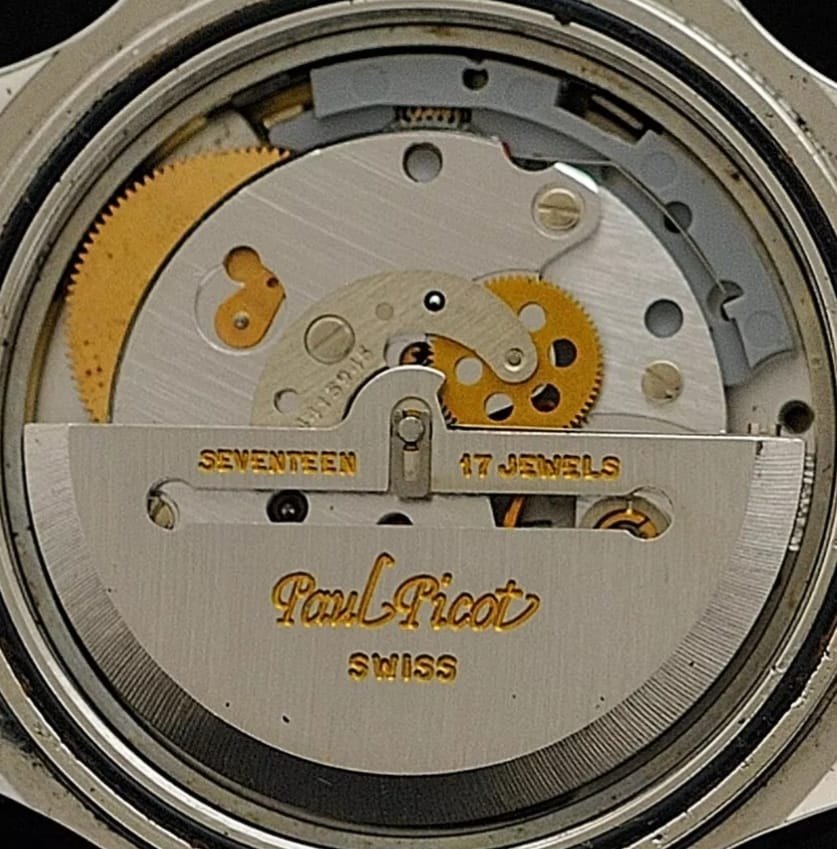
Calibre record · Automatic chronograph
Lemania 5100
A rugged, economical automatic chronograph whose minute recorder turns on the centre arbor, chosen for military and pilots' watches by Tutima, Sinn and Fortis, and made for Omega as calibre 1045.
- Manufacturer
- Lemania
- Type
- Automatic chronograph
- Winding
- Automatic (unidirectional rotor), hand-winding, hacking
- Production
- 1974–2002 (a 1998 Chronos article gives 1978 as the start)
- Country
- Switzerland
- Diameter
- 31 mm (13¾ lignes)
- Height
- 8.2 mm
- Jewels
- 17
- Frequency
- 28,800 vph (4 Hz)
- Power reserve
- c. 45–48 h
- Oscillator / escapement
- Detached lever escapement
- Complications
- Chronograph with central seconds and central 60-minute recorder, 12-hour counter; 24-hour indicator; day-date
Figures are those commonly published for the standard version; individual versions and grades differ. “Undocumented here” means the value has not yet been confirmed for this record.
How it is built
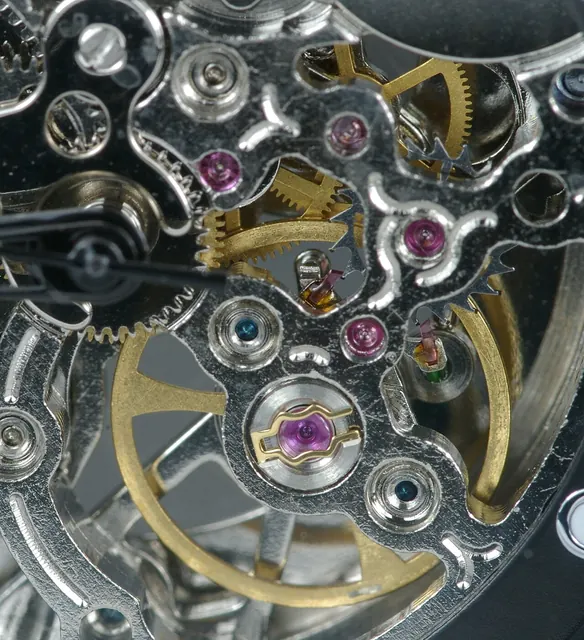
An automatic chronograph built for economy and robustness. Lemania used stamped steel parts and synthetic (Delrin) components in the chronograph works, coupled the chronograph through a friction disc rather than a lateral clutch, and drove all three chronograph hands from a single train so that they stay in step.
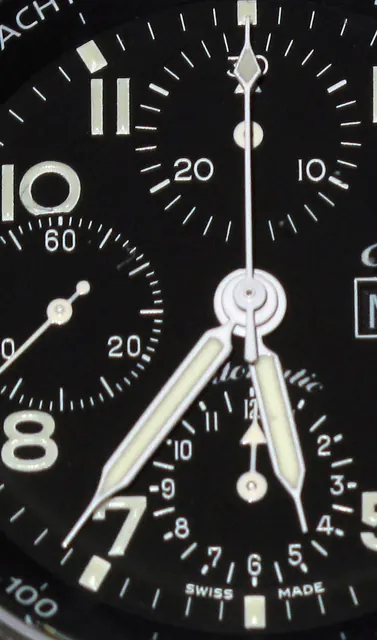
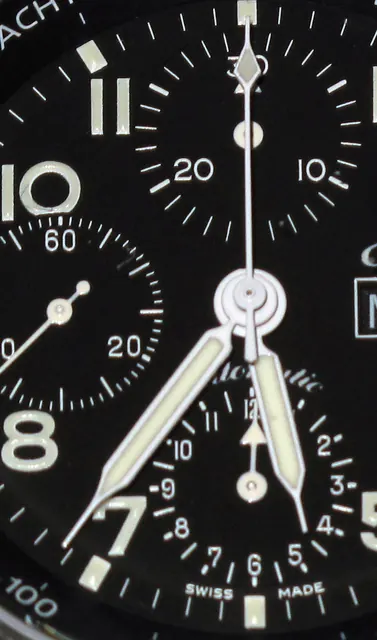
Its signature is the chronograph minute hand on the centre arbor, alongside the chronograph seconds: elapsed minutes are read on the main minute track, like a stopwatch, instead of on a small sub-dial. A 12-hour counter, small seconds and a 24-hour indicator occupy the sub-dials, with day and date at 3 o'clock.
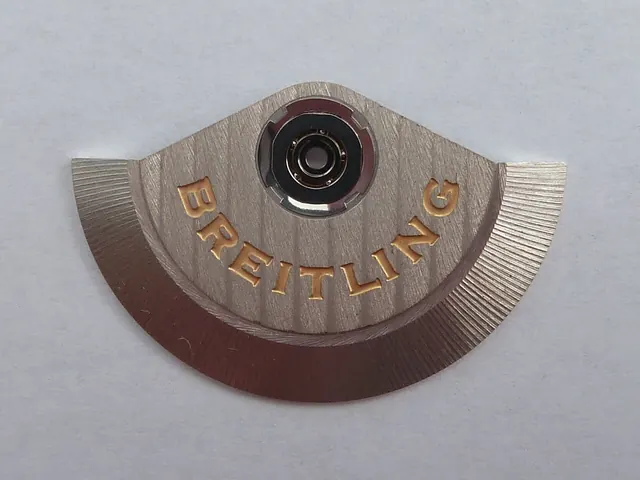
The rotor winds in one direction; the barrel can be removed without dismantling the movement; and the running seconds stop when the crown is pulled out to set the time.
History
Lemania designed the 5100 in the 1970s to be cheap to make and service, using stamped steel parts and synthetic components in the chronograph works. Its central minute hand made elapsed times easy to read at a glance, which suited professional users: Tutima's chronograph for West German air force pilots in the 1980s used it. By the late 1990s its remaining main customers were Fortis, Sinn and Tutima, and production ended in 2002; ETA's later low-cost chronograph calibre C01.211, made for Tissot from 2008, drew on its design.
Watches fitted with it
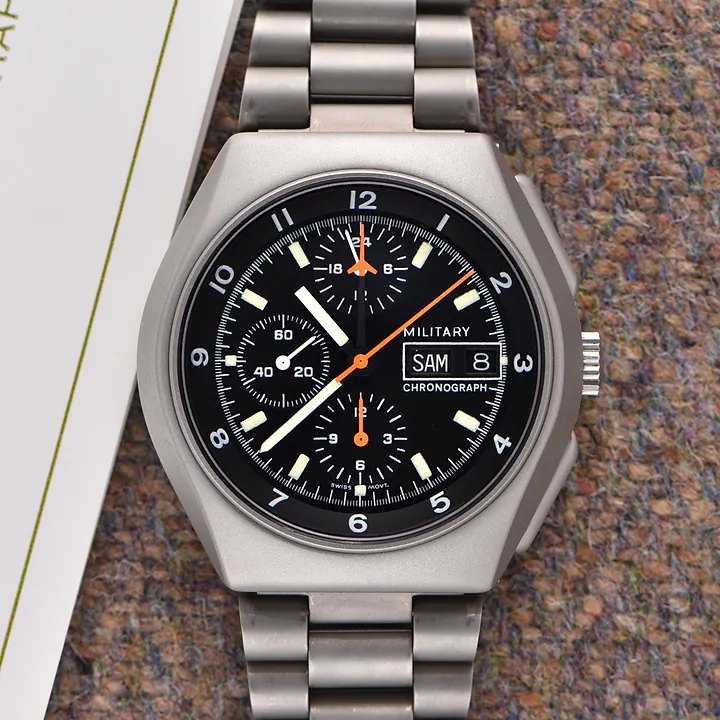
- Tutima military chronograph ref. 798 for West German air force pilots (1980s)
- Sinn 140 and 142 'space chronographs' and the EZM 1
- Fortis Official Cosmonauts Chronograph
- Heuer automatic chronograph ref. 510.500 (1980s)
The numbers explained
- 28,800 vibrations per hour means the balance makes 8 beats (ticks) every second — 4 complete back-and-forth oscillations, or 4 Hz.
- A sweeping seconds hand therefore advances in 8 small steps per second.
- That is 691,200 beats a day. A watch that gains one second a day is out by about 1 part in 86,400 — roughly 11.6 parts per million.
- Faster balances resist knocks and changes of position better but wear their pivots and need fresh oil sooner.
Convert beat rates and daily error with the Atlas tools · See a balance and escapement in the lab
How to recognise it
- Four hands on the centre arbor — hours, minutes, chronograph seconds and chronograph minutes — usually with the chronograph minute hand in a contrasting colour.
- Sub-dials for 24 hours at 12, the 12-hour counter at 6 and small seconds at 9, with day-date at 3 (some watches omit one or more sub-dials).
- A solid case back: the plain, largely utilitarian movement was rarely shown behind glass.
For collectors
The 5100 is valued for toughness rather than finish. Its synthetic parts are a known weak point when a watch has been dropped or badly serviced, and replacement parts have become harder to find since production ended in 2002, so a recent service by a watchmaker familiar with the calibre is worth asking about.
Versions and derivatives
| Calibre | Difference |
|---|---|
| Omega 1045 | Omega's version of the calibre, documented with the same 31 mm, 8.2 mm, 17-jewel specification. |
Compared with related calibres
| Calibre | Type | Frequency | Jewels | Power reserve | Diameter | Production |
|---|---|---|---|---|---|---|
| Lemania 5100 | Automatic chronograph | 28,800 vph (4 Hz) | 17 | c. 45–48 h | 31 mm (13¾ lignes) | 1974–2002 (a 1998 Chronos article gives 1978 as the start) |
| Valjoux 7750 | Automatic chronograph | 28,800 vph (4 Hz) | 25 | c. 42–48 h | 30 mm (13¼ lignes) | 1974–present |
| Valjoux 72 | Hand-wound chronograph | 18,000 vph (2.5 Hz) | 17 | c. 48 h | 29.5 mm (13 lignes) | 1938–1974 (some sources date its introduction to 1946) |
| Omega calibre 861 / 1861 | Manual chronograph | 21,600 vph (3 Hz) | 17 (861); 18 (1861) | c. 45 h | 27 mm (12 lignes) | 1968–1996 (861); 1996–2019 (1861) |
Mechanisms in this calibre
Related calibres
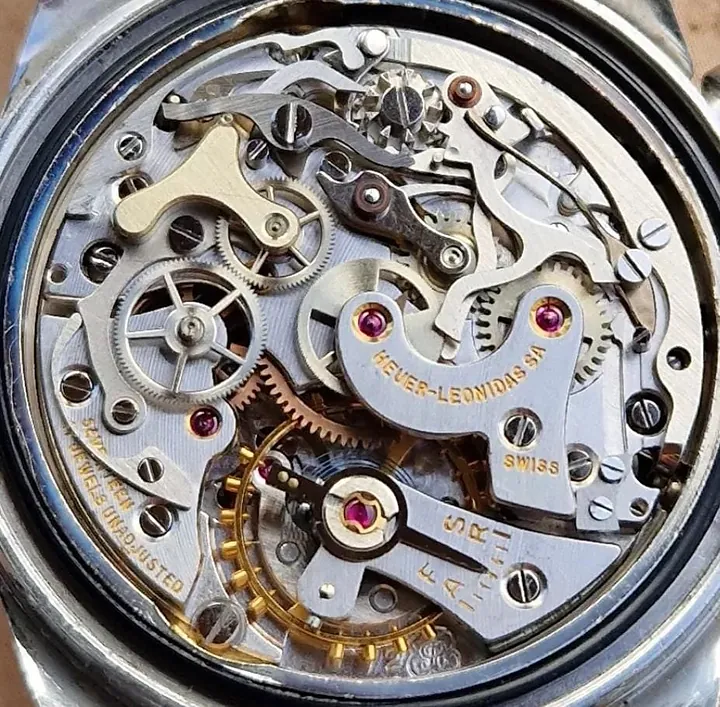
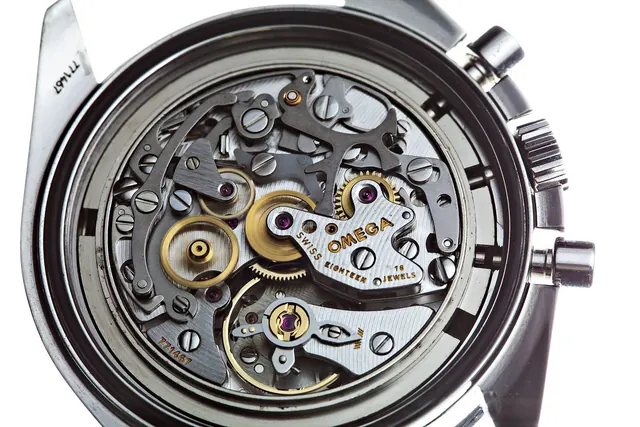
Related records in the catalogue
Records whose titles name this calibre or a model family that used it. Earlier or later examples of a model may contain a different calibre, so check each record's description for the movement actually fitted.
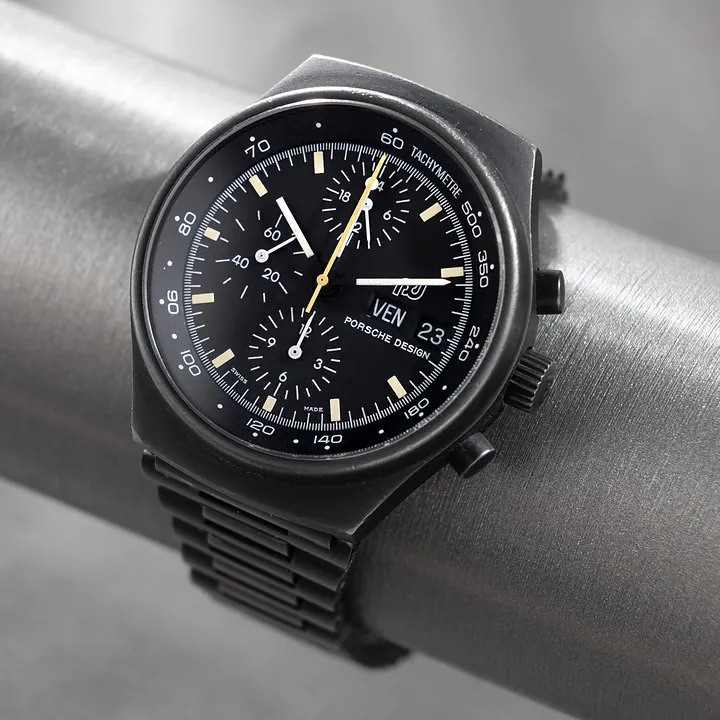
Wristwatches · 1970s
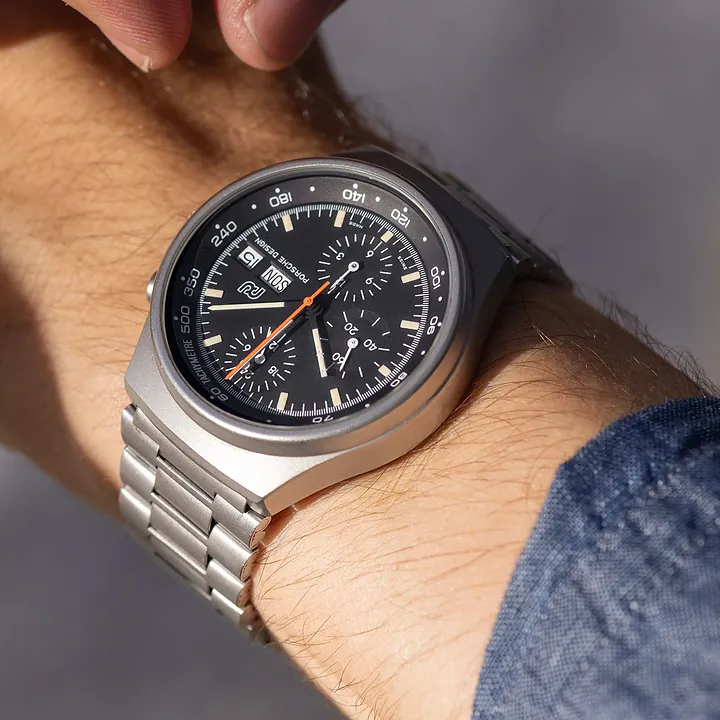
Orfina Porsche Design Chronograph 1 ‘Top Gun’ Lemania 5100 Ref 7176, 1970s
Bulang & Sons (dealer), Copenhagen
Wristwatches · 1970s
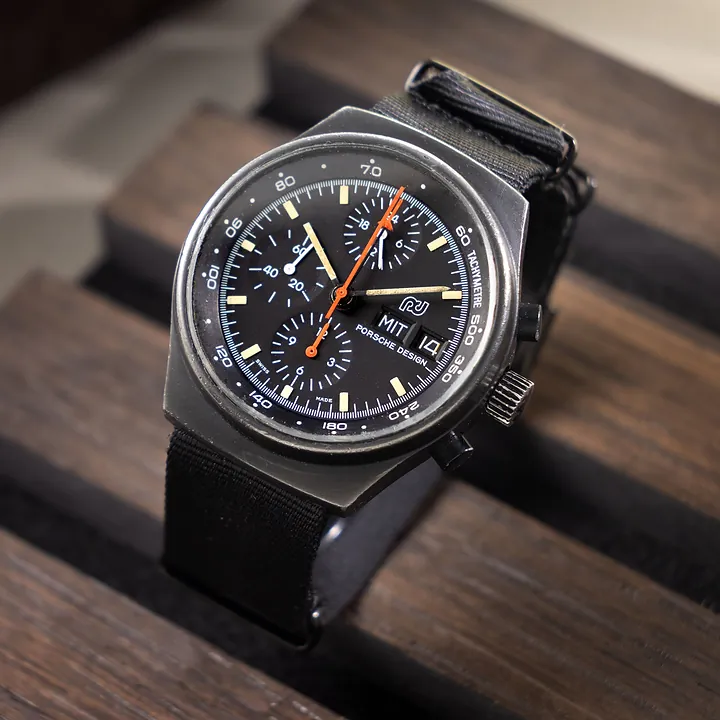
Porsche Design by Orfina Chronograph 1 ref. 7176D Lemania 5100 Sandblasted Grey, 1970s
Bulang & Sons (dealer), Copenhagen
Wristwatches · 1970
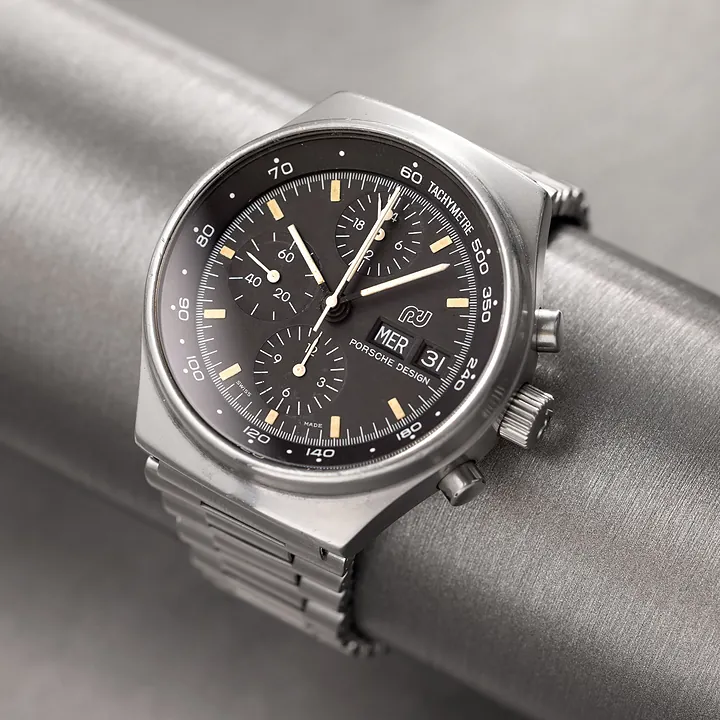
Orfina Porsche Design Chronograph 1 Lemania 5100 Ref 7176 PVD Coated, 1970
Bulang & Sons (dealer), Copenhagen
Wristwatches · 1970s
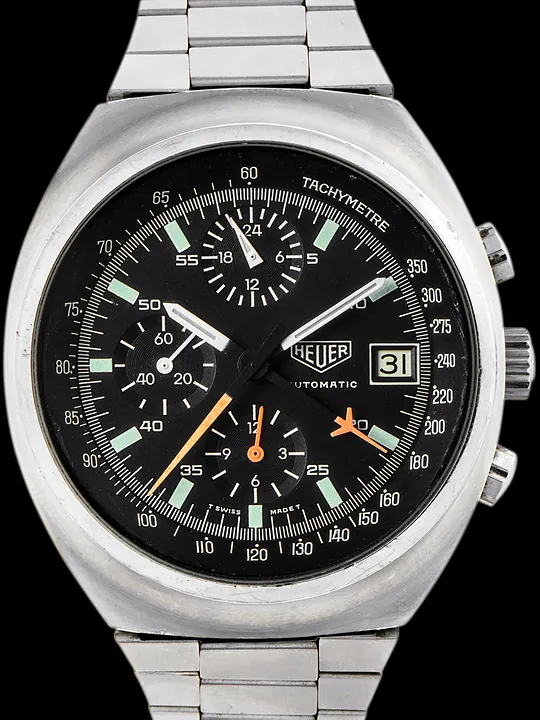
Porsche Design by Orfina Chronograph 1 ref. 7176 “Top Gun” Lemania 5100, 1970s
Bulang & Sons (dealer), Copenhagen
Wristwatches · 1980s
Heuer Automatic Chronograph (Ref. 510.500) 'Lemania Cal. 5100', 1980s
Craft & Tailored (dealer), Los Angeles
Wristwatches · 1985
Tutima Military Chronograph - Papers & Manual **MINT**, 1985
Huntington Company (dealer)