
Wristwatches · Wristwatch
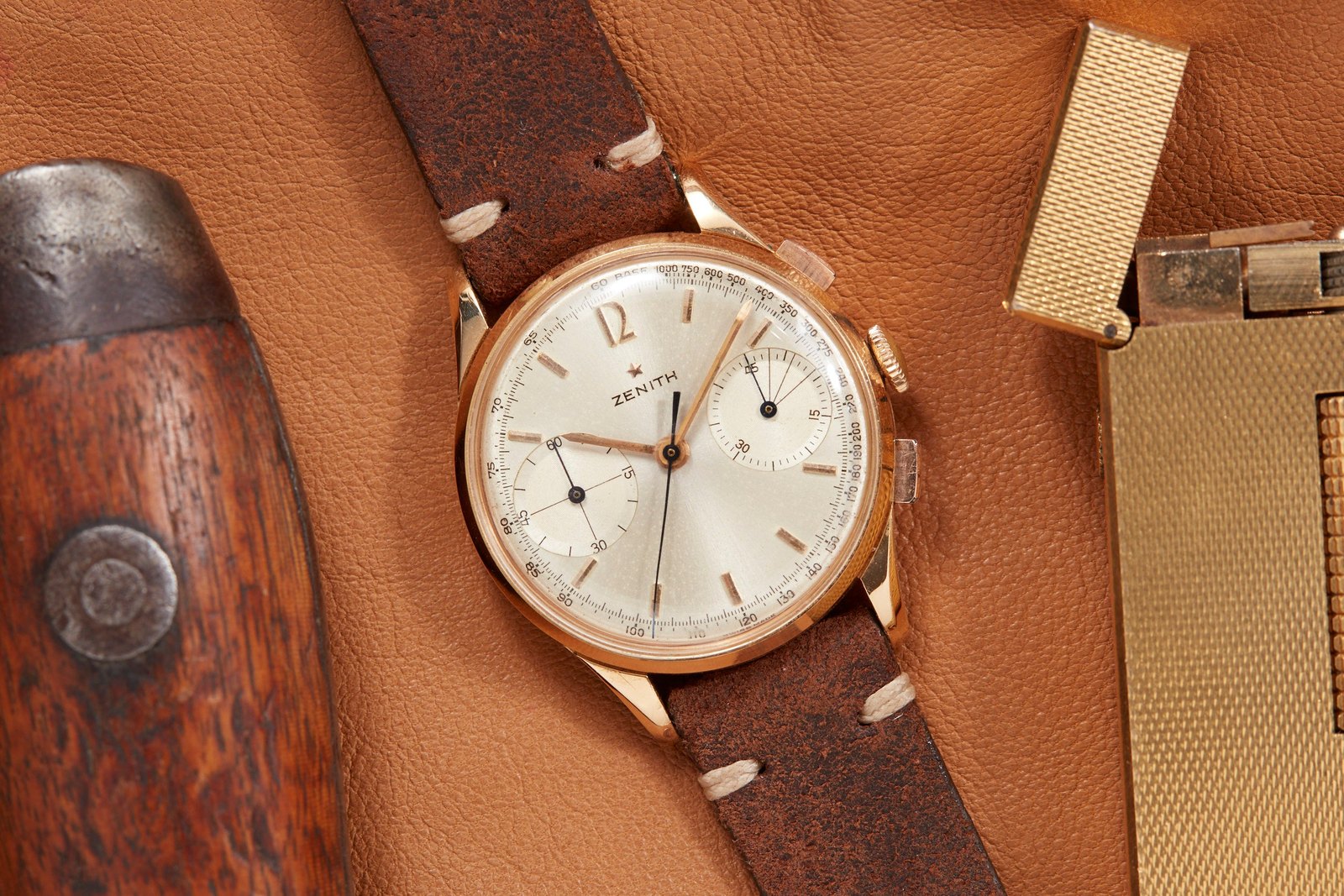
Zenith Two Register Chronograph, 1950s
- Maker / attribution
- Zenith (maker)
- Date
- 1950s
- Historical period
- Modern Mechanical Horology (1945 – 1969)
- Country of origin
- Switzerland
- Object type
- Wristwatch
- Stock no.
- Product 454773538846
- Credit line
- Dealer listing, Analog/Shift (product 454773538846)
- Catalogue title (original)
- Zenith Two Register Chronograph (English)
View the source record (dealer listing) ↗ (opens another website in a new tab)Suggest a correction
Record summary
Catalogued by Analog/Shift (dealer), New York (stock number Product 454773538846), this is a wristwatch by Zenith, made in Switzerland, dated 1950s. The Atlas places it in the Modern Mechanical Horology period (1945 – 1969) of its Wristwatches collection. The record is illustrated with 6 photographs.
Assembled from the source record's structured fields. Dates and attributions are given as the source states them; where a field is missing the Atlas leaves it blank rather than estimating.
Catalogue description
Dealer description — Analog/Shift
Although the automatic El Primero might be Zenith’s most famous product, the manufacture counted scores of other handsome watches in its arsenal. This was in part due to Zenith’s relationship with èbauche manufacturers like Martel, who was responsible for some of the most beautiful chronograph movements of the 20th century. Martel was established in 1911 by Georges Pellaton-Steudler. For the site of his factory, Pellaton-Steudler chose Les Ponts-de-Martel, a village nestled in a heavily-forested valley in the Canton of Neuchatel. It was close to the heart of the Swiss watch industry, particularly to the manufactures located in La Chaux-de-Fonds and Le Locle—among them Zenith and Universal Genève. Within a few years, Martel began to specialize in chronograph movements. In 1917 the manufacture collaborated with Universal Genève on what they claimed was the first wrist chronograph movement ever produced. This would establish a long and fruitful relationship that yielded many technically significant watches—such as the Compur and the Compax, for example, which were also retailed by Zenith. Although Martel continued to collaborate with Universal Genève, it was with Zenith that Martel would be inextricably linked, resulting in Zenith’s purchase of Martel in 1958. The calibres that had been used by Universal Genève were rechristened in Zenith’s catalogs. Among them was the 146D, the calibre contained in this chronograph. The Calibre 146D was one of Zenith’s highest-grade movements, and could be found in a variety of watches, from sporty variants in steel cases to the elegant gold watch seen here. This lovely chronograph dates from the 1950s, and is an excellent example of the sport-influenced dress pieces that were produced by many manufactures following World War II. Like the World War that preceded it, World War II had a profound effect on men’s fashions. World War I had done much to popularize the idea of wristwatches for men, and by the time the Second World War had come around, most troops were issued wristwatches. These GI watches were spartan affairs, often with black dials and bold Arabic numerals. Austerity became the watchword when it came to wrist wear, and the trend would persist in the post-war years. This particular watch, though cast in a precious metal, maintains the sleek look of chronographs that Zenith produced during the war years. With gold watches coming back into fashion, we think that gold chronographs like this one offer the perfect solution for the collector who wants a touch of elegance and class.
Historical context
Modern Mechanical Horology (1945 – 1969)
Tool watches for divers, pilots and astronauts; electric watches anticipate the electronic age.
The classic era of the mechanical wristwatch: dive watches, chronographs for motor racing and space flight, GMT watches for jet travel, slim dress watches, automatic calendars, and the rise of Japanese manufacturers alongside Swiss, American, German and Soviet industries.
Read the period in the timelineMore wristwatches from this periodEarlier: Golden Age of Mechanical Watchmaking
Atlas type guide
Chronographs and split-seconds watches
A chronograph is a watch with an additional seconds hand that can be started, stopped and returned to zero independently of the timekeeping. Louis Moinet built an early example in 1816 and Nicolas Rieussec a recording 'chronographe' in 1821; Adolphe Nicole's heart-shaped reset cam (patented 1862) made the modern return-to-zero possible. Split-seconds (rattrapante) chronographs add a second hand that can be stopped for intermediate times; flyback chronographs restart instantly.
Chronographs were essential tools for doctors (pulsometer scales), artillery (telemeter), engineers and sport. In wristwatches, Valjoux, Venus, Lemania and later the automatic chronographs of 1969 (Zenith El Primero, the Chronomatic Calibre 11 group and Seiko 6139) are milestones.
What to look for
- Push-pieces on the case band or a single button in the crown (monopusher).
- Subsidiary registers for minutes and hours; tachymeter, telemeter or pulsometer scales.
- Column wheel versus cam control visible in the movement.
- Calibre markings of specialist makers (Valjoux, Lemania, Venus, Landeron).
Dating clues
- Pocket chronographs with heart cam reset: after 1862.
- Wrist chronographs: from c. 1910; two-button designs from the 1930s.
- Automatic chronographs: from 1969.
General guidance written by the Atlas editors about this kind of object. It is not a statement about this particular piece; for that, rely on the source record above and on physical examination.
Read next:Flyback chronographChronograph
Related records
Pocket Watches · 1900
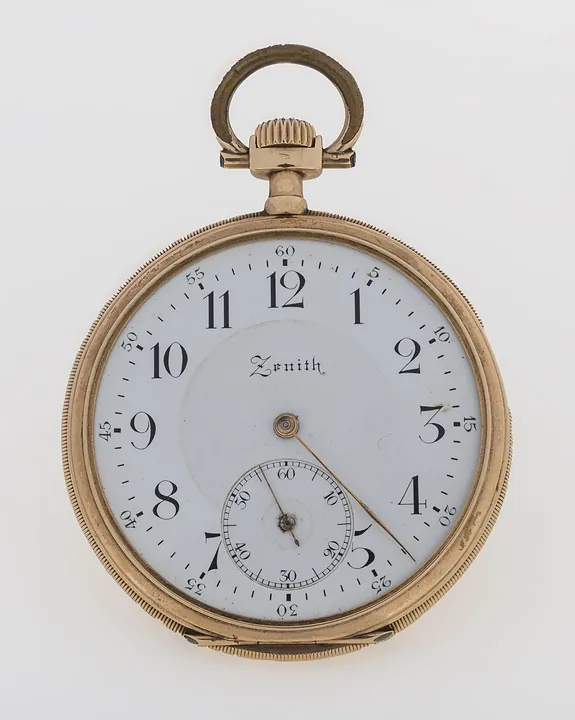
Pocket watch by Zenith, Switzerland, 1900
Museum Rotterdam
Pocket Watches · c. 1900s
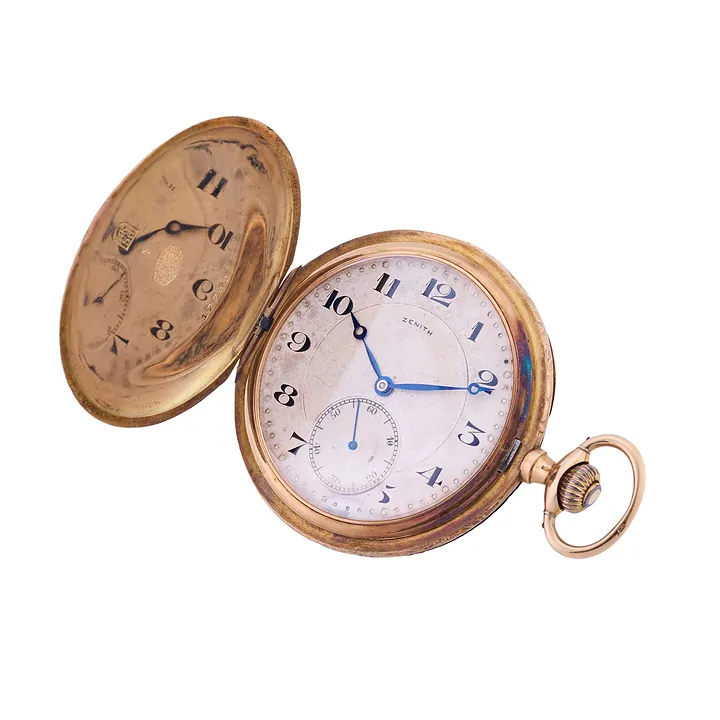
Zenith pocket watch, c. 1900s
Antiquorum auction archive, Geneva
Wristwatches · c. 1980s
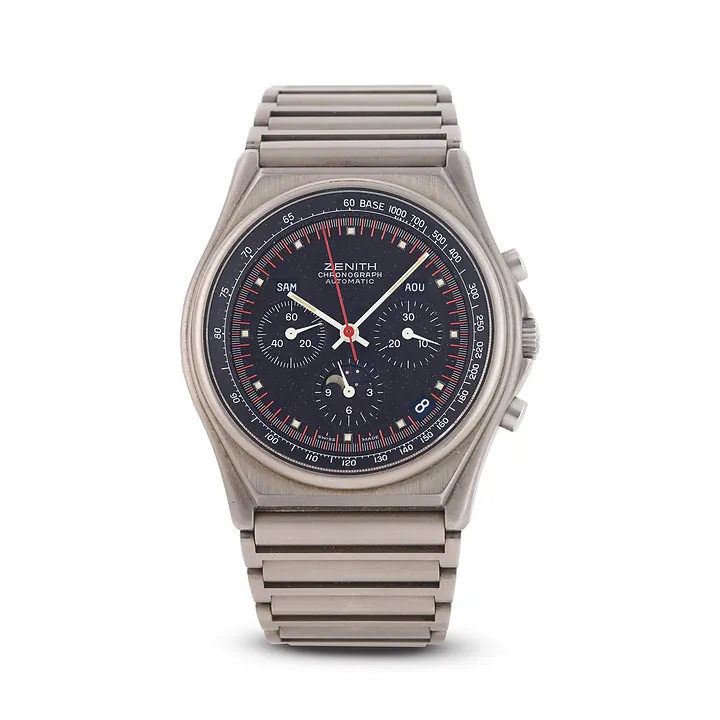
Zenith El Primero Triple Calendar Chronograph, ref. 95.0100.418, c. 1980s
Antiquorum auction archive, Geneva
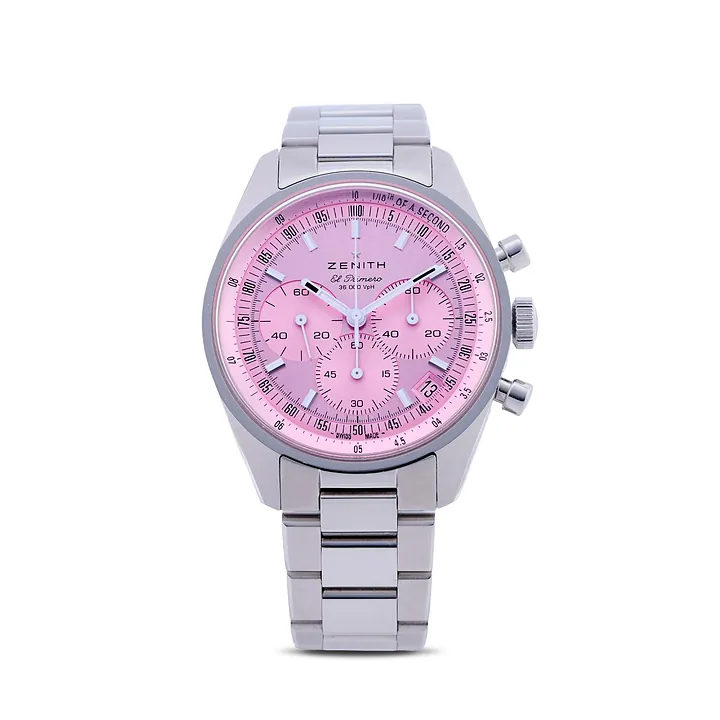
Wristwatches · originally sold in 2022 (per the lot record)
Zenith Chronomaster Original, ref. 03.3202.3600/33.M3200, originally sold in 2022
Antiquorum auction archive, Geneva

Wristwatches · 1945
Wristwatch by Eterna, 1945
Museum Rotterdam

Wristwatches · c. 1945
Breitling Premier, ref. 790, c. 1945
Antiquorum auction archive, Geneva

Wristwatches · c. 1945
Universal Genève Uni-Compax, ref. 22492, c. 1945
Antiquorum auction archive, Geneva

Wristwatches · c. 1950s
Baume & Mercier wristwatch, c. 1950s
Antiquorum auction archive, Geneva