
Wristwatches · Wristwatch
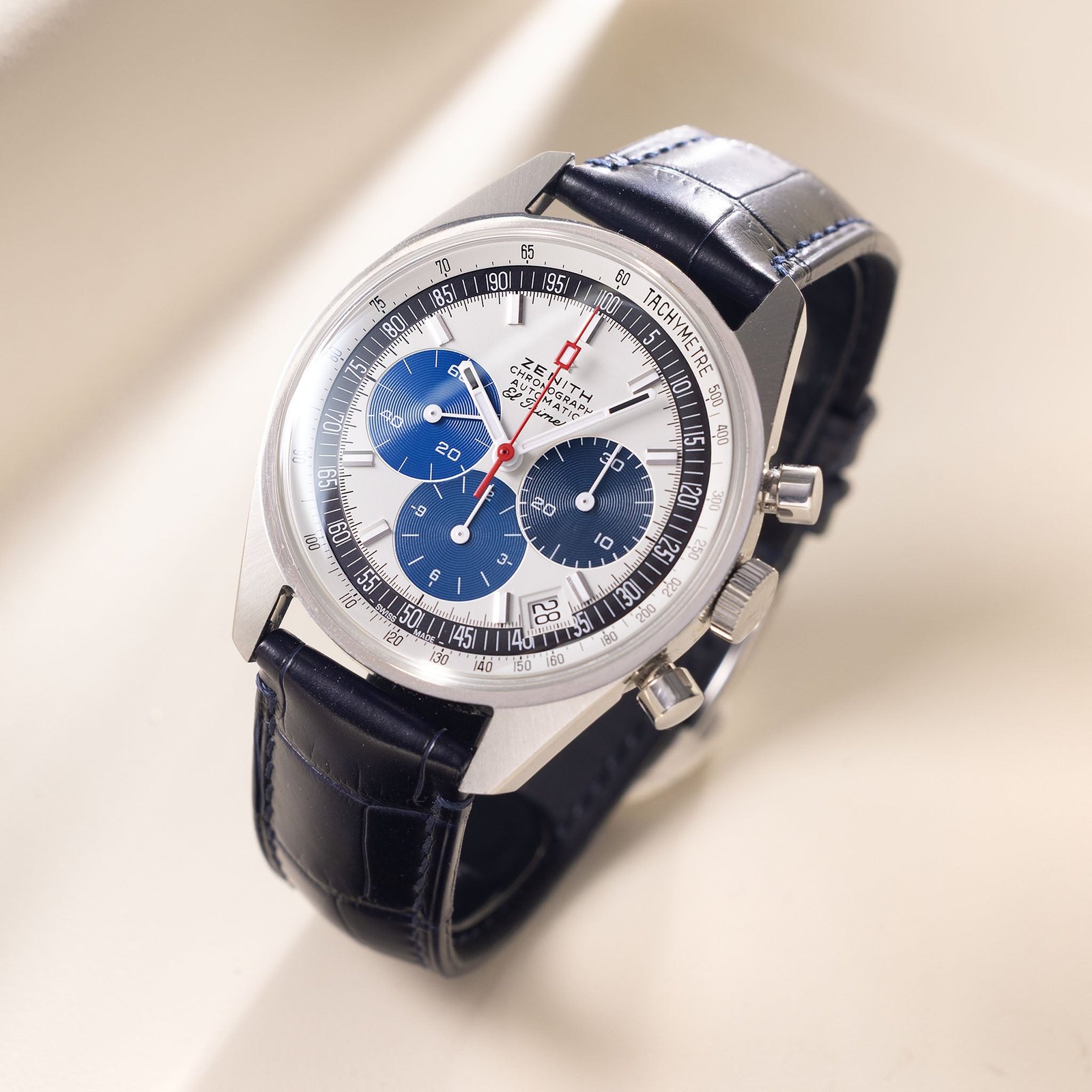
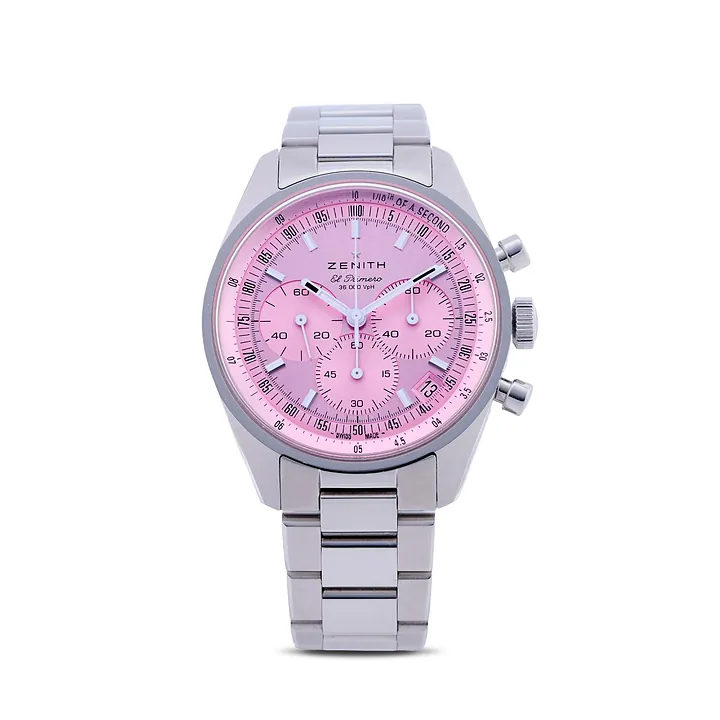
Zenith El Primero Chronomaster Revival A386 “Manufacture Edition” Full Set ref. 03.Z386.400, 2021
- Maker / attribution
- Zenith (maker)
- Date
- 2021
- Historical period
- Contemporary Horology (2010 – Present)
- Country of origin
- Switzerland
- Object type
- Wristwatch
- Dimensions
- Case 38 mm
- Stock no.
- W-3327
- Credit line
- Dealer listing, Bulang & Sons (W-3327)
- Catalogue title (original)
- Zenith El Primero Chronomaster Revival A386 “Manufacture Edition” Full Set ref. 03.Z386.400 (English)
View the source record (dealer listing) ↗ (opens another website in a new tab)Suggest a correction
Record summary
Catalogued by Bulang & Sons (dealer), Copenhagen (stock number W-3327), this is a wristwatch by Zenith, made in Switzerland, dated 2021. The Atlas places it in the Contemporary Horology period (2010 – Present) of its Wristwatches collection. Recorded dimensions: Case 38 mm. The record is illustrated with 6 photographs.
Assembled from the source record's structured fields. Dates and attributions are given as the source states them; where a field is missing the Atlas leaves it blank rather than estimating.
Catalogue description
Dealer description — Bulang & Sons
Originally unveiled in 1969 as the world’s first automatic chronograph calibre, the El Primero (Spanish for “the first one”) remains one of the most revered movements over 50 years later. The first El Primero chronograph, the A386, introduced in 1969, was distinguished by its three subdials in blue, light grey, and anthracite—a signature layout that would go on to define many El Primero models in the years that followed. For its inaugural “Manufacture Edition,” Zenith delved into a hidden chapter of the El Primero legacy, reviving a prototype dial originally designed for the A386. Featuring three distinct shades of blue, the dial was unearthed in the secret attic of Charles Vermot—one of the original watchmakers who worked on the El Primero movement when it was unveiled 56 years ago—bringing a forgotten piece of El Primero history to light. The watch is housed in a 38mm stainless steel case, faithfully recreating the design of the original A386 model from 1969. To ensure the proportions remained true to the original, Zenith used the original blueprints as a reference. The case now features a lovely display caseback, offering a view of the Calibre 400 El Primero. The curved glass with its magnifying effect, the tachymeter scale on the outer ring, the date aperture at 4:30, the font, hour markers, and the shape of the hands—including the red sweep seconds chronograph hand—are all faithful to the original vintage design. Another detail we love: a humorous comic book that Zenith added, illustrating the history and importance of the El Primero. This is a unique and pretty cool-looking watch that is easy to wear—and for sure a cool watch to wear on your summer holidays! Specifications: - Zenith reference 03.Z386.400 chronograph - Steel 38mm case with display caseback - Serial 579xxx dating to 2021 - Silver dial with three shades of blue subdials - Original Zenith strap with steel Zenith pin buckle - Zenith “El Primero” automatic movement, date function cal. 400 - HUGE Zenith outer and inner boxes, comic about the “El Primero’s” history, hang tag, polishing cloth, cardholder, booklet, copy of the “prototype” dial - Fully checked by our watchmaker
Historical context
Contemporary Horology (2010 – Present)
Silicon components, connected watches, optical-lattice research clocks and a thriving independent scene.
Smartwatches became the world's best-selling watches, while mechanical watchmaking focuses on craft, innovation (silicon components, new escapements) and independent makers.
Read the period in the timelineMore wristwatches from this periodEarlier: Mechanical Renaissance
Atlas type guide
Wristwatches
Bracelet watches were worn by women from the early nineteenth century — Breguet made one for Caroline Murat, Queen of Naples, in 1810–12 — but the wristwatch only became a man's instrument with military use and aviation in the early twentieth century. Between the World Wars it overtook the pocket watch; the 1920s and 1930s brought rectangular Art Deco cases, water-resistant cases and the first automatic winding systems.
After 1945 the wristwatch became a carrier of identity — dress watches, sports and dive watches, chronographs, calendars — produced by Swiss, American, Japanese, German, Soviet and Chinese industries. The quartz revolution after 1969 and the mechanical renaissance since the 1990s, including the rise of independent watchmakers, complete the story.
What to look for
- The reference number (between the lugs or inside the case back) and serial number, the starting point for dating.
- The calibre: its maker and number are often stamped under the dial or on the bridge.
- Originality of dial, hands and crown — refinished ('redial') dials are common.
- Case material marks: 18K/750, 14K/585, stainless steel, gold-filled, plated.
Dating clues
- Wire-lug cases: before c. 1925.
- Water-resistant screw-down cases: from 1926.
- Quartz movements: from 1969; sapphire crystals widespread after c. 1980.
General guidance written by the Atlas editors about this kind of object. It is not a statement about this particular piece; for that, rely on the source record above and on physical examination.
Related records
Pocket Watches · 1900
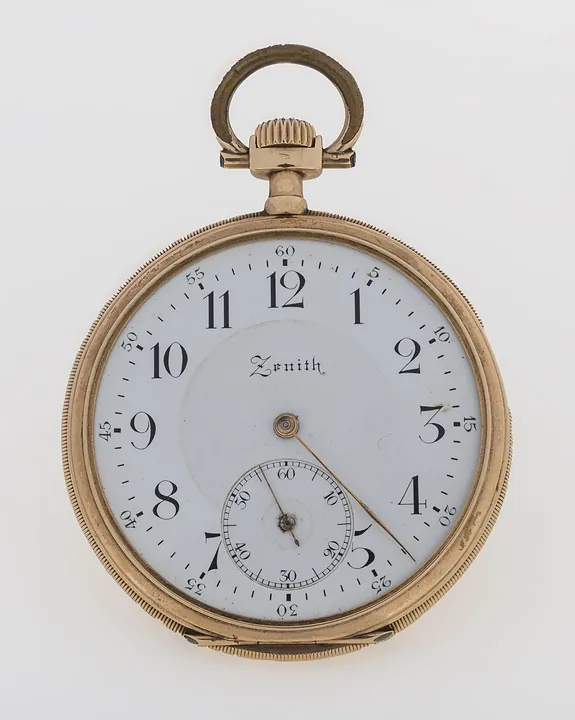
Pocket watch by Zenith, Switzerland, 1900
Museum Rotterdam
Pocket Watches · c. 1900s
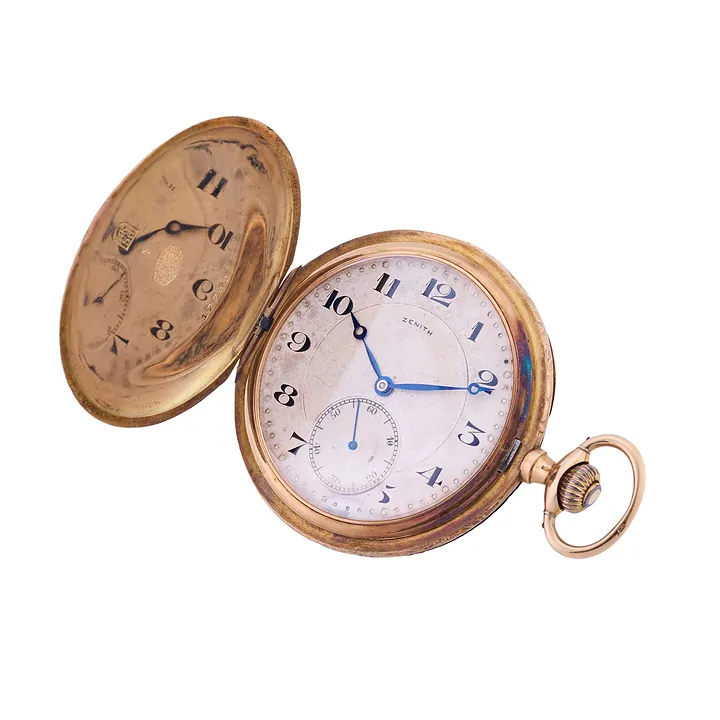
Zenith pocket watch, c. 1900s
Antiquorum auction archive, Geneva
Wristwatches · c. 1980s
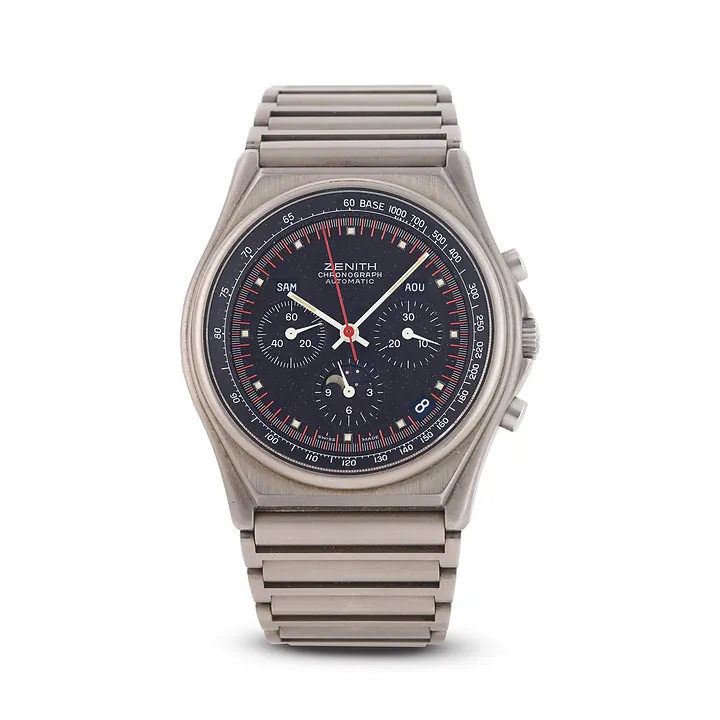
Zenith El Primero Triple Calendar Chronograph, ref. 95.0100.418, c. 1980s
Antiquorum auction archive, Geneva
Wristwatches · originally sold in 2022 (per the lot record)
Zenith Chronomaster Original, ref. 03.3202.3600/33.M3200, originally sold in 2022
Antiquorum auction archive, Geneva

Wristwatches · c. 2010s
Breguet Type XXI, ref. 3810, c. 2010s (Antiquorum Lot 381-24)
Antiquorum auction archive, Geneva

Wristwatches · c. 2010s
Breguet Type XXI, ref. 3810, c. 2010s (Antiquorum Lot 386-229)
Antiquorum auction archive, Geneva

Wristwatches · Sold in September 2010
Breitling Cosmonaute, ref. A 22322, Sold in September 2010
Antiquorum auction archive, Geneva

Wristwatches · c. 2010
Corum Bubble Chrono, ref. 396.150.20, c. 2010
Antiquorum auction archive, Geneva