
Wristwatches · Wrist watch
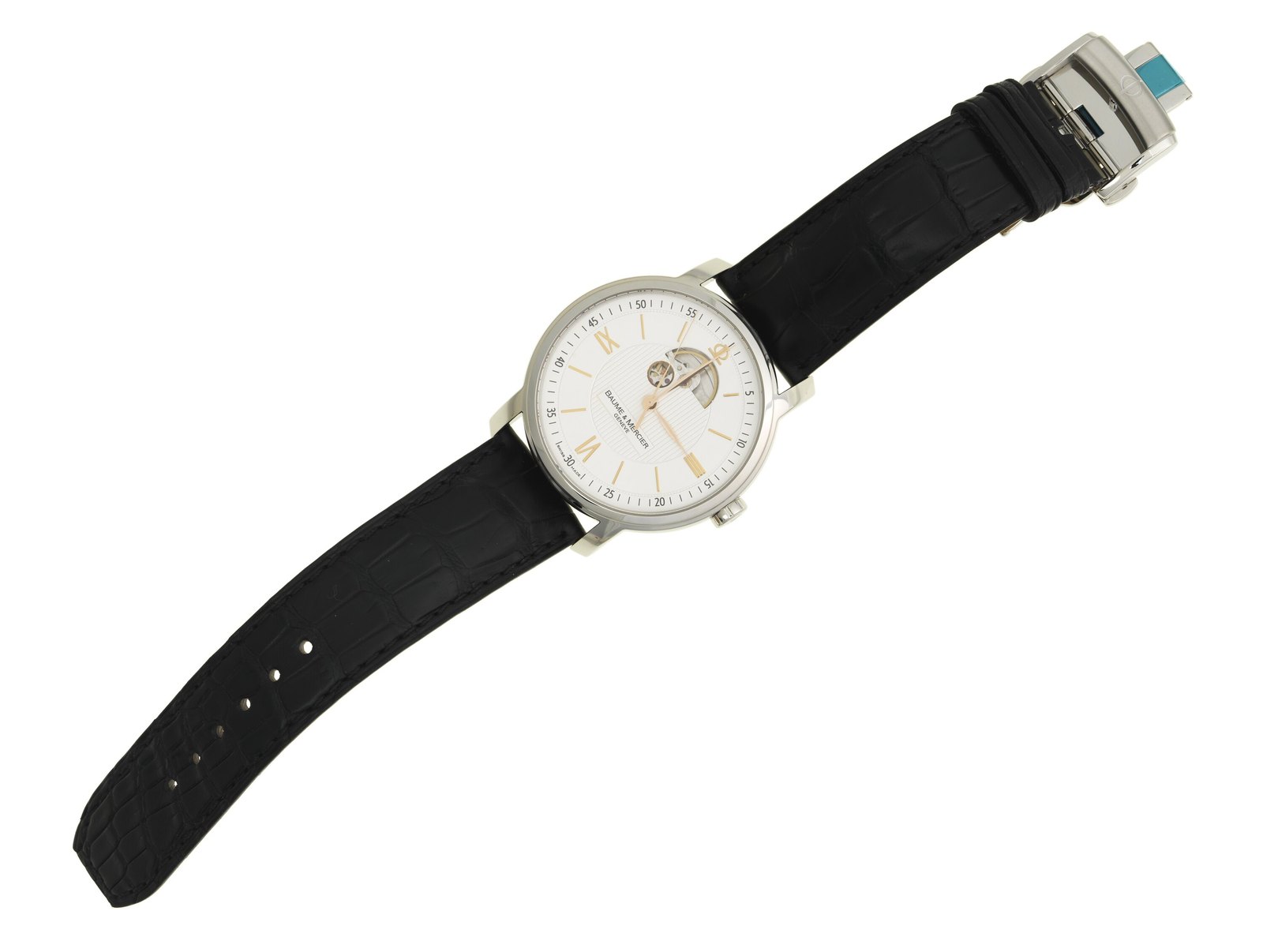
Wrist Watch - Baume et Mercier, Classima, 160th Anniversary Limited Edition, 2012
- Maker / attribution
- Unrecorded in source
- Date
- 2012
- Historical period
- Contemporary Horology (2010 – Present)
- Country of origin
- Unrecorded in source
- Object type
- Wrist watch
- Holding institution
- Museums Victoria, Melbourne
- Accession / object no.
- HT 32967
- Catalogue title (original)
- Wrist Watch - Baume et Mercier, Classima, 160th Anniversary Limited Edition, 2012 (English)
View the source record ↗ (opens another website in a new tab)Suggest a correction
Record summary
Held and catalogued by Museums Victoria, Melbourne (object number HT 32967), this is a wrist watch, dated 2012. The Atlas places it in the Contemporary Horology period (2010 – Present) of its Wristwatches collection. The record is illustrated with 6 photographs.
Assembled from the source record's structured fields. Dates and attributions are given as the source states them; where a field is missing the Atlas leaves it blank rather than estimating.
Catalogue description
Summary — Museums Victoria
Automatic wristwatch, by Baume & Mercier, Geneva, Switzerland, 2012. In 2012, Baume et Mercier celebrated its 160th anniversary in Australia. To mark the occasion, the company launched a limited edition Classima wrist watch, and curated an exhibition which was hosted by their official retailers in Sydney and Melbourne. A number of historical timepieces were displayed, alongside images and artefacts from the 1880 Melbourne International Exhibition (MIE). Baume & Co was a key exhibitor in the Swiss Court at the Melbourne International Exhibition. Though occupying a small area, the Swiss Court had a prominent position on the grand avenue of the temporary annexe, a favourite area for promenading. The entrance to the court was dressed like a Swiss chalet, with carved wood-work and picturesque gables. Over this hung the coat-of-arms of the confederation - a plain white cross on a red ground - with the national motto 'one for all and all for one'. The largest and finest display in the Swiss Court was undoubtedly its timepieces. The exhibit by 33 watch makers was valued at £14,000 (just over $1 million at 2012 exchange rates). It was noted in the official catalogue that watch making 'has been one of the most important industries of Switzerland for more than a century, and at present it gives employment to nearly 40,000 men'. So important was watch making to the Swiss economy, the Swiss commission published a photo book illustrating production methods, which it presented as a gift to the Victorian commissioners of the MIE. Baume's handsome show case of black and gold, lined in dark crimson velvet, was prominently positioned at the centre of the Swiss Court. On display were keyless chronometers, keyless perpetual calendars, keyless chronographs, and quarter repeaters. The Horolgoical jury said of the Baume display: 'These are hand-made watches of the best quality, and their external appearance and workmanship are admirable.' Overall Baume was awarded third order of merit and a certificate, while the Swiss watch collective was awarded first prize and a certificate. Current brand manager for Baume et Mercier in Australia, Mathilde Percheron, was keen to emphasise Baume & Co's participation at the MIE in the 160th anniversary exhibition and related publications. Museum Victoria, as custodians of the Royal Exhibition Building (venue of the MIE), lent a number of collection pieces to the exhibition, and senior curator Charlotte Smith spoke at exhibition events in Sydney and Melbourne. This Classima 160th anniversary watch was donated to Museum Victoria as a thank you for its support of Baume et Mercier's celebrations.
Physical description — Museums Victoria
Automatic movement, stainless steel case, crystal window in face and back of case. In boxed presentation case, with booklet.
Inscriptions & marks
Face marked: 'Baume & Mercier, Geneve'. Roman numerals for hours and arabic numerals for minutes. Rear of case marked: 'Classima. Baume & Mercier, Geneve 1830. 160th Anniversary Edition. 65558. Swiss. 50M. Stainless Steel. Baume & Mercier Australia. One out of 160.' Serial number: 4300621.
Provenance
Donation from Baume et Mercier Richemont Australia, 21 Sep 2012
Historical context
Contemporary Horology (2010 – Present)
Silicon components, connected watches, optical-lattice research clocks and a thriving independent scene.
Smartwatches became the world's best-selling watches, while mechanical watchmaking focuses on craft, innovation (silicon components, new escapements) and independent makers.
Read the period in the timelineMore wristwatches from this periodEarlier: Mechanical Renaissance
Atlas type guide
Wristwatches
Bracelet watches were worn by women from the early nineteenth century — Breguet made one for Caroline Murat, Queen of Naples, in 1810–12 — but the wristwatch only became a man's instrument with military use and aviation in the early twentieth century. Between the World Wars it overtook the pocket watch; the 1920s and 1930s brought rectangular Art Deco cases, water-resistant cases and the first automatic winding systems.
After 1945 the wristwatch became a carrier of identity — dress watches, sports and dive watches, chronographs, calendars — produced by Swiss, American, Japanese, German, Soviet and Chinese industries. The quartz revolution after 1969 and the mechanical renaissance since the 1990s, including the rise of independent watchmakers, complete the story.
What to look for
- The reference number (between the lugs or inside the case back) and serial number, the starting point for dating.
- The calibre: its maker and number are often stamped under the dial or on the bridge.
- Originality of dial, hands and crown — refinished ('redial') dials are common.
- Case material marks: 18K/750, 14K/585, stainless steel, gold-filled, plated.
Dating clues
- Wire-lug cases: before c. 1925.
- Water-resistant screw-down cases: from 1926.
- Quartz movements: from 1969; sapphire crystals widespread after c. 1980.
General guidance written by the Atlas editors about this kind of object. It is not a statement about this particular piece; for that, rely on the source record above and on physical examination.
Related records
Wristwatches · 2010
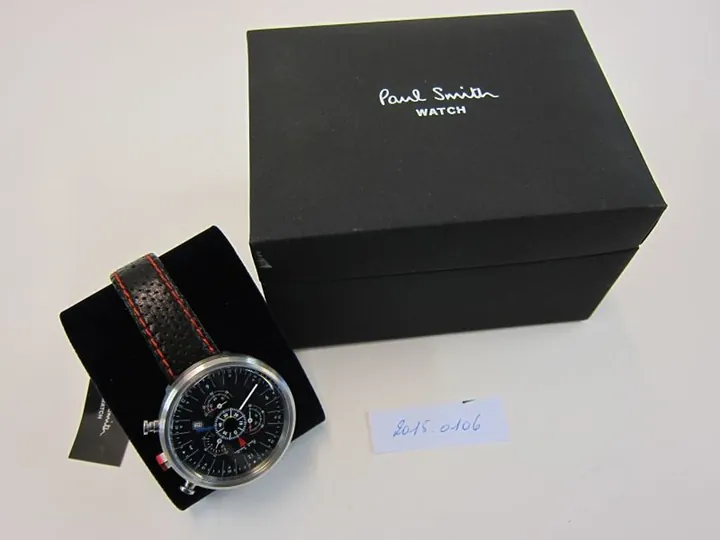
Wristwatch, 2010
Modemuseum Hasselt
Wristwatches · 2018 (Series 4 released in September 2018; '1977' in the source is the model number A1977)
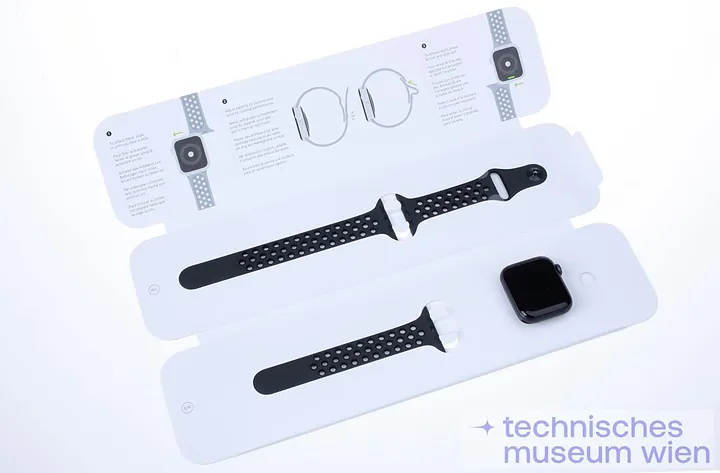
Apple Watch Series 4 (GPS, 40 mm, model A1977), 2018
Vienna Museum of Science and Technology
Wristwatches · c. 2010s
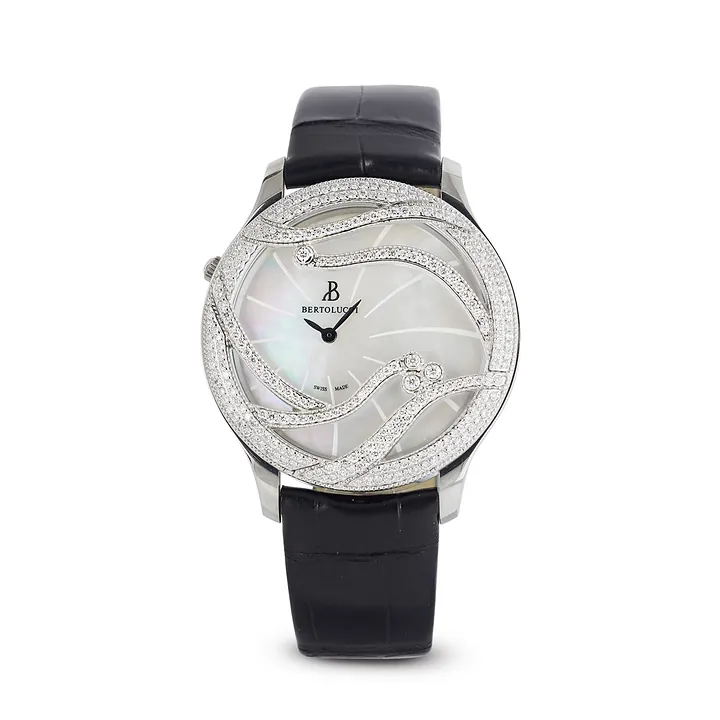
Bertolucci Stria III, ref. 11513.50.45.B88.6C1.501, c. 2010s
Antiquorum auction archive, Geneva
Wristwatches · c. 2010s
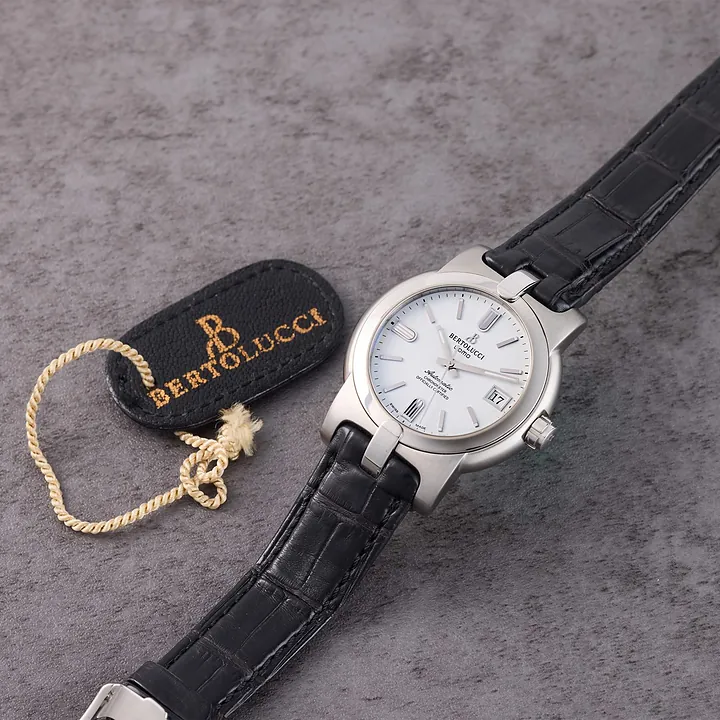
Bertolucci Uoma, ref. 824.51.41.10B, c. 2010s
Antiquorum auction archive, Geneva

Wristwatches · c. 2010s
Breguet Type XXI, ref. 3810, c. 2010s (Antiquorum Lot 381-24)
Antiquorum auction archive, Geneva

Wristwatches · c. 2010s
Breguet Type XXI, ref. 3810, c. 2010s (Antiquorum Lot 386-229)
Antiquorum auction archive, Geneva

Wristwatches · Sold in September 2010
Breitling Cosmonaute, ref. A 22322, Sold in September 2010
Antiquorum auction archive, Geneva
Wristwatches · c. 2010s
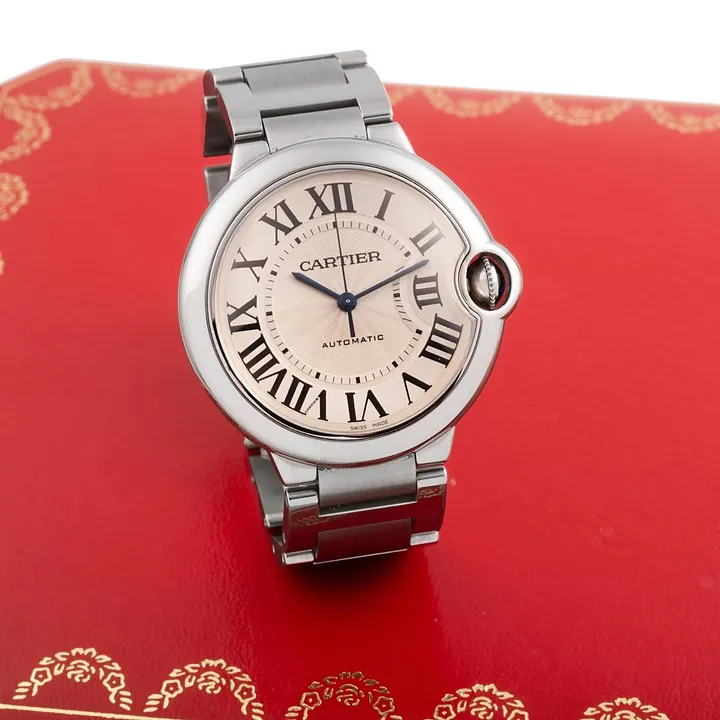
Cartier Ballon Bleu, ref. 3284, c. 2010s
Antiquorum auction archive, Geneva