
Wristwatches · Wristwatch
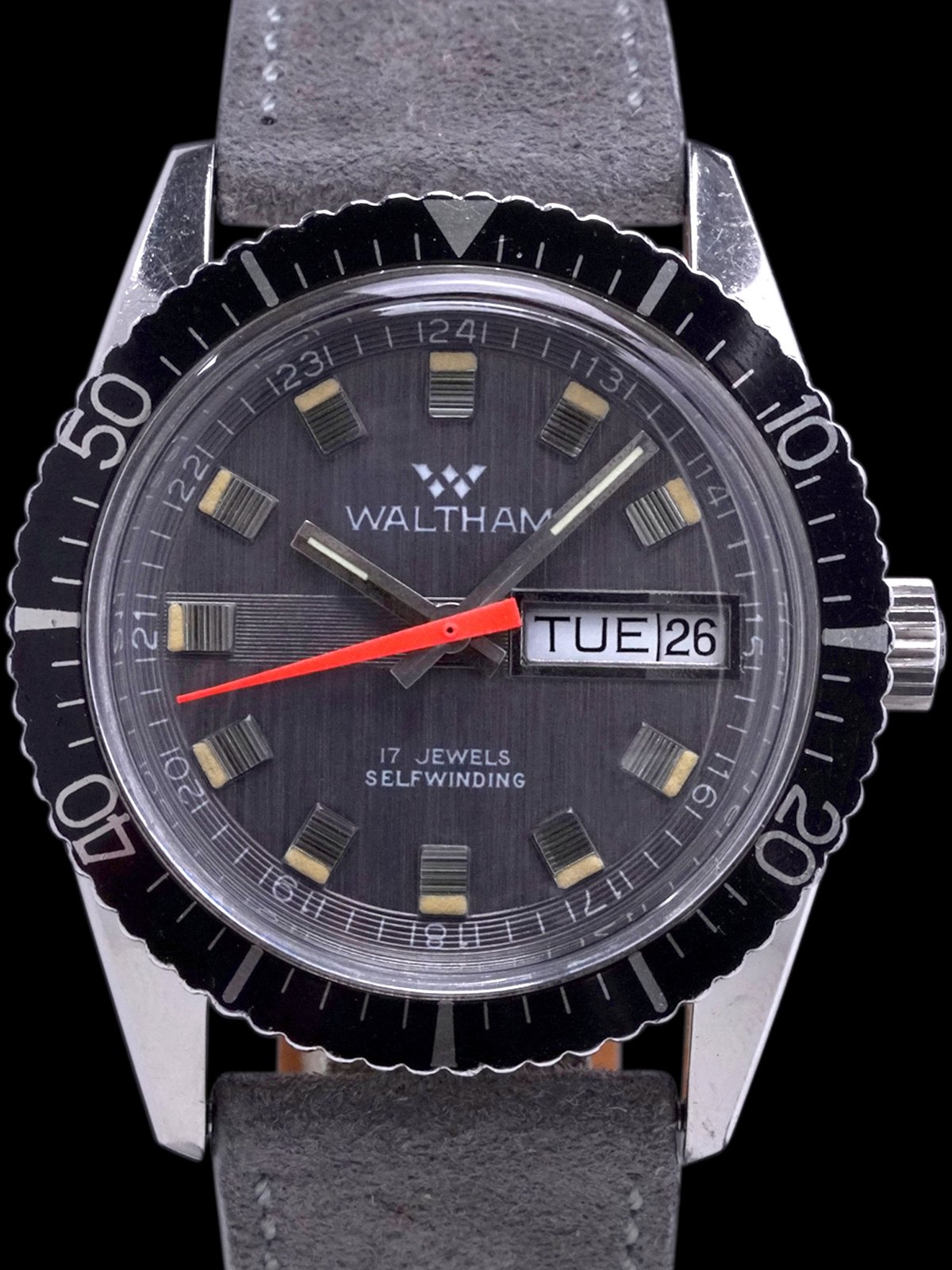
Waltham Automatic Day-Date, 1970s
- Maker / attribution
- Waltham (maker)
- Date
- 1970s
- Historical period
- Quartz Revolution (1969 – 1990)
- Country of origin
- United States
- Object type
- Wristwatch
- Stock no.
- WTHMDD
- Credit line
- Dealer listing, Craft & Tailored (WTHMDD)
- Catalogue title (original)
- 1970s Waltham Automatic Day-Date (English)
View the source record (dealer listing) ↗ (opens another website in a new tab)Suggest a correction
Record summary
Catalogued by Craft & Tailored (dealer), Los Angeles (stock number WTHMDD), this is a wristwatch by Waltham, made in United States, dated 1970s. The Atlas places it in the Quartz Revolution period (1969 – 1990) of its Wristwatches collection. The record is illustrated with 6 photographs.
Assembled from the source record's structured fields. Dates and attributions are given as the source states them; where a field is missing the Atlas leaves it blank rather than estimating.
Catalogue description
Dealer description — Craft & Tailored
Waltham was once one of the most important and prolific watchmakers in the United States and was perhaps best known for their elegantly adored and high-quality pocket watches of the late 1800s and early 1900s. As with all timepiece manufacturers at the turn of the century, Waltham naturally switched manufacturing as watches migrated to the wrist, and over time produced a variety of sport and dress models. This Waltham Automatic is tastefully manufactured, melding aesthetics perfectly with functionality. Featuring a gorgeous grey “linen” dial, a rotating bezel, and a highly visible orange sweep seconds hands, while the cal. E4909 movement offers both day and date complications. This elegantly sporty piece is the perfect example of mid-century Waltham. SPECS Stock # WTHMDD Brand Waltham Style Automatic Day-Date Model N/A Serial N/A Size Men's Material Stainless Steel Dial Grey "Linen" Millimeters 36 Bracelet 2pc Handmade Leather Strap CASE & BRACELET The charming straight-luged case has been lightly polished in the past but it still retains noticeable bevels throughout and exhibits light signs of honest use. The rotating bezel is in excellent condition showing no major signs of use. The case retains its original Waltham signed crown. The case back retains all of its original factory engravings. The watch will come supplied on a 2pc handmade leather strap. DIAL & HANDS The grey linen dial is a work of art, featuring multiple textures from the main portion of the dial to the concentric texture of the outer minute track. The dial does show some very minor marks however they are almost invisible due to the dial texture. The tritium lume plots have aged to a charming bright yellow coloration and display no degradation when inspected under U.V. light. The original tritium hands match the dial perfectly and show no degradation under U.V. light inspection. ACCESSORIES None. The watch is keeping time, previous service history is unknown.
Historical context
Quartz Revolution (1969 – 1990)
Seiko's Astron begins mass quartz timekeeping; traditional industries contract sharply.
Quartz and digital watches transformed the market after 1969. Swiss employment collapsed, Japanese and Hong Kong production soared, and the Swatch (1983) helped the Swiss industry recover; mechanical watches survived as luxury goods.
Read the period in the timelineMore wristwatches from this periodEarlier: Modern Mechanical Horology
Atlas type guide
Calendar, moon-phase and perpetual calendar watches
Calendar complications range from a simple date to the perpetual calendar, which automatically allows for months of different lengths and leap years until 2100. Pocket watches with perpetual calendars were made in the eighteenth and nineteenth centuries; Patek Philippe made the first perpetual calendar wristwatch in 1925, and series production followed in 1941. The annual calendar (Patek Philippe, 1996) needs correction only once a year.
Moon-phase displays use a disc with two moons and 59 teeth advanced daily, approximating the 29.5-day lunation; more precise trains reduce the error to one day in over a century.
What to look for
- Apertures or subsidiary dials for day, date, month and leap year.
- Moon disc under a 'bosom' shaped aperture.
- Recessed correctors on the case band for setting the calendar.
Dating clues
- Triple-date wristwatches: popular c. 1940–1955.
- Perpetual calendar wristwatches: from 1925 (unique) and 1941 (series).
General guidance written by the Atlas editors about this kind of object. It is not a statement about this particular piece; for that, rely on the source record above and on physical examination.
Related records
Pocket Watches · 1910s
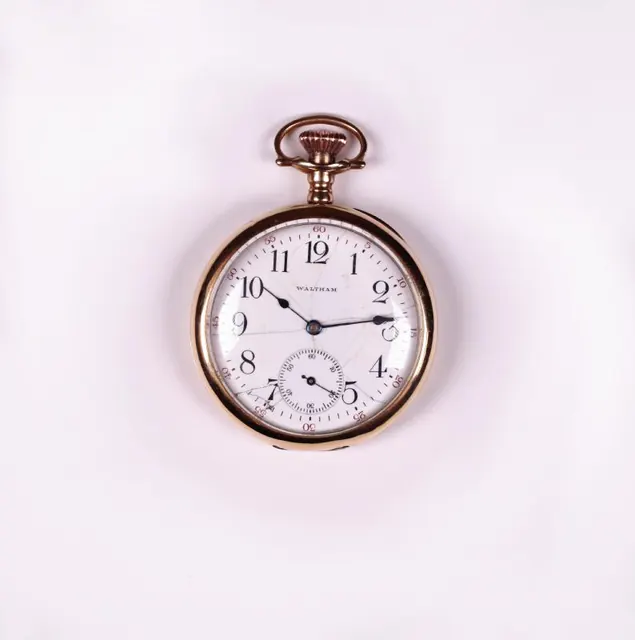
Pocket watch by Waltham, United States, 1910s
Suomen Urheilumuseo
Pocket Watches · 1902
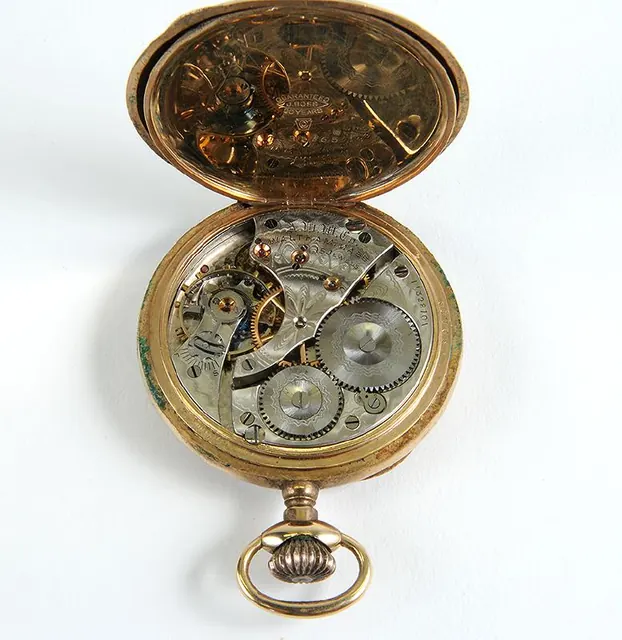
Pocket watch by Waltham, United States, 1902
Turun kaupunginmuseo
Instruments · c.1938
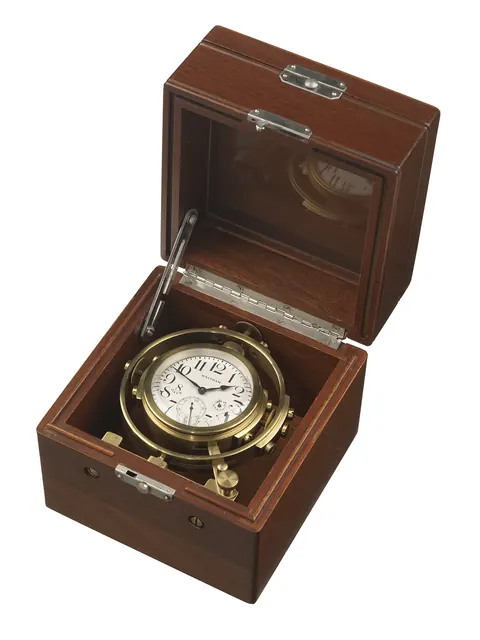
Marine chronometer watch no. 30683313 by Waltham
Royal Museums Greenwich
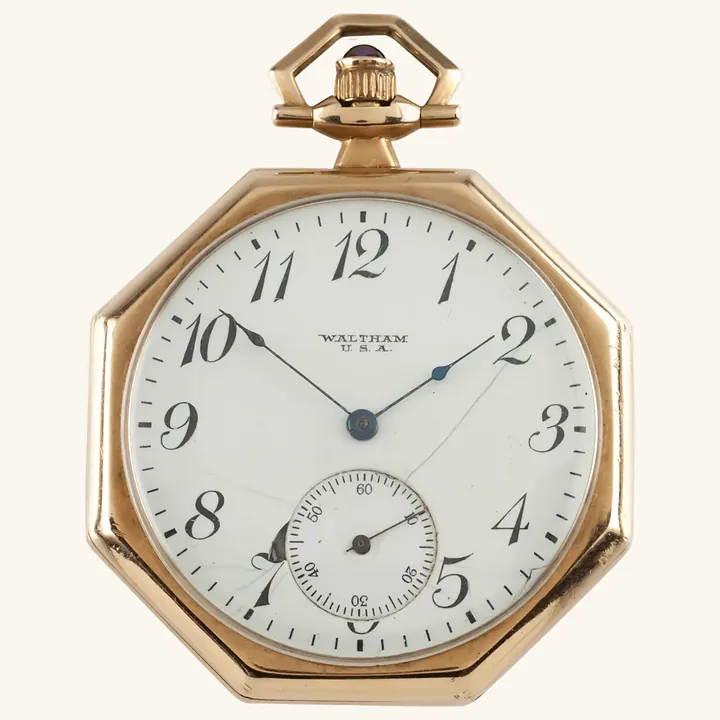
Pocket Watches · 1917
Waltham Octagon14 Karat Pocket Watch Jewel, 1917
WatchMuseum.org shop
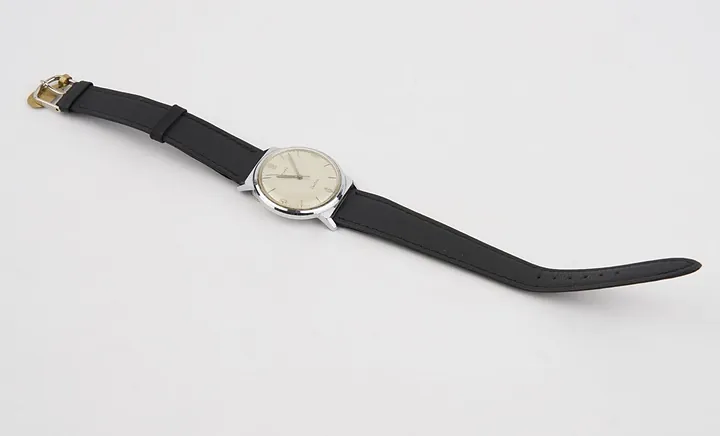
Wristwatches · 1949–1992
Timex `Electric' wristwatch, with electrically operated balance wheel mechanism, United States, 1949–1992
Science Museum Group, London
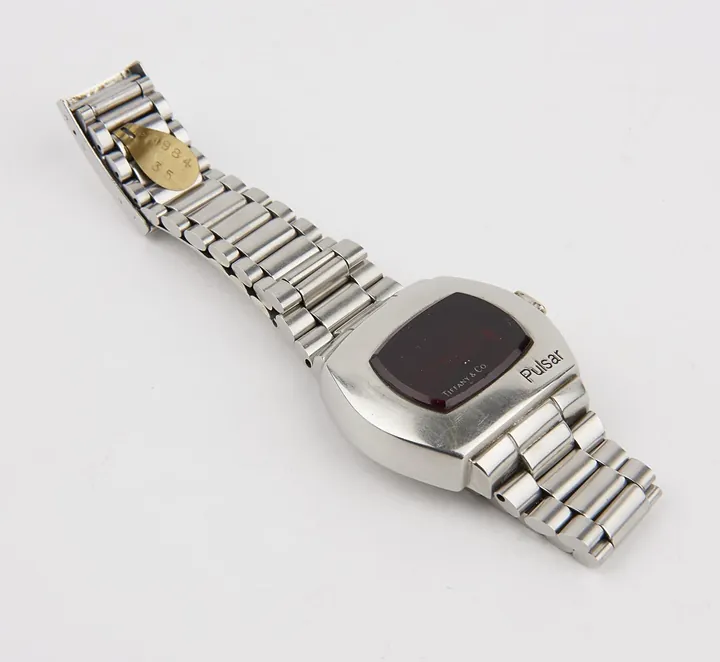
Wristwatches · 1972
Wristwatch by Hamilton Watch Company and Electro-Data Inc, United States, 1972
Science Museum Group, London
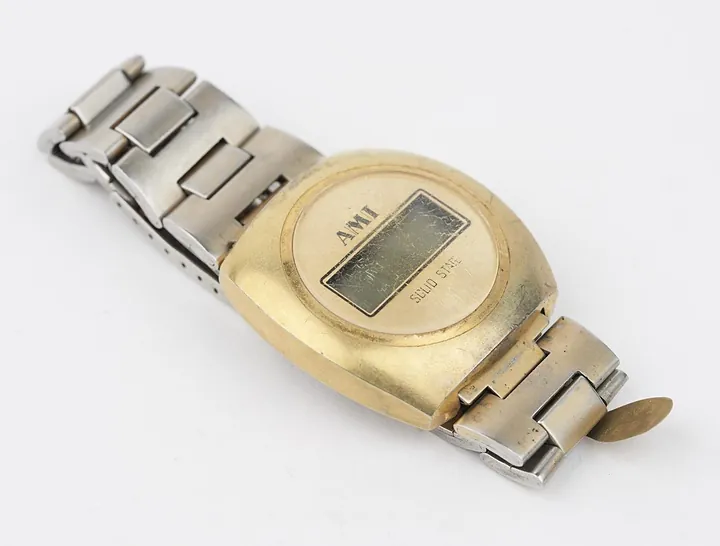
Wristwatches · 1973–1974
Quartz watch with liquid crystal digital display, made by American Microsystems Inc. (AMI) . 1973/74
Science Museum Group, London
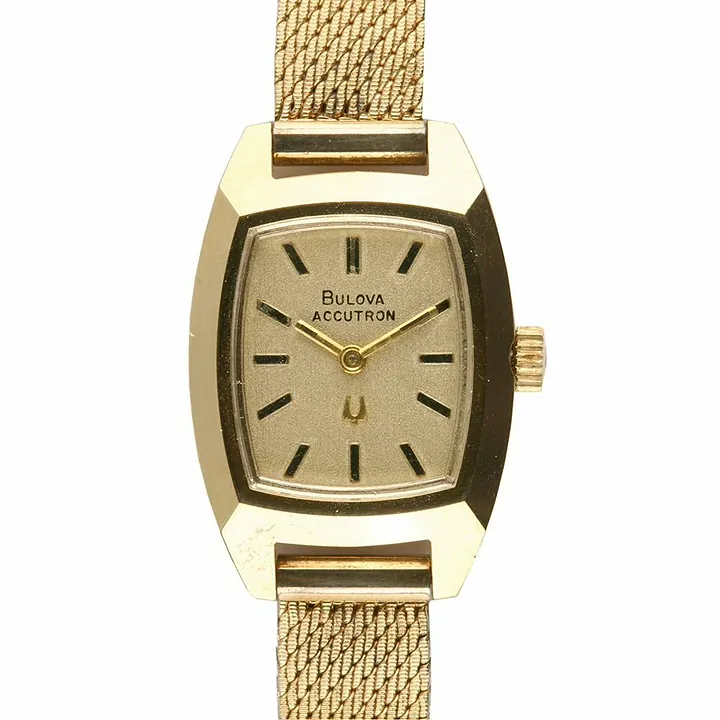
Wristwatches · c. 1973
Wristwatch by Josef Bulova, United States, c. 1973
German Clock Museum