
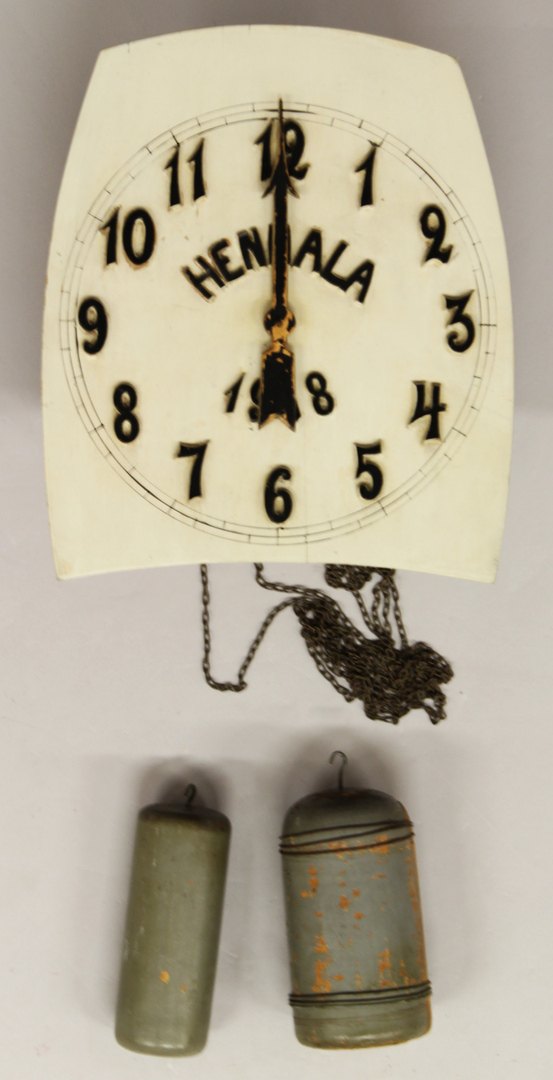
Clocks · Wall clock
Wall clock by Kustaa Adolf Kilpinen, 1918
- Maker / attribution
- Kustaa Adolf Kilpinen (maker)
- Date
- 1918
- Historical period
- Golden Age of Mechanical Watchmaking (1900 – 1945)
- Country of origin
- Unrecorded in source
- Place
- Hennalan vankileiri
- Object type
- Wall clock
- Materials / technique
- glass, paint, iron, wood
- Dimensions
- Kellotaulun height: 35 cm Kellotaulun width: 31 cm Heilurin length: noin 95 cm Isomman punnuksen length: 17 cm Isomman punnuksen diameter: 10 cm Pienemmän punnuksen length: 17 cm Pienemmän punnuksen diameter: 7 cm Kellon kokonaispituus koottuna: noin 130 cm
- Holding institution
- Työväenmuseo Werstas
- Accession / object no.
- tk_36477:1-6
- Credit line
- Työväenmuseo Werstas (via Finna)
- Catalogue title (original)
- Kello, seinäkello; Seinäkello Hennalan vankileiriltä, vankileirimuisto (Finnish)
View the source record ↗ (opens another website in a new tab)Suggest a correction
Record summary
Held and catalogued by Työväenmuseo Werstas (object number tk_36477:1-6), this is a wall clock by Kustaa Adolf Kilpinen, made in Hennalan vankileiri, dated 1918. The Atlas places it in the Golden Age of Mechanical Watchmaking period (1900 – 1945) of its Clocks collection. Materials and techniques recorded by the source: glass, paint, iron, wood. Recorded dimensions: Kellotaulun height: 35 cm Kellotaulun width: 31 cm Heilurin length: noin 95 cm Isomman punnuksen length: 17 cm Isomman punnuksen diameter: 10 cm Pienemmän punnuksen length: 17 cm Pienemmän punnuksen diameter: 7 cm Kellon kokonaispituus koottuna: noin 130 cm. The record is illustrated with 4 photographs.
Assembled from the source record's structured fields. Dates and attributions are given as the source states them; where a field is missing the Atlas leaves it blank rather than estimating.
Catalogue description
Description — Työväenmuseo Werstas
Kustaa Kilpisen vankileirillä tekemä puinen seinäkello. Tietoja Kansan Arkiston lähteistä: Kustaa Adolf Kilpinen syntyi Tuuloksen pitäjässä Sairialassa torpparin poikana vuonna 1877. Hänen isänsä jätti torpparintyöt Kustaan ollessa 14-vuotias. Kustaa aloitti työt nuorena ja kävi isänsä kanssa talvisin metsätöissä ja kesäisin ”kuokosmailla”. Toimi renkinä 17-vuotiaasta lähtien ja teki sivussa puhdetöinään esim. kukkaroita ja rukkasia. Pääsi suutarinoppiin. Muutti Helsinkiin, jossa harjoitti suutarin ammattia yli 10 vuotta. Näihin aikoihin Kilpinen myös solmi avioliiton ja perusti perheen. Vuonna 1909 perhe muutti takaisin Tuulokseen ja Kilpinen sai hankittua yhdessä isänsä kanssa tilan kartanon alueelta, jossa hänen isänsä oli aiemmin toiminut torpparina. Sairialan kartanon alustalaiset olivat perustaneet maanosto-osuuskunnan, joka osti kartanon maat ja Kilpisen autettua osuuskunnan ostoasioissa hänelle järjestyi mahdollisuus hankkia maatilkku myös itselleen ja isälleen. Tuuloksessa Kilpinen liittyi mukaan työväenyhdistyksen toimintaan ja hänestä tuli myös sen puheenjohtaja. Sisällissodan alkaessa Kilpinen liittyi paikalliseen punakaartiin ja toimi sen päällikkönäkin. Taistelujen jälkeen joutui vangiksi. Kilpinen vältti kuolemantuomion ja istui vankina lopulta 3,5 vuotta. Sodan jälkeen asui perheensä kanssa Hämeenlinnassa. Perheeseen kuului vaimo ja kolme tytärtä. Kilpinen kuoli vuonna 1955 78-vuotiaana. Vankina ollessaan Kilpinen teki monia muistoesineitä perheelleen. Puisia kelloja hän teki kolme kappaletta. Niistä yhden hän myi ja lahjoitti toisen. Tämän kolmannen kellon hän toi kotiinsa. Kilpinen käytti työkaluina linkkuveistä ja pöytäveitsestä viilaamaansa sahaa. Tiedoissa on mainittu myös toinen poliittinen vankeus, joka saattaa olla 22.4.1931 Hämeen Kansassa kerrottu kommunistijuttu, jossa kirvesmies Kustaa Adolf Kilpistä syytettiin valtiopetoksen valmistelusta kommunistisen maanalaisen postin järjestämiseen liittyneessä jutussa. Valtiorikosylioikeuden akti digitaaliarkistossa: VRYO 7460: Palstatilallinen Kustaa Adolf Kilpinen (s. 14.11.1877) Tuuloksen kirkonkylästä anoi armoa kuolemanrangaistukseensa. Hänen tuomionaan oli maanpetos, valtiopetos, ryöstö ja pakotus. Kilpinen vangittiin 1.5.1918 Vesalassa, vankileirillä Lahdessa (VRO 4106?). Kilpisellä oli vaimo ja 3 lasta, joista nuorin 10-vuotias. Hän oli tehnyt myös suutarin töitä. Hän kuului Tuuloksen työväenyhdistykseen ja oli toiminut sen puheenjohtajana. Kielsi toimineensa rintamalla tai taisteluissa. Kilpisen syytettiin toimittaneen Tuulokseen vallankumouksellista "kunnallisjärjestöä" ja vallankumousoikeutta. Suojeluskunnan lausunnon mukaan Kilpinen on asuskellut Helsingissä ja siellä imenyt itseensä sen kaiken myrkyn mitä Työmies ja sikäläiset kiihottajat ovat kylväneet. VRYO 25409 Toinen Kustaf/Kustaa Adolf Kilpinen (s.16.12.1876 Sysmässä) Ks. myös teos Pekkalainen & Rustanius 2007: Punavankileirit, s. 263: jossa puhutaan Hennalassa puisen seinäkellon tehneestä Kustaa Kilpiöstä. Ks. kuva Kansan Arkistosta KansA111232
Shown in the original language of the source catalogue. An editor-reviewed English translation has not yet been published; we do not publish machine translations as authoritative text.
Historical context
Golden Age of Mechanical Watchmaking (1900 – 1945)
The wristwatch displaces the pocket watch; waterproof cases, self-winding and grand complications.
Between 1900 and 1945 clocks were electrified: master-clock systems ran factories and offices, synchronous mains clocks entered homes, and the Shortt free-pendulum clock set new standards of accuracy before the first quartz clocks (1927). Art Deco design reshaped mantel and table clocks.
Read the period in the timelineMore clocks from this periodEarlier: Industrial Revolution
Atlas type guide
Regulators, wall and Vienna clocks
A regulator is a precision pendulum clock used as a time standard in observatories, workshops and railway offices. Typical features are a deadbeat or Graham escapement, a temperature-compensated pendulum (mercury jar, gridiron or later invar), maintaining power and a regulator dial that separates hours, minutes and seconds. George Graham's deadbeat escapement (c. 1715) and his mercury pendulum, together with Harrison's gridiron, set the pattern for two centuries.
Wall clocks span a much wider range: the elegant Viennese Laterndluhr and Dachluhr of the Biedermeier period, the Dutch stoelklok and staartklok, English 'dial' clocks used in schools, offices and railway stations, and mass-produced spring and weight wall clocks from Germany (Gustav Becker, Junghans, Kienzle) and America.
What to look for
- Deadbeat escapement and compensated pendulum (gridiron rods, mercury jar or wood rod).
- A regulator dial with a large central minute hand and separate hour and seconds dials.
- Vienna regulators: glazed cases, slender pendulum, small weights, enamel two-piece dials.
- German factory trademarks stamped on the backplate (e.g. Gustav Becker anchor and crown, Junghans star).
Dating clues
- Graham-type deadbeat regulators: from c. 1720.
- Viennese Laterndluhr: c. 1800–1850.
- German factory 'Vienna-style' regulators: c. 1870–1930; Gustav Becker serial numbers allow close dating.
General guidance written by the Atlas editors about this kind of object. It is not a statement about this particular piece; for that, rely on the source record above and on physical examination.
Read next:Deadbeat escapementAnchor (recoil) escapementGrasshopper escapement
Related records
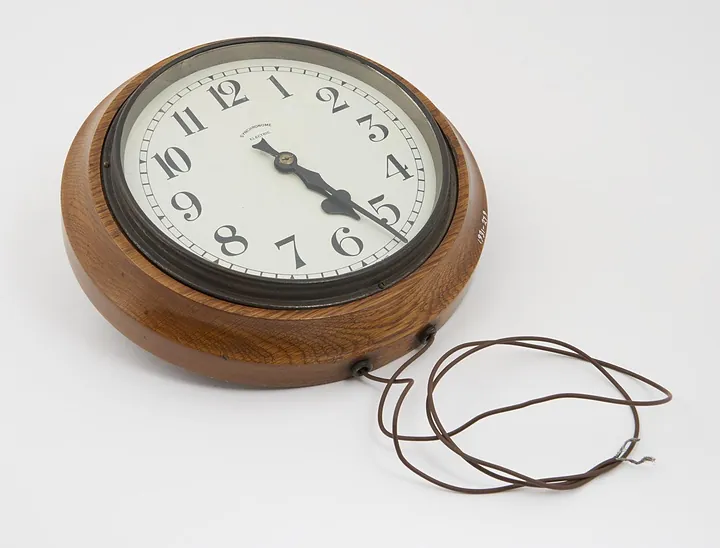
Clocks · 1890–1930
Clock with 8-inch impulse dial, by the Synchronome Company Limited, England, 1890–1930.
Science Museum Group, London
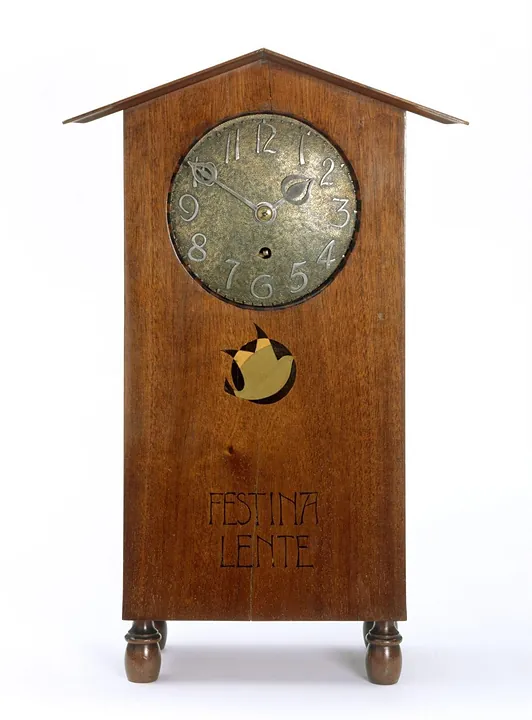
Clocks · c.1900
Clock by Mackay Hugh Baillie Scott, Bedfordshire, c.1900
Victoria and Albert Museum, London
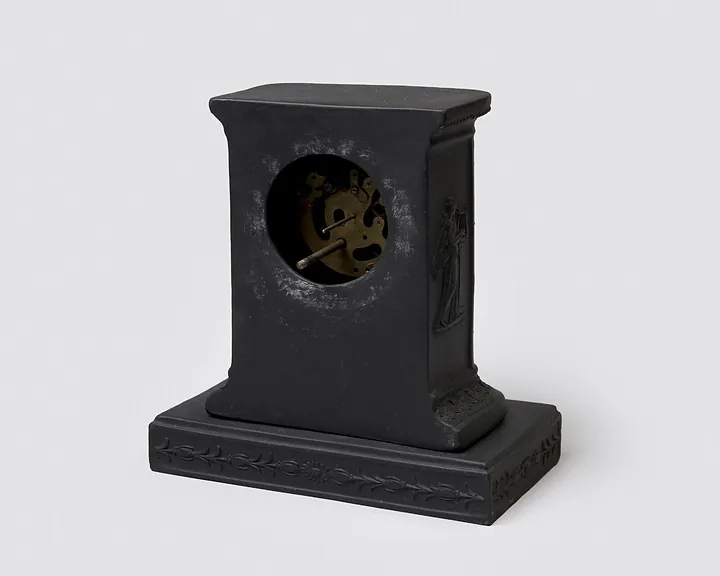
Clocks · c. 1900
Clock, black basalt, brass, Josiah Wedgwood and Sons, Etruria, c. 1900
Victoria and Albert Museum, London
Clocks · c.1903-1904
Clock, pewter, made for Liberty& Co., England. 1903-4.
Victoria and Albert Museum, London
Clocks · c. 1900
Alarm clock by Union Clock Company, Germany, c. 1900
German Clock Museum
Clocks · 20th century
Base Metal, 20th c. Bronze, marble and ivory clock by Chiparus
Victoria and Albert Museum, London
Clocks · 1900–1939
Clock by Cox-Walkers of Darlington, England, 1900–1939
Science Museum Group, London
Clocks · 1900–1999
Clock by Französisch (Schule), 1900–1999
Fine Arts Museum Vienna