
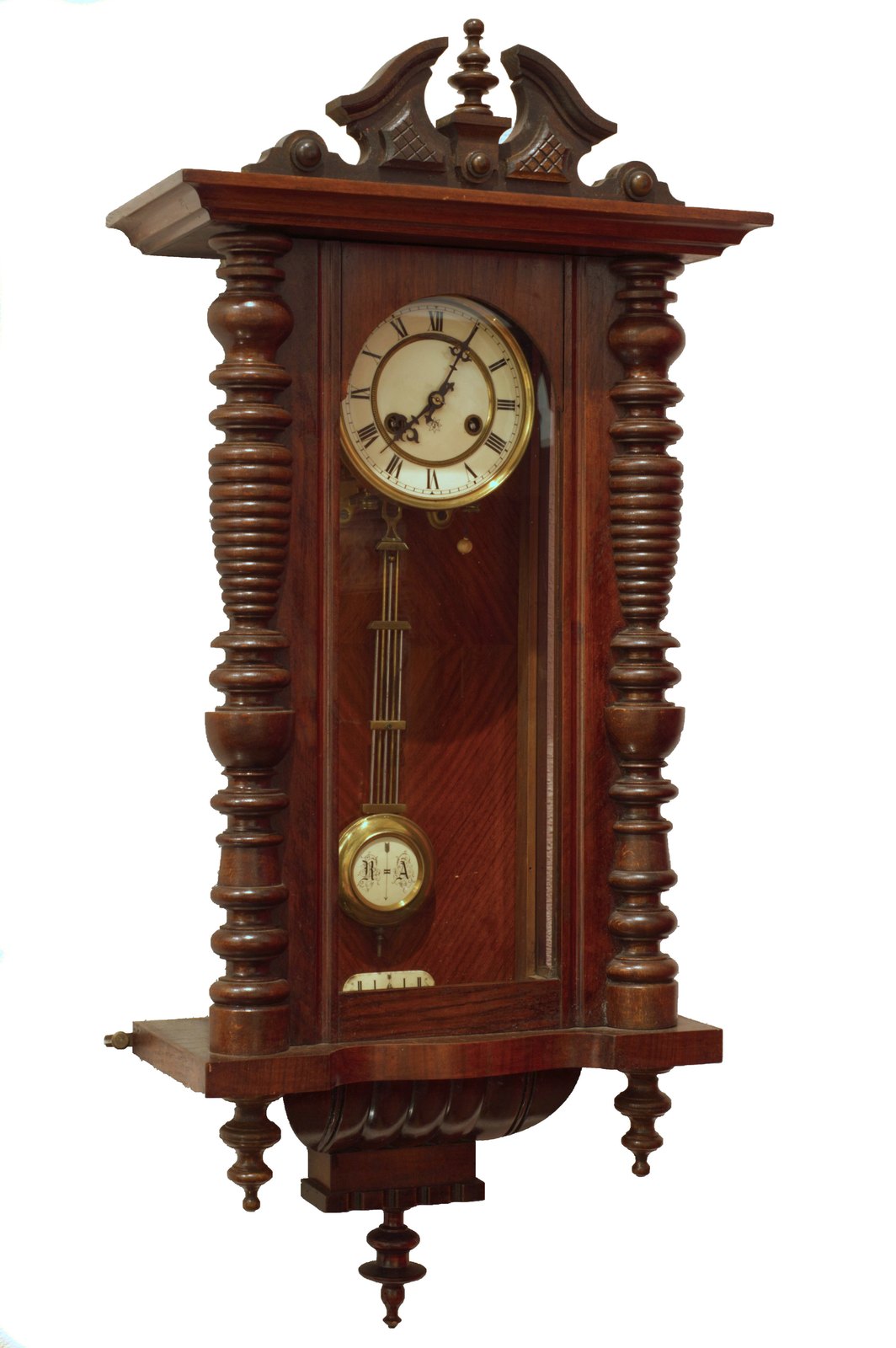
Clocks · Wall clock
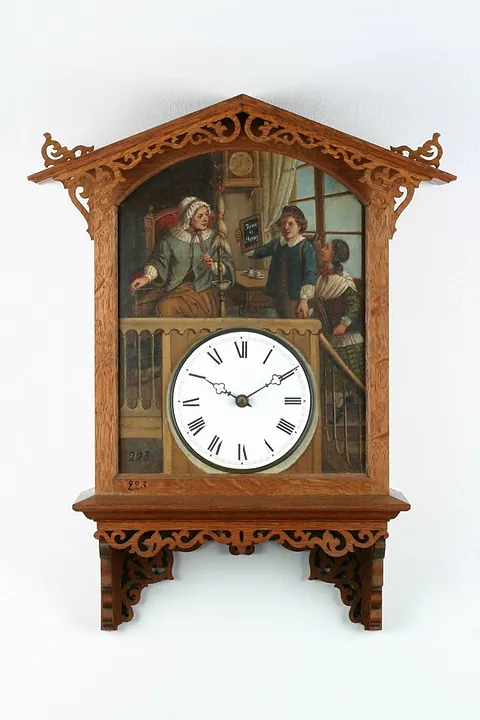
Wall clock by Junghans, Germany, 1880–1910
- Maker / attribution
- Junghans (Created)
- Date
- 1880–1910
- Historical period
- Industrial Revolution (1850 – 1900)
- Country of origin
- Germany
- Place
- Schramberg
- Object type
- Wall clock
- Materials / technique
- Holz, Glas, Messing
- Dimensions
- ca. 90x30x17 cm
- Holding institution
- Museumsfabrik Pritzwalk
- Accession / object no.
- 001.00365
- Credit line
- Museumsfabrik Pritzwalk
- Catalogue title (original)
- Pendelwanduhr, Junghans (German)
View the source record ↗ (opens another website in a new tab)Suggest a correction
Record summary
Held and catalogued by Museumsfabrik Pritzwalk (object number 001.00365), this is a wall clock by Junghans, made in Schramberg, Germany, dated 1880–1910. The Atlas places it in the Industrial Revolution period (1850 – 1900) of its Clocks collection. Materials and techniques recorded by the source: Holz, Glas, Messing. Recorded dimensions: ca. 90x30x17 cm. The record is illustrated with 4 photographs.
Assembled from the source record's structured fields. Dates and attributions are given as the source states them; where a field is missing the Atlas leaves it blank rather than estimating.
Catalogue description
Catalogue description from Museumsfabrik Pritzwalk (German)
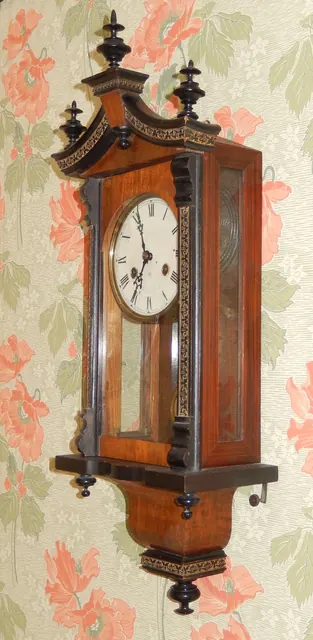
Das Uhrwerk und Pendel der Wanduhr ist in einem Holzgehäuse (Nussbaum) untergebracht. Vorn und seitlich ist eine Verglasung eingebaut. Das Gehäuse ist im Stil des Historismus gestaltet. Die vordere Tür schlägt rechts an und hat beiseitig gedrehte säulenförmige Holzverzierungen. Unten und oben sind jeweils verzierte Holzaufsätze. Uhrwerk und Pendel sind in Messing ausgeführt. Das Ziffernblatt, die Front des Pendels und der untere Anzeiger des Pendelausschlages sind weiß emailliert. Die Beschriftung des Ziffernblattes ist umlaufend mit römischen Ziffern I-XII, unterhalb der Zeiger ist das Markenzeichen der Firma Junghans (achteckiger Stern mit zentralem "J". Auf dem Pendel ist verzierte Frakturschrift "R - A" als Einstellhilfe (Retarder - Avancer). Der Aufzug des Federwerkes für Uhrwerk und Gong geschieht über einen beiligenden Vierkantschlüssel am Ziffernblatt. Der Gong kann manuell über eine Kordel rechts unten am Uhrwerk ausgelöst werden. Für die genaue Ausrichtung an der Wand sind im unteren Bereich beidseitig Schrauben als Abstandshalter befestigt.
Shown in the original language of the source catalogue. An editor-reviewed English translation has not yet been published; we do not publish machine translations as authoritative text.
Historical context
Industrial Revolution (1850 – 1900)
American interchangeable-parts manufacture; railroad time standards; Swiss and German factory systems.
Factory production transformed the clock into an everyday object. American makers (Seth Thomas, Ansonia, Waterbury) and German factories (Junghans, Gustav Becker, Lenzkirch) sold millions of shelf, wall and alarm clocks worldwide; France produced standardised Paris movements and carriage clocks; electric time distribution began.
Read the period in the timelineMore clocks from this periodEarlier: Precision & Scientific Horology
Atlas type guide
Regulators, wall and Vienna clocks
A regulator is a precision pendulum clock used as a time standard in observatories, workshops and railway offices. Typical features are a deadbeat or Graham escapement, a temperature-compensated pendulum (mercury jar, gridiron or later invar), maintaining power and a regulator dial that separates hours, minutes and seconds. George Graham's deadbeat escapement (c. 1715) and his mercury pendulum, together with Harrison's gridiron, set the pattern for two centuries.
Wall clocks span a much wider range: the elegant Viennese Laterndluhr and Dachluhr of the Biedermeier period, the Dutch stoelklok and staartklok, English 'dial' clocks used in schools, offices and railway stations, and mass-produced spring and weight wall clocks from Germany (Gustav Becker, Junghans, Kienzle) and America.
What to look for
- Deadbeat escapement and compensated pendulum (gridiron rods, mercury jar or wood rod).
- A regulator dial with a large central minute hand and separate hour and seconds dials.
- Vienna regulators: glazed cases, slender pendulum, small weights, enamel two-piece dials.
- German factory trademarks stamped on the backplate (e.g. Gustav Becker anchor and crown, Junghans star).
Dating clues
- Graham-type deadbeat regulators: from c. 1720.
- Viennese Laterndluhr: c. 1800–1850.
- German factory 'Vienna-style' regulators: c. 1870–1930; Gustav Becker serial numbers allow close dating.
General guidance written by the Atlas editors about this kind of object. It is not a statement about this particular piece; for that, rely on the source record above and on physical examination.
Read next:Deadbeat escapementAnchor (recoil) escapementGrasshopper escapement
Related records
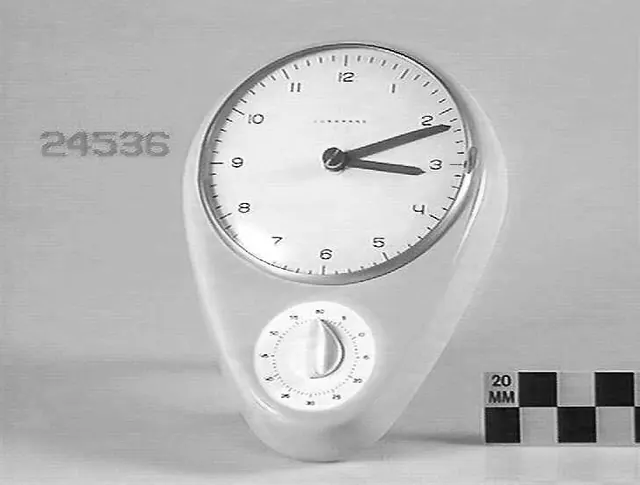
Clocks · c. 1955
Electric Clock - Junghans, 'Electora', c. 1955
Museums Victoria, Melbourne
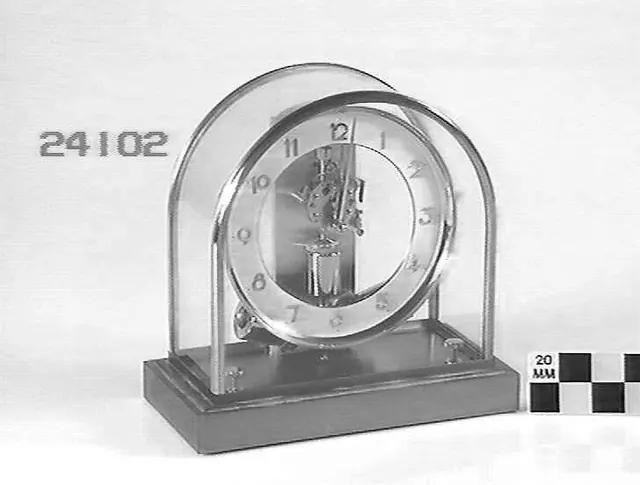
Clocks · 1956
Electric Clock - Junghans, 'ATO, Germany, 1956
Museums Victoria, Melbourne
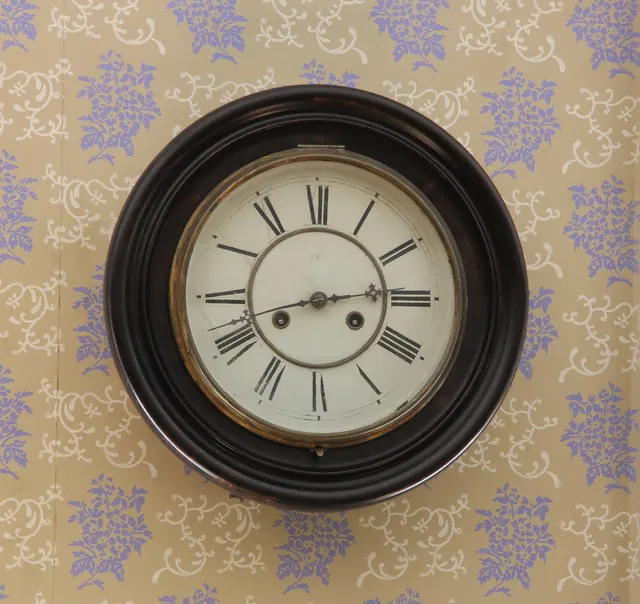
Clocks · 1888–1900
Clock by Junghans, Sweden, 1888–1900
Skansen
Clocks · 1890–1910
Clock by Junghans, Sweden, 1890–1910
Skansen
Clocks · c. 1850
Cuckoo / black forest clock, Germany, c. 1850
German Clock Museum
Clocks · 1850
Wall clock by Glatz und Co. Kreuzer, Germany, 1850
German Clock Museum
Clocks · 1858
Clock by Jacob Bäuerle, Germany, 1858
German Clock Museum
Clocks · 1860
Clock by August Tritschler, Germany, 1860
German Clock Museum