
Wristwatches · Wristwatch
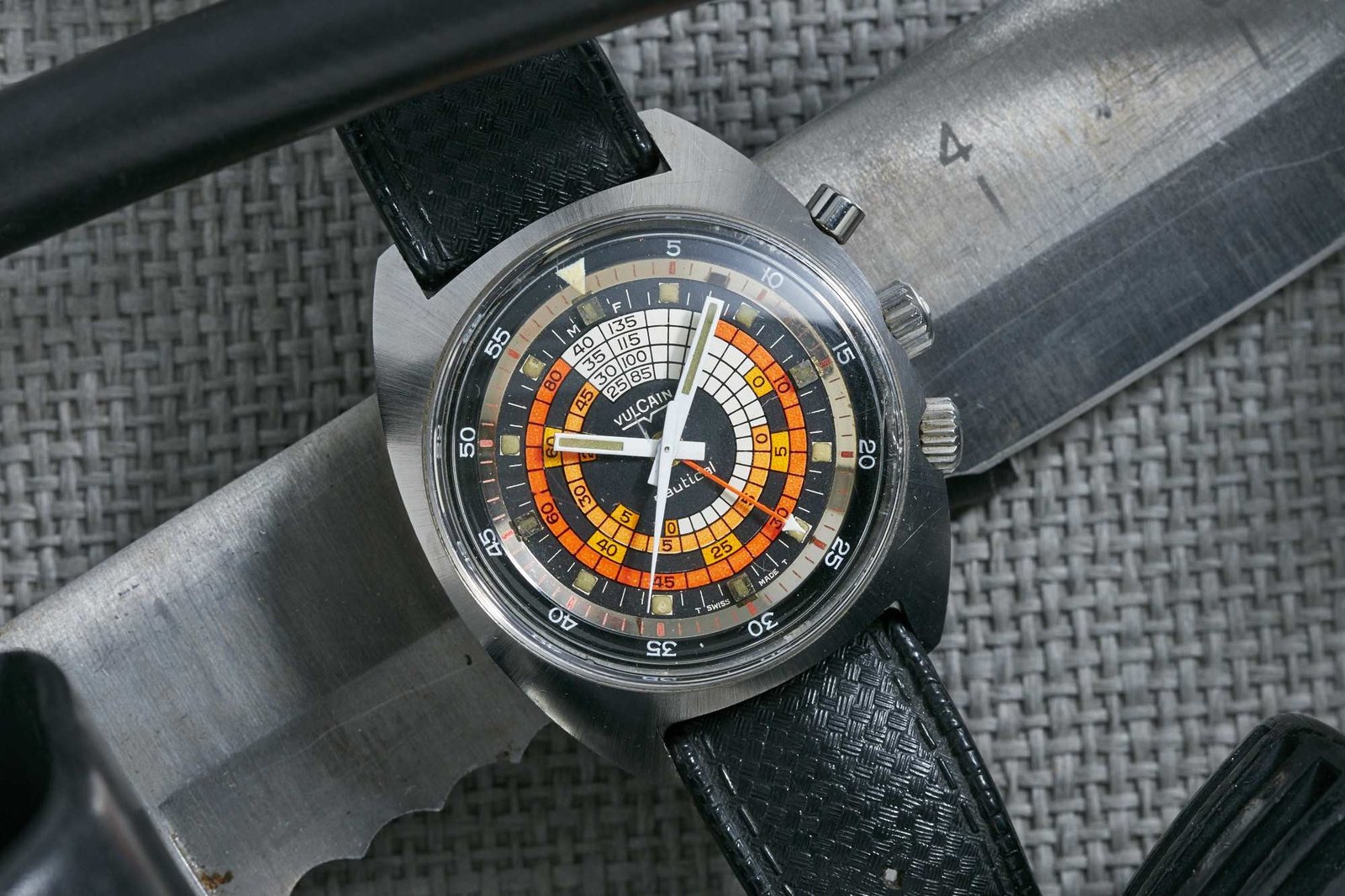
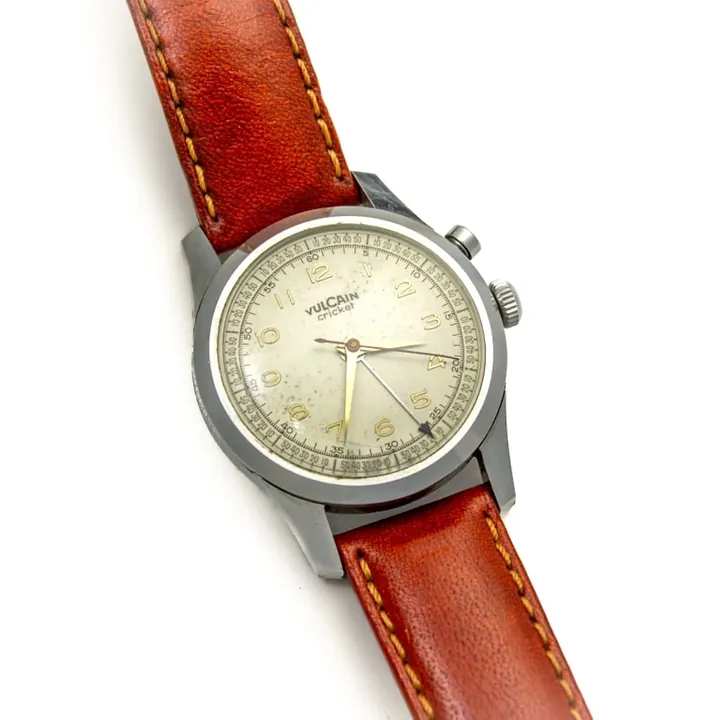
Vulcain Cricket Nautical, 1970s
- Maker / attribution
- Vulcain (maker)
- Date
- 1970s
- Historical period
- Quartz Revolution (1969 – 1990)
- Country of origin
- Switzerland
- Object type
- Wristwatch
- Stock no.
- Product 7015969857
- Credit line
- Dealer listing, Analog/Shift (product 7015969857)
- Catalogue title (original)
- Vulcain Cricket Nautical (English)
View the source record (dealer listing) ↗ (opens another website in a new tab)Suggest a correction
Record summary
Catalogued by Analog/Shift (dealer), New York (stock number Product 7015969857), this is a wristwatch by Vulcain, made in Switzerland, dated 1970s. The Atlas places it in the Quartz Revolution period (1969 – 1990) of its Wristwatches collection. The record is illustrated with 6 photographs.
Assembled from the source record's structured fields. Dates and attributions are given as the source states them; where a field is missing the Atlas leaves it blank rather than estimating.
Catalogue description
Dealer description — Analog/Shift
Vulcain unveiled the Cricket in 1947 at the famous (and, sadly, soon-to-shutter) Waldorf Astoria in New York City. It caused a media sensation, and for good reason: the Vulcain was the first wristwatch to feature an alarm function. While other brands have since developed their own alarm movements--most notably Jaeger-LeCoultre with its Memovox--the Cricket was the first working model, making it a true milestone in modern day horology. Indeed, in addition to being the world's first alarm caliber, the Calibre 120 was also among the most accurate. This was thanks to Vulcain's Exactomatic system, for which Vulcain secured the patent in 1946. The Exactomatic system achieved unprecedented equilibrium of the balance wheel in all positions, guaranteeing accuracy to within four or five seconds a day. The Vulcain Calibre 120 would go on to power watches that would adorn the wrists of such august personages as every US President since Nixon (except George W. Bush). Despite this more regal association, the Cricket also found its way onto the wrists of mountaineers--in fact, the watch accompanied the first expedition to reach the 28,250 foot peak of K2, in the Himalayas. Future advertisements for the Vulcain would read: “The teams of all these expeditions have expressed their satisfaction and admiration of the record performance of their Vulcain Cricket, testifying that their running was as faultless and the ringing of the alarm as distinct on the summit of K2 as in the damp jungle of Equatorial Africa.” The Cricket also found itself in a most unlikely place: under the ocean. In collaboration with underwater explorer Hannes Keller, Vulcain developed a submersible Cricket model. Keller had descended to a depth of 728 feet in the Italian Lake Maggiore in 1961, making him an ideal consultant for Vulcain. Along with diving instructor Arthur Droz and Max-Yves Brandly, noted explorer and film director, Vulcain began development of the Cricket Nautical. Like the original of 1947, the Cricket Nautical made waves. It was the first wristwatch that could sustain a depth of 300 meters. Additionally, like the later Doxa Sub 300T , it featured decompression charts--in this case on the dial in concentric circles. Vulcain ensured the audibility of the alarm with a triple case back. And, as anyone who's ever worn an alarm wristwatch knows, when the alarm goes off, it vibrates, buzzing like an angry cricket trapped in a Mason jar. Since words can't illustrate just how loud--and how long--this alarm sounds, we've taken a video for you. Our Cricket Nautical is a successor to the earlier model of 1961, this one dating from the 1970s. The famed Calibre 120 is housed in a chunky cushion case with brushed finishing in a sunburst pattern that radiates outward from the dial. And what a dial it is--rings of bright orange interspersed among the more staid black and white, more commonly associated with models from Fortis. It's a treat to find a Vulcain branded model--particularly one with this outstanding movement and alarm. If you want a watch that makes a statement, both visually and aurally, the Cricket is it.
Historical context
Quartz Revolution (1969 – 1990)
Seiko's Astron begins mass quartz timekeeping; traditional industries contract sharply.
Quartz and digital watches transformed the market after 1969. Swiss employment collapsed, Japanese and Hong Kong production soared, and the Swatch (1983) helped the Swiss industry recover; mechanical watches survived as luxury goods.
Read the period in the timelineMore wristwatches from this periodEarlier: Modern Mechanical Horology
Atlas type guide
Wristwatches
Bracelet watches were worn by women from the early nineteenth century — Breguet made one for Caroline Murat, Queen of Naples, in 1810–12 — but the wristwatch only became a man's instrument with military use and aviation in the early twentieth century. Between the World Wars it overtook the pocket watch; the 1920s and 1930s brought rectangular Art Deco cases, water-resistant cases and the first automatic winding systems.
After 1945 the wristwatch became a carrier of identity — dress watches, sports and dive watches, chronographs, calendars — produced by Swiss, American, Japanese, German, Soviet and Chinese industries. The quartz revolution after 1969 and the mechanical renaissance since the 1990s, including the rise of independent watchmakers, complete the story.
What to look for
- The reference number (between the lugs or inside the case back) and serial number, the starting point for dating.
- The calibre: its maker and number are often stamped under the dial or on the bridge.
- Originality of dial, hands and crown — refinished ('redial') dials are common.
- Case material marks: 18K/750, 14K/585, stainless steel, gold-filled, plated.
Dating clues
- Wire-lug cases: before c. 1925.
- Water-resistant screw-down cases: from 1926.
- Quartz movements: from 1969; sapphire crystals widespread after c. 1980.
General guidance written by the Atlas editors about this kind of object. It is not a statement about this particular piece; for that, rely on the source record above and on physical examination.
Related records
Wristwatches · originally sold in June 2024 (per the lot record)
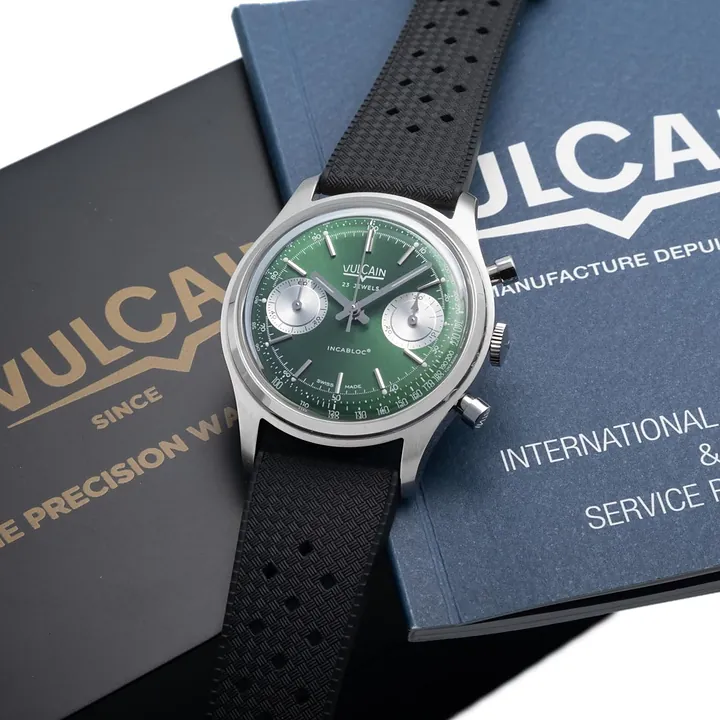
Vulcain Chronograph 70's Green, ref. 640109A90.BAC201, originally sold in June 2024
Antiquorum auction archive, Geneva
Wristwatches · c. 1950s
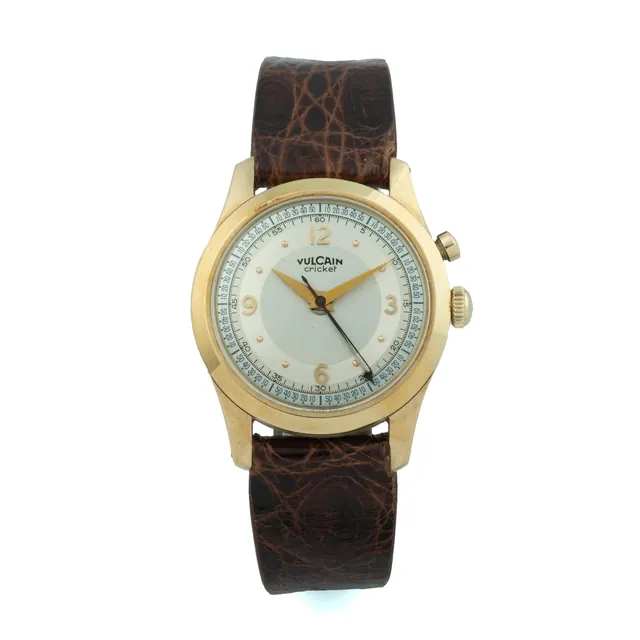
Vulcain wristwatch, Cricket, circa 1950's
Antiquorum auction archive, Geneva
Wristwatches · originally sold in 2014 (per the lot record)
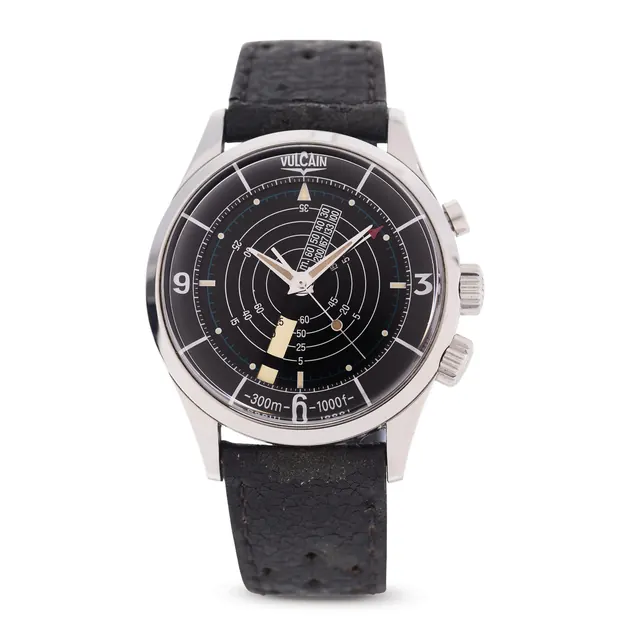
Vulcain wristwatch, ref. 100152080L, Cricket-Nautical Heritage, originally sold in 2014
Antiquorum auction archive, Geneva
Wristwatches · 1960s
1960's Vulcain Cricket Alarm Mens Wrist Watch
LiveAuctioneers auction archive

Wristwatches · 1970
Wristwatch by Heno, Switzerland, 1970
Museum Rotterdam

Wristwatches · 1960–1986
'Tri-Compax' calendar chronograph wristwatch in gold case, by Universal, Geneva, Switzerland, 1960–1986.
Science Museum Group, London

Wristwatches · 1969–1970
Beta 21 Quartz wristwatch movement, made in Switzerland, 1970.
Science Museum Group, London

Wristwatches · c. 1969
Omega Speedmaster Moonwatch, ref. 145022-69st, c. 1969
Antiquorum auction archive, Geneva