
Wristwatches · Wristwatch
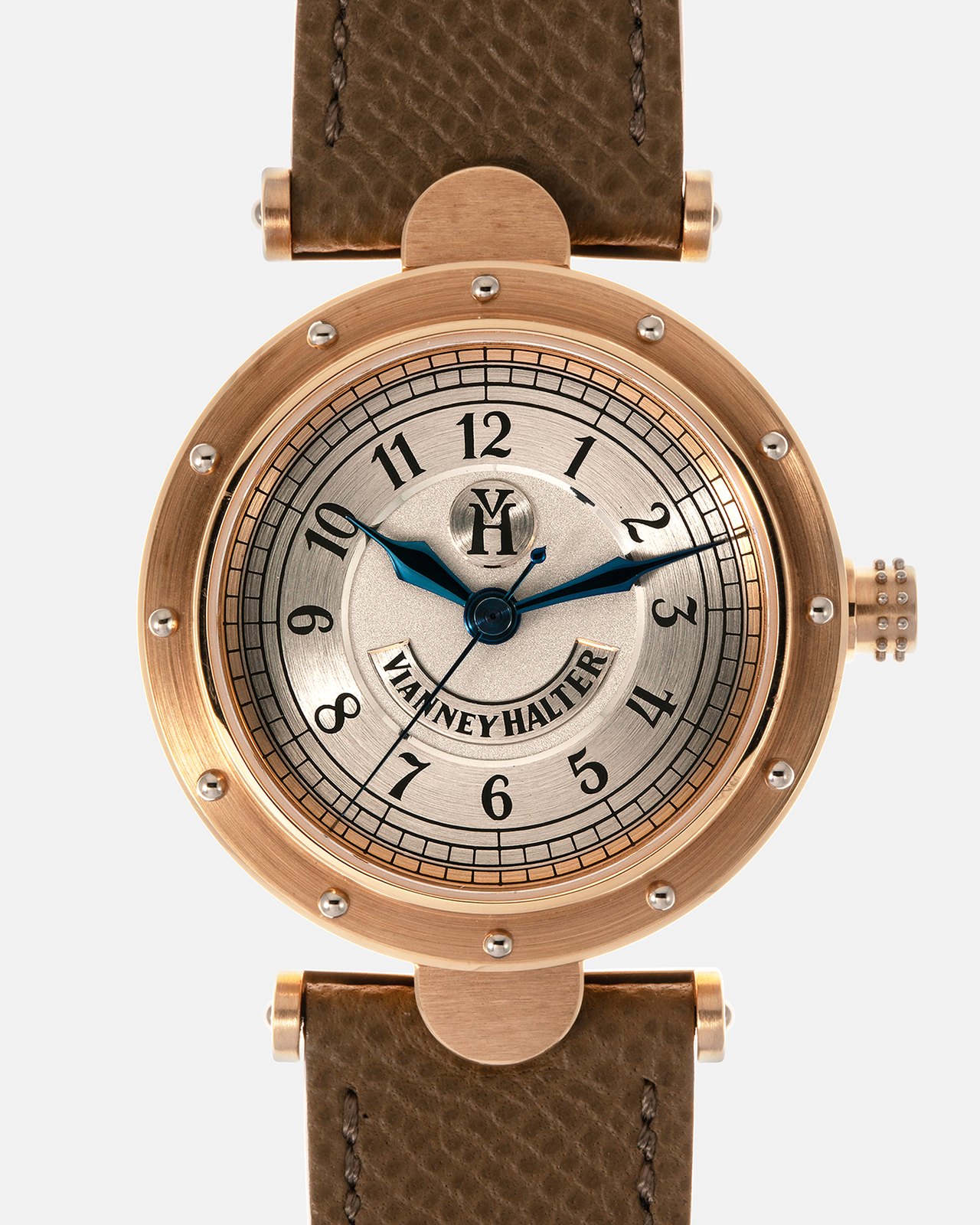
Vianney Halter Classic Rose Gold, 2000s
- Maker / attribution
- Vianney Halter (maker)
- Date
- 2000s
- Historical period
- Mechanical Renaissance (1990 – 2010)
- Country of origin
- Unrecorded in source
- Object type
- Wristwatch
- Materials / technique
- rose gold
- Dimensions
- Case 36 mm
- Stock no.
- Product 7382620242007
- Credit line
- Dealer listing, S.Song Watches (product 7382620242007)
- Catalogue title (original)
- Vianney Halter Classic Rose Gold (English)
View the source record (dealer listing) ↗ (opens another website in a new tab)Suggest a correction
Record summary
Catalogued by S.Song Watches (dealer), Seattle (stock number Product 7382620242007), this is a wristwatch by Vianney Halter, dated 2000s. The Atlas places it in the Mechanical Renaissance period (1990 – 2010) of its Wristwatches collection. Materials and techniques recorded by the source: rose gold. Recorded dimensions: Case 36 mm. The record is illustrated with 6 photographs.
Assembled from the source record's structured fields. Dates and attributions are given as the source states them; where a field is missing the Atlas leaves it blank rather than estimating.
Catalogue description
Dealer description — S.Song Watches
It is not often that a watch design can be called entirely unique and original, but if anyone comes close, Vianney Halter certainly deserves mention. As one of the early pioneers of the independent watchmaking movement, Vianney Halter began long before collecting independent watches became a trend. Working on a small scale and taking his time, he has become renowned for his distinctive aesthetic. This is the Vianney Halter Classic, one of his most iconic pieces of work, next to the more complicated Antiqua. A time-only piece, it is housed within a modestly sized 36mm 18-carat rose gold case and features actual rivets on the edge of the case, along with a studded crown. Two nibs on the top and bottom of the case connect the lugs, which hold each end of the strap, rounding off this steampunk-style watch. The case is finished with a circular brushing at the top and polished sides, adding some nice depth to the overall look. Wearing and winding the watch, I found it to be a very pleasant tactile experience, from the grip of the studded crown and touching the different contrasting surfaces of the watch. Needless to say, the dial is incredibly beautiful on this Classic, with radial stylized Arabic numerals sitting atop a circular brushed silver surface. Towards the center portion of the dial, there is an obvious visual contrast with the graining, and this is topped off with the delicately beautiful curved blued hands. Powering this watch is a heavily modified Lemania Cal. 8810, featuring a mystery ‘sapphire’ rotor that offers an unobstructed view of the self-winding movement. If you look closer, you’ll see that there are weights on the periphery of the rotor to allow effective oscillation and the movement looks simple but is nevertheless expertly finished. At first glance, the Vianney Halter Classic may appear to be a relatively simple and novel watch, but the more you examine it, the more you realize the incredible attention to detail in its design—from the case to the textures of the dial and the finishing of the movement. Limited to just 250 pieces and released in 2001, this is a truly rare and exclusive timepiece that stands out as completely unique in today’s market.
Historical context
Mechanical Renaissance (1990 – 2010)
Mechanical watches return as cultural objects; independent watchmaking flourishes.
Mechanical watches returned as cultural and luxury objects. Complications, tourbillons and new materials proliferated; independent watchmakers such as George Daniels, F.P. Journe and Philippe Dufour revived artisanal watchmaking; collecting vintage watches became a major field.
Read the period in the timelineMore wristwatches from this periodEarlier: Quartz Revolution
Atlas type guide
Wristwatches
Bracelet watches were worn by women from the early nineteenth century — Breguet made one for Caroline Murat, Queen of Naples, in 1810–12 — but the wristwatch only became a man's instrument with military use and aviation in the early twentieth century. Between the World Wars it overtook the pocket watch; the 1920s and 1930s brought rectangular Art Deco cases, water-resistant cases and the first automatic winding systems.
After 1945 the wristwatch became a carrier of identity — dress watches, sports and dive watches, chronographs, calendars — produced by Swiss, American, Japanese, German, Soviet and Chinese industries. The quartz revolution after 1969 and the mechanical renaissance since the 1990s, including the rise of independent watchmakers, complete the story.
What to look for
- The reference number (between the lugs or inside the case back) and serial number, the starting point for dating.
- The calibre: its maker and number are often stamped under the dial or on the bridge.
- Originality of dial, hands and crown — refinished ('redial') dials are common.
- Case material marks: 18K/750, 14K/585, stainless steel, gold-filled, plated.
Dating clues
- Wire-lug cases: before c. 1925.
- Water-resistant screw-down cases: from 1926.
- Quartz movements: from 1969; sapphire crystals widespread after c. 1980.
General guidance written by the Atlas editors about this kind of object. It is not a statement about this particular piece; for that, rely on the source record above and on physical examination.
Related records
Wristwatches · 2000s
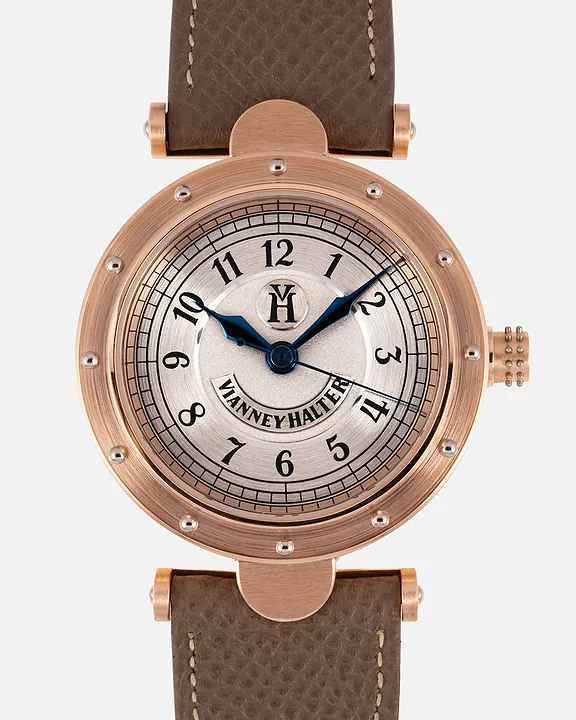
Vianney Halter Classic, 2000s
S.Song Watches (dealer), Seattle
Wristwatches · 1999
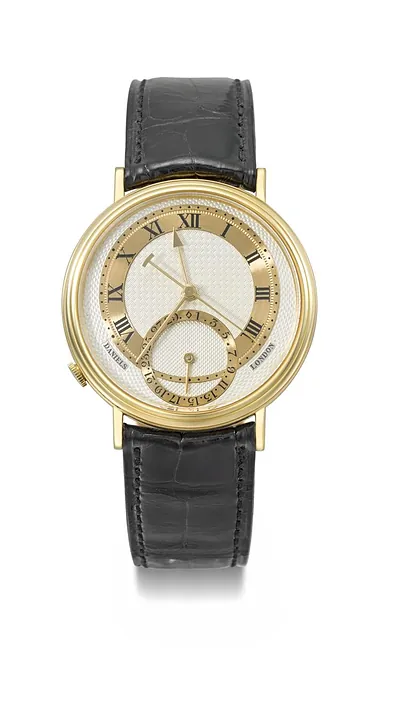
'Millennium' co-axial wristwatch by George Daniels and Omega, England, 1999
Science Museum Group, London

Wristwatches · 2008
Wristwatch by Breitling?, 2008
Museum Rotterdam
Wristwatches · 2008
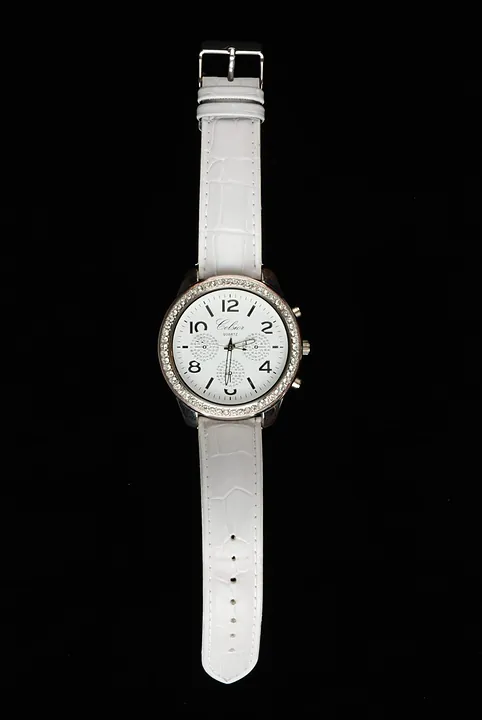
Wristwatch by Celsior Quartz, 2008
Museum Rotterdam
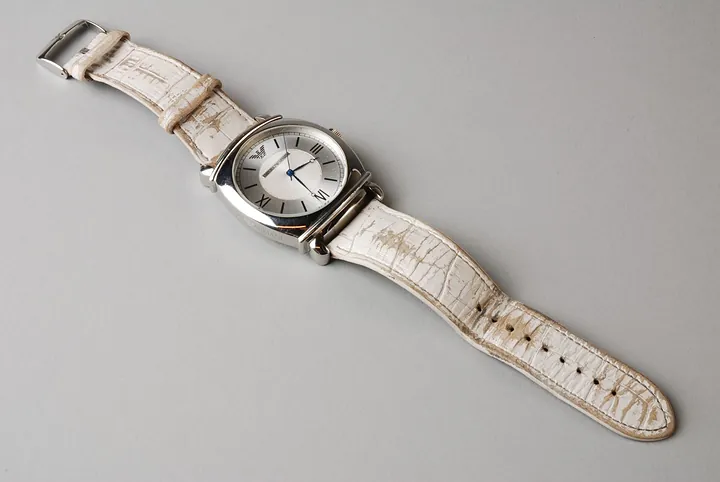
Wristwatches · 2008
Wristwatch possibly by Emporio Armani, 2008
Museum Rotterdam

Wristwatches · c. 1990s
Audemars Piguet Bamboo, c. 1990s
Antiquorum auction archive, Geneva

Wristwatches · c. 1990
Audemars Piguet Huitieme Perpetual Calendar, ref. 25696PT, c. 1990
Antiquorum auction archive, Geneva

Wristwatches · c. 1990
Breitling Chronomat, ref. b13050.1, c. 1990
Antiquorum auction archive, Geneva