
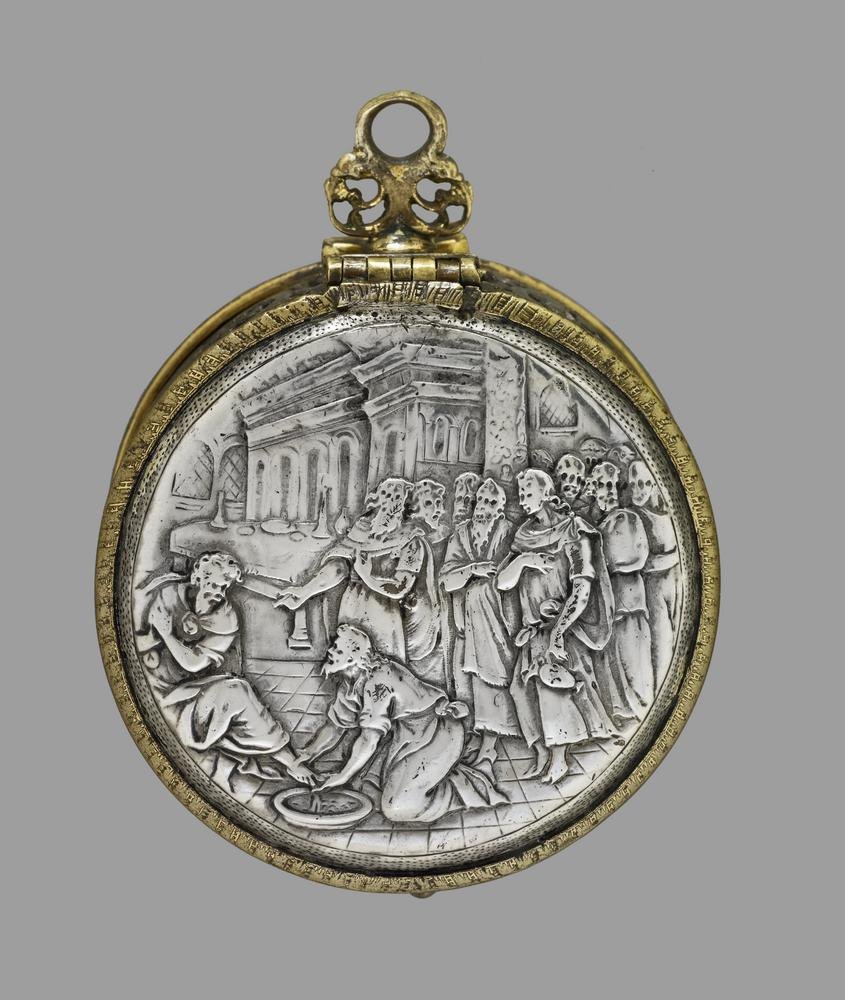
Pocket Watches · Alarm watch
Verge watch with alarm in a gilt-brass and silver case
- Maker / attribution
- Cornelius Mellin (Made by)
- Date
- 1620–1630
- Historical period
- Early Modern Horology (1600 – 1750)
- Country of origin
- England
- Place
- London (England) (Blackfriars)
- Object type
- Alarm watch
- Materials / technique
- silver, gold
- Holding institution
- British Museum
- Accession / object no.
- 1958,1201.2275
- Credit line
- British Museum, London
- Catalogue title (original)
- Verge watch with alarm in a gilt-brass and silver case (English)
View the source record ↗ (opens another website in a new tab)Suggest a correction
Record summary
Held and catalogued by British Museum (object number 1958,1201.2275), this is an alarm watch by Cornelius Mellin, made in London (England) (Blackfriars), dated 1620–1630. The Atlas places it in the Early Modern Horology period (1600 – 1750) of its Pocket Watches collection. Materials and techniques recorded by the source: silver, gold. The record is illustrated with 6 photographs.
Assembled from the source record's structured fields. Dates and attributions are given as the source states them; where a field is missing the Atlas leaves it blank rather than estimating.
Catalogue description
Description — British Museum
Verge watch with alarm in a gilt-brass and silver case. Case The gilt-brass case consists of a skeletonised band with an upper and lower moulding and and hinge-block at 12 and a small finial at 6. The finial is a later replacement and the cast pendant is badly worn. Screwed to the band is pierced and engraved silver band decorated with scrolling foliage and flowers with grotesque bird's heads and a grotesque dog's head at the four ends. Within the foliate design are a boar, two hounds and a hare/rabbit. The back is covered by a gilded inner dome which is drilled for winding and carries the bell. The heavy layer of gilding gives the impression that it is not original but it may well be genuine. The hinged back has a gilt-brass bezel with hatched decoration. Into this is soldered a silver panel very finely engraved in high relief on the outside with a depiction of the Last Supper, and on the inside, in low relief shows the Last Judgement. The hinged lid is constructed in a similar manner to the back. The engraved scenes show, on the front in high relief The Washing of the Feet and on the inside, in low relief the crucifixion. The Bell is secured to a dome in the back of the case by a screw into a square boss. Two holes for winding. Extensively filed on the back. On the inside next to one winding hole a pattern . The poor fit and the rough holes for winding suggest that it may be a later replacement. Dial Silver dial-plate with three feet with decorative ends and four lugs. At the top a brazed-on hinge block with two-elements. The reverse of the dial is decorated with a border of gadroon decoration. On the dial side the plate is superbly engraved with a scrolling foliate design emanating from the winged angel heads merging at 3 and 9 into two grotesque male and female human figures. At the top a nude figure reclines with its back (probably male) to the onlooker resting the left arm on a book and holding a sword in the right hand. The recessed centre of the dial is created by a riveted-on brass disc which is overlaid by the gold chapter ring. The chapter ring has blue enamelled roman hour numerals between two circles with + half-hour marks; the enamel for the chapters etc is a translucent dark blue. Around the edge of the chapter ring are a series of ovals filled with opaque blue enamel of a paler colour than the chapters. The chapter-ring is effectively a canister shape being hollowed out inside and underneath. In the central recess rotates the alarm-setting disc of silver with a pierced central area decorated with scrolling foliage and flowers. Around the edge a solid ring engraved 1-12 with dots for half-hours. Riveted at 12 a steel pierced pointer to show the time. The alarm time is set by a steel hand at the centre, pinned to the alarm-setting disc arbor, which is filed to a rectangular section. Movement Circular gilt-brass plates with four pierced Egyptian pillars. There is a hole in the front-plate traversed by a bridge for the recessed wheels of the alarm train. Engraved foliate decoration around the verge aperture. The rivet heads for the potence and counter potence are engraved as flowers. Main-spring & set-up Gilt-brass barrel with an upper and lower flange, dovetailed cap and riveted steel hook.
Curator's comments — British Museum
The two panels are later modifications to the original watch case but are none the less of a similar period. The fitting is not particularly neat and it seems probable that they are taken from a box or even another watch. The religious scenes from these panels do not match with the more secular iconography of the band and dial.
Inscriptions & marks
signature; C.Mellin aux Blackfriers.
Provenance
Previous owner/ex-collection:, Courtenay Adrian Ilbert; Purchased through:, Christie's; Acquired 1958
Historical context
Early Modern Horology (1600 – 1750)
Huygens' pendulum and balance spring transform accuracy; English makers develop the anchor and deadbeat escapements.
The balance spring (c. 1675) improved watches dramatically and introduced the minute hand. English pair-cased verge watches with pierced balance cocks and French oignons were typical; enamel painting at Blois and Geneva, and the repeating watch (1680s), made watches objects of great refinement.
Read the period in the timelineMore pocket watches from this periodEarlier: Renaissance Horology
Atlas type guide
Verge and pair-cased watches
After Christiaan Huygens and Robert Hooke applied the balance spring around 1675, the verge watch became a reasonably reliable timekeeper and the minute hand became standard. Through the eighteenth century the typical English watch was a pair-cased verge: a fusee movement with a pierced, engraved balance cock, housed in an inner case and a separate protective outer case, often of repoussé gold, shagreen, tortoiseshell or enamel.
French watches of the same period were thicker 'oignons', later replaced by elegant thinner watches following Jean-Antoine Lépine's bar-bridge calibre of c. 1770. Dutch, Swiss and German makers supplied international markets, and verge watches were made until the mid-nineteenth century as cheaper alternatives to the cylinder and lever.
What to look for
- The pierced balance cock on the backplate: winged (continental) or with a foot (English); its style dates the watch.
- Fusee and chain visible through the movement; key winding through the dial (early) or case back.
- Hallmarks inside English silver or gold cases, which give a date letter.
- Maker's name and serial number engraved on the backplate; watch papers inside outer cases.
- Enamel dials (after c. 1720) versus earlier champlevé metal dials.
Dating clues
- Champlevé dials: c. 1680–1730; white enamel dials thereafter.
- English case hallmarks give the year of assay to within a year.
- Verge watches persisted in cheap production until c. 1850.
General guidance written by the Atlas editors about this kind of object. It is not a statement about this particular piece; for that, rely on the source record above and on physical examination.
Related records
Pocket Watches · 17th century
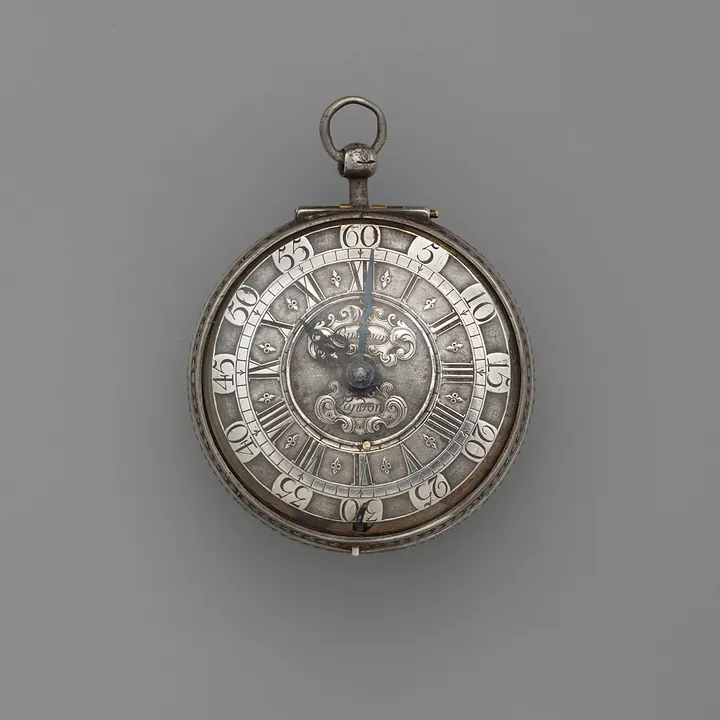
Watch by John Bushman, England, 17th century
The Metropolitan Museum of Art, New York
Pocket Watches · c. 1610-1620
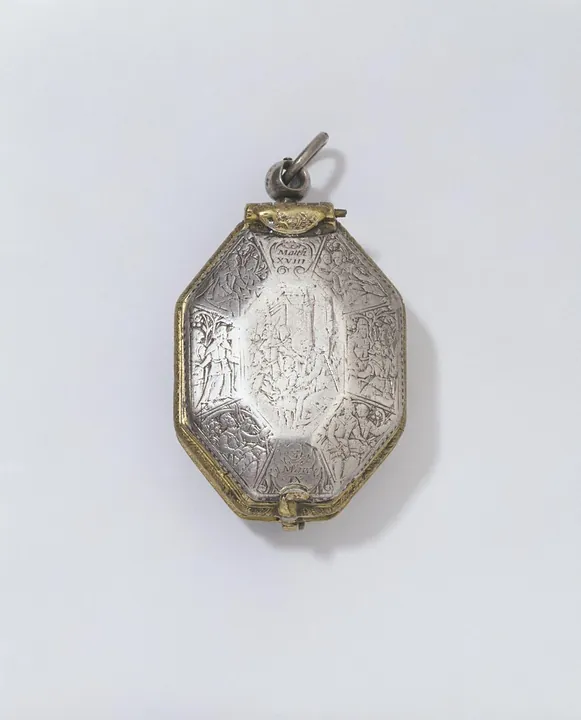
Case and dial of engraved silver and gilt brass. English, about 1640.
Victoria and Albert Museum, London
Pocket Watches · c. 1610
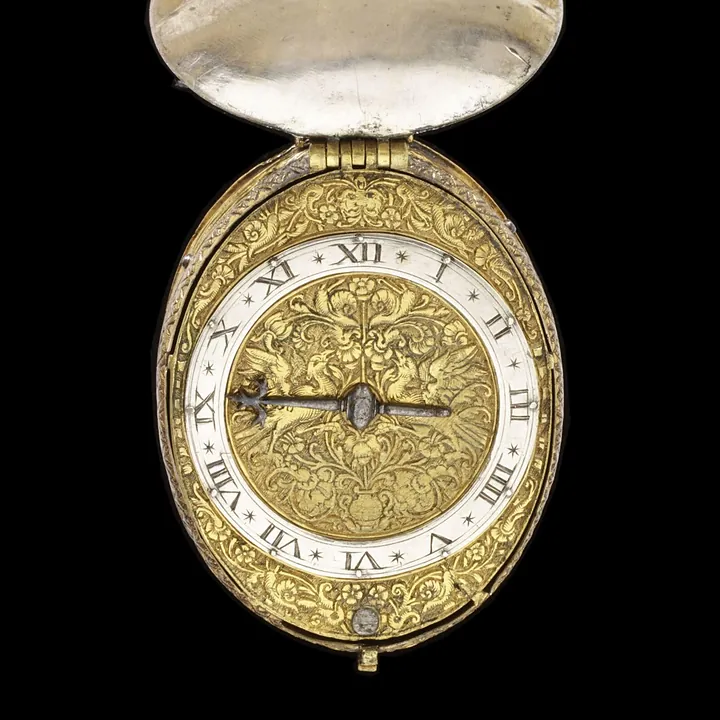
Watch by N. Ridgdale, England, c. 1610
Victoria and Albert Museum, London
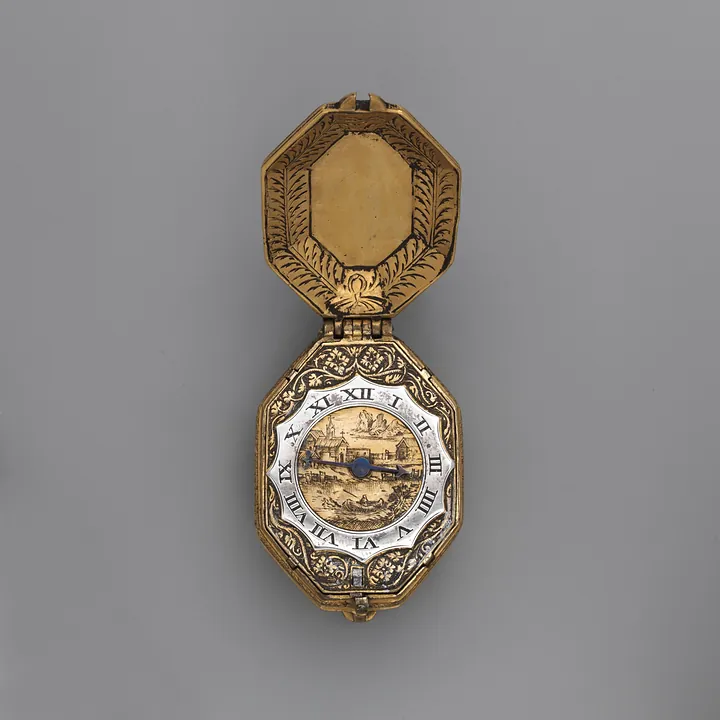
Pocket Watches · c. 1620–25
Watch by Isaac Symms, England, c. 1620–25
The Metropolitan Museum of Art, New York
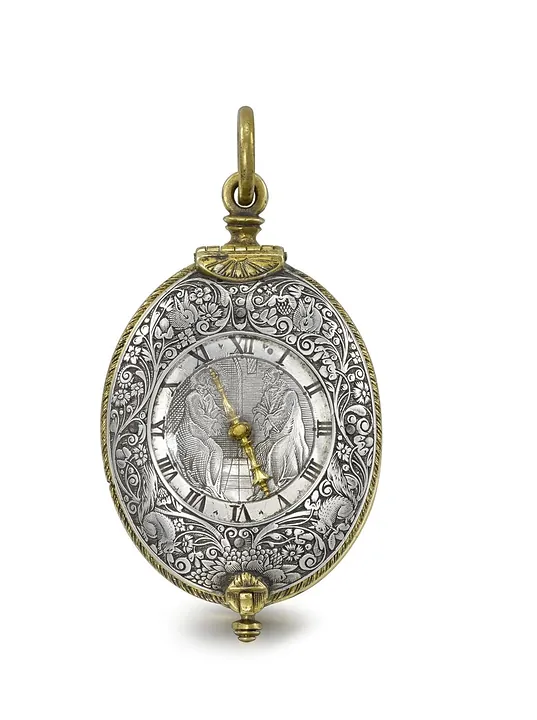
Pocket Watches · 1622–1628
Pocket watch by James Vautrollier, England, 1622–1628
Science Museum Group, London
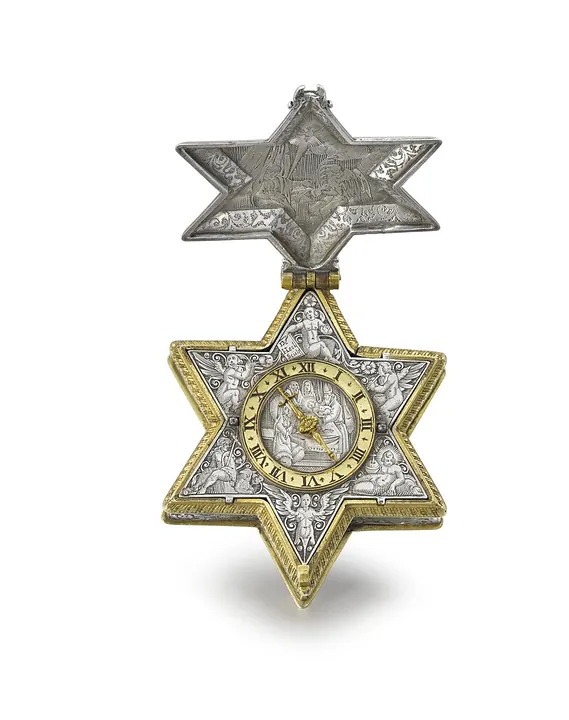
Pocket Watches · 1625
Pocket watch by David Ramsay, England, 1625
Science Museum Group, London
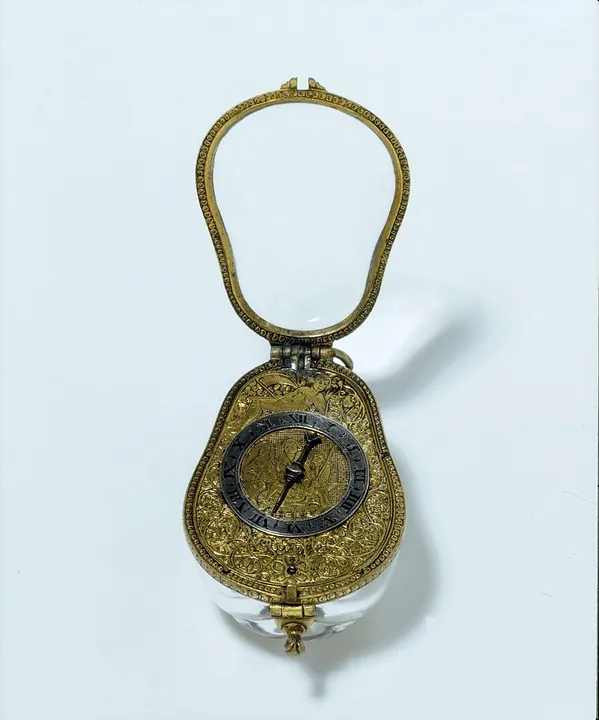
Pocket Watches · c. 1635
Jewellery, England
Victoria and Albert Museum, London
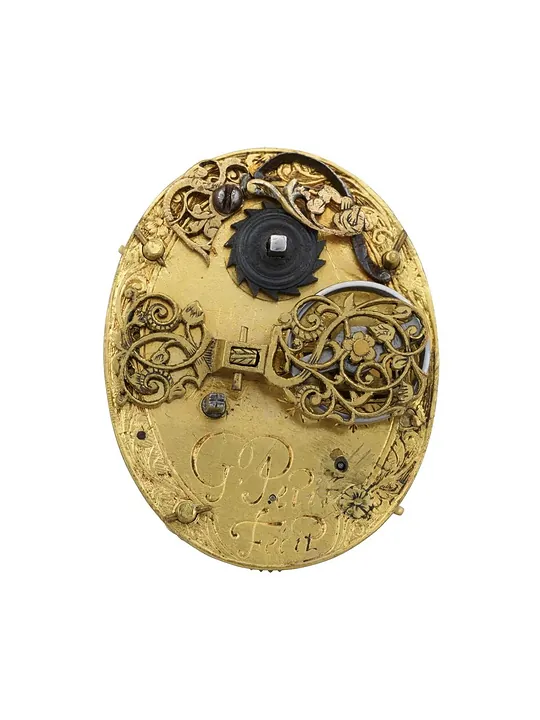
Pocket Watches · 1630
Pocket watch by G Petit, England, 1630
Science Museum Group, London